NYC Office Space Cost and Effective Rent Guide
NYC office space can cost under $50 per square foot or exceed $200 per square foot annually. Location matters, but location alone never tells the full story. Building quality, lease structure, concessions, construction, electricity, taxes, and space efficiency can change the economics dramatically.
A quoted rent therefore gives you only the starting number. Your real obligation depends on what you pay, what the landlord contributes, and how much space you actually use.
We represent office tenants only. We compare competing spaces, model lease economics, and negotiate from the tenant’s side. Our goal is simple: help you understand the true cost before you commit.
What NYC Office Space Costs Right Now
Most NYC office rents use an annual price for each rentable square foot, often written as “PSF.” An $80 PSF quote means $80 per rentable square foot each year. It does not mean $80 per square foot each month.
For example, 5,000 rentable square feet at $80 PSF creates $400,000 of first-year base rent. Divide that amount by 12, and the starting monthly base rent equals about $33,333.
Current-cost methodology — August 10, 2026. We use the latest complete Q2 2026 reports where available. We also compare multiple datasets rather than presenting one citywide average as absolute truth. Research firms track different building sets, lease types, and availability definitions. Consequently, Manhattan averages currently range from roughly $73 to $80 PSF across major datasets.
Here is a practical current benchmark:
| NYC office market | Current asking-rent benchmark | Approximate monthly rent per RSF | What it means for tenants |
|---|---|---|---|
| Manhattan overall | About $73–$80 PSF | $6.08–$6.67 | Useful starting benchmark, not a deal quote |
| Midtown | About $77–$86 PSF | $6.42–$7.17 | Premium corridors and better buildings run much higher |
| Midtown South | About $81–$86 PSF | $6.75–$7.17 | Quality creative and Class A space carries a premium |
| Downtown | About $57–$61 PSF | $4.75–$5.08 | Often Manhattan’s strongest value among major submarkets |
| Brooklyn | About $48 PSF | About $3.97 | Broad averages hide major neighborhood differences |
| Long Island City | About $52 PSF | About $4.37 | Availability can create negotiating opportunities |
Q2 2026 research placed one Manhattan-wide average at $80.17 PSF. Another measured $72.83 PSF and Class A at $84.79 PSF. Midtown reached $86.18 in one dataset, while another reported $76.98 overall and $88.50 for Class A.
Downtown showed the clearest discount. Current reports placed overall asking rents between about $56.66 and $61.34 PSF. Downtown sublease asking rent averaged $47.13 in another current dataset.
Brooklyn averaged $47.61 PSF during Q2 2026. Long Island City averaged $52.42 PSF during the first half. Those numbers do not represent every Brooklyn or Queens building.
For deeper neighborhood comparisons, use our Manhattan office rent guide.
Building quality widens these ranges considerably. Older value buildings can fall below broad averages. Meanwhile, modern Class A and trophy towers can reach well above $100 PSF. Some premium Manhattan offices exceed $200 PSF.
The practical lesson matters more than the citywide average. A tenant should price the specific competitive set that fits its requirements.
A 5,000-square-foot law firm near Grand Central competes in one market. A creative company seeking a loft downtown competes in another. Their relevant rent benchmarks can differ by tens of dollars per square foot.
Monthly base-rent examples make the scale easier to understand.
| Rentable area | $50 PSF | $75 PSF | $100 PSF | $150 PSF |
|---|---|---|---|---|
| 1,000 RSF | $4,167/month | $6,250/month | $8,333/month | $12,500/month |
| 2,500 RSF | $10,417/month | $15,625/month | $20,833/month | $31,250/month |
| 5,000 RSF | $20,833/month | $31,250/month | $41,667/month | $62,500/month |
| 10,000 RSF | $41,667/month | $62,500/month | $83,333/month | $125,000/month |
These figures show base rent only. They exclude escalations, electricity, construction, taxes, internet, insurance, and other occupancy costs.
That distinction leads to the most important concept in this guide: asking rent does not equal effective rent.
Asking Rent, Monthly Rent, and Effective Rent
Three different rent concepts often get mixed together. Tenants should separate them before comparing proposals.
Asking rent is the landlord’s quoted starting rate. It gives you a useful pricing reference, but not final economics.
Face rent usually means the contractual rent written into the lease. Negotiations can move that figure below the original asking rate.
Effective rent measures economic value after concessions. Free rent and landlord contributions can reduce effective rent significantly.
However, people use “effective rent” differently. That creates confusion.
A tenant should therefore calculate several versions.
Base effective rent after free rent measures the rent you actually pay across the lease term.
Use:
Total scheduled base rent − rent abatement ÷ rentable square feet ÷ lease years
That calculation shows how free rent changes the rent obligation.
Economic effective rent goes one step further. It assigns value to landlord-funded concessions.
Use:
Rent paid − cash-equivalent concessions ÷ rentable square feet ÷ lease years
A tenant improvement allowance can represent substantial economic value. However, you should not treat every TI dollar like unrestricted cash.
Landlords usually tie TI reimbursements to approved project costs. Lease language can also impose deadlines, documentation rules, and permitted-use restrictions.
As a result, a $100 PSF allowance does not always equal $100 PSF of spendable cash.
Our NYC office leasing incentives guide explains those distinctions in greater detail.
Current concessions still matter, although the market has tightened. H1 2026 data showed 12.4 months of weighted average rent abatement for new Manhattan deals. The same dataset reported average TI allowances of $140.02 per square foot.
Those averages do not create an entitlement for every tenant.
Large long-term deals can receive much larger packages than small prebuilt leases. Stronger buildings can also offer smaller concessions when several tenants compete.
Moreover, Manhattan’s available supply has tightened. One current measure fell to 13.0% during Q2 2026, its lowest level since October 2020. Premium buildings face much tighter conditions than weaker commodity inventory.
Therefore, “How many free months should I get?” has no universal answer.
Term length, credit, space condition, landlord motivation, building quality, commencement timing, and competing proposals all matter.
Free rent also needs a definition. Ask whether the concession covers only base rent. Electricity and other additional rent may continue during an abatement period.
Likewise, early construction access does not necessarily equal free occupancy. A tenant may enter for construction but lack permission for normal business operations.
Annual escalations can reverse an overly simple effective-rent calculation.
Suppose a tenant leases 5,000 RSF at an $80 starting rent. Assume a ten-year term with 3% annual increases.
Scheduled base rent would total about $4.59 million over the term.
Now assume the landlord grants 12 months of initial base-rent abatement. Rent paid falls to roughly $4.19 million.
That produces an average base effective rent near $83.71 PSF annually.
The result exceeds the $80 starting rate because later-year escalations increase total rent.
Next, assume the landlord provides a $100 PSF TI allowance. The allowance carries $500,000 of economic value.
After assigning that concession value, economic effective rent falls to about $73.71 PSF annually.
Yet the tenant still needs another calculation: total occupancy cost.
The Full NYC Office Cost Stack
A good office budget has three columns: recurring costs, upfront costs, and exit costs.
That structure prevents one inexpensive line item from hiding a costly overall deal.
Recurring monthly occupancy costs usually start with base rent. Depending on your lease, you may also pay electricity, tax increases, operating escalations, and cleaning.
Internet, telecommunications, insurance, and after-hours HVAC add more recurring expenses.
Do not automatically add a generic operating-expense estimate to every Manhattan lease. Lease structures vary significantly.
Instead, read the actual tax and operating clauses. Identify the base year, exclusions, gross-ups, management fees, and escalation formulas.
Our true monthly cost of NYC office space guide provides another way to model these expenses.
Electricity can look small until you multiply it across a large office. Common structures include direct metering, submetering, and fixed rent inclusion.
A fixed electricity inclusion often runs around $3.00 to $4.50 per rentable square foot annually. Submetering can add an administrative markup above actual use.
After-hours HVAC creates another variable. Many Manhattan buildings charge approximately $50 to $150 hourly for each unit or zone. Actual building charges can differ.
Review the Manhattan office electricity guide before finalizing your occupancy budget.
Commercial Rent Tax can become meaningful for some Manhattan tenants.
The tax applies to qualifying commercial tenants south of 96th Street. Annual or annualized gross rent generally must reach at least $250,000. Exemptions and credits can change the result.
The statutory rate equals 6% of base rent after the applicable calculation. A 35% base-rent reduction produces a 3.9% effective rate before other credits.
Small-business credits can eliminate or reduce the tax for qualifying tenants. Therefore, never assume every lease above $250,000 creates a 3.9% additional cost.
Your accountant should confirm the actual liability.
Upfront occupancy costs require a separate budget.
They can include:
| Upfront cost | Why tenants should track it |
|---|---|
| Security deposit or letter of credit | Ties up cash even when refundable |
| Architectural and engineering work | Often starts before construction |
| Construction above landlord funding | Can create the largest move-in cash requirement |
| Furniture | TI language may limit reimbursement |
| IT, cabling, AV, and access control | Often sits outside basic construction |
| Legal review | Commercial leases require detailed negotiation |
| Moving and installation | Includes movers, equipment, freight, and coordination |
| Temporary overlap rent | Appears when old and new leases overlap |
| Permits and professional fees | Scope and building rules affect totals |
Construction deserves particular attention.
A 2026 NYC fit-out benchmark puts hard costs near $220.62 PSF in its model. Adding soft costs, technology, AV, furniture, and related items pushes its modeled all-in total to $330.92 PSF.
That does not mean every office costs $331 PSF to build.
A furnished second-generation suite may require very little work. Meanwhile, a headquarters with complex infrastructure can exceed broad benchmarks.
The lesson remains important. A cheap raw office can become an expensive office after construction.
Likewise, a more expensive prebuilt office can produce the lower total cost.
Exit costs deserve attention before lease signing.
Restoration obligations can require removal of cabling, specialty installations, furniture, or alterations. Holdover clauses can also impose steep rent increases after expiration.
Consequently, total occupancy cost should cover the entire real-estate lifecycle.
Do not stop at the first month’s invoice.
Rentable Area, Loss Factor, and Cost Per Employee
NYC office listings usually discuss rentable square feet, or RSF. Your employees occupy usable square feet, or USF.
The difference creates the loss factor.
Rentable area may include your proportionate share of corridors, restrooms, lobbies, and other common building areas. Usable area measures the space within your premises.
For a deeper explanation, see our NYC office loss factor guide.
A basic formula works well:
Loss factor = (RSF − USF) ÷ RSF
Suppose a landlord quotes 7,000 RSF for a suite containing 5,000 USF.
The difference equals 2,000 square feet.
Divide 2,000 by 7,000, and the loss factor equals approximately 28.6%.
Manhattan loss factors commonly fall around 25% to 35%, although individual buildings can fall outside that range.
This number can completely change a tenant’s cost comparison.
Consider two 5,000-USF offices.
Space A carries 6,500 RSF at $80 PSF. Space B carries 7,200 RSF at $75 PSF.
Space A costs $520,000 yearly before additions.
Space B costs $540,000 yearly.
Therefore, the $75 office costs more despite its lower quoted rate.
That is why tenants should compare rent against usable functionality.
Cost per workstation provides another useful metric.
Start with the office layout rather than a random square-footage target.
Open plans often use roughly 125–150 USF per person. Hybrid layouts commonly use about 150–175 USF. Private-office-heavy layouts can require about 200–275 USF.
Those ranges provide planning assumptions, not design rules.
Conference rooms, reception areas, pantries, wellness rooms, circulation, storage, and collaboration areas all affect the result.
You can test these variables with our office space calculator and office sizing guide.
Hybrid occupancy adds another consideration.
A company with 50 employees does not automatically need 50 permanent desks. Peak daily attendance matters more than total payroll headcount.
However, aggressive desk sharing can create false savings. Conference demand and peak attendance may still force a larger footprint.
Therefore, measure peak simultaneous occupancy, not simply average attendance.
A tenant should eventually calculate these four numbers:
Annual cost per RSF.
Annual cost per USF.
Annual cost per employee.
Annual cost per peak in-office employee.
Those figures often expose differences that asking rent hides.
How Location, Building Class, and Lease Type Change Cost
“NYC office rent” covers several very different markets.
A trophy Midtown tower does not compete directly with a Downtown loft. Brooklyn and Long Island City also operate under different supply conditions.
Midtown usually carries the largest premium for mainstream corporate space. Q2 2026 asking rents reached $86.18 PSF in one broad Midtown dataset. Another measured $76.98 overall and $88.50 for Class A.
Prime towers can rise far above those averages.
Transit access, new construction, building amenities, views, floor height, ownership quality, and tenant demand all influence pricing.
Midtown South behaves differently. Its creative districts contain converted lofts, renovated buildings, and newer Class A properties.
One Q2 2026 dataset measured Midtown South at $81.14 PSF overall. Class A reached $104.50 PSF.
Consequently, an older loft and a newly delivered trophy-quality office can share a neighborhood without sharing a price range.
Downtown often creates the clearest Manhattan value comparison.
Broad Q2 asking rents sat around the upper-$50s to low-$60s. Sublease averages could fall below $50 PSF.
However, “cheapest PSF” should never become the only goal.
A Downtown office requiring $200 PSF of tenant-funded work can lose against a pricier turnkey Midtown option.
Similarly, a poor loss factor can erase part of a location discount.
Brooklyn and Queens can offer lower headline averages. Brooklyn averaged $47.61 PSF during Q2 2026. Long Island City averaged $52.42 during H1 2026.
Yet each borough contains different building qualities, transit profiles, and inventory types.
Accordingly, evaluate employee commute patterns before chasing a borough discount.
Building class helps organize choices, but labels remain subjective.
Class A generally describes higher-quality buildings with stronger systems, amenities, and management.
Class B often covers functional properties that lack some premium characteristics.
Class C generally represents older or more basic inventory.
Trophy buildings occupy the upper edge of Class A.
Tenants should inspect the actual building rather than buying a label.
Elevator performance, HVAC, security, fiber, ceiling heights, window lines, common areas, and ownership stability matter directly.
Lease type changes economics just as much as location.
A direct lease creates a relationship with the building owner. It can support longer terms, larger TI packages, and custom construction.
A sublease comes from an existing tenant. It may provide furniture, wiring, shorter terms, or discounted rent.
However, subleases create additional credit, consent, and expiration considerations.
For example, compare the structure of a furnished Downtown sublease with a direct Downtown office. Availability and terms can change, so verify them before relying on any listing.
Flexible private offices represent another pricing model.
They usually quote monthly prices by office, suite, or desk. Traditional leases usually quote annual rent per rentable square foot.
Therefore, comparing $1,000 per desk with $75 PSF produces meaningless results without normalization.
Convert each option into a total annual cash requirement.
Then account for furniture, internet, reception, shared meeting rooms, cleaning, deposits, and expected occupancy duration.
Flexible space can make sense for short horizons or uncertain headcount. Conventional space often gains economic advantages as size and lease duration increase.
Neither structure wins automatically.
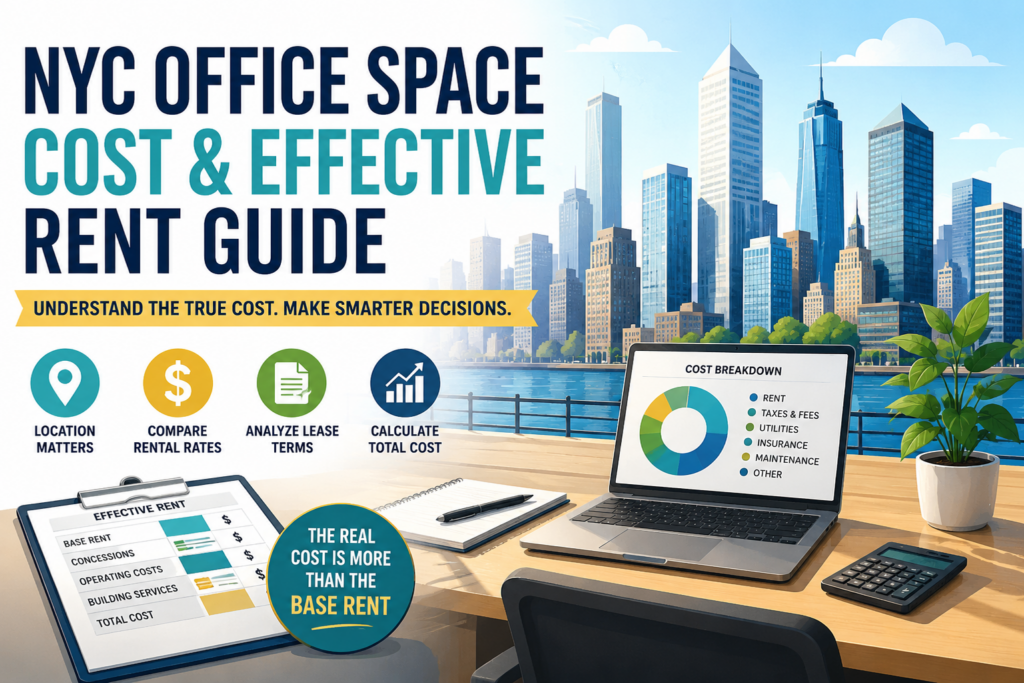
Concessions, Build-Outs, and Lease Economics
A tenant can negotiate more than the face rent.
The strongest comparisons evaluate rent, free rent, TI, work letters, escalations, commencement timing, security, and flexibility together.
That approach prevents one headline concession from distracting you.
Free rent reduces rent expense, but timing matters.
Twelve free months at the beginning of a lease carry more present value than twelve months near expiration.
Likewise, free rent outside the stated lease term has different economics from abatement inside that term.
Read the dates carefully.
Tenant improvement allowances can be more valuable than modest rent reductions.
Current H1 2026 Manhattan research measured average TI allowances near $140.02 PSF for new deals. Rising construction costs have reduced the purchasing power of those allowances.
Again, that market average does not describe every transaction.
Lease term strongly affects landlord investment.
A landlord may justify substantial capital for a ten-year credit tenant. The same owner may offer little capital on a short prebuilt lease.
Space condition also matters.
A landlord may deliver a completed turnkey office instead of providing a large cash allowance. That arrangement can protect a tenant from construction overruns.
However, the tenant sacrifices some design control.
Calculate the build-out gap explicitly.
Suppose a 5,000 RSF project costs $150 PSF. Total project cost equals $750,000.
Now assume the landlord funds $100 PSF, or $500,000.
The tenant still needs $250,000.
Across a ten-year lease, that gap equals another $5 PSF annually before financing costs.
A tenant who only subtracts the $100 allowance from rent would miss that cash requirement.
Security also changes the transaction.
A refundable deposit does not equal rent expense. Still, it ties up capital throughout the lease.
Startups and private companies may face larger security requirements than established credit tenants.
Therefore, include security in the cash-flow model without pretending the landlord “spent” it.
Escalations compound over long leases.
A $70 starting rate with 3% annual increases reaches about $91.30 during year ten.
That means the starting quote understates the later obligation.
Fixed-dollar increases can produce similar effects.
Tax and operating escalations also need separate attention. A base year can make early costs look predictable while later years become more expensive.
Renewal, expansion, contraction, and sublease rights also have economic value.
A slightly higher rent can make sense when the lease provides meaningful flexibility.
For example, an expansion option may prevent an expensive midterm relocation.
A termination right can limit downside risk for a changing business.
Sublease rights can create another exit route.
However, consent requirements, recapture provisions, profit sharing, and continuing liability can reduce that flexibility.
Our NYC commercial leasing guide covers the broader lease process.
Finally, use present-value analysis for major commitments.
A dollar paid today costs more economically than a dollar paid years later.
Discounted cash flow places proposals with different rent schedules on a common basis.
That calculation becomes especially valuable when two landlords structure concessions differently.
A Tenant Calculator for Comparing Real Deals
The cleanest way to compare NYC offices uses one standardized worksheet for every proposal.
Do not change assumptions between buildings.
Start with the same headcount, planning ratio, growth assumption, lease horizon, and discount rate.
First, calculate the space requirement.
Use:
Headcount × target USF per employee = required usable area
Then convert usable area into rentable area.
Use:
USF ÷ (1 − loss factor) = estimated RSF
For example, 30 employees at 165 USF each require 4,950 usable square feet.
With a 30% loss factor, divide 4,950 by 0.70.
The result equals roughly 7,071 RSF.
Our office space calculator lets you test the physical program before pricing leases.
Next, calculate starting monthly base rent.
Use:
RSF × annual asking rent ÷ 12
At 7,071 RSF and $75 PSF, monthly starting base rent equals about $44,194.
That remains only the first line.
Now build the recurring monthly stack.
Add electricity, cleaning gaps, internet, insurance, tax escalations, operating escalations, and overtime HVAC.
Include Commercial Rent Tax only when the tenant actually qualifies.
Do not add refundable security as monthly expense.
Then model lease-term economics.
Build one row for each month.
Your spreadsheet should show contractual rent, escalations, free rent, recurring additions, tenant capital, and landlord contributions.
That monthly model prevents annual averages from hiding timing differences.
For a simpler screening calculation, use:
Average annual tenant cash cost = total tenant cash outflow ÷ lease years
Then use:
Tenant cash cost per RSF = annual tenant cash cost ÷ RSF
You can also calculate:
Tenant cash cost per employee = annual tenant cash cost ÷ peak occupancy
That metric makes offices of different sizes easier to compare.
Consider this ten-year example.
Assumptions:
| Input | Example |
|---|---|
| Rentable area | 5,000 RSF |
| Starting rent | $80 PSF |
| Annual increase | 3% |
| Lease term | 10 years |
| Free base rent | 12 months |
| Landlord TI | $100 PSF |
| Total build-out | $150 PSF |
Scheduled base rent totals about $4.59 million.
After the 12-month initial abatement, contractual rent paid falls to roughly $4.19 million.
Average base effective rent becomes approximately $83.71 PSF annually.
Assign the $500,000 landlord allowance as concession value. Economic effective rent then falls to roughly $73.71 PSF.
However, the build-out costs $750,000.
The landlord contributes $500,000, so the tenant funds the remaining $250,000.
That tenant contribution adds $5 PSF annually when spread evenly across ten years.
Therefore, the tenant’s cash economics before operating additions equal roughly $88.71 PSF annually.
Three valid figures now exist:
$80 PSF starting asking rent.
$73.71 PSF economic effective rent after concessions.
$88.71 PSF tenant cash cost before recurring extras.
None answers every question by itself.
That is precisely why an effective-rent guide needs more than one formula.
Finally, calculate the net present value of each proposal.
Use the same discount rate and same lease horizon.
The proposal with the lowest starting rent may not have the lowest present-value occupancy cost.
Likewise, the largest TI allowance may not create the best deal.
Compare the whole cash flow.
NYC Office Cost Questions Tenants Ask Most
How much does it cost to rent an office in NYC?
Current conventional office pricing ranges widely. Manhattan broad asking averages sit around $73–$80 PSF, depending on the dataset. Midtown often costs more, while Downtown generally costs less. Brooklyn and Long Island City currently post lower broad averages.
However, citywide averages cannot price a specific office.
Size, building class, floor height, condition, neighborhood, term, and concessions all influence the transaction.
What does $75 per square foot mean for NYC office rent?
Commercial office rents usually quote annual dollars per rentable square foot.
A 5,000 RSF office at $75 PSF carries $375,000 of first-year base rent.
That equals $31,250 monthly before additional costs.
How much does Manhattan office space cost?
Current Q2 datasets place broad Manhattan averages between roughly $73 and $80 PSF. Class A averages can run into the mid-$80s before premium-building adjustments.
Individual spaces can range far below or above those figures.
Older value properties can trade much lower. Trophy buildings can exceed $150 or $200 PSF.
What is the difference between asking rent and effective rent?
Asking rent gives the landlord’s headline price.
Effective rent accounts for concessions and the lease’s actual payment schedule.
Free rent can reduce effective rent.
TI can reduce economic occupancy costs when the allowance offsets expenses the tenant would otherwise pay.
Is effective rent the same as total monthly cost?
No.
Effective rent measures lease economics.
Total monthly cost also considers recurring expenses such as electricity, taxes, cleaning, internet, insurance, and after-hours services.
The two numbers answer different questions.
Why can effective rent still be misleading?
Different parties use different formulas.
One calculation may subtract TI from rent. Another may only recognize free rent.
Neither method necessarily captures the tenant-funded construction gap.
Therefore, always define the formula before comparing results.
What is the true monthly cost of an NYC office?
Start with monthly base rent.
Then add recurring costs that your specific lease shifts to you.
Common items include electricity, tax increases, operating escalations, cleaning gaps, telecommunications, insurance, and overtime HVAC.
Upfront capital requires another calculation.
Are NYC office utilities included in the rent?
Lease structure controls the answer.
Heat often sits inside the base building service. Electricity commonly uses direct metering, submetering, or a fixed inclusion.
Fixed electric inclusions often range near $3.00–$4.50 per RSF annually.
Review the lease language rather than assuming utilities come with the rent.
What is the cheapest office space in NYC?
The cheapest headline rent often appears in older buildings, secondary locations, or discounted subleases.
Downtown Manhattan also offers broad discounts against Midtown. Brooklyn and Long Island City can provide lower broad averages.
However, the cheapest quoted rent may not create the cheapest occupancy.
Construction, loss factor, commuting impact, and operating costs can erase the savings.
Does a sublease usually cost less than a direct lease?
It can.
Current Manhattan data placed average sublease asking rents at $59.94 PSF, below the $80.17 broad market average. Downtown sublease asking rents averaged $47.13.
Yet subleases differ greatly.
Furniture and existing improvements can create extra value. Short remaining terms can also limit flexibility.
How much free rent can an NYC office tenant get?
H1 2026 Manhattan data measured 12.4 months of weighted average abatement for new leases.
That figure reflects aggregated transactions.
A small five-year prebuilt deal may receive much less. A large long-term lease can produce a different package.
Never underwrite a deal using an average before receiving the landlord’s proposal.
How much TI allowance should a tenant expect?
A current H1 2026 Manhattan benchmark reached about $140.02 PSF for new deals.
Again, individual outcomes can differ substantially.
Term length, credit, construction scope, building demand, and ownership strategy all influence TI.
How expensive is an NYC office build-out?
Construction varies more than base rent.
One 2026 benchmark models NYC hard fit-out costs around $220.62 PSF. Its expanded model reaches $330.92 PSF after additional project categories.
A second-generation furnished office can cost much less.
A complex premium office can cost much more.
Get a test fit and preliminary construction budget before treating a TI allowance as sufficient.
How much office space does one employee need?
Open layouts often plan around 125–150 USF per person.
Hybrid layouts commonly use 150–175 USF.
Private-office-heavy plans may use approximately 200–275 USF.
Your workplace program should drive the number.
Do not multiply headcount by a generic ratio and sign a lease without a test fit.
What is a loss factor?
Loss factor describes the difference between rentable and usable area.
A tenant pays rent on RSF but occupies USF.
Manhattan loss factors commonly fall around 25%–35%, although buildings vary.
Two offices with identical usable area can therefore carry very different rent bills.
Should I compare office spaces by price per square foot?
Yes, but never exclusively.
Also compare price per usable square foot, workstation, employee, and peak occupant.
Add construction and recurring expenses.
Then compare present-value lease costs.
That process turns an asking-rate comparison into a genuine occupancy-cost comparison.
How much cash will I need before moving into an NYC office?
The answer depends heavily on the deal.
Plan for security, legal work, construction gaps, furniture, technology, moving, and overlapping rent.
Landlord concessions may offset some costs.
However, reimbursements often arrive after the tenant incurs approved expenses.
Cash-flow timing therefore matters.
Does NYC Commercial Rent Tax apply to every Manhattan tenant?
No.
Qualifying premises generally sit south of 96th Street. Annual or annualized gross rent must generally reach at least $250,000.
Credits and exemptions can reduce or eliminate liability.
The effective rate can reach 3.9% after the statutory base-rent reduction.
Confirm your own tax treatment with an appropriate adviser.
Is Midtown always more expensive than Downtown?
Broadly, current data says yes.
Midtown averages currently sit around the upper-$70s through mid-$80s. Downtown broad averages sit around the upper-$50s through low-$60s.
Specific properties can break that pattern.
A premium Downtown tower can cost more than an older Midtown building.
Is Brooklyn cheaper than Manhattan for office space?
Broad averages currently suggest a substantial discount.
Brooklyn’s Q2 2026 average asking rent reached $47.61 PSF. Manhattan broad datasets sit around $73–$80 PSF.
Still, compare the actual competitive properties.
Neighborhood, transportation, and building quality matter more than borough labels.
Is Long Island City an affordable office alternative?
It can be.
H1 2026 data placed its overall asking rent at $52.42 PSF. Availability reached 24.3% under that dataset’s methodology.
Those conditions can create negotiating opportunities.
Nevertheless, transit patterns and employee geography should influence the decision.
Are landlords still offering strong concessions in 2026?
Yes, but negotiating power has become less uniform.
Manhattan availability fell sharply through Q2. Premium inventory now faces much tighter competition than weaker commodity buildings.
Meanwhile, free-rent packages have retreated from earlier peaks. Current H1 data recorded the lowest average abatement period since 2019.
Tenants therefore need building-specific leverage.
Why can a higher-rent office become the better deal?
A more expensive space may need little construction.
It may also have a better loss factor, more efficient floor plate, stronger concessions, or lower operating costs.
Those savings can outweigh a higher face rent.
That is why total occupancy cost matters.
How should I compare a conventional lease with a serviced private office?
Normalize the numbers first.
Convert each option into annual cash cost over the expected occupancy period.
Include items that the monthly private-office fee already covers.
Then include items that the conventional lease requires separately.
A five-person team with uncertain growth can value flexibility differently from a 75-person established company.
When should a tenant start looking for office space?
A construction-heavy direct lease requires far more lead time than a furnished short-term option.
Planning, tours, proposals, legal negotiation, design, permits, construction, cabling, and moving all consume time.
Start early when your existing lease creates a hard expiration date.
Waiting until the final months can destroy negotiating leverage.
What determines NYC office pricing most?
Location matters first, but only as part of the equation.
Building quality, space condition, views, floor height, transit, amenities, ownership, term, credit, and lease structure also influence rent.
Supply inside your exact requirement set matters even more.
A citywide vacancy statistic cannot tell you how many suitable 8,000-square-foot offices exist near your preferred transit hub.
Is NYC still a good place to lease office space?
That depends on your business, not a generic market verdict.
Current Manhattan leasing remains active, while availability has tightened materially. Better-quality inventory has gained pricing power.
Value opportunities still exist in older buildings, subleases, Downtown, and selected outer-borough markets.
The right question is not whether New York represents a “good” market.
Ask whether a particular office improves your company’s workforce access, client access, operations, and economics.
What should I ask before signing an NYC office lease?
Ask for the rentable and usable area.
Confirm the loss factor.
Request the entire rent schedule.
Identify every free-rent month.
Understand the TI allowance and reimbursement rules.
Price the construction gap.
Review electricity and after-hours HVAC.
Model tax and operating escalations.
Check Commercial Rent Tax exposure.
Understand security requirements.
Review assignment and sublease rights.
Examine renewal, expansion, contraction, and termination language.
Finally, calculate the entire occupancy cost before comparing proposals.
That final calculation changes the conversation.
The best NYC office deal rarely comes from finding the lowest asking rent.
Get More Insight
It comes from right-sizing the premises, understanding every cost, valuing every concession, and negotiating the complete lease economics.
Fill out our 📋 online form or give us a call today 📞 212-967-2061 — let’s find the right options for your business.