NGO Office Space Near the United Nations
NGO office space near the United Nations serves organizations with international, humanitarian, policy, diplomatic, educational, and charitable missions. However, “near the United Nations” can describe several distinct office markets. Each location offers different costs, commute patterns, building standards, and lease structures.
A useful search must therefore begin with your organization’s operating needs. Proximity alone does not determine whether an office supports your staff, visitors, programs, and budget.

What NGO Office Space Near the United Nations Actually Means
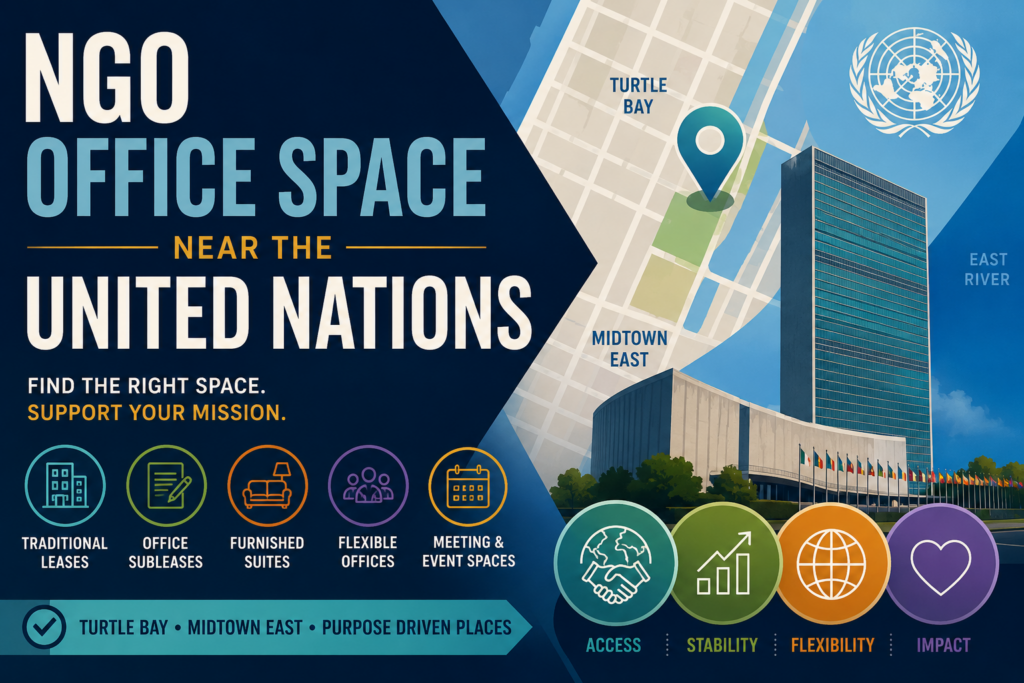
The phrase usually describes commercial office space in Turtle Bay and eastern Midtown Manhattan. Most tenants focus on the area between East 42nd Street and East 53rd Street. Their search often extends from First Avenue west toward Lexington Avenue.
However, several different options can appear under the same description.
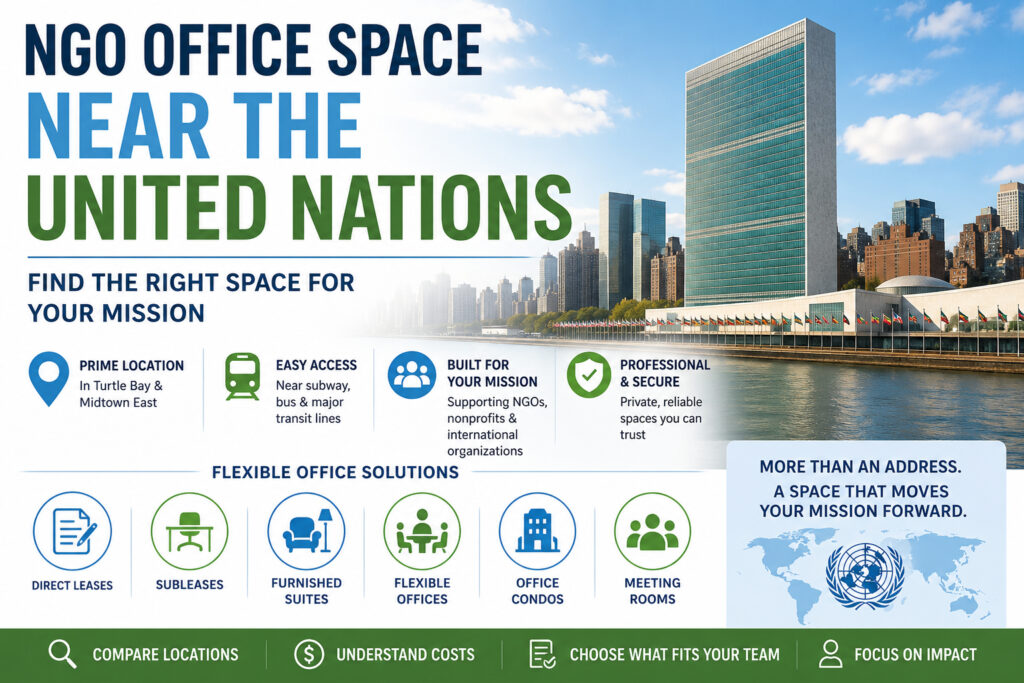
Traditional leased offices provide private space under a direct agreement with a building owner. These offices usually suit established organizations with stable funding and longer planning horizons.
Office subleases let an NGO occupy space under another tenant’s existing lease. Subleases may include furniture, wiring, conference rooms, and shorter commitments.
Furnished private offices offer quicker occupancy than unfinished direct space. These suites can reduce construction costs and operational disruption.
Flexible offices bundle space, furniture, internet, reception, and shared amenities into a monthly payment. They often suit small teams, temporary programs, and newly formed organizations.
Office condominiums allow qualified organizations to purchase commercial space. Ownership may support long-term stability, although it creates financing and capital obligations.
Meeting and event space serves organizations that only need temporary rooms during major conferences, assemblies, or advocacy programs.
Online results often mix listings, building information, flexible workspace pages, nonprofit centers, and unrelated organizations. Therefore, tenants should identify the offered arrangement before comparing prices.
The practical definition: An office qualifies as “near the United Nations” when staff and visitors can reach the campus reliably.
That definition may include an immediate campus-edge office or a transit-friendly suite farther west.
Where NGOs Should Search in Midtown East
Location affects rent, visitor convenience, security procedures, transit access, and daily employee experience. For that reason, tenants should divide the neighborhood into practical zones.
The campus edge includes offices along First Avenue and nearby plaza blocks. These locations provide the shortest walk to meetings and official events. They also create a recognizable international setting for visiting delegations.
Supply remains limited in this immediate area. Residential properties, institutional facilities, diplomatic uses, and the river restrict commercial inventory.
The Second Avenue corridor offers a broader selection of traditional offices. Many buildings contain smaller suites, full floors, medical layouts, and office condominium units. The corridor also sits close to diplomatic and international organizations.
The Third Avenue corridor often provides the strongest balance between campus access and transportation. Buildings generally offer larger floor plates, better subdivision options, and more varied pricing.
A tenant needing immediate occupancy could consider a furnished Turtle Bay office. That option illustrates how Third Avenue can combine furniture, wiring, conference rooms, and campus proximity.
The Grand Central edge places staff closer to regional rail and subway service. It may require a longer walk to First Avenue. However, many employees value the easier commute.
The side streets and Tudor City area may offer quieter offices and smaller footprints. Older buildings can also provide distinctive layouts and lower occupancy costs.
Practical location comparison
| Location | Typical advantage | Possible drawback | Best suited for |
|---|---|---|---|
| First Avenue area | Shortest campus walk | Limited inventory | Frequent official meetings |
| Second Avenue | International tenant environment | Longer subway walk | NGOs, missions, associations |
| Third Avenue | Strong balance of access and transit | Less immediate campus presence | Growing teams |
| Grand Central edge | Best regional commute | Higher rent in premium buildings | Larger employee populations |
| Side streets | Smaller and quieter options | Building quality varies | Budget-focused organizations |
A five-minute difference on a map can materially change rent and commuting conditions. Therefore, staff travel patterns should guide the final boundary.
Choosing the Right Office Format for an NGO
No single lease format suits every nonprofit or nongovernmental organization. Funding structure, headcount, program duration, and reporting obligations should guide the decision.
A direct lease gives the tenant the strongest control. Your organization can negotiate the layout, branding, security, access, and construction.
Direct leases often require longer commitments. A five-year term may work for a stable organization. Larger construction packages may require ten years.
A prebuilt direct office reduces the time between lease signing and occupancy. The landlord has already installed offices, meeting rooms, lighting, ceilings, and a pantry.
Prebuilt suites work well when the existing layout closely matches your program. Otherwise, alterations can reduce their cost advantage.
A sublease may offer furniture and a shorter remaining term. It can also provide a lower entry cost than comparable direct space.
However, subtenants receive limited control over the underlying lease. The primary tenant’s financial condition can also affect the arrangement.
For example, a turnkey Third Avenue office may support a team that needs furniture and immediate possession.
A flexible private office can support a new field office, project team, or temporary initiative. Monthly pricing also simplifies initial budgeting.
Nevertheless, per-person costs can become expensive as the team grows. Shared conference rooms may also create scheduling problems.
An office condominium may serve an organization with long-term capital and stable New York operations. Ownership can provide cost predictability and greater control.
A larger NGO could review the structure of a full-floor office condominium. Ownership requires legal, financial, engineering, and tax review before commitment.
A temporary project office serves short programs tied to conferences or annual meetings. These offices should include dependable internet, private calls, printing, and secure document storage.
The correct format should support the mission without creating unnecessary financial exposure.
Current Costs and Realistic NGO Budgets
Office pricing near the United Nations varies widely. Building class, avenue, floor height, views, condition, lease term, and tenant credit all affect the proposal.
Midtown East direct asking rents generally fall within the low-to-mid $80s per square foot. However, smaller or older offices may appear in the $40s through $60s. Mainstream Class A offices often reach the $80s through low $100s. Premium buildings may exceed those levels.
Those figures represent annual rent per rentable square foot. They do not represent the complete occupancy cost.
For example, 5,000 square feet at $80 per square foot creates $400,000 in annual base rent. That equals about $33,333 each month.
At $60 per square foot, the same office creates $300,000 in annual base rent. The monthly equivalent falls to $25,000.
Before using those numbers, tenants must understand rentable square feet. A lease may charge for more space than the organization physically occupies.
Building loss factors allocate portions of common areas to each tenant. Therefore, a 5,000-square-foot lease rarely provides 5,000 square feet of usable interior space.
The Midtown East office rent guide explains current pricing bands and monthly rent calculations in greater detail.
Costs beyond the stated rent
An NGO budget should include more than the base rental rate.
| Cost category | What it may include |
|---|---|
| Base rent | Annual rent for the leased premises |
| Rent increases | Fixed increases or percentage adjustments |
| Electricity | Direct meter, submeter, or rent inclusion |
| Cleaning | Office cleaning and waste removal |
| Internet | Installation, monthly service, and redundancy |
| Construction | Design, permits, labor, and materials |
| Furniture | Workstations, chairs, storage, and meeting tables |
| Security | Access systems, cameras, guards, or visitor controls |
| Insurance | Liability, property, and required coverage |
| Legal review | Lease negotiation and organizational approvals |
| Moving | Technology transfer, movers, and records handling |
| Operating escalations | Increases in building expenses |
| Real estate taxes | Tenant share of increases above a base year |
Flexible offices usually combine several categories into one monthly fee. However, meeting rooms, printing, after-hours access, and additional users may cost extra.
A lower asking rent does not always create the lowest effective cost. Generous free rent and construction allowances can improve a higher-priced offer.
Planning Space for Staff, Programs, and Visitors
NGOs rarely operate like conventional corporate tenants. Their offices may support staff, volunteers, board members, donors, visiting officials, consultants, and temporary program teams.
Therefore, headcount alone should not determine square footage.
A highly efficient open office may use 125 to 175 rentable square feet per employee. Office-intensive layouts may require 175 to 250 rentable square feet per person.
An organization with 20 regular employees could therefore need 3,000 to 5,000 rentable square feet. Frequent visitors may increase that requirement.
Private offices support executives, legal work, human resources, fundraising, and confidential program discussions.
Open workstations improve density and flexibility. They also require strong acoustic planning.
Conference rooms often matter more for NGOs than ordinary workstation counts. International calls, board meetings, training sessions, and visiting groups create heavy demand.
Small meeting rooms support interviews, counseling, calls, and confidential conversations. They can prevent larger conference rooms from becoming unavailable.
A reception area helps manage guests and deliveries. It also creates separation between public and staff-only areas.
Secure storage may protect records, passports, equipment, donor information, and program materials.
A flexible project room can support workshops, volunteer coordination, briefings, and emergency response work.
A wellness or private room can serve employees, nursing parents, prayer needs, or confidential calls.
A smaller team may review a furnished Third Avenue office with private offices and a conference room.
Growing organizations may need a larger Class A Third Avenue office with a mixed layout.
Before touring, create three headcount figures:
Current headcount represents employees who need regular workspace now.
Peak headcount includes consultants, interns, volunteers, and temporary teams.
Planned headcount reflects realistic growth during the lease term.
The final plan should also account for hybrid schedules. However, desk sharing requires reservation systems and clear attendance policies.
Operational Requirements That NGOs Should Test
A polished lobby does not guarantee that a building can support your organization. Operational testing should begin during the first tour.
Visitor access matters immediately. Ask how guests enter, register, receive credentials, and reach the office.
Some buildings require government identification. Others need advance visitor lists or tenant escorts.
These procedures can affect conferences, volunteer events, and visiting delegations. Consequently, tenants should test the process with realistic group sizes.
Security requirements differ by mission. Some organizations need controlled reception, restricted internal zones, package screening, or private elevator access.
High-profile programs may also require coordination with outside security teams. Confirm building rules before signing.
After-hours access can affect international work. Global teams may need evenings, weekends, and early mornings.
Ask whether the building provides 24-hour tenant access. Also confirm HVAC charges outside standard operating hours.
Internet resilience deserves careful review. A single provider may not support critical communications.
Organizations should identify available carriers, riser access, installation timing, and backup options. Conference rooms may also need strong wireless coverage.
Power capacity can affect dense work areas. Older offices may lack enough outlets or electrical capacity.
Accessibility extends beyond the lobby. Review entrances, elevators, restrooms, door clearances, and emergency procedures.
Heating and cooling can vary by floor. Perimeter offices may experience strong temperature changes near the river.
Acoustics affect confidentiality. Glass-fronted rooms often require sound masking and proper seals.
Loading and delivery rules influence events. Ask about messenger access, freight elevators, loading hours, and package storage.
Signage rules affect identity. Some NGOs need visible branding. Others prefer discretion.
Operational failures can create daily frustration. They can also undermine programs long after rent negotiations end.
Lease Negotiation, Concessions, and Due Diligence
An NGO lease should protect both the organization’s mission and its funding structure. Standard commercial forms rarely address those concerns automatically.
Lease term requires careful judgment. A longer term can secure rent and improve landlord contributions.
However, uncertain grants may make a long commitment risky. Short terms provide flexibility but usually reduce concessions.
Free rent can lower the effective cost. Landlords often structure free periods at the lease beginning.
Some agreements spread free rent across the term. Others delay it until construction ends.
Tenant improvement allowances fund construction. The lease should define eligible costs, payment procedures, deadlines, and unused balances.
A generous allowance may still fall short of actual construction costs. Therefore, tenants need preliminary pricing before final negotiations.
Landlord work can simplify delivery. However, the lease must define plans, materials, completion standards, and delay remedies.
Renewal rights protect continuity. A renewal option can reduce relocation risk after the initial term.
Nevertheless, renewal language often gives the landlord broad pricing discretion. Tenants should negotiate clear timing and valuation procedures.
Expansion rights support growth. A first offer or first refusal right may create access to nearby space.
Contraction rights remain uncommon. Larger organizations may negotiate phased occupancy or termination rights instead.
Assignment and subletting rights matter. Programs can change, merge, move, or lose funding.
Restrictive language may prevent the organization from reducing unused space. The lease should also address affiliates and successor entities.
Funding contingencies require special attention. Landlords rarely accept broad grant cancellation rights.
However, tenants can sometimes negotiate security adjustments, shorter terms, expansion phases, or limited termination options.
Organizational authority must match approval procedures. Board consent, donor restrictions, and headquarters approval may affect timing.
Insurance terms should fit nonprofit operations. Volunteer programs, public events, and international visitors may create additional requirements.
Building rules deserve full review. They can control events, deliveries, security, contractors, signage, and after-hours use.
A tenant representative should compare complete economic proposals. Asking rent alone cannot reveal the best deal.
Transportation, Meetings, and High-Activity Periods
The United Nations area offers unusual transportation advantages and limitations.
Grand Central Terminal connects Midtown East with Metro-North and Long Island Rail Road service. It also provides access to the 4, 5, 6, 7, and shuttle subway lines.
That access benefits employees traveling from Westchester, Connecticut, Long Island, and other parts of Manhattan.
However, the subway does not extend to First Avenue. Employees may walk several avenues or use buses.
The M15 and M15 Select Bus Service support north-south travel along the East Side. Crosstown routes also connect the neighborhood with western Midtown.
Organizations should test actual commutes before choosing a building. A route that looks simple on a map may include a long transfer.
The Midtown East office space guide provides additional context on neighborhood boundaries and office corridors.
Official meetings can change the ideal location. Teams visiting the campus several times daily may prefer First or Second Avenue.
Employees who visit occasionally may prefer Third Avenue or the Grand Central edge.
Major international meetings can affect the neighborhood. Security zones, motorcades, street closures, and visitor surges may disrupt normal access.
Therefore, offices should maintain alternate arrival plans. Teams may also need remote-work procedures during the busiest periods.
Hotels and meeting venues matter for visiting groups. An office near lodging can reduce transportation demands for international guests.
Airport access also affects delegations. East Side road connections can support travel toward regional airports.
Traffic remains unpredictable. Consequently, visiting teams should allow generous travel time.
Food and support services vary by corridor. Third Avenue and the Grand Central area provide broader daily options.
Campus-edge locations may offer a quieter environment. They can also require longer walks for some services.
A full-floor Turtle Bay office may suit an organization that needs scale, amenities, and Midtown access.
Questions NGOs Should Answer Before Signing
How close must the office sit to the campus?
Measure frequency rather than preference. Daily meetings justify a closer location. Monthly visits may not justify a premium.
What size office does a small NGO need?
A five-person team may need 750 to 1,500 rentable square feet. Visitor volume and meeting needs can increase that figure.
Can an NGO rent a normal commercial office?
Yes. However, the organization must provide financial information, authority documents, insurance, and required security.
Do nonprofit organizations receive lower rents?
Landlords do not automatically discount rent because of nonprofit status. Strong credit and lease competition create greater leverage.
Can an NGO purchase office space?
Yes. Office condominiums can support owner-occupancy. Qualified organizations should review tax treatment with professional advisers.
Is a flexible office always cheaper?
No. Flexible space can reduce setup costs. However, monthly per-person pricing may exceed a direct lease at larger headcounts.
Should a temporary program sign a direct lease?
Usually not. A sublease, furnished suite, or flexible office may better match a short program.
What documents will a landlord request?
Expect financial statements, budgets, tax filings, bank references, formation documents, and organizational authority.
Can grant funding support a lease guarantee?
Possibly. Landlords will assess funding duration, restrictions, renewal history, and available reserves.
What happens when funding changes?
The lease continues unless it includes a negotiated termination right. Tenants should avoid commitments that exceed reliable funding.
Can the office host public events?
That depends on occupancy limits, building rules, security procedures, insurance, and local regulations.
Can staff work overnight?
Many buildings permit 24-hour access. However, after-hours HVAC may create additional charges.
Does the organization need a prestigious address?
A recognizable location may support fundraising, recruiting, and visiting delegations. Still, operational quality should guide the decision.
How early should an NGO begin searching?
A small turnkey office may require three to six months. A larger constructed office may require nine to eighteen months.
Need an Office Near the United Nations
We represent office tenants, not landlords. Our work starts with your mission, budget, timing, staff, visitors, and operating requirements. We then compare options, negotiate terms, and protect your interests through lease execution.
Fill out our 📋 online form or give us a call today 📞 212-967-2061 — let’s find the right options for your business.