Navigating Legal Challenges as Employees Return to Offices in 2026
Why This Topic Changed in 2026
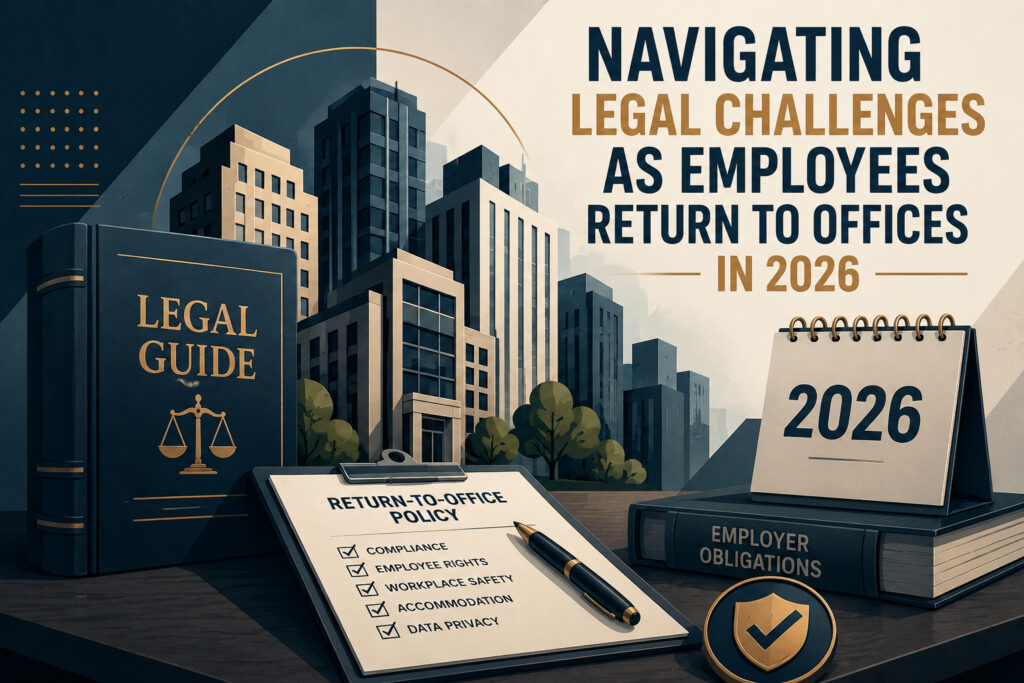
Return-to-office in 2026 looks very different from return-to-office in early 2025. The old conversation focused on emergency precautions and whether temperature checks crossed the line. Today, the real pressure points sit elsewhere. Employers now wrestle with formal attendance mandates, disability requests, pregnancy-related flexibility, workplace monitoring, documentation, and whether their space can actually support the level of in-person work they demand. Federal guidance still allows employers to assess accommodation requests case by case, but it does not let them ignore the interactive process or bypass role-specific analysis.
Current work patterns explain why this topic now carries more legal weight. WFH Research reported that about 26% of paid workdays in the United States still took place from home in June 2026. In the past year, 12% of full-time employees worked fully remote, 26% worked hybrid, and 62% worked fully on site. At the same time, Kastle’s early July 2026 data showed a 55.2% weekly average office occupancy across ten major markets, with New York at 62.1% for that week, while Class A+ buildings averaged 78.6% occupancy and hit 91.3% on their peak day. In other words, many employers now ask for more office presence than the broader labor market has fully normalized, which turns policy language and physical space planning into legal issues fast.
New York also stands out. Axios reported that New York City office visits in July 2025 ran 1.3% above July 2019 levels, making the city the first major metro in Placer.ai’s tracking to return to growth. Yet the same report noted that weekly occupancy remained below peak-day levels, which means many firms still face a gap between headline recovery and everyday usage patterns. That gap matters. A company can point to strong citywide attendance trends, then still create legal exposure if its own office lacks enough desks, meeting rooms, quiet rooms, support spaces, or a clear accommodation workflow.
Manhattan leasing data shows why tenants should care right now instead of later. JLL figures cited in April 2026 reporting put Manhattan’s first-quarter leasing volume at 8.5 million square feet, with vacancy down to 13.5% and asking rents at $85.31 per square foot overall and $95.49 for Class A space. Then, second-quarter reporting said Manhattan sublease inventory fell below 11 million square feet, down from a late-2022 peak of 23 million square feet. AI firms signed 21 deals totaling 719,200 square feet in 2026 to date, and one AI user just leased an entire 16-floor Hudson Square building while planning to double its local headcount by year-end. Another financial user moved to Lexington Avenue for about 39,552 square feet at an asking rent near $84 per square foot. Premium space still wins. Flexible space still disappears. Delayed planning now costs more.
Where Employers Now Face Legal Exposure
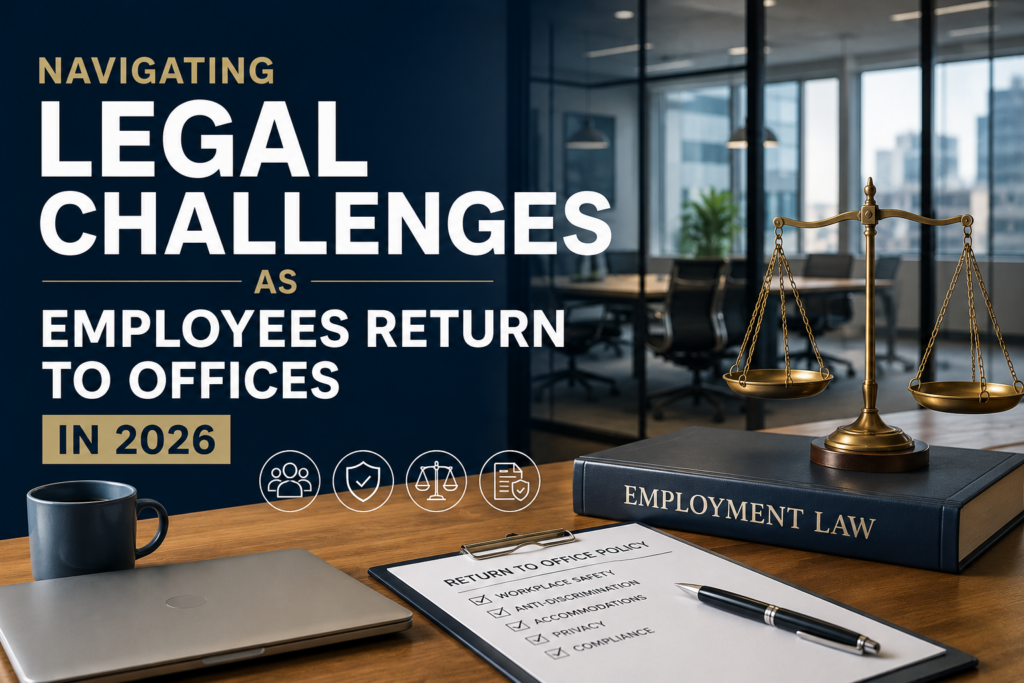
Attendance policy consistency now matters more than slogans. Employers can require in-office work in many roles, but they still need rules that managers can enforce evenly. Once exceptions spread through side deals, inconsistent manager calls, or undocumented flex arrangements, claims often shift from policy disagreement to discrimination or retaliation. The EEOC still says employers may ask whether a disability-related limitation requires accommodation, and it still says reopening the office does not automatically obligate an employer to continue telework forever. Even so, the agency also makes clear that employers should consider what remote work proved in practice and should engage in a flexible, cooperative process. A blanket “everyone back, no exceptions” approach often reads strong in a memo and weak in a legal file.
Disability accommodation will remain the main flashpoint. EEOC guidance says working from home may qualify as a reasonable accommodation under the ADA when the disability prevents successful on-site performance and the job can still be done remotely without significant difficulty or expense. That does not mean every request wins. It does mean every serious request needs a real review. A current federal lawsuit illustrates the point. Two immigration judges sued after a federal return-to-office policy allegedly eliminated remote work despite serious health conditions, claiming the policy violated anti-discrimination law by refusing telework as a reasonable accommodation. Private employers should not wait for a charge or complaint before they build a clean review path, define essential functions, and document why a requested change does or does not work.
Pregnancy-related flexibility requires its own lane. The Pregnant Workers Fairness Act gives workers a separate and growing source of accommodation rights. EEOC guidance lists longer or more flexible breaks, stools or workstation changes, schedule changes, part-time work, later start times, and telework among possible accommodations. The same guidance also explains that temporary suspension of one or more essential functions can qualify in some situations, so long as the worker can perform them again in the near future. New York raised the stakes further when a state law took effect in 2025 requiring private-sector employers to provide at least 20 hours of paid prenatal leave for pregnancy-related medical appointments. A 2026 return policy that ignores these realities invites avoidable conflict.
Privacy and tracking rules now sit inside the return-to-office debate. Badge swipes, Wi-Fi logs, camera systems, email reviews, browser tracking, and VPN records now help many employers police attendance. New York law does not ban every form of monitoring, but it does require notice. Civil Rights Law section 52-c says employers that monitor telephone, email, or internet usage by electronic device or system must give prior written notice to monitored employees and must also post the notice in a conspicuous place. Firms that tighten attendance rules without updating notices, handbook language, and manager training create a second legal problem while trying to solve the first.
Medical screening deserves a narrower hand than it got in earlier reopening cycles. EEOC guidance states that once employment begins, disability-related inquiries and medical exams must be job-related and consistent with business necessity. That standard matters because some employers still carry over old screening instincts into a very different legal environment. If a firm wants to ask health questions, require documentation, or treat an employee as a direct threat, it needs a role-based reason and a defensible record. Casual screening habits that once rode on emergency logic now look much thinner.
How Tenants Should Translate Policy Into Space
A lawful return plan needs a lawful workplace. OSHA states that employers must provide a workplace free from recognized serious hazards, examine workplace conditions, update operating procedures, and provide safety training in a language and vocabulary employees can understand. That sounds basic. In practice, it forces tenants to confront real operational questions. Do teams have enough assigned or reservable desks? Can the office absorb a Tuesday surge? Does the plan include quiet rooms for private calls, lactation or wellness needs, and faith-based or disability-related flexibility? Have managers mapped evacuation, after-hours access, visitor flow, and equipment use to the actual attendance target instead of last year’s lighter pattern?
Space design now plays a legal role, not a cosmetic one. If a company demands more in-person work, it should build an office that supports the demand. A weak layout can undermine the employer’s case on essential functions, fairness, productivity, and accommodation. For example, a floor plan with too few focus rooms can turn every medical call into a privacy issue. An office without flexible touchdown seats can make a stricter attendance policy look careless. A workplace with poor sight lines, crowded circulation, or too little meeting capacity can also weaken claims that in-person presence truly improves collaboration. Space should prove the policy, not contradict it.
This is where tenant representation matters. Manhattan still offers options, but the market no longer rewards hesitation. Transit-rich neighborhoods remain the safest starting point for firms that want more office usage without pushing legal and retention risk onto the workforce. Grand Central offices put teams near dense regional and subway access, and the neighborhood page currently shows a wide mix of small and midsize availabilities, including featured offerings around East 42nd Street and Lexington Avenue. Hudson Yards offices suit firms that prize premium buildouts, larger floor plates, and newer infrastructure, while pages such as One Vanderbilt, 560 Lexington Avenue, and 600 Third Avenue help narrow building-level fit.
Right sizing matters just as much as location. A tenant who expects five-day attendance from a support team, three-day attendance from a sales team, and flexible schedules for pregnancy, disability, or religious needs should not shop space as if every employee uses the office in the same way. Instead, the lease search should begin with policy assumptions. Count peak-day headcount. Add rooms for accommodation. Reserve extra touchdown seats for rotating teams. Build storage around actual paper and equipment needs. Then decide whether a direct lease, sublease, or mix of both makes more sense. Use the Office Space Calculator to build the first draft, then pressure-test those numbers against a live market search through office listings.
The leasing examples from 2026 reinforce the point. Demand concentrates in offices that support collaboration, recruiting, and prestige, but the best legal outcome often comes from fit rather than flash. One newly expanded financial tenant chose a Lexington Avenue move at an asking rent near $84 per square foot. A rapidly growing AI tenant took an entire Hudson Square building. Another AI-focused occupier expanded to about 185,326 square feet in a fully leased redeveloped Midtown South tower where asking rents ranged from $120 to $180 per square foot. Different users chose different footprints, but each move tied office strategy to a specific operating model. Tenants should do the same before they commit to a policy that outgrows the office.
Tenant Checklist for 2026
Use this checklist before any company tightens an attendance rule or signs more space:
- Write one policy, then define role-based exceptions. Do not let managers invent side rules by team or by personality. Base exceptions on function, not favoritism.
- Create a real accommodation track. Route disability, pregnancy, religious, and prenatal leave issues through a consistent review process with deadlines and decision records.
- Audit monitoring language now. Match your handbook, notices, onboarding documents, and posted signs to how you actually track phone, email, and internet use.
- Test the office against peak-day demand. Count seats, meeting rooms, wellness rooms, storage, and access flows before you increase required in-office days.
- Train managers before enforcement starts. A lawful policy can still fail when a manager denies a stool, delays a response, asks the wrong medical question, or disciplines one worker but not another.
- Tie lease language to workforce policy. Negotiate for expansion rights, contraction flexibility, furniture timing, after-hours HVAC, and buildout terms that support the attendance model you actually plan to run. Manhattan’s tighter 2026 conditions make that work harder to do after signing.
The central idea stays simple. Employers do not reduce legal risk by ordering people back to an office that cannot support the order. Smart tenants line up the policy, the process, and the premises before a mandate starts. That sequence protects the workforce and protects the business.
Office Tenants 2026
If your team plans a firmer office schedule in 2026, start with the space, not the press release. Search live options through the full NYC listings database, map your real headcount with the Office Space Calculator, and use direct tenant-broker support to compare layouts, rents, concessions, and timing. New York Offices states that it offers free comprehensive broker assistance, full-database access, and same-day response for tenants who need help narrowing requirements across Manhattan.
Fill out our 📋 online form or give us a call today 📞 212-967-2061 — let’s find the right office for your business.