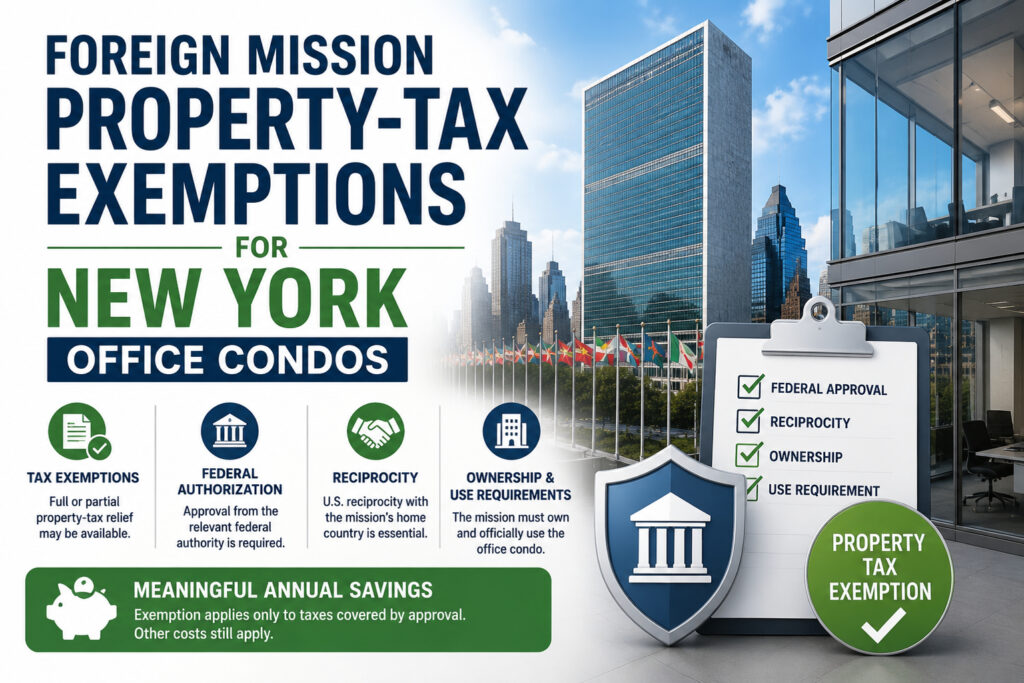
A qualifying foreign mission may receive a full or partial property-tax exemption for a New York office condominium. However, ownership alone does not create that exemption. The transaction must satisfy federal authorization, reciprocity, ownership, and property-use requirements.
The exemption can create meaningful annual savings for a long-term diplomatic or consular owner. Still, it only removes costs that the controlling authorization covers. Common charges, assessments, utilities, insurance, financing, construction, and professional fees require separate treatment.
Most importantly, a covered foreign mission must include government review within its real estate schedule. The mission should not treat approval as paperwork that follows closing. Federal law requires foreign missions to notify and obtain approval before completing applicable acquisitions or dispositions.
Core rule:A qualifying foreign mission that purchases and officially uses a New York office condo may receive full or partial relief. The relevant federal authority must first approve the property, ownership, use, and reciprocal treatment.
The answer in one minute
Can a foreign mission receive an office-condo property-tax exemption?
Yes, a foreign mission can qualify under the right facts. The federal government determines entitlement through its diplomatic property and tax review process. New York City then implements the authorized annual exemption for the qualifying tax lot or portion.
Four issues usually control the result:
Who owns the office condo
Which recognized mission or post will occupy it
How every part of the unit will function
What reciprocity the United States receives abroad
A foreign government often presents the clearest ownership structure. In some cases, the head of a diplomatic mission or consular post may also hold qualifying property. Other diplomats, staff members, agencies, enterprises, and affiliated organizations do not receive automatic real-property tax treatment.
Is the exemption always complete?
No. The exemption may cover all or only part of an office condominium.
A unit used entirely for authorized diplomatic or consular work may qualify for full annual property-tax relief. By contrast, mixed or unauthorized use can leave part of the unit taxable. New York applies the exemption to the qualifying portion rather than the owner’s entire footprint.
For example, a mission might use most of a floor for official offices. It might license another section to an unrelated organization. That outside section could remain taxable, even when the mission owns the entire unit.
Likewise, vacant investment space may not qualify merely because a foreign government holds title. The government must establish an approved diplomatic or consular purpose for the relevant area.
Does an office condo receive special treatment because it is a condominium?
The condominium form does not create diplomatic tax status. However, it can simplify the physical and tax boundaries around the mission’s premises.
New York generally treats each condominium unit and its related common interest as a separate parcel. Therefore, an office condo often has its own tax lot, assessment, tax bill, and exemption record.
That separation can support cleaner administration when the mission occupies one defined unit. Nevertheless, the mission must still prove qualifying ownership, authorized use, and federal approval.
Does the exemption follow the buyer automatically?
No. A seller’s exemption does not guarantee a buyer’s exemption.
The federal review concerns the incoming owner, the proposed use, reciprocity, and the specific transaction. A buyer should never value a condominium by assuming that an existing exemption will continue unchanged.
Instead, the mission should underwrite two scenarios:
Underwriting case
Annual property-tax assumption
Recommended use
Approved exemption
Full or authorized partial tax relief
Long-term planning after written authorization
Pending approval
Taxes remain payable
Contract period and pre-approval budgeting
Denied or limited exemption
Full or partial taxes remain
Downside analysis and purchase decision
Changed use later
Possible reassessment
Ongoing compliance planning
This approach protects the mission from relying on an exemption that has not yet reached the property account.
Who qualifies and what use counts
Permanent missions, consulates, and other international users
Different international occupants can appear similar during an office search. Their legal and tax positions may differ greatly.
A permanent mission to the United Nations represents a member government before the United Nations. New York law can exempt qualifying property owned by the foreign government or its principal resident representative. The property must support the representative’s offices, authorized quarters, or staff offices.
A consulate conducts consular functions within its assigned territory. The applicable treaty can protect consular premises when the sending government, or someone acting for it, owns or leases the premises. However, charges for specific services and certain assessments can remain payable.
A diplomatic mission uses premises for official mission purposes. Treaty rules can apply when the sending government or mission head owns or leases those premises. Those rules do not automatically remove every service charge or assessment.
An international organization may fall under a separate exemption framework. Qualifying organizations must satisfy their own ownership, organizational, and exclusive-use rules. Their treatment should not be confused with a foreign government’s treatment.
Users that should not assume mission status
Several organizations may work near diplomatic institutions without holding diplomatic property rights.
Examples include:
Nongovernmental organizations
Charitable organizations
Policy institutes
Foreign trade promotion offices
Government-owned commercial enterprises
Tourism offices
Cultural organizations
Press bureaus
Contractors serving a mission
Private foundations
Honorary consular operations
These occupants may qualify for another exemption or benefit. Yet their international work does not create a foreign mission exemption by itself.
New York’s sales-tax rules make a similar distinction. Foreign-government enterprises and agencies do not receive automatic diplomatic treatment. The federal government must determine their entitlement, where applicable.
Therefore, the acquisition team should define the purchaser before discussing tax savings. It should also identify the exact diplomatic, consular, governmental, or commercial function.
What counts as authorized office use?
A qualifying office condo should support recognized mission or consular activity. Typical uses may include:
Offices for accredited representatives
Administrative offices for authorized mission staff
Delegation meeting rooms
Secure communications rooms
Records and document storage
Official conference facilities
Consular processing areas
Public waiting and interview areas
Internal security facilities
Official reception space
Staff support areas serving the approved operation
The precise authorization controls. Consequently, the mission should describe each room and function accurately during review.
A floor plan can become an important tax document. It shows where official work occurs, where the public enters, and whether any unrelated occupant shares the premises.
Exclusive use does not mean one activity per room
“Exclusive use” concerns the overall qualifying purpose. It does not require every room to perform only one narrow task.
A conference room may host diplomatic briefings, staff meetings, and official receptions. Similarly, a secure multipurpose room can support several approved mission functions.
Problems arise when the mission introduces unrelated use. Examples include commercial subleasing, investment occupancy, private professional services, or unapproved residential use.
The exemption can shrink when only part of a property serves qualifying purposes. New York law supports taxation of the remaining portion.
Vacant space requires careful planning
A mission may purchase more space than it needs immediately. That strategy can support later growth, security separation, or future delegation requirements.
However, vacant space does not automatically receive the same treatment as active mission offices. The mission should explain the planned use, expected activation date, and operational reason for holding that area.
Meanwhile, leasing excess space to another user can weaken an exclusive-use position. Even a friendly organization may create a taxable mixed-use section.
A divisible office condo can help manage this issue. The buyer may purchase separate units, separate tax lots, or legally distinct sections. That structure can isolate authorized occupancy from investment or third-party use.
Ownership must match the approved diplomatic structure
Direct ownership by the foreign government often provides the clearest path. It also reduces questions about nominees, affiliates, holding companies, and beneficial interests.
A special-purpose company may look convenient for financing or liability planning. Nevertheless, that entity may not satisfy diplomatic ownership requirements.
Similarly, a ministry, state enterprise, cultural agency, or sovereign fund may not equal the recognized foreign mission. Its governmental connection does not guarantee an exemption.
The acquisition contract should identify the final deed owner correctly. Changing the purchaser late can trigger new review, lender issues, title work, and closing delays.
The head of mission presents a narrower case
Federal guidance generally recognizes qualifying property owned by a foreign government. It can also recognize certain property owned by a mission or consular head.
However, other mission personnel do not receive the same real-property protection. Their private office investments and personal properties remain outside the general rule.
An office condo titled personally to a mission head therefore needs detailed review. The team should confirm the proposed use, title structure, succession plan, and effect of personnel changes.
Direct government ownership may offer stronger continuity. A change in ambassador, representative, or consul should not disrupt title to the mission’s permanent offices.
How government approval fits into the transaction
Approval belongs at the beginning
The relevant federal office reviews proposed foreign mission acquisitions, uses, renovations, leases, and dispositions. It considers reciprocity, national interests, applicable law, and the specific property.
Therefore, the mission should contact its government and diplomatic property advisors before making an unconditional commitment.
Early review can reveal issues involving:
The purchaser’s legal identity
Proposed diplomatic or consular use
Building location
Security plans
Planned construction
Reciprocal treatment
Financing structure
Title and ownership
Future disposition
Shared occupancy
Waiting until closing can place the deposit, schedule, and exemption at risk.
A practical acquisition sequence
The following sequence aligns the real estate process with the approval process:
Transaction stage
Mission action
Main risk to control
Requirement planning
Define staff, public access, security, size, and budget
Searching for unsuitable buildings
Ownership planning
Confirm the authorized purchasing entity
Wrong name on term sheet or contract
Initial property review
Screen title, use, tax lot, and condo rules
Selecting a unit that blocks mission functions
Preliminary government contact
Present the proposed property and use
Discovering approval issues too late
Term sheet
Include approval, access, and diligence assumptions
Creating expectations before authorization
Contract negotiation
Add government approval and diligence protections
Losing the deposit after a denial
Formal review
Submit required property and transaction materials
Incomplete or inconsistent information
Condo and technical review
Complete legal, tax, physical, and security diligence
Closing with hidden liabilities
Closing
Complete only after required authorization
Acquiring without recognized approval
Post-closing implementation
Record title and complete tax administration
Delayed or missing local exemption
Ongoing compliance
Monitor use, recertification, and occupancy changes
Partial or full loss of exemption
The exact process can vary. Accordingly, the mission should follow the current instructions that apply to its government and transaction.
What should the purchase contract address?
A standard office-condo contract may not protect a foreign mission adequately. The contract should reflect the approval process and specialized use.
Counsel may need to address:
Government approval. The buyer should receive enough time to secure required authorization.
Deposit protection. The agreement should explain what happens after a timely denial or limiting condition.
Permitted use. The seller should not promise a use that the declaration, zoning, or building rules prohibit.
Board process. The contract should account for any condominium waiver, interview, consent, or information requirement.
Tax allocation. The parties should identify pre-closing taxes, exemption timing, arrears, and adjustments.
Access. The buyer may need architects, engineers, security consultants, lenders, and government reviewers to inspect the premises.
Alterations. The mission should understand which improvements require board, building, municipal, or federal review.
Closing date. A flexible outside date can accommodate approval without creating indefinite uncertainty.
Confidentiality. Sensitive security or diplomatic information may require controlled disclosure.
A mission should not rely on a vague “government approval” clause. The clause should define the relevant approval, timing, cooperation, and consequences.
What information can support the review?
The reviewing office may need detailed transaction and use information. A complete package can include:
Contract or proposed transaction terms
Deed owner and beneficial ownership details
Property address and legal description
Condominium unit and tax-lot information
Purchase price
Existing and proposed floor plans
Intended diplomatic or consular functions
Occupancy and staffing details
Renovation scope
Security improvements
Financing information
Closing schedule
Current tax status
Proposed mixed or shared uses
Seller and building information
The mission should keep every document consistent. A floor plan showing one use can conflict with a contract, board application, or approval submission showing another.
What happens after approval?
Approval to acquire does not always complete the annual tax-exemption process.
After the deed transfer, the federal authority reviews the completed ownership and qualifying use. When it authorizes annual property-tax relief, it instructs the city’s government exemption unit. The city can then apply the authorized benefit to the property account.
Some authorizations may require periodic confirmation. Changes in use, ownership, or occupancy can also require new review.
For that reason, the mission should retain a permanent property file. It should include:
Acquisition approval
Recorded deed
Closing statement
Tax authorization letter
Floor plans
Use descriptions
Property tax bills
Exemption notices
Recertifications
Condo amendments
Occupancy changes
Sublease or license documents
Renovation approvals
What is a property-tax exemption letter?
The relevant exemption letter provides written federal authorization to the local tax authority. It does not operate as a general promise from the seller or broker.
The letter usually concerns a specific property, owner, use, and scope. It may authorize full relief, partial relief, or another defined treatment.
A prior owner’s letter should not substitute for the incoming buyer’s authorization. Likewise, a diplomatic identification card does not replace real-property approval.
When does the exemption begin?
The mission should never assume that relief starts on contract signing.
Timing can depend on the approval, deed transfer, qualifying use, tax lien dates, and local administration. New York guidance generally connects relief to taxes that become due after qualifying use begins. Older taxes and liens can remain chargeable.
Therefore, the closing statement should address outstanding taxes carefully. The buyer should also maintain funds for bills issued before the city updates its account.
A delayed account change does not necessarily establish final tax liability. However, the mission must manage the bill, authorization, and correction process actively.
Dispositions also require planning
A foreign mission must consider government review when selling or otherwise disposing of property. The disposition process should not begin only after the mission finds a buyer.
A sale can affect tax treatment, sovereign issues, title, tax adjustments, and closing documents. Moreover, a transfer to a private buyer can produce different local filing and payment obligations.
Early planning allows the mission to coordinate the exit with its relocation. It also protects against a gap between surrendering one property and opening another.
What the exemption covers and what remains
Annual property tax
Annual New York City property tax represents the central benefit discussed here. A full authorization can remove the qualifying unit’s taxable assessed value from the annual calculation.
A partial authorization reduces only the qualifying portion. The city can continue taxing areas that support unrelated, private, commercial, or unauthorized uses.
New York generally places commercial and industrial property within tax class four. The city calculates tax from taxable assessed value after applicable exemptions.
Still, diplomatic authorization controls the mission’s benefit. Regular commercial exemptions and residential condo abatements do not define foreign mission eligibility.
Common charges
An annual property-tax exemption does not eliminate office-condominium common charges.
Common charges fund the building’s shared operations. They may cover lobby staffing, security, management, cleaning, elevators, building insurance, repairs, and common utilities.
The condominium declaration assigns each unit a percentage interest. The board then uses that percentage, or another authorized method, to allocate expenses.
New York law does not let an owner avoid common charges simply by abandoning the unit or declining common services. Unpaid charges can also create a lien against the unit.
Consequently, a mission must underwrite common charges as a continuing occupancy cost.
Condominium assessments
A board can impose a special assessment for capital work or an unexpected shortfall. Examples include facade repairs, elevator modernization, roof replacement, and security upgrades.
Diplomatic property-tax treatment does not remove a private condominium assessment. The assessment arises from the condominium’s governing documents rather than the city’s annual tax system.
Before purchasing, the mission should review:
Current assessments
Approved future assessments
Capital plans
Reserve funding
Major repair reports
Board meeting minutes
Pending litigation
Insurance claims
Building violations
Local compliance work
A low common charge can hide deferred work. Conversely, a higher charge may support stronger reserves and better building services.
Governmental special assessments and service charges
Some public charges fall outside the annual property-tax exemption.
Federal guidance distinguishes real estate taxes from separately stated charges for commodities or services. It does not treat refuse collection or similar service charges as annual real estate taxes.
New York law also distinguishes general taxes, special ad valorem levies, and special assessments. The applicable exemption can treat those categories differently.
Therefore, the mission should review every line on the bill. It should not classify every city charge as exempt merely because it appears beside property tax.
Utilities
The property-tax exemption does not erase electricity, water, telecommunications, or other utility consumption.
A separate diplomatic sales-tax authorization may affect taxes charged on utility services. New York requires the appropriate federal documentation for that treatment.
However, the mission still pays for the underlying service. It should review:
Direct electric metering
Submetering markups
Heating and cooling charges
Overtime HVAC
Water and sewer allocation
Generator access
Internet and data circuits
After-hours building services
A directly metered unit can provide useful cost control. Yet the building may still charge for central systems through common charges.
Insurance
An exemption does not remove insurance obligations.
The condominium may require liability, property, workers’ compensation, and alteration coverage. A lender can impose additional limits and endorsements.
The building’s master policy usually does not insure every mission improvement or item. The buyer should identify gaps involving:
Interior improvements
Furniture and equipment
Fine art and cultural property
Electronic systems
Business interruption
Cyber incidents
Terrorism coverage
Flood exposure
Public consular operations
Construction work
Security equipment
Sovereign status does not make physical risks disappear. Therefore, the mission should coordinate insurance with counsel, its risk office, and the condo’s requirements.
Financing and debt service
A property-tax exemption does not eliminate loan principal, interest, appraisal costs, lender legal fees, or financing expenses.
Commercial lenders may also examine sovereign immunity, enforcement rights, governing law, and permitted collateral. Some lenders may request waivers or specialized documentation.
The mission should resolve these issues before contract signing. A financing contingency alone may not address government approval or diplomatic ownership requirements.
Mortgage recording tax can require separate analysis. Federal guidance may authorize relief from certain transfer and recordation taxes under reciprocal treatment. However, the mission should confirm the exact written authorization before budgeting a zero amount.
New York City real property transfer tax
Annual property tax and city transfer tax require separate analysis.
New York City generally imposes real property transfer tax on qualifying transfers above the applicable threshold. However, the city recognizes an exemption for certain foreign-government transactions involving exclusively diplomatic or consular premises.
The exemption depends on the parties, use, and controlling treaty treatment. It does not follow automatically from a hoped-for annual exemption.
A foreign government selling to a private buyer presents a different situation. The private party may face filing or payment duties, even when the government held exempt status.
Accordingly, counsel should analyze these items separately:
Cost or tax
Does annual property-tax approval automatically remove it?
Annual real property tax
It may, within the authorized scope
City real property transfer tax
No; separate transaction analysis applies
Mortgage recording tax
No; confirm separate authorization
Common charges
No
Condo special assessments
No
Utilities
No; separate sales-tax status may affect the tax component
Insurance
No
Debt service
No
Title insurance
No
Legal and accounting fees
No
Construction and security work
No
Separately stated service charges
Usually not through annual tax approval
Taxes on nonqualifying space
No
Construction and security improvements
Ownership can support permanent security work. Still, the mission must budget for that work independently.
Potential improvements include controlled entrances, screening areas, ballistic protections, secure communications, reinforced partitions, and protected records storage.
The condominium board may control structural work, windows, risers, roof equipment, and common corridors. The city can also require permits and code compliance.
Federal property officials monitor compliance with local requirements for construction, maintenance, and renovation.
Therefore, diplomatic status should not replace normal architectural and engineering diligence.
An illustrative cost comparison
Consider a hypothetical office condo with these annual costs:
Expense
Without exemption
With full annual exemption
Property tax
$180,000
$0
Common charges
$130,000
$130,000
Insurance
$25,000
$25,000
Utilities
$45,000
$45,000
Capital reserve
$35,000
$35,000
Financing costs
$320,000
$320,000
Total
$735,000
$555,000
The hypothetical exemption saves $180,000. It does not create free occupancy.
Moreover, a partial exemption would save less. Any taxable use, special charge, or delayed implementation could also change the result.
When ownership beats leasing
Ownership is not always the better choice
Purchasing can prove more practical for a long-term international user. Yet no mission should treat that conclusion as universal.
Ownership may fit when the mission:
Expects a long occupancy
Qualifies for meaningful tax relief
Has available capital
Needs extensive security work
Wants control over improvements
Requires permanent communications systems
Can manage board obligations
Accepts resale risk
Has time for government review
Wants protection from rent renewal risk
Leasing may fit when the mission:
Needs rapid occupancy
Wants flexibility
Has uncertain staffing
Faces a short program horizon
Prefers lower initial capital
Cannot accept acquisition delays
Needs a wider building selection
Wants the landlord to fund improvements
May relocate soon
Cannot establish qualifying ownership
The correct answer depends on total occupancy cost, not the purchase price alone.
Ownership can support long-term control
An office condo allows the mission to own its defined premises. That control can support permanent improvements, internal security, and a stable institutional address.
The mission can also avoid lease expiration and renewal negotiations. However, it assumes responsibility for capital value, resale timing, and building governance.
A buyer exploring the broader ownership process can review our New York office-condo acquisition guide. It explains condominium structure, ownership costs, and due diligence.
Leasing can reduce timing and capital pressure
A lease usually requires less initial capital than a purchase. It can also provide faster access to existing built space.
Still, a diplomatic lease requires specialized review. The mission should address sovereign issues, permitted use, security, alterations, restoration, and governmental approval.
A landlord may also pass property taxes through additional rent. Therefore, the lease must explain how any diplomatic tax treatment affects those charges.
The tenant should not assume that its diplomatic status automatically reduces rent. The economic benefit depends on the lease, ownership, tax account, and federal authorization.
Do lessees receive a property-tax exemption?
Treaty rules can recognize leased diplomatic or consular premises. However, that does not mean every mission tenant receives a direct annual tax benefit.
The building owner usually receives the city’s property-tax bill. A tenant’s economic benefit depends on the lease and applicable authorization.
For example, the lease may include taxes within base rent. Another lease may pass through tax increases. A third may require the tenant to reimburse the owner directly.
Accordingly, the mission should negotiate these points:
Whether the landlord will cooperate with government review
Whether the lease assumes exempt or taxable treatment
How the parties handle tax delays
Who receives refunds
How tax escalations change
Whether the landlord can retain savings
What happens after a use change
Whether the lease ends after approval denial
Treaty guidance recognizes leased mission and consular premises under specific conditions. Nevertheless, local billing and lease economics still require separate analysis.
Compare costs across the full holding period
A sound comparison should use a common period. Ten years often produces a clearer answer than one year.
For ownership, include:
Purchase price
Equity cost
Debt service
Closing costs
Common charges
Assessments
Utilities
Insurance
Repairs
Construction
Security
Nonexempt taxes
Resale costs
Expected sale proceeds
For leasing, include:
Base rent
Escalations
Tax payments
Operating expenses
Electricity
Security
Buildout
Professional fees
Restoration
Renewal risk
Relocation costs
Residual furniture and cabling value
Then compare both cases with and without tax relief. This method shows whether the exemption changes the decision.
Tax relief can improve ownership economics
Annual relief can lower the recurring cost of ownership significantly. The benefit becomes more valuable over a long holding period.
Still, the mission should avoid capitalizing uncertain savings fully into its purchase offer. It should first confirm approval, use, and likely implementation.
The buyer also needs a downside case. That case should assume partial approval, delayed approval, or future loss after an occupancy change.
Security work can favor ownership
A mission may need alterations that provide little value to a conventional landlord. These improvements can include hardened walls, secure data rooms, and controlled circulation.
A short lease may not justify that investment. Restoration clauses can also require the tenant to remove expensive work later.
Ownership reduces lease-end restoration risk. Yet the condo board still controls many changes.
Therefore, the buyer should review the declaration before assuming ownership guarantees complete freedom.
Flexibility can outweigh ownership benefits
A foreign mission may face changing representation, budget cycles, staffing, or government policy.
In those cases, a lease can provide a better operational answer. The mission may accept rent in exchange for flexibility and lower disposition risk.
Leasing can also offer access to large institutional buildings that do not sell units. Those properties may provide stronger infrastructure, easier expansion, and established diplomatic occupancy.
Our consulate office-space guide compares mission requirements, ownership considerations, lease issues, and Midtown East locations.
How to evaluate a New York office condo
Start with legal use
The mission should confirm that the condominium legally supports its operation.
Important documents include:
Certificate of occupancy
Condominium declaration
Bylaws
Rules and regulations
Offering plan
Amendments
Unit deed
Tax-lot records
Board resolutions
Alteration agreement
Current insurance requirements
The New York Attorney General maintains records concerning condominium offering plans and amendments. Those documents can help identify the legal structure and historical filings.
However, the mission should obtain the complete current document set from the seller or building.
Confirm office and consular functions
A standard professional office use may not cover every diplomatic operation.
Public consular services can create different needs involving occupancy, queues, security screening, accessibility, and life safety.
The mission should describe its functions before selecting a unit. Relevant questions include:
Will the public visit daily?
Will visitors require screening?
How many people may wait?
Will staff process passports or visas?
Does the operation require interview windows?
Will delegations arrive by vehicle?
Does the mission need ceremonial space?
Will secure deliveries enter separately?
Does the mission need after-hours access?
Will demonstrations affect the entrance?
Does the mission need protected parking?
An attractive boardroom does not cure a poor entrance or unsafe visitor path.
Review condominium restrictions
The declaration can limit alterations, signage, access, use, deliveries, and roof equipment.
Some buildings reserve approval rights over every buyer. Others require a waiver of a purchase option or right of first refusal.
A mission should also confirm whether the board can impose special requirements. Those requirements may involve sovereign immunity, insurance, security, or financial disclosure.
The contract must allow enough time for this process. Government approval and board review may proceed together, but neither should depend on wishful timing.
Investigate the building’s finances
The mission will share building expenses with other owners. Therefore, building finances matter as much as unit condition.
Review at least several years of:
Financial statements
Operating budgets
Common-charge history
Arrears reports
Reserve balances
Capital schedules
Insurance premiums
Assessment notices
Litigation reports
Vendor contracts
Major repair projects
A small office condo can face large assessments when a building needs facade or elevator work.
New York law gives boards lien rights for unpaid common charges. In an exclusively nonresidential condominium, the declaration may even elevate that lien above mortgage interests.
Lenders and buyers should review that language closely.
Check current and historical taxes
The buyer should obtain the current property-tax bills and assessment records.
It should verify:
Tax class
Assessed value
Taxable assessed value
Existing exemptions
Exemption codes
Outstanding balances
Tax liens
Abatement history
Lot description
Unit percentage
Prior use
The seller should not describe a diplomatic exemption casually. The buyer needs the actual authorization and account history.
Prior arrears can remain important. New York guidance indicates that taxes already attached before a qualifying transfer may remain payable.
Inspect the physical building
Security-sensitive users require more than a standard property inspection.
The team should evaluate:
Structure and slab capacity
Exterior walls and windows
Elevator access
Stair locations
Loading and deliveries
Fire alarm systems
Sprinkler systems
Emergency power
HVAC capacity
Electrical capacity
Telecommunications pathways
Roof rights
Water intrusion
Facade condition
Accessibility
Public circulation
After-hours staffing
The unit’s buildout may conceal expensive base-building limitations. An architect and engineer should evaluate both the premises and shared systems.
Test the security plan before closing
A mission should confirm that its security concept works within the building.
For example, a controlled vestibule may affect the common corridor. Ballistic treatment may affect window systems. Secure telecom may require riser and roof access.
The board may reject changes that interfere with common elements. Likewise, local authorities may require permits.
Federal property officials also oversee foreign mission compliance with local construction and maintenance requirements.
Therefore, the mission should not postpone security feasibility until after closing.
Study access and transportation
Location affects staff, delegations, diplomatic vehicles, and public visitors.
Midtown East remains a common focus because it connects the United Nations area, Grand Central, major avenues, and the East River corridor.
These examples do not establish a universal value range. Size, condition, floor, views, building quality, restrictions, and location can change pricing substantially.
More importantly, the mission should compare each property’s total occupancy cost. A lower purchase price can lose its advantage through high charges, assessments, or unsuitable security conditions.
Small and large units create different issues
A small unit can offer an efficient permanent address. Yet it may lack dedicated visitor screening, separation, or expansion capacity.
Large floors can support secure zoning and delegation work. However, excess space creates cost and exemption questions.
The mission should avoid buying unusable surplus solely to secure a prestigious building. A partial exemption may leave the extra section taxable.
Where possible, separate condo units can provide flexibility. The mission could occupy one unit and reserve another for future expansion, subject to approval.
Examine the resale market
Office condos form a smaller market than leased office space. Therefore, resale can take longer.
The buyer should consider:
Future buyer pool
Unit size
Divisibility
Building reputation
Financing availability
Board restrictions
Physical condition
Common charges
Tax assessment
Permitted uses
Location
Delivery condition
A unit designed only for one mission’s security program may need expensive alterations before resale.
Long-term users can accept that risk more easily. Shorter-term users should place greater weight on flexibility.
Questions missions should resolve before signing
Can a foreign mission get a property-tax exemption?
Yes, a qualifying mission can receive full or partial relief. Federal authorization must support the ownership, reciprocity, and official use. The city then implements the authorized annual benefit.
Does every diplomatic mission receive an exemption?
No. Diplomatic identity alone does not exempt every property.
The relevant authority reviews the country, entity, owner, use, and reciprocal treatment. A mission must also complete the applicable property process.
Can a permanent mission purchase an office condo?
Yes, a permanent mission can pursue condominium ownership. The purchasing entity, authorized use, federal approval, and building documents must all support the transaction.
New York law specifically recognizes qualifying property used for a principal representative’s offices and staff offices.
Can a consulate purchase an office condo?
Yes, a consulate can pursue ownership. Treaty rules protect qualifying consular premises owned by the sending government or someone acting for it.
However, service charges and assessments can remain outside the exemption.
Does a foreign government-owned company qualify?
Not automatically. A state-owned enterprise can perform commercial rather than diplomatic activity.
The mission should obtain a specific federal determination before assuming any exemption.
Can a mission use a holding company?
A holding company may complicate eligibility. Direct government ownership often provides the clearest structure.
The mission should obtain approval for the precise deed owner. It should not insert an affiliate without review.
What does reciprocity mean?
Reciprocity compares the treatment that the foreign government provides to United States missions abroad.
The federal government uses reciprocity when determining the scope of property-tax relief. Therefore, two missions with similar New York properties may receive different treatment.
Can the exemption cover only part of a unit?
Yes. New York can exempt the qualifying section and tax the rest.
A clear floor plan and use schedule can help define that division.
What happens after the mission subleases part of the condo?
The subleased section may lose exemption when the occupant or use does not qualify.
The mission should seek advice before signing any sublease, license, occupancy agreement, or concession.
Does vacant space qualify?
Not necessarily. The mission should establish the vacant area’s approved purpose and planned use.
Long-term investment vacancy may not satisfy an exclusive diplomatic-use requirement.
Are staff residences inside an office building exempt?
The answer depends on the occupant’s role, applicable treaty, federal determination, and use.
New York has taxed portions used to house lower-ranking staff when those areas fell outside the recognized exemption.
A mission should not convert office space into housing without advance review.
Does the exemption eliminate common charges?
No. Common charges remain private condominium obligations.
An owner cannot avoid them simply because it does not use every common element.
Does the exemption eliminate special assessments?
No, not automatically.
Private condominium assessments remain payable. Public special assessments and service charges can also remain, depending on the controlling exemption.
Does the exemption cover utilities?
It does not remove consumption charges.
A separate diplomatic sales-tax authorization may affect the tax charged on utilities. The mission must use the required federal documentation.
Does the exemption cover insurance?
No. The mission must maintain the insurance required by the building, lender, and its risk plan.
Does the exemption cover financing?
No. Principal, interest, lender costs, and most financing expenses remain payable.
Any exemption from a recording tax requires separate confirmation.
Does the exemption cover city transfer tax?
Not through annual property-tax approval alone.
New York City has separate rules for qualifying foreign-government transfers and diplomatic or consular use. The transaction parties and documents matter.
Should the mission close before approval?
It should not complete an acquisition that requires prior approval without that authorization.
Federal law requires notification and approval before foreign missions finalize applicable acquisitions and dispositions.
Can the contract depend on approval?
Yes. A properly drafted contract can make required government approval a closing condition.
Counsel should define the deadline, cooperation duties, deposit treatment, and effect of limiting conditions.
How long does approval take?
Timing depends on the property, transaction, country, completeness, and review issues.
The mission should start early and avoid setting a closing date that assumes immediate approval.
Can approval include conditions?
Yes. The relevant authority can evaluate use, ownership, renovation, reciprocity, and national interests.
The mission should review every condition before closing.
Can the exemption change later?
Yes. A change in ownership, use, occupancy, or reciprocal treatment can affect the result.
Some cases also require annual recertification.
Is purchasing always better than leasing?
No. Purchasing may suit a long-term user with capital, stable needs, and extensive security requirements.
Leasing may suit a user that values speed, flexibility, and lower initial capital.
What should a mission compare first?
It should compare total occupancy cost under both approved and unapproved tax scenarios.
The mission should then compare security, flexibility, location, timing, and exit risk.
Which professional advisors should participate?
A mission may need:
Diplomatic property officials
Real estate counsel
Tax counsel
Tenant or buyer representation
Title professionals
Architect
Engineer
Security consultant
Insurance advisor
Lender
Accountant
Government representatives
Each advisor addresses a different risk. No single participant should promise the final tax result.
What records should the mission preserve?
The mission should retain every approval, deed, tax letter, floor plan, bill, and use record.
It should also preserve board documents, alterations, recertifications, and occupancy agreements.
What is the most important transaction rule?
Connect the approval timeline to the real estate timeline.
The mission should not sign an unconditional contract first and seek authorization later. It should define the owner, use, approval path, and cost assumptions before making a binding commitment.
Decision standard: Purchase only when the approved ownership structure, long-term use, security needs, capital plan, and total occupancy cost support ownership. Lease when flexibility, timing, or lower initial exposure carries greater value.
Review Office Options
Our tenant representation work starts with mission requirements, approval timing, and total occupancy cost. We coordinate the search, comparison, and negotiation process around your counsel and government review. Contact us before signing a term sheet or purchase contract, so the real estate timeline supports the approval timeline.
Fill out our 📋online form or give us a call today 📞212-967-2061 — let’s find the right options for your business.