Buy vs. Lease Office Space Near the United Nations
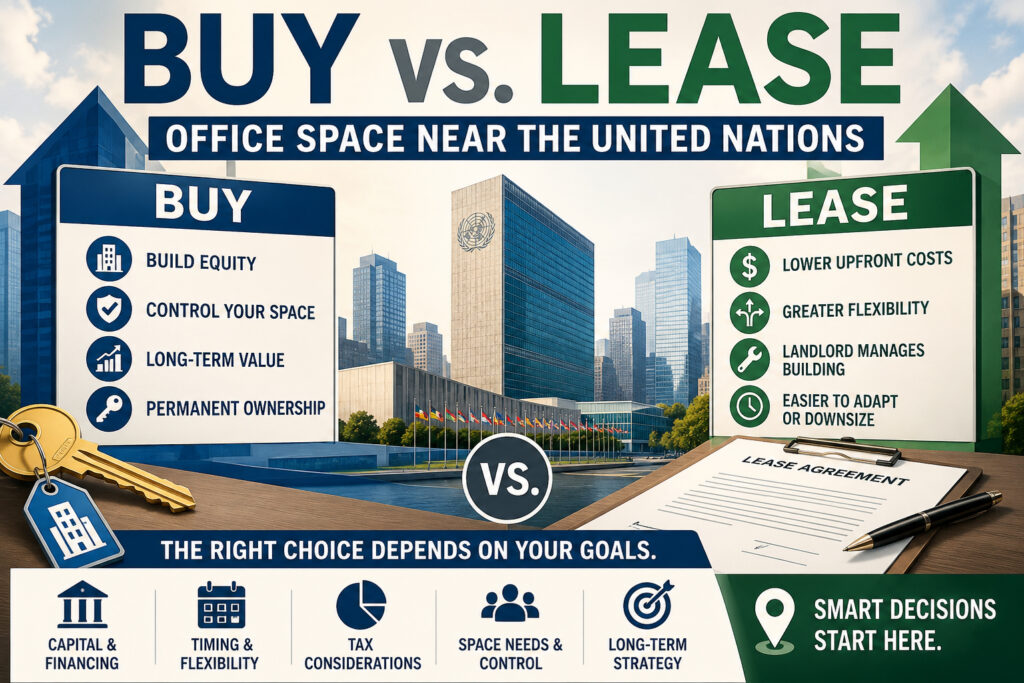
Choosing between buying and leasing near the United Nations requires more than a simple monthly payment comparison.
The right answer depends on capital, timing, space needs, tax status, operational control, and long-term location plans. Local inventory also matters because ownership opportunities remain much scarcer than lease opportunities.
For most tenants, leasing offers the safer and more flexible occupancy path. However, ownership can create exceptional value for stable organizations with long planning horizons.
The Occupancy Decision in Plain English
Leasing gives your organization temporary occupancy rights under a negotiated agreement. Buying gives your organization a transferable ownership interest in the premises.
That distinction affects almost every financial and operational decision.
A lease preserves capital and shifts many building responsibilities to the landlord. Ownership requires more cash, more diligence, and more management responsibility.
However, ownership can build equity and protect against future rent increases. It can also support specialized layouts that remain useful for decades.
The fastest way to frame the choice
| Your situation | Usually favors leasing | Usually favors buying |
|---|---|---|
| Expected occupancy under seven years | Strongly | Rarely |
| Expected occupancy over fifteen years | Sometimes | Strongly |
| Headcount may change quickly | Strongly | Rarely |
| Space needs should remain stable | Sometimes | Strongly |
| Capital must support operations | Strongly | Rarely |
| Organization has surplus capital | Sometimes | Strongly |
| Major custom construction is required | Sometimes | Strongly |
| Immediate occupancy is important | Strongly | Sometimes |
| Tax exemption may apply | Sometimes | Strongly |
| Future relocation remains possible | Strongly | Rarely |
| Full control matters greatly | Sometimes | Strongly |
| Resale liquidity matters | Strongly | Rarely |
Leasing often works better when uncertainty remains
Growing companies rarely know their exact headcount ten years ahead. Even established organizations can face funding changes, mergers, policy shifts, or hybrid attendance changes.
A lease creates an expiration date and a natural decision point. Renewal options can extend occupancy without forcing permanent ownership.
Tenants can also negotiate expansion rights, contraction rights, assignment rights, and subletting rights. Those protections create additional flexibility.
Buying often works better when permanence has real value
Ownership deserves serious consideration when the organization expects decades of occupancy. It also suits highly specialized operations with expensive installations.
Diplomatic offices, international organizations, nonprofits, medical users, and institutional occupiers may fit this profile. Their location needs often remain stable.
A permanent address can also support identity, security, institutional memory, and public accessibility.
“Near the United Nations” covers several distinct office pockets
The phrase usually includes Turtle Bay, the diplomatic corridor, and the eastern side of Midtown East. Most searches focus on First, Second, and Third Avenues.
The practical area often stretches from East 42nd Street through the low East 50s. Grand Central sits west of this district.
Properties closest to First Avenue offer the strongest proximity and international identity. Second Avenue buildings often provide the broadest mix of office and condominium options.
Third Avenue usually provides larger floorplates and better subway access. Tudor City and nearby side streets can offer smaller or less expensive alternatives.
Distance matters because a few avenues can change pricing, transit convenience, building quality, and ownership availability.
What Buying and Leasing Actually Mean Here
The words “buy” and “lease” can describe several different transactions. Understanding those structures prevents misleading comparisons.
A direct office lease
A direct lease creates a relationship between the tenant and building owner. Terms commonly run between five and ten years.
Longer commitments may support stronger concessions. These concessions can include free rent, construction allowances, turnkey delivery, and favorable renewal options.
Direct leases offer the largest inventory pool. They also provide the clearest path toward a customized office.
Tenants comparing direct opportunities can review our direct leased office space inventory.
An office sublease
A sublease creates a relationship between the incoming occupant and an existing tenant. The building owner still controls many important rights.
Subleases can provide furniture, shorter terms, and faster occupancy. They may also provide lower pricing when the existing tenant wants a quick exit.
However, sublease supply near the United Nations can remain thin. Diplomatic and institutional occupiers often retain their premises for long periods.
Subleases also create added credit risk. The incoming occupant depends on the original tenant’s continued lease performance.
Review the master lease, consent requirements, restoration obligations, and remaining term before proceeding. Our office sublets page explains available sublease formats.
An office condominium purchase
Buying near the United Nations usually means purchasing an office condominium. It rarely means purchasing an entire Midtown office building.
A commercial condominium creates direct ownership of a defined unit. The owner also receives an interest in the building’s common elements.
The condominium board governs shared matters through its declaration and bylaws. Common charges fund building operations, staff, repairs, insurance, and reserves.
Unit owners may sell, finance, lease, or occupy their premises. However, condominium documents can limit those rights.
Use restrictions deserve special attention. Some buildings restrict medical use, public access, signage, heavy visitor traffic, or particular alterations.
Current ownership opportunities appear within our office condos for sale inventory.
A commercial cooperative purchase
Commercial cooperatives appear less frequently near the United Nations. The buyer purchases shares rather than receiving a deeded condominium unit.
Those shares provide occupancy rights through a proprietary lease. The cooperative board may exercise greater control over financing, alterations, sales, and subleases.
Lenders may also treat cooperative collateral differently. Therefore, buyers should compare financing terms before choosing this structure.
A fee-simple building purchase
Buying an entire building offers maximum control. It also creates maximum responsibility.
Whole-building opportunities near the United Nations remain scarce and expensive. They may also require extensive capital work.
Security, elevators, façades, roofs, mechanical systems, and accessibility become the owner’s responsibility. Staffing and regulatory compliance also require ongoing attention.
Most office users should compare condominiums before considering an entire building.
Owner occupancy and investment ownership are different strategies
An owner-user purchases space for its own operations. An investor purchases space for rental income or appreciation.
Those goals require different financial models. An owner-user values occupancy stability, customization, and control.
An investor focuses on rent, credit, lease duration, expenses, resale value, and capitalization rates. Mixing those analyses can produce a poor decision.
Why different types of pages appear during your research
Online research often mixes several content categories. Each category answers a different question.
General buy-versus-lease guides explain broad financial principles. However, they may ignore Midtown transaction costs and local inventory.
Neighborhood guides explain location, transportation, tenants, and building stock. They may not compare ownership and leasing directly.
Property profiles describe one building or unit. They cannot establish a complete market benchmark.
Listing databases show active availability. Asking terms may change quickly, and many listings omit concessions.
Financial articles discuss taxes, depreciation, and financing. They cannot determine whether a particular office meets operational needs.
Brokerage pages can combine listings with transaction guidance. Their usefulness depends on accuracy, depth, and tenant focus.
A sound decision requires all those perspectives. No single listing or broad article can resolve the complete occupancy question.
Current Costs and Availability Near the United Nations
Midtown’s broader office market strengthened during the first half of 2026. Availability tightened while high-quality asking rents increased.
However, the United Nations area still behaves differently from Midtown’s trophy corridors. The local tenant base remains more institutional and diplomatic.
Building age, transit distance, ownership structure, floor height, and river views create wide pricing spreads. Therefore, one neighborhood average can mislead tenants.
Practical leasing ranges
The following bands provide planning guidance rather than binding quotes.
| Space category | Typical asking range | Common characteristics |
|---|---|---|
| Prime Class A and high-view floors | $75–$100+ per square foot | Strong security, attended lobby, river views, upgraded systems |
| Renovated Class A or strong Class B | $60–$85 per square foot | Modernized lobby, efficient floorplates, good light |
| Standard Class B | $50–$70 per square foot | Older systems, practical layouts, fewer amenities |
| Value-oriented offices | $40–$60 per square foot | Older finishes, smaller buildings, side-street locations |
| Furnished subleases | $40–$65 per square foot | Limited supply, shorter terms, existing furniture |
| Highly customized suites | Property specific | Medical, diplomatic, institutional, or high-security installations |
A building can span several bands. Floor condition and views can matter more than the building’s general classification.
One renovated floor may command a premium. Another floor may need substantial construction and justify a lower rent.
How to calculate monthly rent
Manhattan office rents usually use an annual rate per rentable square foot.
Rentable square feet × annual rent per square foot ÷ 12 = monthly base rent
A 5,000-square-foot office at $60 per square foot costs $300,000 annually. Monthly base rent equals $25,000.
The same office at $75 per square foot costs $375,000 annually. Monthly base rent equals $31,250.
At $90 per square foot, annual base rent reaches $450,000. Monthly base rent equals $37,500.
Those figures exclude several possible expenses. Electricity, cleaning, overtime HVAC, taxes, operating escalations, security, and insurance may add costs.
What “$24.00 per square foot per year” means
The notation $24.00/SF/YR means $24 annually for each rentable square foot.
A 3,000-square-foot office at $24 per square foot costs $72,000 annually. Monthly base rent equals $6,000.
That rate would sit far below most conventional Midtown office asking rents. Therefore, tenants should inspect what the quote excludes.
The figure may represent additional rent, operating expenses, taxes, or a partial charge. It may not represent full base rent.
Asking rent and effective rent are not the same
Asking rent provides only the starting number. Effective rent reflects negotiated concessions across the lease term.
Suppose a tenant leases 5,000 square feet at $70 per square foot. Annual base rent equals $350,000.
A ten-month rent abatement reduces early occupancy costs. A landlord construction allowance can reduce the tenant’s cash investment further.
However, contractual rent may escalate each year. Operating expenses and real estate taxes may also increase.
Compare each proposal through a complete cash-flow schedule. The first page of a proposal never tells the full story.
Our commercial leasing guide explains the broader lease structure.
Free rent and construction allowances
A landlord may offer free rent during construction or early occupancy. The amount depends on term length, credit, space condition, and competition.
Construction support can take several forms. The landlord may provide cash, reimburse expenses, or deliver a turnkey installation.
A tenant improvement allowance usually uses a dollar amount per rentable square foot. For example, $80 per square foot equals $400,000 on 5,000 square feet.
Yet the allowance may not cover furniture, technology, moving, or legal costs. Review our guide to tenant improvement allowances before comparing offers.
Current ownership pricing
Office sale pricing near the United Nations varies even more than rent. Unit size, condition, floor height, and tax status drive major differences.
Current and recent offerings show asking prices from roughly $600 to above $1,100 per square foot. Small units can command higher per-foot pricing.
A current Second Avenue condo office for sale offers 7,663 rentable square feet. Its asking price equals $4.5 million.
That pricing equals about $587 per rentable square foot. The space includes a renovated layout and direct elevator access.
Another nearby sample offered approximately 6,450 square feet for $4.88 million. That figure equaled about $757 per square foot.
A Grand Central fringe property recently asked $7.25 million for 6,480 square feet. That price equaled about $1,119 per square foot.
These examples show why location labels alone cannot establish value. Building quality and ownership rights can outweigh distance.
Common charges can materially change ownership economics
Office condominium buyers pay recurring common charges. These charges fund shared building operations and reserves.
A recent 6,450-square-foot sample showed monthly maintenance near $11,000. Annual maintenance reached approximately $132,000.
That equals roughly $20.47 per square foot annually. Property taxes, insurance, financing, and unit repairs may add further costs.
Some buyers focus only on the mortgage payment. That approach understates the true cost of ownership.
Additional purchase costs
A purchase budget should include more than the contract price.
| Purchase cost | What it covers |
|---|---|
| Equity contribution | The buyer’s cash investment |
| Lender costs | Appraisal, underwriting, legal review, and loan fees |
| Mortgage recording costs | Taxes and recording charges tied to financing |
| Buyer’s legal fees | Contract review, diligence, and closing |
| Title costs | Title search, insurance, and recording |
| Engineering review | Building systems and unit condition |
| Condominium diligence | Declaration, bylaws, financials, and minutes |
| Construction | Alterations, cabling, furniture, and security |
| Common charges | Shared building expenses |
| Property taxes | Annual real estate tax obligations |
| Insurance | Unit coverage and liability protection |
| Reserves | Future repairs and unexpected assessments |
Transfer taxes often fall to the seller under local custom. However, the contract controls each party’s obligation.
Buyers should never assume customary treatment. Counsel must review the complete closing allocation.
Availability changes the decision
Lease inventory usually offers more size choices than sale inventory. That difference can decide the question before financing begins.
A tenant needing exactly 12,000 square feet may find several leases. The ownership market may offer nothing close.
Buying too much space creates carrying costs. Buying too little can force another transaction soon afterward.
Condominium units may allow combinations or divisions. However, structural, legal, and board constraints can limit those plans.
The Financial Comparison That Actually Matters
A reliable comparison measures total occupancy costs over the expected holding period. Monthly rent versus monthly mortgage payments will not suffice.
The model should compare cash outlays, tax effects, capital appreciation, resale costs, and opportunity costs.
Build one timeline for both choices
Use the same planning horizon for each option. Ten years provides a useful starting point for many organizations.
The lease model should include every expected payment. The ownership model should include every expected ownership cost.
Lease model
Include these items:
| Lease input | Why it matters |
|---|---|
| Initial base rent | Establishes the contractual starting cost |
| Annual escalations | Increases rent throughout the term |
| Free rent | Reduces effective occupancy cost |
| Tenant improvement allowance | Reduces construction spending |
| Security deposit | Restricts cash during occupancy |
| Tax escalations | Passes property tax growth to the tenant |
| Operating escalations | Passes building cost growth to the tenant |
| Electricity and cleaning | May sit outside base rent |
| Legal and design costs | Increase transaction expenses |
| Moving and furniture | Affect initial cash requirements |
| Renewal assumptions | Extend the model beyond the first term |
| Exit costs | Cover restoration, moving, and overlap |
Ownership model
Include these items:
| Ownership input | Why it matters |
|---|---|
| Purchase price | Establishes total investment |
| Down payment | Determines initial equity |
| Interest rate | Drives debt service |
| Amortization period | Determines principal repayment |
| Closing costs | Increase the acquisition basis |
| Common charges | Cover shared building operations |
| Property taxes | Create a major annual expense |
| Insurance | Protects the unit and owner |
| Unit maintenance | Covers interior systems and repairs |
| Capital assessments | Fund major building work |
| Construction | Adapts the space for occupancy |
| Appreciation or depreciation | Affects future sale proceeds |
| Selling costs | Reduce net exit value |
| Opportunity cost | Measures returns forgone elsewhere |
An illustrative current comparison
Consider a 7,663-square-foot condominium asking $4.5 million. The asking price equals about $587 per square foot.
Assume a 35% down payment. Initial equity would equal $1.575 million.
The remaining $2.925 million would require financing. Assume a 7.25% rate and a 25-year amortization schedule.
Annual debt service would equal approximately $253,700. This figure remains illustrative and does not represent a lender quote.
Now assume common charges of $20 per square foot. Annual common charges would equal about $153,260.
Assume property taxes of $18 per square foot. Annual taxes would equal about $137,934.
Add $3 per square foot for insurance and reserves. That adds approximately $22,989 annually.
Total annual cash carrying costs would approach $567,900. Construction and closing costs remain outside that estimate.
A comparable lease at $76 per square foot would cost about $582,400 annually. Monthly base rent would equal approximately $48,500.
At first glance, buying and leasing appear similar. However, that first glance ignores several major differences.
The buyer commits $1.575 million before closing costs. The tenant preserves most of that capital.
The buyer also repays principal through debt service. First-year principal repayment could exceed $40,000 under these assumptions.
Ownership may also create appreciation. Conversely, a sale could produce a loss after brokerage and closing expenses.
The tenant may receive free rent and landlord-funded improvements. Those concessions could reduce lease costs substantially.
A tax-exempt owner could gain another major advantage. Removing property taxes would materially reduce annual carrying costs.
This example shows why tax status can change the answer. It also shows why rent and mortgage comparisons remain incomplete.
Opportunity cost often decides close cases
A down payment cannot support payroll, hiring, technology, acquisitions, or program delivery. That tradeoff deserves a measurable value.
Suppose the organization invests $1.5 million into an office purchase. That capital no longer earns returns elsewhere.
A 6% annual alternative return would produce $90,000 during the first year. Compounding increases that difference over time.
However, real estate equity may also appreciate. Therefore, compare realistic property appreciation against realistic business returns.
Do not assume either return. Use conservative, moderate, and optimistic scenarios.
Break-even timing
Ownership usually needs time to absorb closing and resale costs. A short holding period can destroy otherwise attractive economics.
Many buyers should plan for at least ten years. Fifteen years often creates a stronger ownership case.
A five-year horizon rarely supports a purchase. Transaction costs and market timing create too much exposure.
Exceptions can occur. A deeply discounted purchase or unusual tax benefit may shorten the required period.
Equity does not equal liquidity
Mortgage principal repayment builds equity. Property appreciation may create additional equity.
Yet office condominium equity remains illiquid. Selling can take months or longer.
The buyer may also face a narrow purchaser pool. Specialized layouts can further reduce resale demand.
A lease preserves liquidity but creates no property equity. That tradeoff should remain explicit.
Tax treatment requires professional review
Rent paid for business property may qualify as a business expense. Ownership creates different deductions and capitalization rules.
Commercial property owners may depreciate qualifying building value over the applicable recovery period. Land does not depreciate.
Mortgage interest may also qualify for deductions. However, business interest limitations can affect some taxpayers.
Capital improvements follow separate rules. Resale may also trigger depreciation recapture and taxable gain.
Nonprofit status does not automatically eliminate every real estate tax. Usage, ownership, approvals, and organizational structure matter.
Foreign missions face additional approval requirements. Property tax exemption may depend on authorized diplomatic or consular use.
A foreign government should secure the required federal approvals before closing. Informal assumptions can create major liabilities.
Tax professionals should model each alternative before final approval. Real estate brokers should not replace legal or tax counsel.
Lease concessions can outperform a lower asking rent
Tenants often focus on reducing rent by several dollars per square foot. That focus can miss larger economic terms.
Free rent can save hundreds of thousands of dollars. Construction allowances can create similar savings.
Expansion rights and early termination rights can protect future operations. Those rights may carry greater value than a modest rent reduction.
Restoration language can also create expensive end-of-term obligations. Every proposal should include the full legal and financial package.
A simple decision scorecard
Score each factor from one through five. A higher total indicates stronger alignment.
| Factor | Lease score | Buy score |
|---|---|---|
| Need to preserve cash | 5 | 1 |
| Stable fifteen-year occupancy | 2 | 5 |
| Fast move required | 5 | 2 |
| Custom security investment | 3 | 5 |
| Uncertain headcount | 5 | 1 |
| Tax exemption available | 2 | 5 |
| Strong resale concerns | 5 | 2 |
| Need complete alteration control | 2 | 5 |
| Desire for predictable location | 3 | 5 |
| Limited management capacity | 5 | 2 |
| Need short commitment | 5 | 1 |
| Willingness to accept market risk | 2 | 5 |
The score does not replace financial modeling. It reveals which operational priorities drive the decision.
Location-Specific Factors Near the United Nations
The neighborhood creates benefits that a generic Midtown comparison may overlook. It also creates several operational constraints.
Proximity can have direct business value
Organizations serving diplomats, international institutions, nonprofits, and foreign delegations may need daily local access.
A five-minute walk can reduce travel delays and security complications. It can also support urgent meetings and document delivery.
Clients may recognize the location immediately. That recognition can strengthen credibility for internationally focused organizations.
However, a prestigious address creates no value without operational relevance. Tenants should avoid paying for symbolism alone.
Grand Central supports regional commuting
Grand Central provides regional rail, subway, and airport connections. Offices west of Second Avenue usually gain easier access.
The walk becomes longer near First Avenue and the East River. Employees should test the route during peak hours.
The neighborhood has no subway line along First or Second Avenue. Buses handle much of the north-south movement.
Employees coming from Westchester or Connecticut may value regional rail access. Long Island commuters also gain direct rail options.
New Jersey commuters may face a less direct trip. Their route often requires another transfer across Midtown.
A commute analysis should use employee home locations. A famous transportation hub does not help every workforce equally.
Street security can affect daily operations
The district experiences periodic street restrictions, motorcades, checkpoints, and heightened security. Major international events can intensify those conditions.
Visitor-heavy operations should test arrival procedures carefully. Loading, deliveries, rideshare pickups, and courier access may face restrictions.
Buildings with diplomatic tenants may offer stronger security experience. They may also impose stricter visitor procedures.
Tenants should inspect lobby screening, freight access, loading procedures, and emergency communication systems.
Diplomatic operations require specialized planning
A mission or consulate may need public service counters, waiting rooms, interview rooms, secure storage, and controlled circulation.
Delegation areas may require separation from public processing areas. Senior officials may need private arrival routes.
Security consultants should review glazing, entrances, walls, communications, and life-safety systems. Building approval must precede final planning.
Our guide to consulate office space covers these specialized requirements.
Public access changes space planning
Visa services and public appointments create different needs than standard corporate offices. Waiting areas consume significant square footage.
Security screening also requires adequate circulation. Restrooms, accessibility, elevators, and queuing space need careful review.
A small suite can look affordable but fail operationally. Test the complete visitor journey before negotiating.
Building quality varies by avenue
First Avenue offers the strongest United Nations identity. Premium views and limited prime inventory can support higher pricing.
Second Avenue contains a deeper selection of institutional and diplomatic buildings. It also includes notable ownership opportunities.
Third Avenue offers larger commercial buildings and easier access toward Lexington Avenue. It may suit corporate and professional tenants better.
Side streets and Tudor City can offer quieter settings. Smaller buildings may provide privacy and lower occupancy costs.
River proximity requires resilience review
East River proximity creates outstanding views. It also requires a careful resilience review.
Ask about flood protections, emergency power, water intrusion history, and building shutdown procedures. Review mechanical equipment locations.
Confirm generator coverage and elevator emergency procedures. Technology-dependent occupiers should also evaluate redundant connectivity.
Ownership buyers should examine insurance availability and deductibles. Lease tenants should review casualty and rent-abatement language.
Building systems matter more than lobby appearance
An attractive lobby cannot fix weak cooling, poor elevators, or limited electrical capacity.
Review HVAC hours, after-hours charges, ventilation, supplemental cooling rights, and condenser-water availability. Inspect electrical capacity and telecom pathways.
Medical, diplomatic, and technology users may need greater capacity. Those needs should enter the search criteria immediately.
Office use does not permit residential living
A commercial office lease does not create residential occupancy rights. Sleeping regularly in office space can violate zoning and safety requirements.
Commercial buildings may lack residential kitchens, showers, egress systems, and fire protections. Lease language also restricts permitted use.
Tenants should never treat an office as an apartment. Live-work arrangements require legally compliant property and explicit approvals.
How to Choose, Negotiate, and Complete the Transaction
A successful decision starts before property tours. Organizations should first define their operational and financial requirements.
Build an occupancy brief
Create one written brief that covers both leasing and ownership.
Include current headcount, projected headcount, attendance patterns, and growth expectations. Define private offices, workstations, and meeting rooms.
Add security, public access, records storage, technology, accessibility, and branding requirements. Include operating hours and delivery needs.
Use our office space calculator to create an initial requirement.
Next, confirm the difference between usable and rentable square feet. A large loss factor can distort comparisons.
Test every serious option
A test fit shows whether the program works within the actual floorplate. It can also expose hidden inefficiencies.
Two spaces with equal rentable area may support different headcounts. Columns, cores, windows, and circulation create the difference.
Request a preliminary plan before final negotiations. Review our guide to test fit planning.
Run parallel searches
Organizations with a genuine ownership interest should search lease and sale opportunities together.
Parallel searches create better information. They also prevent emotional commitment to one structure.
The lease search reveals current occupancy pricing. The sale search reveals capital requirements and inventory scarcity.
Comparing both markets can also improve negotiation leverage. A landlord may respond differently when ownership remains credible.
Evaluate lease proposals through a single spreadsheet
Normalize every proposal across the same term. Include all fixed and variable costs.
Calculate nominal rent, effective rent, and present value. Show free rent separately.
Add construction contributions and tenant-funded work. Include electricity, cleaning, taxes, operating escalations, and security deposits.
Model the renewal period when occupancy may continue. Otherwise, the lease model may understate long-term risk.
Key lease terms near the United Nations
| Lease term | Tenant concern |
|---|---|
| Permitted use | Must cover all current and future operations |
| Lease term | Should match the organization’s planning horizon |
| Renewal option | Protects continuity without permanent ownership |
| Expansion right | Supports future growth |
| Contraction right | Reduces excess space risk |
| Assignment rights | Protect organizational changes |
| Subletting rights | Create an exit strategy |
| Security deposit | Affects liquidity |
| Guaranty | Can expose principals or affiliates |
| Free rent | Reduces effective occupancy costs |
| Construction allowance | Reduces upfront capital |
| Delivery condition | Defines landlord work |
| Commencement trigger | Controls when rent starts |
| Tax escalation | Passes tax growth to the tenant |
| Operating escalation | Passes building cost growth |
| HVAC | Controls hours, capacity, and extra charges |
| Access | Covers staff, visitors, and deliveries |
| Signage | Matters for public-facing organizations |
| Casualty | Protects against unusable premises |
| Restoration | Controls move-out expenses |
| Holdover | Sets penalties after expiration |
Smaller tenants may face a personal guaranty request. A limited guaranty can reduce personal exposure.
Our Good Guy clause guide explains one common New York structure.
Lease timing
Small, move-in-ready suites may close within several months. Construction can extend the process substantially.
A typical 5,000-square-foot search should begin six to nine months before occupancy. Larger or specialized transactions need more time.
Diplomatic security work can add approvals and design stages. Public service areas can also require more planning.
Never let an expiring lease eliminate negotiating time. Urgency usually transfers leverage to the landlord.
Purchase due diligence
Purchasing requires broader diligence than leasing. The buyer must evaluate both the unit and the building.
Legal review
Counsel should review the contract, title, condominium declaration, bylaws, rules, and recorded amendments.
Examine use restrictions, transfer rights, leasing rights, voting rights, and board approval procedures.
Confirm rights concerning signage, roof equipment, supplemental cooling, generators, and security installations.
Review any right of first refusal. That right can affect closing certainty and future resale.
Financial review
Examine several years of condominium financial statements and budgets. Review reserve levels and arrears.
Identify pending assessments, litigation, insurance claims, and major capital projects. Elevator or façade projects can create substantial costs.
Compare common charges against similar properties. Very low charges can indicate deferred maintenance.
Physical review
Inspect HVAC, plumbing, electrical systems, windows, and life-safety equipment. Review building-wide systems as well.
Confirm usable ceiling heights, floor loading, telecom capacity, and emergency power. Evaluate accessibility and restroom compliance.
An engineer should identify deferred work. Construction professionals should price the proposed installation.
Tax and ownership review
Verify the unit’s tax lot and current assessment. Review existing exemptions and their transferability.
Foreign missions should address federal approval before acquisition. Nonprofits should confirm exemption eligibility before underwriting savings.
The buyer should also choose an ownership entity carefully. Liability, financing, taxes, and governance may influence that choice.
Financing review
Begin lender discussions early. Commercial loans require more diligence than typical residential mortgages.
Lenders may review financial statements, tax returns, occupancy plans, organizational documents, and property condition.
Owner-occupied small businesses may qualify for specialized financing. Eligibility and occupancy requirements apply.
Nonprofits and foreign governments may need different capital sources. Therefore, financing strategy should start before contract signing.
Purchase timing
A straightforward office condominium purchase may require several months. Financing and complex approvals can extend that timeline.
Board processes can add uncertainty. Title issues and document review can also delay closing.
Construction begins only after plans, permits, and building approvals. The full occupancy timeline may exceed one year.
Compare exit strategies before signing
Every transaction should include an exit plan.
A tenant can seek assignment rights, subletting rights, termination options, or contraction rights. Those provisions reduce future exposure.
An owner can sell or lease the unit. However, market liquidity and condominium rules affect both choices.
Specialized construction may increase operating value but reduce resale appeal. Design adaptable space whenever possible.
Which Option Fits Different Occupiers
The same financial model can produce different answers for different organizations.
Foreign missions and consulates
Ownership may suit missions expecting a permanent presence. It can support stronger control over security and ceremonial functions.
Potential tax benefits can improve the economics substantially. However, approval requirements demand careful coordination.
Leasing may still work better when acquisition budgets remain uncertain. It also supports faster occupancy and easier relocation.
A mission should generally consider buying when all five conditions exist:
- The location will remain necessary for at least fifteen years.
- The organization has approved acquisition capital.
- The unit supports required security and public access.
- Relevant authorities approve the acquisition and use.
- Future staffing fits the available floorplate.
Without those conditions, a long direct lease may provide better protection.
International nonprofits and foundations
Nonprofits often value predictable occupancy costs. They may also need proximity to international institutions and donors.
Buying can work when funding remains stable and the organization plans long-term occupancy. Tax treatment requires individual review.
Leasing protects unrestricted capital and supports changing program needs. It can also shift building responsibilities away from management.
A nonprofit should not exhaust reserves to purchase an office. Program continuity should remain the first priority.
Professional services firms
Law, consulting, accounting, and advisory firms usually benefit from leasing. Headcount and partner structures can change quickly.
Leases also provide access to a wider range of high-quality buildings. Expansion rights can support growth.
Ownership can work for established firms with stable leadership and space needs. The partnership agreement must address ownership and succession.
Medical and clinical users
Medical build-outs can cost substantially more than standard offices. Plumbing, power, accessibility, and equipment create specialized requirements.
A long occupancy horizon can support ownership. Location stability also matters for patient retention.
However, buyers must confirm lawful medical use. Condominium documents and building systems may restrict clinical operations.
A long lease can also work. Strong renewal rights become especially important after a costly build-out.
Advocacy groups and membership organizations
These occupiers may require event space, public access, and flexible meeting areas. Funding cycles can create occupancy uncertainty.
Leasing usually provides better protection during organizational change. A shorter term may match grant or program horizons.
Established organizations with permanent missions may consider buying. They should preserve adequate operating reserves.
Small businesses and startups
Leasing almost always offers the safer structure. Young companies need capital for people, products, marketing, and technology.
Headcount uncertainty also creates ownership risk. A purchased office can become too small or too large quickly.
A prebuilt direct lease or furnished sublease often supports faster occupancy. Negotiated flexibility matters more than property equity.
Large corporations
Large companies often lease despite strong balance sheets. Leasing lets them preserve capital and respond to portfolio changes.
Corporate accounting, acquisitions, and workplace strategy can also favor leases. Ownership creates concentration in one asset.
However, a strategic headquarters may justify ownership. The company must value permanence, control, and capital investment.
Organizations with hybrid attendance
Hybrid work increases planning uncertainty. Peak attendance matters more than average attendance.
A buyer should avoid sizing space around untested assumptions. Ownership can lock the organization into the wrong footprint.
A lease with expansion and contraction protections usually works better. Test actual attendance before pursuing a permanent acquisition.
When leasing is probably the correct answer
Leasing likely wins when several of these statements apply:
- Your headcount may change during the next five years.
- Your organization needs capital for core operations.
- You need occupancy within several months.
- You cannot find a suitable ownership unit.
- You may relocate after one lease term.
- Your preferred space needs substantial landlord funding.
- You want building management to handle major repairs.
- Your leadership does not want real estate responsibilities.
- You need several exit options.
- Your tax status offers no ownership advantage.
When buying deserves serious consideration
Buying becomes compelling when several different statements apply:
- Your organization expects occupancy beyond fifteen years.
- Your staff size and layout should remain stable.
- The location has direct operational importance.
- You have capital beyond required operating reserves.
- A suitable condominium unit exists.
- The unit supports long-term security and access needs.
- Ownership may produce verified tax advantages.
- Management accepts real estate responsibilities.
- You can tolerate a slow resale process.
- Your financial model works under conservative assumptions.
Frequently Asked Questions and Tenant Guidance
Is it better to lease or buy office space near the United Nations?
Leasing works better for most organizations. It offers more inventory, lower upfront costs, and greater flexibility.
Buying can outperform leasing for stable, well-capitalized occupants. A long holding period and suitable unit remain essential.
Why do large companies lease buildings instead of buying?
Large companies often prefer operational flexibility. They can move capital toward growth, hiring, technology, or acquisitions.
Leasing also simplifies portfolio changes. A company can expand, contract, relocate, or consolidate more easily.
Can I buy office space near the United Nations?
Yes. Office condominium opportunities appear near Second Avenue, Third Avenue, and the diplomatic corridor.
However, sale inventory remains much smaller than lease inventory. Buyers may need to adjust size, timing, or building preferences.
What type of office can I buy?
Most buyers purchase commercial condominium units. Commercial cooperatives and entire buildings appear less frequently.
A condominium usually provides the clearest ownership interest. Still, its governing documents can limit use and transfers.
How much does office space near the United Nations cost to lease?
Many conventional offices fall between $50 and $85 per square foot annually. Prime floors can reach $100 or more.
Older or less improved spaces may fall below that band. Final economics depend on concessions and additional rent.
How much does office space near the United Nations cost to buy?
Current asking prices can range from roughly $600 to above $1,100 per square foot. Smaller units can command higher pricing.
Condition, floor height, views, common charges, and tax treatment influence value. Asking price does not equal closing price.
How much cash does an office purchase require?
Traditional commercial financing may require substantial equity. A buyer should also budget for closing costs and construction.
The complete initial cash requirement can exceed the down payment materially. Obtain lender and contractor estimates before signing.
What costs come with buying office space?
Buyers face debt service, common charges, taxes, insurance, repairs, reserves, legal costs, and closing expenses.
Capital assessments can create additional obligations. Construction and furniture can also require major cash.
What costs come with leasing office space?
Tenants pay base rent and negotiated additional rent. Electricity, cleaning, taxes, and operating escalations may sit outside base rent.
Deposits, construction, furniture, moving, technology, and legal costs also matter. Concessions may offset several expenses.
Does leasing improve business flexibility?
Yes. A lease can provide a defined expiration, renewal choices, and negotiated transfer rights.
However, lease flexibility depends on the document. A restrictive lease can still create substantial long-term exposure.
Can ownership lower long-term occupancy costs?
Ownership may lower costs after a long holding period. Principal repayment and appreciation can also create value.
Yet higher interest rates, assessments, or declining values can weaken the outcome. Conservative modeling remains essential.
How long should I occupy before buying makes sense?
Many buyers should expect at least ten years. A fifteen-year horizon creates a stronger ownership case.
Shorter periods rarely absorb acquisition and resale costs. Unusual pricing or tax benefits can create exceptions.
Are office condominiums easy to resell?
Resale can take time. The buyer pool remains smaller than the office leasing market.
Unit size, condition, common charges, and use restrictions affect liquidity. Specialized construction can narrow demand further.
Can I lease my office condominium later?
Many office condominium owners can lease their units. However, condominium rules may restrict or condition leasing.
Review approval rights, use restrictions, and transfer procedures before purchasing. Never assume unrestricted leasing rights.
Can a nonprofit avoid property taxes after buying?
Some nonprofit owners may qualify for exemptions. Eligibility depends on ownership, use, organizational status, and approval.
An exemption should never enter the model without professional confirmation. Timing and documentation also matter.
Can a foreign mission receive property tax relief?
A qualifying foreign mission may receive relief for approved diplomatic or consular use. Federal authorization plays a central role.
Mixed use or unapproved use can affect eligibility. Specialized counsel should guide the acquisition.
Are subleases common near the United Nations?
Subleases appear, but supply can remain limited. Long-standing institutional tenants often retain their offices.
A direct lease may provide more choices. It can also provide stronger construction support and renewal rights.
How do I compare two lease proposals?
Compare total cash flow across the same period. Include rent, escalations, concessions, construction, electricity, and exit costs.
Then compare each space through a test fit. The cheaper office may support fewer employees.
How do I compare a lease with a purchase?
Build one long-term model for both choices. Use the same occupancy period and space requirement.
Include opportunity cost, tax treatment, resale expenses, and principal repayment. Test several interest and appreciation assumptions.
Is free rent more important than a lower asking rent?
Free rent can create greater savings than a modest rent reduction. The answer depends on term length and timing.
Construction allowances may create even more value. Compare the complete package rather than one line item.
What is a tenant improvement allowance?
A tenant improvement allowance funds approved construction within leased premises. Landlords usually quote it per rentable square foot.
The lease must define eligible costs and payment procedures. Tenants may still fund furniture, technology, and overruns.
How much office space do I need?
A dense office may use about 100 to 125 rentable square feet per person. Traditional layouts may need 200 or more.
Public services, security, storage, and large meeting rooms increase requirements. Use a test fit before finalizing size.
Can I legally live in a rented office?
No standard office lease permits residential living. Zoning, safety, and lease restrictions usually prohibit that use.
Choose legally approved live-work space when residential occupancy matters. Do not improvise residential use inside an office.
How long does an office lease take?
A simple prebuilt lease can close within several months. Construction and complex negotiations can extend the process.
Begin early enough to compare alternatives. Rushed tenants usually lose leverage.
How long does an office purchase take?
A financed purchase can require several months. Board review, title, financing, approvals, and diligence can extend the schedule.
Construction begins after closing and building approval. Total occupancy time can exceed one year.
Do I need a tenant broker?
A tenant broker can compare lease and sale inventory across the full market. The broker can also normalize financial proposals.
Experienced representation helps identify hidden expenses and operational conflicts. Legal, tax, and engineering specialists still remain essential.
Need an Office Nearby
We represent office occupants rather than landlords during the search and negotiation process. Our work includes lease comparisons, acquisition searches, financial modeling, tours, test fits, and transaction coordination. The goal remains a defensible occupancy decision that protects your organization’s capital, operations, and future flexibility.
Fill out our 📋 online form or give us a call today 📞 212-967-2061 — let’s find the right options for your business.