Best Flatiron Offices for Hybrid Teams
Why Flatiron works for hybrid teams
Flatiron works because it solves the hardest hybrid problem first. Your team can reach it without turning every office day into a long commute. The district sits between Midtown and Downtown, and the local transit menu stays deep. Current district guidance highlights the F and M at Sixth Avenue, the R and W along Broadway, the 6 on Park Avenue South, and PATH access nearby. That range matters when your staff lives in different boroughs, or splits time between home and office.
The neighborhood also gives hybrid teams a better in-office experience. Workers do not come in now just to sit at a desk. They come in for project work, training, hiring, client meetings, culture, and faster decisions. Recent workplace research shows in-person work with others keeps rising, while social time in the office has nearly doubled since the pandemic. Great offices now need to support both performance and connection.
Market timing also favors informed tenants. The latest Manhattan quarterlies show very strong leasing demand, tightening availability, and Midtown South asking rents around the low-$80s per square foot. At the same time, sublet supply in Manhattan has fallen sharply over the last year, which means the best turnkey options do not sit forever. Flatiron teams still have real choice, but strong hybrid-ready spaces move faster than generic inventory.
The best Flatiron office for a hybrid team is not the biggest space. It is the one that works hardest on your busiest day.
That point matters even more now. Kastle’s latest data shows New York City reached a record high for peak-day office occupancy, and Tuesday hit the weekly high. So if your team gathers on anchor days, you need an office that still feels smooth when elevators, lobbies, coffee bars, and meeting rooms run hottest.
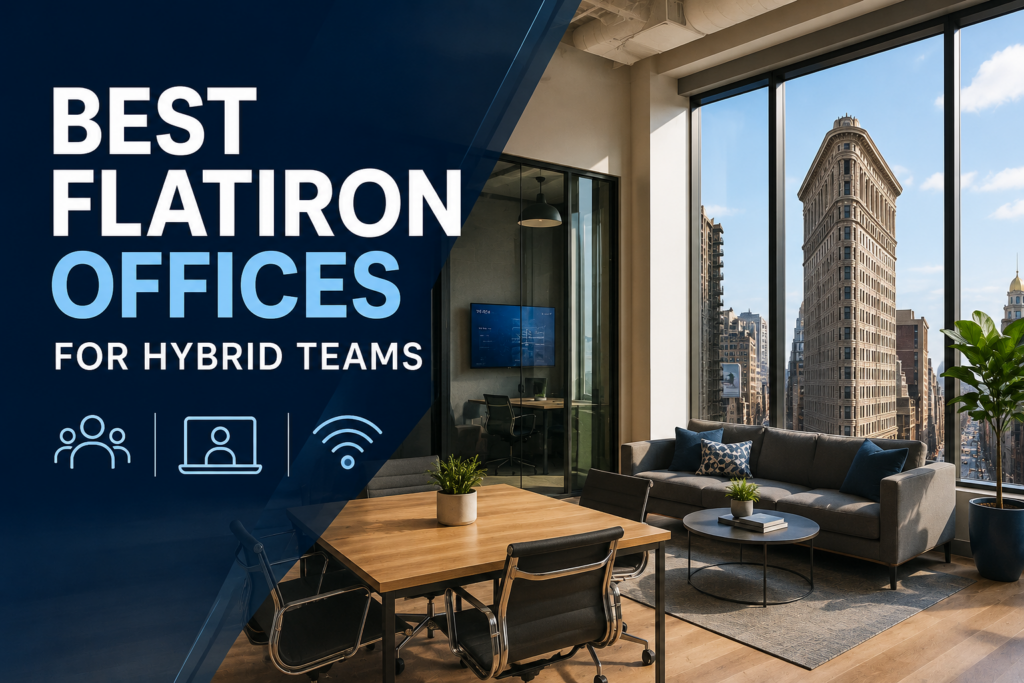
What the best hybrid office in Flatiron actually looks like
A strong hybrid office starts with the right space mix. Desks still matter, but desks alone do not make the office work. CBRE notes that hybrid planning now depends on peak and non-peak attendance, not just headcount. Gensler adds that teams benefit from neighborhood-style layouts, with focus seats, small collaboration areas, meeting rooms, and resource spaces grouped together.
That is why the best Flatiron offices usually include four things. First, they offer enough open seating for your real anchor-day turnout. Second, they provide small enclosed rooms for quick meetings. Third, they include private spots for calls and video work. Fourth, they give the team a pantry or lounge that feels social, not leftover. Steelcase found that large conference rooms often sit underused, while smaller two-to-four-person rooms see the strongest use.
Phone booths now matter far more than most tenants expect. Hybrid teams spend a large part of the day on calls, screens, and mixed-presence meetings. At the same time, privacy remains the top employee need in workplace research, while acoustic satisfaction still lags badly in many offices. Leesman reports that 71% of employees say noise levels matter, but only 33% feel satisfied with them. Quiet rooms, spacing between work settings, and dividers also score weakly when noise control fails.
Pantry logic matters too. The pantry is no longer just a sink and fridge. In a hybrid office, it often becomes the collision zone. Gensler’s workplace guidance points to the value of “in-between” spaces for impromptu meetings, team identity, and flexible use. In practice, that means the best Flatiron hybrid offices give the pantry enough width, seating, and adjacency to turn into a social buffer between focus work and group work.
Technology also separates good from great. Hybrid teams need video-ready rooms, stable connectivity, and simple booking systems. Current listing examples in Flatiron already reflect that shift, with several turnkey suites featuring pre-installed wiring, wired certifications, huddle rooms, furnished layouts, and immediate occupancy. The neighborhood’s current search results also show a heavy concentration of flexible workspace providers, which confirms that the district continues to attract teams that value speed and low setup friction.
How much space a hybrid team really needs
Most hybrid teams overbuy desks and underbuy support space. That mistake creates a quiet office on Monday, a packed office on Tuesday, and frustrated staff every time a call starts. CBRE’s hybrid planning framework shows why. Space demand now follows show-up rates, busy-day peaks, and workstyle, not one seat per employee. Steelcase also notes that most organizations now plan for shared desking, often at ratios of 2:1 or higher.
A practical starting point helps. If your team comes in two set days each week, start around 0.5 to 0.7 desks per employee. If people come in three days, or you expect uneven attendance, start around 0.7 to 0.85 desks per employee. If your team spends large blocks of time on confidential work, recruiting, finance, or heads-down production, move closer to 0.85 to 1.0 desks per employee. Then size rooms and quiet spaces around your busiest overlap day, not your average day.
Meeting room planning should stay smaller and more frequent. Most hybrid teams need more two-to-four-person rooms than oversized boardrooms. Small rooms handle standups, hiring calls, one-on-ones, demo prep, coaching, and mixed-presence check-ins. Larger rooms still matter, but you need fewer of them than older pre-2020 layouts assumed. Steelcase’s latest research makes that pattern clear.
Phone booth planning should stay intentional. As a rule, a small hybrid suite should rarely settle for zero booths. Once your team reaches roughly 15 to 20 regular in-office users, dedicated call rooms or booths become hard to avoid. Noise research backs that up, and so do current Flatiron listings, where several better-positioned turnkey suites already include booths, huddle rooms, or both.
Pantry sizing should match culture goals. If the office exists mainly for group days, your pantry should support gathering. If the office exists mainly for quiet production, keep the pantry efficient and contained. The right answer depends on why your team comes in. Gensler’s recent workplace research keeps landing on the same point: workers want experience, variety, and meaningful interaction, not a sea of identical desks.
When we build a shortlist, we usually test three attendance questions first:
Who comes in together?
Not every employee creates the same peak pressure.
When do they overlap?
Tuesday and midweek patterns matter more than Friday averages.
How do they work on site?
Sales, product, leadership, recruiting, and client teams use the same square footage very differently.
Those answers shape the real target. After that, the listing search gets much cleaner.
Best Flatiron offices by hybrid team pattern
Best for lean teams that need credibility without wasted space
If you run a small hybrid team, you do not need excess square footage. You need a polished space that feels central, moves fast, and protects budget. A current example on our site is this small 1,500 SF prebuilt suite, which suits about 10 people and includes a private windowed office in a classic Flatiron setting. It fits founders, boutiques, advisory teams, and small operators that meet in person a few days each week.
A second strong option for that same profile is a more flexible loft shell. This 3,067 SF Flatiron loft office offers mostly open space, 11-foot ceilings, a pantry, one private restroom, and a lease term that can run from one to five years. Teams that want to control their own desk density often prefer this format, because it leaves room to shape the layout around real attendance.
Best for teams that gather twice a week and need strong room mix
This is the sweet spot in Flatiron right now. A team with 20 to 40 employees often needs an office that can host project days, onboard new hires, and support hybrid calls, without paying for five-day utilization. The best answer usually looks like a 3,000 to 5,500 SF turnkey space with small rooms, one larger conference room, and a real pantry.
A strong current example is this 3,038 SF furnished suite with three meeting rooms and two phone booths. It also includes four offices, a conference room, a wet pantry, and immediate occupancy. That room mix makes sense for product teams, agencies, and client-facing groups that need several enclosed settings at once.
Another excellent fit is this 4,125 SF turnkey loft office. It provides 30 workstations, two glass meeting rooms, one large conference room, and a new pantry with lounge space. That layout supports hybrid team days very well, because the collaboration seats, focus rooms, and social area all sit in balance. Public listing details also peg the rent from about $60 per square foot.
You can also step up into a fuller meeting-heavy plan with this 5,594 SF full-floor sublease. The layout includes five private offices, three meeting rooms, breakout areas, a pantry, and immediate availability. For hybrid teams with frequent internal meetings, that room count does real work.
Best for image-forward teams that still need practical hybrid function
Some teams want the Flatiron look as much as the mailing address. That does not mean they should sacrifice usability. The better answer is a loft office that keeps the classic Midtown South feel, but still gives your staff proper rooms, pantry space, and a comfortable call environment.
This 5,331 SF furnished Flatiron loft checks that box. It combines breakout rooms, windowed offices, an eat-in kitchen, bar seating, and two conference settings. That balance works well for branding, recruiting, and client-hosting teams that still need their staff to get real work done on site.
Another good example is this fully furnished full-floor suite near Madison Square Park. It adds glass meeting rooms, an oversized pantry, 24/7 access, and strong internet credentials. For hybrid teams, that kind of turnkey polish can cut weeks or months off setup.
Best for larger teams that want turnkey scale now
Once team size pushes past 50 regular users, many tenants need scale and speed at the same time. That often points to furnished subleases or recent prebuilt floors. They let you avoid a long construction cycle while still landing in Flatiron.
A current example is this 11,239 SF furnished Fifth Avenue sublease. The space includes 48 workstations today, room to add more, five huddle rooms or offices, two conference rooms, two movable phone booths, a large pantry, and a term through May 2028. That setup fits growth-stage companies that need room for collaboration now, but still want expansion capacity.
For a more structured layout, consider this full-floor hybrid suite with 36 open workstations. It offers four glass-fronted rooms, a conference room, a breakout lounge, a large kitchen and dining area, phone booths, and pre-installed wiring. The sublease runs through June 2027. That package suits teams that want a ready-made mix of focus and collaboration zones.
If you need still more scale, this 17,050 RSF full-floor office on Park Avenue South gives you a furnished and wired floor, a spacious kitchen, strong finishes, and a flexible longer term. For very large hybrid groups, that kind of floor lets departments share one address without losing internal neighborhoods.
At the top end, this 18,500 SF full-floor opportunity offers 17 offices, one conference room, and 102 open seats. Bigger teams can use that scale to build true neighborhoods, event space, or training zones inside one floor.
For a broader starting point, our live Flatiron office listings page continues to show dozens of active district options across direct lease and sublet inventory.
Cost and deal structure for hybrid teams
Hybrid tenants in Flatiron usually choose from three paths. Each path solves a different problem.
Flexible office or part-time office works best when your team is still testing its schedule. Current public workspace pages in Flatiron show day-pass pricing from about $40 to $125, coworking memberships from about $399 per month, some private offices from roughly $1,882 to $1,906 per month, and part-time private offices advertised from $750 per month. That route makes sense if you want low commitment, bundled services, and very fast move-in.
Sublease space works best when you want turnkey value, more privacy, and a better layout per dollar. Manhattan sublet supply has tightened a lot over the last year, but good subleases still offer a faster path than a fresh direct lease buildout. Hybrid teams often like sublets because furniture, wiring, and conference rooms already exist on day one.
Direct lease space works best when your schedule has stabilized and your company wants more control. Midtown South’s latest asking-rent average sits around $80.27 per square foot, while current Flatiron turnkey examples on our site span smaller direct suites, furnished lofts, and larger built options. Direct leases usually win when your team expects to stay, refine the layout, and build stronger long-term identity.
A simple rule helps here. If you still debate how often people will come in, stay lighter and shorter. If your anchor days have normalized, and your department mix looks stable, lean toward a more controlled sublease or direct deal.
That decision also depends on hidden costs. Flexible space bundles internet, power, furniture, cleaning, and operations into one payment. Traditional space can still win on total value, but only after you price the real setup burden. Even current Flatiron market guides aimed at flexible users make that point clearly. All-inclusive space often looks expensive per seat, yet it can still make financial sense for small or unevenly attended teams.
Hybrid tour checklist for Flatiron offices
Bring this checklist to every tour. It will save you from falling in love with the wrong suite.
Tour on your busiest day.
If Tuesday is your anchor day, walk the building on Tuesday.
Count real enclosed settings.
One conference room does not replace two huddle rooms and two booths.
Stand in the pantry.
If the pantry feels cramped empty, it will fail when the team gathers.
Test the noise path.
Listen near open seats, glass rooms, and phone areas.
Check call privacy.
Ask where recruiters, managers, and sales staff take live calls.
Look at the window line.
Natural light helps, but glare control matters too.
Ask about internet and power.
Turnkey space should not become an IT project.
Map your commute split.
A central address only works if your staff can reach it easily.
Measure desk density against behavior.
Do not size for payroll headcount if half the team rotates.
Confirm term flexibility.
Growth and contraction rights matter more in hybrid models.
If you want to start from proven district inventory, browse our live Flatiron office search page, then compare it against your attendance plan, not just your headcount.
Frequently asked questions
What makes an office one of the best Flatiron offices for hybrid teams?
The best option matches your attendance pattern, not just your brand image. It gives you enough desks for anchor days, enough small rooms for hybrid meetings, enough privacy for calls, and enough pantry space to make office days worthwhile. Research from CBRE, Gensler, Steelcase, and Leesman all points in that direction. Variety beats a desk-only layout.
Is Flatiron better for hybrid teams than a generic Midtown tower?
For many teams, yes. Flatiron offers stronger neighborhood character, excellent transit reach, walkable amenities, and a heavy supply of loft, boutique, furnished, and flexible formats. That mix often fits hybrid schedules better than a one-size-fits-all tower floor. It gives smaller and midsize firms more choice between ready-to-go space and longer-term leased space.
How many desks should a hybrid team actually lease?
Start with your busiest overlap, not total headcount. Many hybrid teams now use shared desking, and current planning research shows organizations often run with 2:1 or higher sharing ratios. That does not mean every team should go that far. Teams with heavy client work, recruiting, or confidential calls often need more seats and more enclosed rooms.
Are coworking or part-time offices a real option in Flatiron?
Yes. Public district workspace pages currently show day offices, monthly memberships, private offices, and part-time private office models in the neighborhood. Those formats fit early-stage firms, distributed teams, and companies still testing attendance before they commit to a larger suite.
What size Flatiron office fits a team of about 20 to 30 people?
For many hybrid groups, the answer lands around 3,000 to 5,500 square feet, depending on attendance overlap and room count. Current examples on our site in that range include furnished suites with multiple meeting rooms, booths, breakout zones, and pantries. Those features usually matter more than raw square footage alone.
Should a hybrid team choose a sublease or direct lease in Flatiron?
Choose a sublease when speed, furniture, and short-to-midterm flexibility matter most. Choose a direct lease when your attendance policy feels settled and you want more control over layout, term, and long-term economics. Both formats remain active in Flatiron today. The right answer depends on your timing, growth path, and how much setup work you want to handle.
If you want the strongest result, start with your schedule, your busiest day, and your room needs. Then shortlist live options from our Flatiron office inventory and compare each space against how your team actually works. That is how hybrid tenants find the right Flatiron office, and avoid paying for the wrong one.
Looking for Hybrid Office Space?
We represent tenants only. We compare lofts, prebuilts, subleases, and flexible suites across Flatiron. Then we help you secure the right fit, the right timing, and the right leverage for your team.
If your team is evaluating Flatiron office space, we can help you compare direct leases, subleases, furnished offices, and flexible workspace options throughout the neighborhood. Our tenant-only advisors will identify the best opportunities, negotiate favorable terms, and help you secure an office that fits your hybrid work model today while preserving flexibility for tomorrow.
Fill out our 📋 online form or give us a call today 📞 212-967-2061 — let’s find the right office for your business.