Office Expansion Rights for Growing FinTech Companies
A growing FinTech company can outgrow a Manhattan office faster than a conventional lease can adapt. Funding, hiring, acquisitions, product launches, and regulatory changes can alter space requirements within months. Expansion rights create a path for growth before nearby space disappears.
However, an expansion clause alone does not solve the entire problem. The rent, security deposit, construction obligations, timing, and renewal term must also work together. Otherwise, a valuable expansion right can become too expensive or impractical to exercise.
FinTech tenants should therefore treat expansion rights as part of a broader capital and occupancy strategy. That strategy should address today’s footprint, tomorrow’s headcount, and the financial requirements for both.

Why FinTech Companies Need Office Expansion Rights
Growth rarely follows the exact forecast attached to an annual budget.
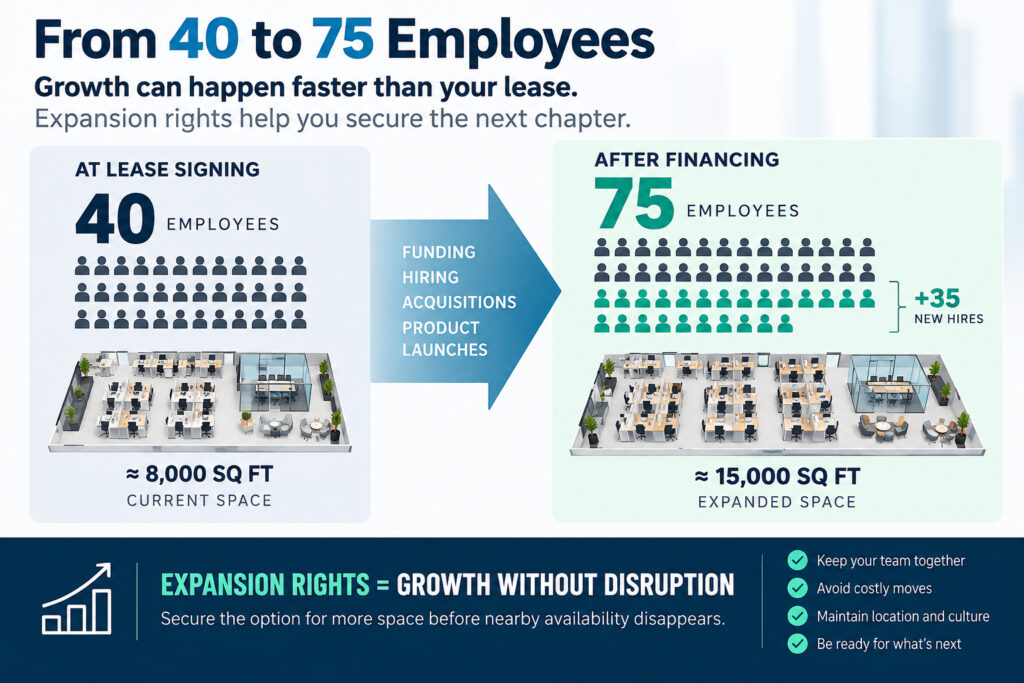
A FinTech company may sign a lease with 40 employees and hire another 35 after financing. Another firm may acquire a product team and need additional rooms almost immediately. Meanwhile, a third company may delay hiring while investing heavily in infrastructure.
The office lease must accommodate those different outcomes.
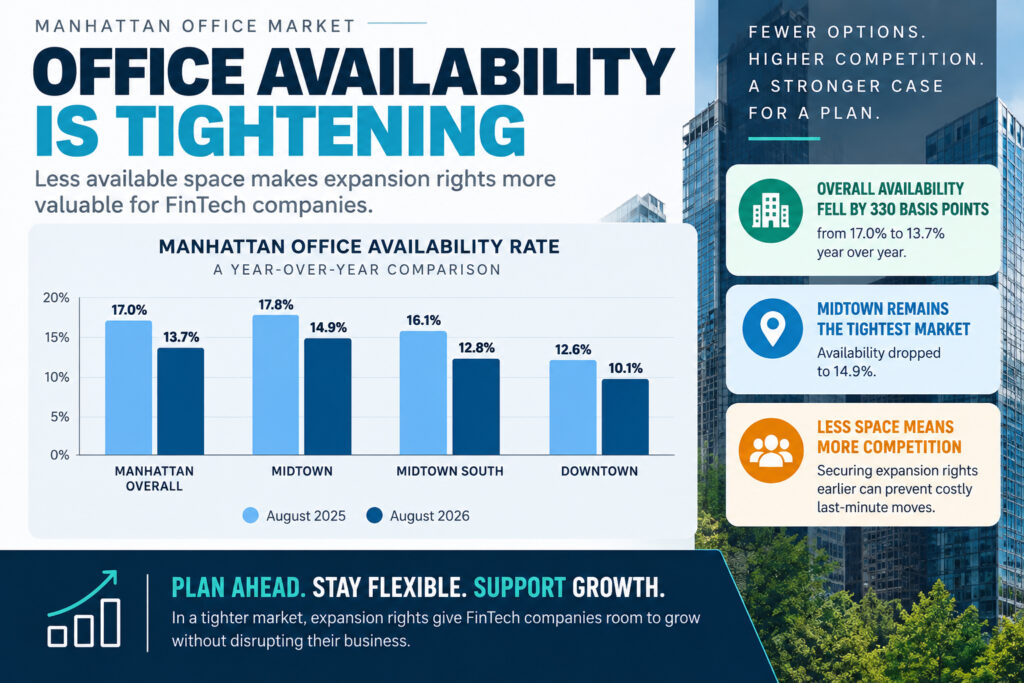
Current Manhattan conditions make advance planning more important. Manhattan office availability stood at 13.7% during August 2026. Average asking rent reached $80.05 per square foot. Availability also declined by 330 basis points from one year earlier.
Those broad numbers can create a false sense of security.
A building may have vacant space without offering useful expansion space beside your office. Another floor may become available, yet another tenant could hold priority rights. A landlord might also prefer leasing a larger combined block.
Therefore, building availability and usable expansion availability are very different things.
Expansion rights let you lease for today without ignoring tomorrow
Signing for every possible future employee can waste capital.
Suppose your current team needs 7,500 square feet. Your three-year forecast may suggest 15,000 square feet. Leasing all 15,000 square feet now doubles your rent before the additional employees arrive.
That strategy also increases furniture, electricity, insurance, and operating costs.
An expansion right creates another option. You can lease the appropriate initial footprint while reserving access to additional space.
The strongest structures identify that future space before lease execution.
For example, your lease might cover 8,000 square feet today. An expansion option could target another 5,000 square feet next door. A further right might cover another suite during years three through five.
This structure can match real estate commitments with actual business growth.
The alternative can become an expensive relocation
Outgrowing an office without expansion rights creates several problems simultaneously.
Your company must search for replacement space. Management then spends time touring, analyzing, negotiating, designing, and moving.
Meanwhile, employees face a possible location change. Technology systems require migration. Clients may need new access procedures and addresses.
Your company can also carry overlapping rent during the transition.
Expansion rights can reduce those risks.
They do not guarantee that every growth scenario stays inside one building. Still, they can give you priority before the market forces a relocation.
Growth rights matter even when your headcount remains uncertain
Hybrid work does not eliminate expansion planning.
The better question concerns peak simultaneous attendance. A 100-person company may rarely host all 100 employees together.
Yet fewer desks do not eliminate meeting rooms, private calls, security areas, collaboration rooms, or visitor space.
A balanced FinTech workplace often starts near 150 to 200 rentable square feet per peak employee. Dense product teams can operate closer to 125 to 150 square feet. Privacy-heavy financial teams may need 200 to 250 square feet or more.
Therefore, headcount should never serve as the only expansion trigger.
Peak attendance, meeting demand, customer traffic, and team structure matter just as much.
Expansion rights can also protect capital
Real estate decisions compete with product development, hiring, compliance, marketing, and infrastructure.
Taking surplus space early ties capital to unused capacity. Waiting too long creates another financial problem.
Scarce neighboring space can force your company into a larger relocation.
A carefully structured expansion right helps balance those risks.
The objective is not maximum flexibility at any cost. The objective is useful flexibility at a defined cost.
That distinction matters throughout the lease.
How Office Expansion Rights Work in a Manhattan Lease
“Expansion rights” describe several different contractual mechanisms.
They do not provide identical protection.
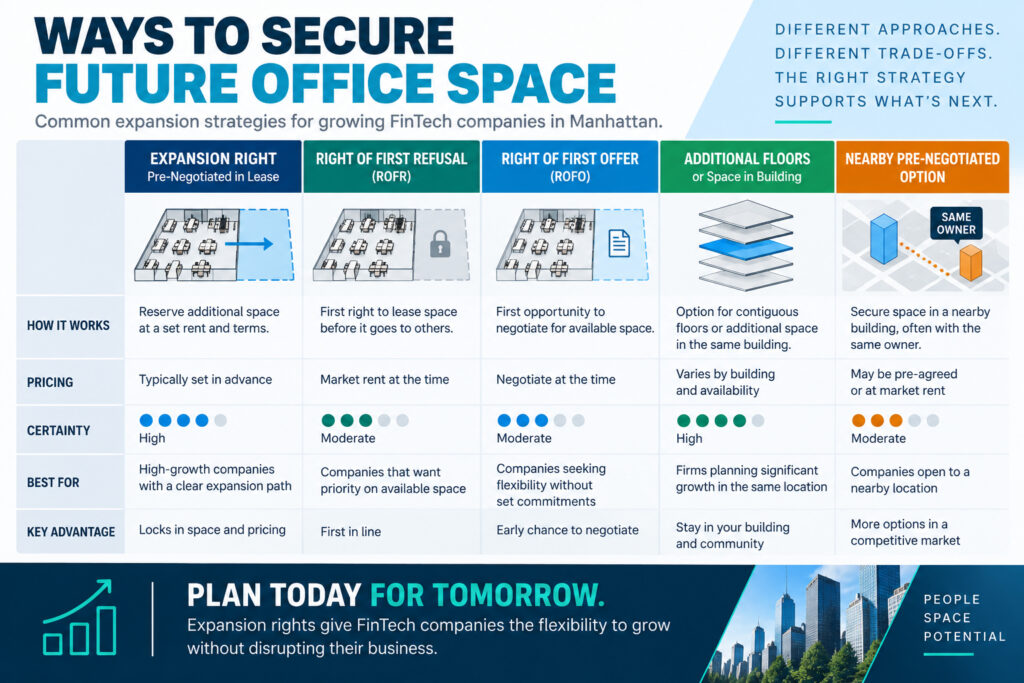
A right of first offer differs from a right of first refusal. Both differ significantly from a fixed expansion option.
Understanding those differences helps you negotiate the correct structure.
Right of First Offer
A Right of First Offer, commonly called a ROFO, gives your company an early opportunity for specified space.
The landlord generally approaches you before broadly offering that space elsewhere.
Your lease should identify exactly which premises the ROFO covers.
“Additional space in the building” sounds broad. However, vague language creates uncertainty.
A stronger description can identify:
the adjacent suite, the balance of your floor, the floor above, the floor below, or another defined area.
The landlord then notifies you when qualifying space becomes available.
Your company receives a limited period to respond. The parties may negotiate rent and other terms under a defined formula.
A ROFO provides early access. However, it does not automatically guarantee favorable economics.
Your lease must explain the pricing mechanism.
Right of First Refusal
A Right of First Refusal, or ROFR, works differently.
The landlord can market the covered space to another prospective tenant. Once acceptable terms emerge, your company receives an opportunity to match them.
That mechanism can provide useful market pricing.
However, timing can become difficult.
A FinTech management team may have only a short period for approval. Meanwhile, the decision can involve hundreds of thousands of dollars.
Your internal approval process should therefore match the lease response period.
Finance, operations, leadership, and legal teams should know the deadline before any notice arrives.
A ROFR can become nearly worthless when internal approvals take longer than the response window. Current leasing guidance also emphasizes the importance of defined notice procedures and decision periods.
Fixed expansion option
A fixed expansion option can provide stronger certainty.
The lease identifies a particular space, future commencement date, and pricing mechanism.
For example, your company might lease 10,000 square feet today.
The agreement could give you an option for another 5,000 square feet during year three. Rent might follow the original lease rate plus predetermined escalations.
Another structure could use a defined percentage of future market rent.
The essential issue concerns certainty.
You should know what you can take, when you can take it, and how the rent gets calculated.
A fixed option becomes particularly valuable when your hiring forecast has a recognizable timeline.
Must-take space is an obligation, not merely a right
Some expansion structures contain a “must-take” requirement.
That language deserves close attention.
A must-take clause can require your company to accept additional space on a specified date.
That may work for a well-funded business with predictable hiring.
However, the same obligation can create excess space after slower growth.
Therefore, distinguish optional growth rights from mandatory future occupancy.
An option gives you a decision. A must-take provision can remove that choice.
Phased occupancy can bridge two growth stages
Phased occupancy provides another useful structure.
Your company leases the entire future footprint. However, rent begins on different portions at different times.
For example, 12,000 square feet may start immediately. Another 6,000 square feet might commence twelve months later.
That approach can provide certainty without charging full rent from day one.
Still, the security deposit needs similar phasing.
A landlord should not automatically receive security for future space months before that obligation begins.
The letter of intent should address that issue.
Swing space can solve temporary growth
Not every expansion requires a permanent addition.
A FinTech tenant may need project space during hiring, integration, or construction.
Temporary swing space can bridge that period.
The building might provide another suite for six months. Your landlord could also offer interim space while constructing the permanent expansion.
This approach can prevent premature relocation.
However, temporary rights should address internet service, furniture, security, HVAC, and access.
A room full of desks does not automatically function as usable FinTech space.
Direct expansion, ROFO, and ROFR are not interchangeable
| Expansion structure | What it gives the tenant | Primary issue to negotiate |
|---|---|---|
| Fixed expansion option | Right to defined future space | Price, timing, and delivery |
| ROFO | First opportunity before wider marketing | Pricing and response period |
| ROFR | Ability to match qualifying outside terms | Matching rules and deadline |
| Must-take | Future space under mandatory terms | Downside if growth slows |
| Phased commencement | Staggered occupancy or rent | Security and delivery timing |
| Temporary swing space | Short-term additional capacity | Technology and operational readiness |
The right choice depends on your growth visibility.
High-confidence hiring may support a fixed option. Uncertain growth may favor broader ROFO coverage.
A company facing acquisition opportunities might prioritize several rights simultaneously.
Security Deposits, Letters of Credit, and FinTech Financial Qualification
Expansion rights answer one question: Can your company obtain more space?
Financial qualification answers another question: Will the landlord approve the additional exposure?
These issues should never remain separate.
A growing FinTech company can negotiate excellent expansion rights yet face a major capital demand later.
The security provision should explain what happens after an expansion.
How much security deposit will a Manhattan landlord require from a FinTech startup?
There is no universal Manhattan commercial office deposit.
Current tenant-side leasing benchmarks generally place established, stronger-credit companies around three to six months. Startups or companies with limited operating histories may face six to twelve months.
Those ranges are negotiation benchmarks, not statutory requirements.
New York does not impose a residential-style one-month cap on commercial office security.
Cash security for real-property leases receives statutory trust protection. New York law requires deposited security money to remain the depositor’s property until properly applied.
The negotiated amount can therefore vary substantially.
Landlords usually focus on their actual exposure.
Why a startup may receive a larger security request
A landlord evaluates more than monthly rent.
A young company may lack several years of profitable operating history. Funding can provide substantial cash while still leaving uncertainty about future revenue.
The owner may also contribute significant construction money.
Free rent creates another period without current rental income.
Brokerage costs, legal expenses, and building work increase the landlord’s upfront investment.
Consequently, the landlord may seek greater security.
A FinTech tenant requesting minimal construction may present a different risk profile.
That difference creates negotiating leverage.
Calculate the deposit before negotiating the headline rent
Security deposits can become surprisingly large.
Consider a 5,000-square-foot office using Manhattan’s August 2026 average asking rent of $80.05 per square foot. That figure creates about $400,250 in annual base rent.
Monthly base rent would equal approximately $33,354.
Six months would equal about $200,125.
Nine months would equal approximately $300,188.
Those figures exclude electricity, additional rent, insurance, and other charges.
A 10,000-square-foot office at the same asking rate produces roughly $400,250 of six-month base-rent security.
Therefore, negotiating one fewer month can preserve meaningful capital.
Base rent or total monthly obligation matters
Never accept “six months of security” without defining the calculation.
Six months of base rent differs from six months of all recurring rent.
Operating escalations can also change future amounts.
The letter of intent should identify the security basis.
A strong formulation explains the initial amount, future adjustments, and any expansion top-up.
Otherwise, the landlord may interpret the requirement more broadly later.
Expansion rights should include a security formula
This issue receives too little attention.
Suppose your original lease requires six months of security.
Three years later, you exercise an expansion option that doubles your footprint.
Will the landlord double the deposit?
Perhaps.
Your lease should answer that question before the expansion occurs.
A useful structure can state that additional security follows a fixed number of months.
Another approach can cap the total amount.
Strong tenants may negotiate no increase after meeting financial thresholds.
Never leave the expansion security adjustment entirely open.
Your leverage will usually decline after you need the space.
Cash security deposit
Cash provides a straightforward structure.
Your company transfers money at lease execution. The landlord then holds that money subject to the lease and applicable law.
The major disadvantage concerns liquidity.
A $300,000 deposit cannot simultaneously fund hiring or technology.
That cost becomes greater during a long lease.
However, cash avoids letter-of-credit banking fees.
It can also simplify a smaller transaction.
Letter of credit office lease security
A standby letter of credit, often called an LOC, can replace some or all cash security.
A bank issues the instrument for the landlord’s benefit.
The tenant usually pays ongoing banking costs. The bank may also require collateral or credit support.
An LOC can therefore preserve operational cash without creating free capital.
Its real value depends on the tenant’s banking relationship.
Commercial letter-of-credit documents also require careful drafting around renewal, draw conditions, replacement, and bank eligibility.
Negotiate LOC requirements before lease drafting
FinTech companies should address several LOC issues in the business terms.
The landlord may require a particular type of financial institution.
Automatic renewal language often matters.
Transfer rights become relevant after a building sale.
Replacement deadlines can also create risk.
The lease should address what happens when your bank changes.
Your counsel should review the final instrument and lease together.
Security deposit burn-downs reward performance
A burn-down reduces required security after your company meets defined conditions.
For example, six months might decline to four months after two years.
Another reduction could occur after year four.
The clause should state objective conditions.
Timely rent payment provides one measurable standard.
A minimum liquidity threshold could provide another.
Your company should resist vague language giving the landlord complete discretion.
Current Manhattan tenant-side practice includes step-down structures where financial performance supports them.
Funding events can support a reduction
A startup may sign its lease shortly before a major financing.
The initial security requirement might therefore reflect weaker financials.
Consider negotiating a future reduction after qualifying financing closes.
The lease could connect that reduction to defined proceeds, liquidity, or another objective measure.
That approach can work better than promising to revisit security later.
A future conversation provides no contractual protection.
Guarantees can substitute for part of the security
Some landlords request a corporate, parent, or personal guarantee.
The request often arises when the tenant entity lacks substantial assets.
A limited guarantee can sometimes reduce the cash deposit.
However, a tenant must understand exactly what that trade accomplishes.
Reducing a $250,000 deposit can look attractive.
Unlimited guarantee exposure could create a much larger problem.
The guarantee should therefore receive the same scrutiny as rent.
A good-guy-style guarantee needs precise conditions
New York office transactions sometimes use limited surrender-based guarantees.
The guarantor remains liable while the tenant occupies the premises under defined conditions.
Liability can end after compliant surrender.
However, the exact language controls the result.
Notice periods, payment requirements, restoration obligations, and surrender conditions can all matter.
A loosely drafted guarantee can create more exposure than expected.
Your lease attorney should review it before execution.
Avoid stacking every landlord protection
A landlord may request substantial cash security, an LOC, and a broad guarantee.
Those protections should not automatically accumulate.
Ask what risk each instrument addresses.
Then negotiate the package as one economic issue.
A company posting significant security may deserve narrower guarantee exposure.
Similarly, a strong corporate guarantee can support a smaller deposit.
The right question is not simply “How much is the deposit?”
Ask instead: “What is our total credit support exposure?”
Planning the Right Manhattan Footprint Before Growth Arrives
Expansion rights work best when the original footprint reflects realistic utilization.
An oversized first lease weakens their value.
An undersized office can create immediate pressure.
Start with peak attendance rather than total payroll.
Then add the rooms and infrastructure your operating model requires.
Use headcount ranges, not one exact forecast
For balanced planning, current Manhattan FinTech sizing can begin near these ranges.
| Peak in-office employees | Balanced initial planning range |
|---|---|
| 20 | 3,000–4,000 RSF |
| 50 | 7,500–10,000 RSF |
| 100 | 15,000–20,000 RSF |
| 200 | 30,000–40,000 RSF |
Those ranges provide a starting point.
A trading-oriented operation could require different infrastructure.
Privacy-heavy teams need more enclosed rooms.
Engineering-heavy organizations may prefer greater workstation density.
Client-facing firms often need larger conference and reception areas.
Model three growth cases before signing
A single headcount projection creates false precision.
Instead, model at least three scenarios.
Slow-growth case: hiring reaches only part of the budgeted plan.
Expected case: staffing develops close to management forecasts.
High-growth case: financing, revenue, or acquisition accelerates hiring.
Now test the lease against each outcome.
The slow-growth case tests your downside.
The expected case tests ordinary occupancy.
High growth tests whether your expansion rights actually solve the problem.
Determine your first physical breaking point
Every office has a practical capacity.
That number does not always match the architect’s maximum desk count.
Meeting rooms may fail first.
Phone rooms can become scarce.
The pantry may become overcrowded.
Reception can lose useful visitor capacity.
A secure team might exhaust enclosed rooms before desks.
Define that practical breaking point.
Then set your expansion timeline backward from it.
A 3,000-square-foot starting point can preserve flexibility
Early-stage teams may intentionally start smaller.
A current 3,138-square-foot furnished Downtown sublease illustrates a compact furnished footprint with a future term extending into 2030.
That type of solution can reduce initial construction exposure.
However, a sublease usually provides weaker control over building-level expansion rights.
The prime tenant still controls the underlying lease relationship.
Therefore, compare short-term flexibility against long-term control.
A direct lease can provide better long-range structuring
Direct leases create a landlord-tenant relationship.
That relationship can support negotiated expansion rights, renewal options, signage, infrastructure, and construction obligations.
A recently listed 6,514-square-foot full-floor Midtown South office provides one example of a direct lease footprint.
A full floor can simplify future planning.
Expansion onto another entire floor may create cleaner physical separation.
However, vertical expansion raises other questions.
Your teams may need an internal staircase, shared reception, or duplicate amenities.
Existing expansion capacity has special value
The best expansion solution sometimes appears inside the available space itself.
A current Pine Street furnished office offers 5,606 square feet with an identified expansion path up to 15,752 square feet.
That structure illustrates why tenants should investigate more than the initial marketed footprint.
Ask what adjoining premises exist.
Then determine when those areas become available.
Find out whether another tenant has priority.
Finally, understand whether expansion can connect physically.
The answers can change the value of the initial space.
Midtown, Midtown South, and Downtown present different economics
Manhattan does not have one FinTech rent.
During August 2026, Midtown’s average asking rent reached $85.55 per square foot. Availability stood at 12.1%.
Midtown South averaged $86.26 per square foot with 16.4% availability.
Downtown averaged $62.01 per square foot with 16.1% availability.
Those differences matter for growth planning.
However, submarket averages do not determine a specific lease.
Building quality, floor height, condition, term, view, infrastructure, and concessions can change the economics dramatically.
Downtown can stretch an expansion budget
Lower average asking rents can make Downtown attractive for cost-sensitive growth.
For example, a current 6,517-square-foot furnished Downtown office carries an advertised asking rent of $39 per square foot.
That price differs materially from broad Manhattan direct asking averages.
The comparison also demonstrates why sublease economics require separate analysis.
Lower face rent can preserve cash.
Yet a shorter remaining term can limit future expansion.
Balance the immediate savings against the next move.
Full floors can simplify larger expansion programs
A growing company approaching 60 or 70 peak employees may prefer a full-floor identity.
A current 10,115-square-foot Financial District full-floor office offers a useful size benchmark for that stage.
Another 11,500-square-foot Plaza District full-floor opportunity provides a Midtown comparison. Its current advertised asking rent is $64 per square foot.
Those examples should not replace a market survey.
Instead, they show how location and lease structure can produce different growth paths.
Larger teams should investigate divisible space
A company expecting rapid scaling may eventually need 20,000 to 40,000 square feet.
That does not mean the initial lease must start there.
A 30,000-square-foot furnished Spring Street full-floor office illustrates the type of larger Midtown South footprint available to maturing companies.
Large floors can sometimes support internal phased occupancy.
They can also allow departmental separation without multiple addresses.
Still, taking unused space too early creates carrying costs.
Model those costs against future expansion uncertainty.
Negotiating Expansion Terms That Actually Work
An expansion clause gains value from detail.
The heading matters far less than the mechanics below it.
Every important variable should receive a clear answer.
Ambiguity usually favors the party controlling the building.
Define the expansion premises
Start with a map.
Identify the exact suites, floors, or areas covered by your right.
Attach a plan when possible.
Do not rely only on “adjacent space.”
Adjacent can mean several things.
Does it include the other side of the elevator core?
Does it include the floor above?
What happens if the landlord combines your target suite with another vacancy?
These questions should surface before lease signing.
Investigate existing superior rights
Your expansion right may sit behind another tenant.
An existing tenant might already hold a renewal option.
Another company could have an earlier ROFO.
The current occupant may possess an extension right.
A large building tenant might hold a broader expansion option.
Ask the landlord for disclosure of superior rights affecting your target premises.
Then address those rights in the lease.
A priority right that rarely reaches first priority provides limited protection.
Negotiate when your right begins
Some rights start immediately.
Others begin after a specific lease year.
That distinction matters.
A FinTech company expecting rapid hiring may need protection during year one.
Delaying the ROFO until year three could miss the relevant growth period.
Your business forecast should determine the timing.
The landlord’s standard form should not.
Negotiate when your right ends
Expansion rights may expire before the lease expires.
Landlords often resist long-running encumbrances.
A right might also disappear after one rejection.
Another structure can remain active for every future availability.
Understand that distinction.
A “one-time” ROFO can vanish after an unsuitable offer arrives.
A continuing right can remain useful throughout the term.
Protect against artificially large offers
Consider this problem.
Your company wants another 5,000 square feet.
The covered suite contains exactly 5,000 square feet.
The landlord then combines it with 20,000 additional square feet.
Can you exercise your right only on your target area?
The lease should answer.
Otherwise, package size can make the right economically impossible.
This issue matters especially in buildings with large floor plates.
Give your company enough response time
A five-business-day deadline may not support proper analysis.
Finance may need a forecast.
Your broker needs market comparisons.
Leadership needs approval.
Counsel may need documentation.
Construction teams may require a feasibility review.
Negotiate a response period that reflects your decision process.
Then create internal reminders long before any notice arrives.
Define the landlord’s notice obligation
Notice mechanics sound administrative.
They can decide whether your right survives.
Specify how the landlord delivers notice.
Email alone may not satisfy formal lease requirements.
The agreement might require delivery to several parties.
Your broker should receive informal warning where possible.
Counsel may also need formal notice.
Keep contact information current throughout the term.
Make the rent formula understandable
Expansion rent can follow several structures.
One approach continues your existing rent schedule.
Another uses a fixed amount.
A third applies fair market rent.
Some formulas apply a percentage of market rent.
Each method creates different risk.
A growing company often values predictability.
A landlord usually values future upside.
The negotiation should find an acceptable balance.
Define “fair market rent” carefully
“Fair market rent” can sound objective.
The definition may still favor one party.
Does it consider comparable direct leases?
Will concessions reduce the analysis?
Do improvement allowances count?
What lease term applies?
Does the calculation consider the existing built condition?
Should expansion space receive the same building concessions?
Resolve those questions in advance.
Otherwise, the future rent dispute may defeat the right.
Address free rent and tenant improvements
Expansion space may require construction.
Your company should know who funds it.
The original landlord contribution may not automatically apply.
Likewise, free rent on the initial premises may not repeat.
The lease can provide a separate allowance formula.
Another structure can use a turnkey delivery.
A prebuilt expansion may need only furniture and technology.
Match improvement economics to the expected condition.
Specify delivery condition
“Available space” does not mean “occupiable space.”
The expansion area may contain another tenant’s installation.
It could also require demolition.
HVAC may need upgrading.
Electrical service might require changes.
Your lease should define delivery condition.
Consider walls, ceilings, flooring, lighting, bathrooms, sprinklers, HVAC, and electrical capacity.
Technology infrastructure deserves separate attention.
Test FinTech technology requirements before expansion
A growing FinTech office may require unusually reliable connectivity.
The building should support appropriate carrier access.
Your company may need redundant internet paths.
Some teams require substantial power.
Trading or operations groups can need specialized workstation density.
Security teams may require controlled rooms.
After-hours activity creates HVAC considerations.
These requirements should influence both the initial lease and expansion areas.
Do not assume identical HVAC rights
Your original premises may have tenant-controlled air conditioning.
The expansion floor might not.
Likewise, after-hours HVAC charges can differ.
Review the building systems serving every possible expansion area.
A physically adjacent suite can operate from another mechanical zone.
That difference can affect comfort and operating cost.
Consider an internal staircase before vertical growth
Taking the floor above sounds simple.
Operationally, it can create two offices.
An internal staircase may improve circulation.
However, structural work can require approvals, engineering, and substantial construction.
The lease should address whether the landlord permits that connection.
Responsibility for restoration also matters.
Evaluate this issue before relying on vertical expansion.
Align the expansion term with the original lease
Suppose you expand during year four of a seven-year lease.
Does the new area expire after three years?
Alternatively, must you extend the entire lease?
Landlords often want co-terminous terms.
That request can convert an expansion into a significant renewal decision.
You should know that outcome beforehand.
An expansion clause must therefore coordinate with renewal rights.
Coordinate renewal and expansion rights
Expansion without enough remaining term may not make financial sense.
A costly buildout needs time for amortization.
Therefore, a renewal option can support the expansion.
However, avoid automatic extensions that create unintended commitments.
A better clause may give your company a choice.
Exercise the expansion and optionally extend the original premises.
Another structure can make extension mandatory only after a late-term expansion.
Model the economics for each case.
Security should not unexpectedly reset
Returning to the financial qualification issue, define the security treatment.
An expansion could require a proportional increase.
That can still become manageable when the formula is known.
The dangerous outcome is an entirely new landlord underwriting process.
Your company could hold the expansion right but fail a discretionary credit review.
Negotiate objective financial standards whenever possible.
Financial reporting requirements should remain reasonable
Some landlords request periodic financial statements.
Startups should understand those obligations.
Private companies may resist broad disclosure rights.
The lease can limit financial delivery to specific events.
An expansion exercise could trigger an updated package.
A renewal might trigger another.
Confidentiality protections should also apply.
The landlord needs credit information.
That need does not justify unrestricted disclosure.
Change-of-control language matters for FinTech companies
Growth frequently includes mergers and acquisitions.
A lease assignment provision can affect those transactions.
Some leases treat a change of control as an assignment.
That language can create unnecessary friction.
Negotiate reasonable exceptions for mergers, reorganizations, and affiliate transfers.
Financial thresholds can protect the landlord without blocking legitimate corporate changes.
Expansion rights should survive qualifying transfers where possible.
Otherwise, an acquisition can unintentionally destroy the growth protection.
Sublease and assignment rights provide a second safety valve
Expansion rights protect the upside.
Sublease and assignment rights help protect the downside.
Together, they create better balance.
If hiring accelerates, expansion rights can provide more room.
When hiring slows, sublease rights can reduce excess-space exposure.
During a corporate transaction, assignment rights can support restructuring.
Flexible leases therefore need multiple tools rather than one clause.
What Happens When Growth Does Not Follow the Plan
No lease structure predicts the future perfectly.
FinTech growth can accelerate, pause, or change direction.
That reality makes downside planning equally important.
A strong expansion strategy should never assume constant hiring.
Reconfigure before taking more square footage
Sometimes the current office can support another growth stage.
Unused private offices may become meeting rooms.
Oversized conference rooms can change function.
A low-density layout may accept additional workstations.
Storage areas can move offsite.
Hybrid schedules may also change peak occupancy.
Measure actual usage before exercising an expansion option.
However, do not wait until employees feel overcrowded.
Design analysis takes time.
Decide when density becomes counterproductive
Adding desks appears cheaper than leasing more space.
That approach has limits.
More people create greater meeting demand.
Noise can increase.
Privacy becomes harder.
Phone-room queues develop.
Common areas face greater pressure.
Employee experience can decline before the floor reaches its technical maximum.
Therefore, establish an operational density threshold.
The expansion decision should start before that threshold arrives.
Give-back rights can protect against slower growth
A contraction or give-back right allows a tenant to surrender part of its premises.
Landlords grant these rights less easily than expansion rights.
Still, they can provide valuable protection.
The clause might allow one defined give-back date.
Another structure can cover a specific portion of the floor.
Termination fees may apply.
The cost must be modeled against long-term excess rent.
A defined surrender payment can still beat years of unused occupancy.
Early termination rights can solve larger changes
A break option provides broader protection.
The tenant receives a contractual exit under defined conditions.
The landlord may require substantial advance notice.
A termination payment can reimburse unamortized concessions.
Those economics can still make sense.
The critical issue remains predictability.
A known termination cost gives management another scenario to model.
No exit right leaves the remaining lease liability uncertain.
Furnished subleases can serve as interim growth space
Temporary space can bridge the period before a permanent expansion.
For example, a current 10,439-square-foot Park Avenue South furnished sublease runs through July 2027.
That type of inventory can solve a short-term requirement.
A company could place a project team there while negotiating larger permanent premises.
However, splitting teams carries operational costs.
The strategy works best when the division has a logical business reason.
Long-term sublease options can provide another bridge
Some furnished subleases now offer surprisingly long remaining terms.
A current 11,091-square-foot Fifth Avenue turnkey office has a stated term extending through August 2034.
A longer sublease can reduce immediate construction requirements.
However, the subtenant remains subject to the underlying lease structure.
Expansion rights must therefore receive careful review.
The prime landlord may owe no direct expansion obligation to the subtenant.
Never confuse cheap space with flexible space
Low rent solves only one part of the occupancy problem.
A discounted office can still create future constraints.
Consider the remaining term.
Review renewal possibilities.
Study adjoining availability.
Understand the security requirement.
Check technology infrastructure.
Then examine sublease and assignment rights.
A more expensive lease can sometimes deliver lower long-term risk.
Expansion can occur through relocation instead
Sometimes moving provides the better answer.
Your current building may have no suitable contiguous space.
The landlord could demand an unreasonable expansion rent.
Infrastructure may no longer support operations.
Another building might offer a larger prebuilt office with better economics.
Therefore, never exercise an expansion right automatically.
Test the external market first.
The expansion right provides leverage partly because you can compare it against alternatives.
Preserve time for that comparison
Timing creates negotiating power.
Begin analyzing expansion before the office reaches capacity.
A rushed company has fewer choices.
The landlord can see the urgency.
Alternative buildings require time for touring and diligence.
Construction needs even more time.
Earlier planning therefore strengthens both your expansion negotiation and relocation alternative.
Current market tightening increases the importance of lead time
Manhattan’s August availability declined to 13.7%. Midtown reached 12.1%.
Midtown South remained higher at 16.4%, while Downtown stood at 16.1%.
Yet those figures include many spaces that will not fit your requirement.
Some offices are too large.
Others are too small.
Several need construction.
Certain floors have short sublease terms.
Accordingly, suitable inventory represents a smaller subset of total availability.
Track expansion rights like financial deadlines
Do not sign the lease and forget the dates.
Create a calendar immediately.
Include renewal deadlines.
Add expansion notice windows.
Track termination rights.
Monitor security burn-down dates.
Record LOC renewal requirements.
Assignment notice provisions also deserve attention.
The person who negotiated the lease may leave before these deadlines arrive.
Institutionalize the information.
Your expansion rights should survive employee turnover inside your company.
FinTech Office Expansion Questions Tenants Should Resolve Before Signing
Is a ROFR better than a ROFO?
Neither right wins in every situation.
A ROFO gives you an earlier opportunity.
A ROFR lets you react after another party establishes acceptable terms.
The ROFO can provide more control over timing.
Meanwhile, a ROFR can provide clearer evidence of market economics.
Your company may negotiate both.
The best structure depends on the building and growth forecast.
What specific triggers should activate an expansion option?
Fixed options usually work best with objective timing.
For example, the lease can permit exercise during a defined period.
A right should not depend solely on the landlord deciding you have “grown enough.”
Headcount-based triggers can also create problems.
Your headcount may change before real estate demand changes.
Date-based or availability-based triggers often provide greater certainty.
What common problems weaken a right of first refusal?
Several issues repeatedly matter.
The covered premises may remain vague.
Another tenant might have superior rights.
Response periods can become too short.
The landlord may bundle your target space with a larger block.
Renewals of existing occupants might remain excluded.
A transfer could terminate the right.
Default language can also block exercise.
Review each issue before signing.
How do expansion rental rates get calculated?
The lease controls the calculation.
Possible structures include fixed rent, existing rent escalations, or fair market rent.
Another method can apply a specified percentage of market value.
Market-rent clauses should define assumptions and concessions.
Your company should also understand the dispute process.
An appraisal mechanism can resolve disagreement.
Without one, a pricing conflict can delay occupancy.
Should the expansion receive the same concessions?
Not automatically.
The original lease may contain free rent and a large improvement allowance.
Expansion space could receive different economics.
That difference becomes especially important after several years.
Landlord construction costs may change.
Market incentives can also move.
Therefore, address expansion concessions directly.
A formula can provide more certainty than silence.
Can a startup get expansion rights?
Yes, size alone does not prevent a tenant from seeking them.
The landlord’s willingness depends on the building and deal structure.
A 5,000-square-foot tenant may secure meaningful rights in one property.
The same company may receive limited rights elsewhere.
Current Manhattan tenant-side practice shows smaller firms can obtain ROFOs or ROFRs in appropriate buildings.
Leverage remains transaction-specific.
Can an expansion right guarantee contiguous space?
Only a strong fixed option can approach that level of certainty.
ROFOs and ROFRs depend on qualifying availability.
Existing tenant rights can intervene.
Renewals can delay delivery.
Physical conditions can also change.
Therefore, ask whether the landlord can reserve a specific suite.
That reservation may carry a price.
However, guaranteed access can justify that cost for high-growth firms.
What happens if another tenant does not leave?
Your lease should address delayed delivery.
The landlord may owe no damages under a weak clause.
A better structure can provide alternatives.
You might receive temporary space.
The commencement date could move.
Rent might remain delayed.
Eventually, a termination right could apply.
Avoid committing employees to a future space without a delivery remedy.
Does taking more space increase the security deposit?
Often, yes.
The landlord’s rent exposure increases after expansion.
However, the adjustment should follow a negotiated formula.
Do not accept a completely new discretionary requirement.
For example, the lease might maintain six months of current base rent.
A stronger-credit tenant could cap security after demonstrating performance.
Another structure could reduce the number of months after a successful financing.
Is a letter of credit better than cash?
The answer depends on your finances.
Cash has no annual LOC fee.
However, cash remains tied up with the landlord.
An LOC can preserve liquidity.
Yet the issuing bank may require collateral.
Analyze both options across the entire lease term.
Do not evaluate only the first-year cash flow.
How much security should a FinTech startup expect?
Many Manhattan startup negotiations begin above established-company levels.
A working benchmark can range around six to twelve months for limited-credit tenants. Stronger companies often negotiate closer to three through six months.
The landlord’s construction contribution matters.
Your financial statements also matter.
Lease length can affect the request.
A guarantee can change the package.
Negotiation therefore matters more than the headline range.
Can the deposit decrease later?
Yes, when the lease contains a burn-down.
The conditions should remain objective.
For example, reductions might follow two years of timely payments.
Another reduction can follow a qualifying financing event.
Financial thresholds may also support the change.
Put the schedule into the lease.
Do not depend on a later request.
Should the expansion right cover the entire building?
Usually, narrower rights receive greater landlord acceptance.
Still, a FinTech tenant can request several priority zones.
Start with contiguous space.
Then add the balance of the floor.
Next, consider the floor above and below.
A secondary right elsewhere in the building can provide another fallback.
Rank the spaces by operational value.
What if the company grows faster than the expansion right allows?
Maintain an external alternative.
A second suite may provide interim capacity.
A sublease can create temporary space.
Relocation can also provide a larger consolidated footprint.
Do not let one lease clause become your only growth strategy.
The right should improve your choices rather than replace planning.
What if the company grows more slowly?
Use your downside protections.
You can decline optional expansion space.
A give-back right may reduce your existing footprint.
Sublease rights can offset unused capacity.
Assignment rights can support a larger business change.
A termination option offers broader protection where negotiated.
That combination creates a more resilient lease.
How early should a FinTech company plan an office expansion?
Start before space pressure becomes urgent.
Large moves require enough time for strategy, touring, negotiation, design, and construction.
Smaller built offices can move faster.
However, lease negotiations still take time.
Begin monitoring headcount and utilization continuously.
Once projected capacity enters the next planning horizon, test your expansion rights and external alternatives.
Should a FinTech company choose Midtown, Midtown South, or Downtown?
Choose the area that supports business operations rather than a label.
Midtown can provide access to major corporate and financial relationships.
Midtown South attracts many technology-oriented teams.
Downtown can offer materially lower broad asking-rent averages.
Transit patterns also matter.
Senior leadership preferences should not drive the entire decision.
Map employee commutes, customer visits, recruiting, and cost.
Does regulatory change affect office expansion planning?
Yes, because regulation can change business priorities.
A new product might require additional compliance staff.
Another change can delay market entry.
Partnership opportunities may accelerate hiring.
FinTech companies should therefore avoid treating regulatory strategy and workplace strategy as unrelated.
Recent federal policy activity has also emphasized financial-technology innovation and regulatory-process changes.
The lease should preserve room for those business shifts.
What should a tenant review before exercising an expansion right?
First, confirm the actual covered premises.
Then verify the deadline.
Calculate rent and additional occupancy costs.
Review the required security increase.
Inspect the physical condition.
Confirm technology and HVAC capability.
Estimate construction timing.
Finally, compare the economics against available alternatives.
An expansion right provides a choice.
It does not eliminate the need for market analysis.
What should the letter of intent say?
The letter of intent should establish the business deal before lease drafting begins.
Expansion rights belong there.
So do security requirements.
State the initial security amount.
Identify whether cash or LOC works.
Describe any guarantee.
Add burn-down terms.
Define expansion premises, timing, rent, and security adjustments.
Include renewal interaction where relevant.
A vague letter of intent usually produces a longer lease negotiation.
What should the final lease define?
The final lease should translate those business terms into enforceable detail.
Pay attention to notice.
Review default conditions.
Check transfer restrictions.
Confirm priority rights.
Define pricing.
Address late delivery.
Specify improvement obligations.
Include security adjustments.
Coordinate expansion with renewal and termination provisions.
Counsel should review the complete lease rather than one clause in isolation.
What does a strong FinTech expansion strategy look like?
It starts with the right initial footprint.
The lease then protects realistic growth paths.
Security requirements preserve reasonable liquidity.
Downside rights protect against slower hiring.
Technology infrastructure supports actual operations.
Deadlines remain manageable.
Expansion pricing remains understandable.
Most importantly, the strategy creates several workable choices.
That is the real purpose of lease flexibility.
Review lease security options
Custom FinTech Office Report?
We represent office tenants rather than landlords, so our job starts with your business requirements and financial exposure. We can benchmark your expansion rights, security structure, and available Manhattan alternatives before you commit. Review your lease security options before additional space, capital, or negotiating leverage becomes urgent.
Fill out our 📋 online form or give us a call today 📞 212-967-2061 — let’s find the right options for your business.
Resources