What Financial Documents Does a Nonprofit Need to Lease Manhattan Office Space?
A nonprofit leasing Manhattan office space usually needs more than a balance sheet and proof of tax-exempt status. Landlords want evidence that the organization can carry rent, additional costs, and long-term lease obligations. A strong package combines historical financials, current operating results, liquidity records, funding details, and organizational authority.
However, no Manhattan rule creates one universal nonprofit financial checklist. Each landlord evaluates credit according to the building, lease term, rent, construction exposure, and tenant profile. Therefore, nonprofits should prepare a complete package before negotiating final economics.
The goal is simple. Show the landlord where your money comes from, where it sits, and why rent remains dependable.

The Financial Package Manhattan Landlords Usually Expect
For an established nonprofit, start with two or three years of year-end financial information. Then add current interim reports through the latest completed month or quarter. Many landlords also request annual federal information returns and recent bank statements.
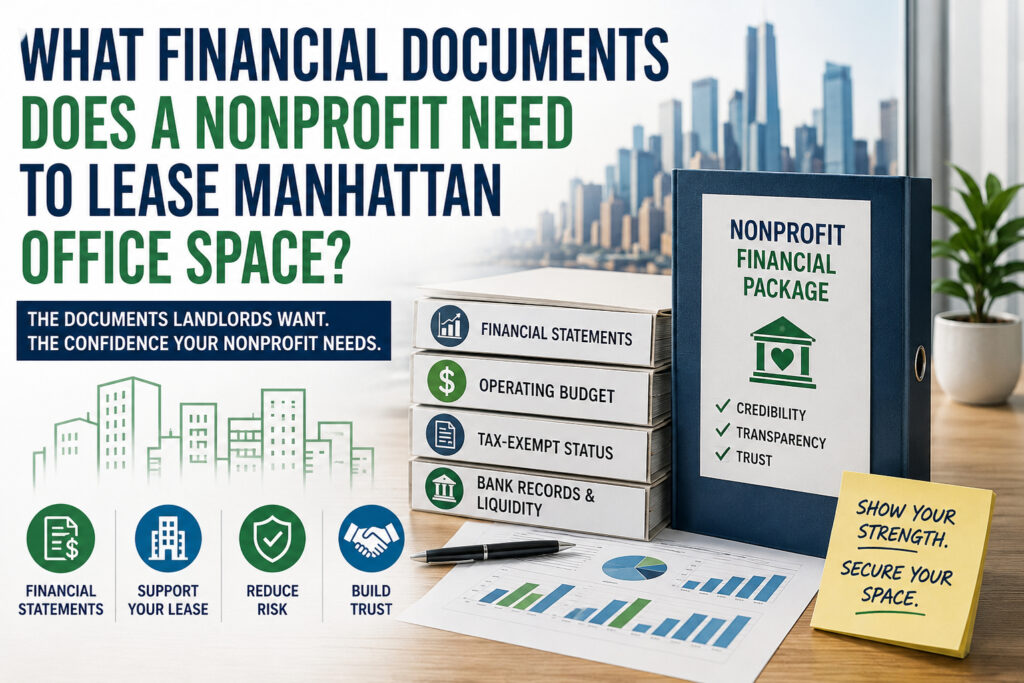
Your package should normally address these categories:
| Document | What It Helps Establish |
|---|---|
| Audited, reviewed, or compiled financial statements | Historical financial condition and operating performance |
| Current statement of financial position | Assets, liabilities, cash, investments, and net assets |
| Current statement of activities | Revenue, expenses, operating gains, and operating deficits |
| Current operating budget | Expected revenue and spending for the present fiscal year |
| Cash-flow forecast | Ability to meet rent and other obligations throughout the year |
| Form 990, 990-EZ, or applicable annual filing | Revenue, assets, governance, and historical financial information |
| Bank and investment statements | Available liquidity and reserves |
| Grant and government-contract schedule | Timing, amount, duration, and concentration of institutional funding |
| Contribution and pledge information | Expected philanthropic support |
| Debt schedule | Existing loans, credit facilities, and repayment obligations |
| Board authorization | Authority to enter the proposed lease |
| Tax-exempt documentation | Organization status and legal structure |
Smaller organizations may not possess audited statements. That fact does not automatically prevent an office lease.
Instead, prepare the strongest available substitute. Current financial statements, bank records, budgets, funding commitments, and cash-flow projections can fill important gaps.
Our broader NYC office leasing document guide explains the general tenant package. A nonprofit should build on that foundation rather than treat tax-exempt status as sufficient credit.
Important: Do not wait until lease drafting starts. Financial qualification often influences the proposal before attorneys receive a draft lease.
Financial Statements and Form 990 Serve Different Purposes
A landlord may ask for audited financial statements and Form 990 filings because they answer different questions.
Financial statements show the accounting picture. An established nonprofit may provide an independent audit containing several statements. These normally include financial position, activities, cash flows, expenses, and explanatory notes.
The notes can matter significantly. They may explain restricted funds, investment holdings, debt, commitments, contingencies, lease liabilities, and revenue concentration.
A landlord may also review the auditor’s opinion. However, the landlord still focuses heavily on cash and operating sustainability.
Form 990 provides another historical view. Most qualifying tax-exempt organizations file an annual information return. Filing requirements vary according to organization type, gross receipts, and assets. Smaller organizations may qualify for Form 990-EZ or Form 990-N instead. Certain organizations also fall under filing exceptions.
Therefore, a landlord should not interpret a missing full Form 990 as automatic financial weakness.
A nonprofit should explain its applicable filing category instead.
Likewise, Form 990 should not replace current financial statements. A filed return can lag present conditions by many months.
Suppose fundraising improved sharply during the current fiscal year. Last year’s filing may understate today’s strength.
The reverse can also occur. An older filing may look healthy while current grant delays create a cash shortage.
Consequently, submit historical filings together with current reports whenever possible.
For larger commitments, include the most recent audit first. Then place prior years behind it in chronological order.
Budgets, Cash Flow, Grants, Contracts, and Restricted Funds Matter
Nonprofit underwriting differs from underwriting a conventional profit-driven company.
A landlord cannot rely only on profit margins. Many healthy nonprofits intentionally spend close to annual revenue because mission delivery drives their budgets.
Therefore, the landlord needs to understand cash availability, recurring support, funding restrictions, and revenue timing.
Start with the board-approved operating budget. Show expected revenue by meaningful category and identify major expense obligations.
Next, provide a cash-flow forecast when timing creates uncertainty. Monthly projections can prove especially useful for organizations receiving reimbursements after delivering services.
Grant-funded tenants should also prepare a funding schedule.
Include the award amount, start date, expiration date, payment structure, renewal expectations, and remaining balance. Identify whether payments arrive upfront, periodically, or through reimbursement.
Government contracts need similar treatment. Delayed receivables can create liquidity pressure even when annual revenue looks substantial.
Restricted funds deserve special attention. A large bank or investment balance does not necessarily mean every dollar can support rent.
Landlords care about funds that the nonprofit may legally and practically use for occupancy costs. Accordingly, separate restricted resources from genuinely available operating liquidity.
Pledges also need context. Distinguish collected cash from unconditional receivables, conditional commitments, and informal fundraising expectations.
Revenue concentration matters as well.
An organization receiving most revenue from one contract presents a different risk profile than a diversified organization. Yet concentration does not automatically prevent approval.
A well-documented renewal history can reduce uncertainty. Strong unrestricted reserves can strengthen the story further.
The best presentation answers a landlord’s next question before that question arises.
Governance and Authority Documents Support the Financial Package
Financial strength alone does not prove that the organization can sign a lease.
The landlord also needs confidence that the correct nonprofit entity will become the tenant. Likewise, the signer must possess proper authority.
For that reason, prepare the organization’s formation and governance records alongside its financial materials.
These records commonly include the certificate or articles of incorporation, bylaws, tax-exempt documentation, and federal identification information. A landlord may also request evidence of current organizational standing.
The lease itself creates a substantial financial obligation. Therefore, many organizations need formal internal approval before signing.
A board resolution can document that approval.
The resolution should authorize the transaction according to the organization’s governance requirements. It can also identify the officer who may execute final documents.
Do not treat that resolution as routine paperwork. A long Manhattan lease can create a major multi-year commitment.
Likewise, review internal approval thresholds before agreeing to the business terms.
Some organizations require committee review before full board approval. Others impose special procedures for debt, real estate, or commitments above defined amounts.
The landlord may also request a concise organizational description. Keep that document practical.
Explain the mission, operating history, staff count, principal programs, funding structure, and intended office use.
Program use matters because a nonprofit office may involve more than desks. Counseling, education, training, public meetings, or community services can affect occupancy requirements.
Our commercial leasing guide explains why permitted use, occupancy, insurance, alterations, and financial terms should work together.
Financial approval gets the deal moving. Proper authority gets the deal signed.
How a Manhattan Landlord Reads Nonprofit Financial Strength
A landlord usually asks one central question: How likely is this tenant to perform throughout the lease?
No universal Manhattan formula determines the answer.
There is no standard rule requiring every nonprofit to maintain a specific cash balance. Likewise, no fixed rent-to-revenue percentage guarantees approval.
Instead, underwriting combines several signals.
Liquidity comes first. How much usable cash can cover operations when revenue arrives late?
Operating history matters next. Recurring deficits require explanation, particularly when they consume reserves.
However, one deficit year may have an ordinary explanation. A planned program expansion can create a temporary loss without threatening long-term solvency.
Revenue quality also matters. Landlords examine recurring grants, contracts, donations, program revenue, dues, and other dependable sources.
Meanwhile, current receivables can strengthen or weaken the picture. A large receivable means little when collection remains uncertain.
Landlords also consider the economics of their own deal.
A landlord funding extensive construction may demand stronger credit than an owner delivering existing space. Longer terms can increase that concern.
Consequently, the same nonprofit may receive different financial requirements from two Manhattan landlords.
Lease size changes the equation too.
A modest office commitment may represent a small percentage of annual expenses. A major headquarters lease creates far greater exposure.
Before making an offer, model the entire occupancy obligation. Include base rent, escalations, utilities, cleaning, overtime services, insurance, construction, and other additional rent.
Then compare that figure with unrestricted operating resources.
A persuasive package does not hide financial weaknesses. Instead, it explains them and shows how the organization manages them.
Security Deposits, Letters of Credit, and Weaker Financial Profiles
Financial documents influence more than approval. They also influence the security package.
Manhattan commercial leases do not use one statutory security-deposit formula. Landlords negotiate security according to credit, lease economics, and perceived default risk.
A financially strong nonprofit may secure a smaller deposit. Another organization may face a larger request because revenue history remains limited.
Recent Manhattan leasing experience shows several months of rent can serve as the starting point. Higher-risk situations can push the requirement further.
However, a landlord’s opening request does not always become the final structure.
A nonprofit can negotiate among several forms of protection.
A cash security deposit offers simplicity but removes money from mission operations.
A letter of credit may preserve operating cash differently. However, the issuing bank may require collateral and charge recurring fees. Our guide to letters of credit in Manhattan leases explains that tradeoff.
A financially stronger affiliate may sometimes provide additional support. Every organization should review that arrangement with its counsel and accounting team.
Individual guarantees require much greater caution.
A nonprofit has no equity owners in the conventional business sense. Board members and executives should not casually accept personal lease liability.
Instead, negotiate the landlord’s actual risk concern.
More security, a shorter term, reduced landlord construction exposure, or another structure may solve that concern.
Burn-down provisions can also help. Security may decline after several years of timely performance.
Our discussion of security deposits and guaranties covers those negotiations in greater detail.
Manhattan-Specific Tax and Lease Accounting Issues
Nonprofit status creates several Manhattan questions that ordinary office tenants rarely face.
Commercial rent tax comes first. Manhattan south of 96th Street generally falls within the city’s commercial rent tax geography.
However, qualifying religious, charitable, and educational nonprofits can receive an exemption. Other nonprofit organizations may also qualify under applicable requirements.
Do not assume federal tax exemption answers every local tax question.
Confirm the organization’s status before finalizing occupancy costs. The lease should also allocate any filing and documentation responsibilities clearly.
Real estate taxes create a separate issue.
A normal nonprofit office lease does not automatically eliminate the landlord’s property taxes. Standard tenant status and property ownership receive different treatment.
Section 420-a can become important in certain long-term structures. A qualifying nonprofit may pursue property-tax benefits through a properly structured leasehold condominium.
That arrangement generally involves at least a 30-year underlying leasehold interest and qualifying nonprofit ownership and use. It requires substantially more documentation than an ordinary office lease.
Therefore, do not confuse a conventional five-year lease with a specialized 420-a transaction.
Our discussion of nonprofit office leasing and Section 420-a provides additional context.
Lease accounting also matters.
ASC 842 generally places most longer-term leases on a nonprofit’s statement of financial position. The organization records a right-of-use asset and corresponding lease liability.
Accordingly, finance teams should model the accounting effect before signing a major Manhattan lease.
When to Submit Documents, What to Include, and Common Questions
A nonprofit should organize financial materials before serious lease negotiations, not after selecting final lease language.
Start with a secure digital folder. Use clear file names and separate historical documents from current reports.
A sensible sequence looks like this:
Before touring becomes serious: prepare organization information, tax status, use description, and preliminary budget.
Before requesting final landlord terms: assemble historical financials, current financials, Form 990 filings, liquidity evidence, and major funding schedules.
During proposal negotiations: discuss expected security, lease term, construction contribution, and any special approval concerns.
Before lease execution: complete board authority, insurance, security arrangements, and final accounting review.
Does every nonprofit need audited financial statements?
No.
Some landlords strongly prefer audits for established organizations. Smaller nonprofits may not undergo an annual independent audit.
In that situation, submit reviewed, compiled, or internally prepared statements where appropriate. Add stronger bank, budget, and funding documentation to provide context.
How many years of financial statements should we prepare?
Prepare two or three years when available, plus current interim reports.
Doing so lets the landlord compare historical performance with today’s position.
Is Form 990 enough by itself?
Usually not.
Form 990 offers useful historical information, but it does not show today’s cash position. Combine it with current financial statements and liquidity evidence.
What happens if our nonprofit files Form 990-EZ or 990-N?
Explain the applicable filing requirement.
Smaller tax-exempt organizations can qualify for different annual filings based on receipts and assets. A landlord should evaluate the actual organization rather than demand an inapplicable form.
Can grant awards prove that we can pay the rent?
They can help, but the details matter.
Show whether each award remains active, restricted, reimbursable, renewable, or already collected. Also identify funding that the organization may use for occupancy.
Will a landlord count restricted cash as available cash?
Do not assume so.
Explain restrictions clearly and distinguish operating liquidity from money dedicated to another purpose. Transparency prevents a large balance from creating a misleading impression.
What if government payments arrive late?
Provide a receivables schedule and realistic cash-flow forecast.
Then show unrestricted reserves, credit capacity, or other liquidity that can bridge normal payment delays.
What if the nonprofit recently launched?
History may not exist yet.
In that case, emphasize committed funding, current cash, board-approved budgets, credible projections, leadership experience, and realistic occupancy costs.
A shorter initial commitment may also reduce underwriting pressure.
Can stronger financial documents reduce the security deposit?
Often, yes.
Landlords size security according to perceived risk. Strong liquidity, recurring revenue, established history, and limited landlord investment can improve the negotiation.
However, every building and transaction differs.
Should board members personally guarantee the lease?
Do not treat a personal guarantee as a routine nonprofit requirement.
First determine why the landlord wants additional protection. Then explore security, credit support, term changes, or other negotiated alternatives.
Does nonprofit status automatically remove Manhattan real estate taxes?
No.
Commercial rent tax treatment, ordinary property-tax treatment, and Section 420-a structures involve different rules. A standard tax-exempt organization does not automatically receive every real estate tax benefit.
What should we send if the landlord asks for “financials”?
Do not send one unexplained PDF.
Ask what period and level of detail the landlord expects. Then provide an organized package with a concise cover summary.
That summary should identify annual revenue, unrestricted cash, major funding sources, current occupancy budget, and requested lease economics.
What should we never omit?
Do not omit information that materially changes the financial story.
A major expired grant, recurring operating deficit, material debt obligation, or serious cash restriction needs context. Surprises discovered later can damage credibility.
The strongest nonprofit lease package tells one coherent story: the organization exists properly, possesses authority, has reliable funding, and can afford the proposed commitment.
Treat your financial submission as part of the lease negotiation rather than an administrative afterthought. Better documentation can improve approval speed, security negotiations, and landlord confidence.
We represent office tenants, not landlords. Our role is to help nonprofit teams compare Manhattan options and negotiate the financial structure behind the lease. We also coordinate the real estate process with the organization’s legal, accounting, and governance requirements.
Fill out our 📋 online form or give us a call today 📞 212-967-2061 — let’s find the right options for your business.