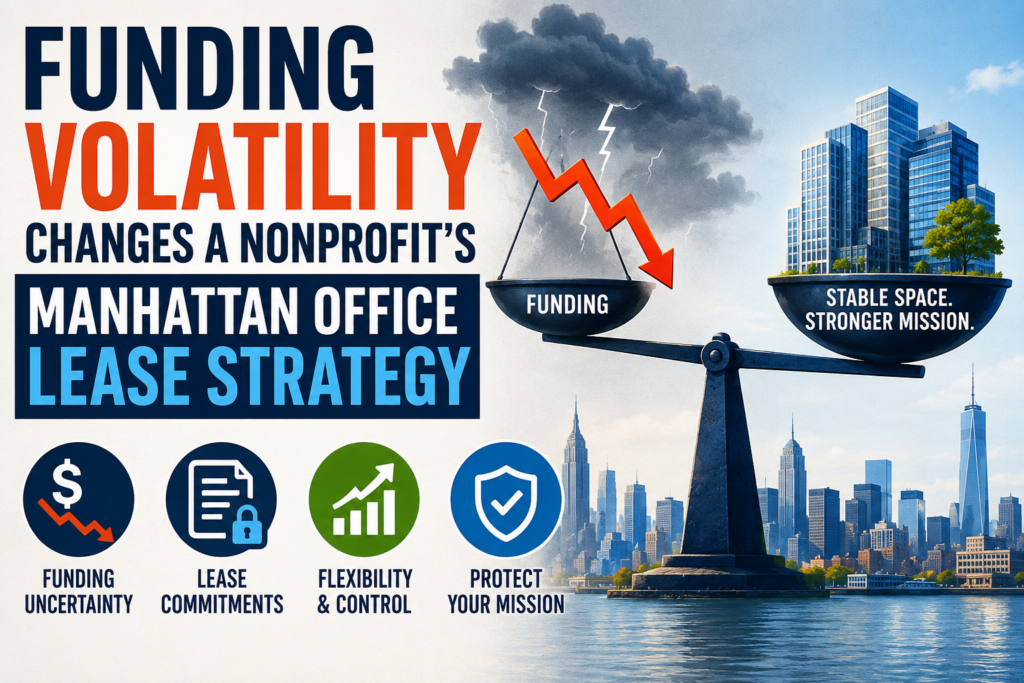
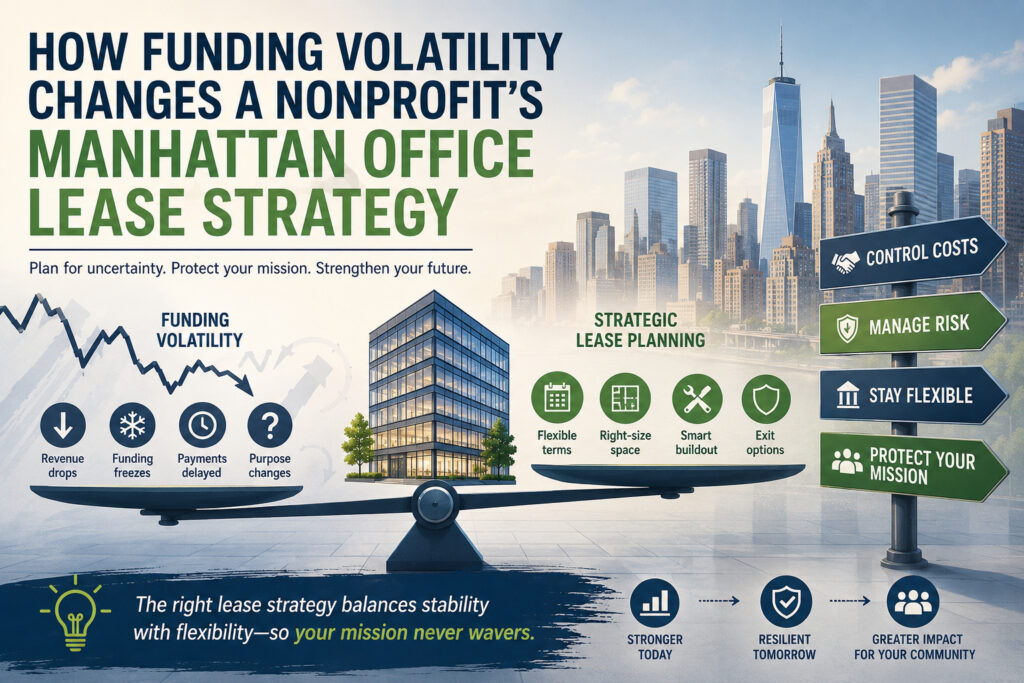
How Funding Volatility Changes a Nonprofit’s Manhattan Office Lease Strategy
Funding volatility changes a nonprofit’s Manhattan office strategy before it changes the office itself.
Revenue can fall, freeze, arrive late, or change purpose quickly. Rent does not move with that same flexibility. A funding loss also does not automatically rewrite an existing commercial lease.
Therefore, a nonprofit should not base its lease solely on today’s annual budget. The better approach measures how much fixed occupancy cost survives a realistic funding downturn.
That changes the discussion around term, square footage, buildout, security, expansion, contraction, subleasing, and exit rights. It also changes when an organization should make each decision.
The underlying issue has become especially important for New York nonprofits. Many organizations face uneven reimbursement timing, uncertain grant renewals, restricted funding, and rising service demand.
In the city-focused nonprofit survey, 78% of respondents received some government funding. Only 19% reported receiving government funding on time. Another 32% reported delays exceeding 90 days.
Those delays affect much more than accounting. They consume the same cash that supports payroll, programs, vendors, and rent.
Meanwhile, Manhattan’s office market has tightened substantially. Better-built and better-located space faces considerably more competition than headline availability suggests.
That combination creates the central leasing problem:
A nonprofit needs enough real-estate stability to deliver its mission, without creating more fixed liability than uncertain funding can safely support.
This page explains how to reach that balance.
Funding Volatility Changes the Lease Before It Changes the Office
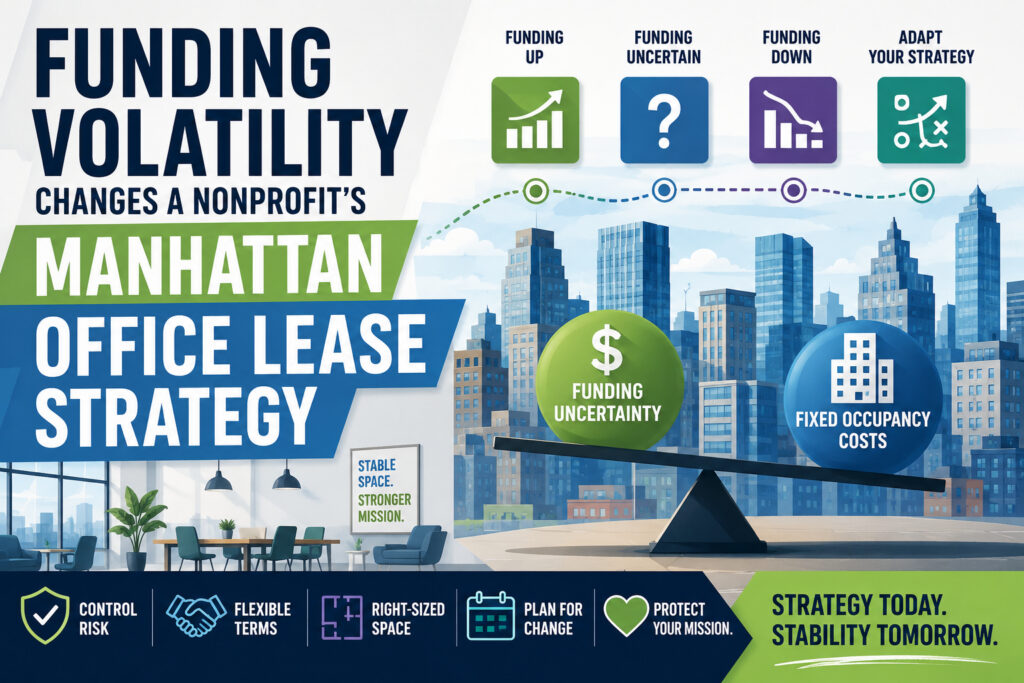
The central mismatch is variable funding against fixed occupancy cost
A nonprofit may receive revenue from government contracts, foundations, individuals, corporate support, program income, endowment distributions, or several sources.
Those sources rarely carry identical risk.
A government award may look secure but reimburse expenses slowly. A foundation grant may expire before a lease does. Restricted funds may support programs without supporting general occupancy costs.
Individual giving can also fluctuate. Earned revenue may depend on program volume. Meanwhile, a lease can continue month after month.
That difference matters because budgeted revenue and spendable cash are not the same thing.
New York nonprofits have already experienced this problem at scale. The city-focused survey found severe government payment delays during the measured period. Organizations responded by borrowing, delaying vendors, and drawing savings.
Specifically, 45% of affected respondents took on debt while awaiting payments. Another 29% delayed vendors, while 29% drew savings.
City initiatives subsequently increased advance payments and accelerated contract registration. Those reforms can improve liquidity for qualifying providers. However, they do not eliminate every nonprofit’s funding or timing risk.
The real-estate lesson remains straightforward.
Do not ask only, “Can we afford this rent today?”
Instead, ask:
“Can we afford this obligation when our least reliable funding behaves badly?”
What actually happens when nonprofit funding changes?
Funding changes can produce several very different real-estate outcomes.
A temporary delay may create a cash-flow problem without changing long-term space requirements. In that situation, moving offices could make the problem worse.
A permanent program cut creates a different issue. The organization may need less staff, fewer workstations, or fewer program rooms.
Meanwhile, a funding increase can create expansion pressure. An organization may suddenly need more employees, meeting rooms, training areas, or service capacity.
Therefore, the leasing response should follow the type of funding event.
| Funding event | Likely office problem | Lease strategy to examine |
|---|---|---|
| Reimbursement arrives late | Temporary cash shortage | Rent timing, reserves, security exposure, temporary restructuring |
| Major grant does not renew | Structural revenue decline | Contraction, termination, sublease, relocation |
| Funding becomes restricted | General overhead pressure | Lower fixed occupancy cost, better cost allocation |
| Program funding expands | Space shortage | Expansion rights, adjacent space, short bridge space |
| Funding source changes | Different compliance or location needs | Use provisions, assignment rights, relocation planning |
| Headcount falls | Excess space | Sublease, partial surrender, consolidation |
| Headcount rises | Capacity shortage | Expansion rights, renewal flexibility, nearby overflow |
| Funding becomes unpredictable | Forecasting risk | Shorter commitment, options, low-capital space |
A nonprofit experiencing budget cuts should therefore resist an automatic “downsize immediately” response.
First determine whether the problem concerns cash timing, permanent revenue, staffing, program delivery, or all four.
The lease itself usually remains a contract
A tenant should never treat lost funding as an informal termination mechanism.
Vacating does not necessarily eliminate the tenant entity’s lease obligations. Returning keys also may not produce a negotiated lease termination. Commercial lease language controls the outcome.
That distinction explains why flexibility matters before financial stress arrives.
A negotiated termination right creates one type of protection. Sublease rights create another. A contraction option addresses a different problem.
Likewise, a guaranty may govern someone’s exposure without terminating the tenant’s lease.
These concepts should never become interchangeable.
For a broader foundation, review our Commercial Leasing Guide for NYC tenants. It explains how lease economics and obligations fit together.
Build Lease Capacity Around Funding Durability, Not the Annual Budget
Start with spendable revenue rather than headline revenue
A nonprofit’s annual operating budget can overstate the money available for rent.
Consider a hypothetical organization with a $12 million annual budget.
That number alone tells very little about its safe office commitment.
Perhaps $5 million supports programs with narrow restrictions. Another $2 million may depend on reimbursement after expenses occur.
A major grant might expire during the proposed lease. Meanwhile, unrestricted recurring revenue could represent a much smaller amount.
Consequently, lease capacity should come from durable cash support rather than organizational size.
National nonprofit financial data reinforces this concern. More than half of surveyed nonprofits reported three months or less cash on hand. About 18% reported one month or less.
New York organizations also reported substantial funding-timing problems. Those conditions make liquidity an essential real-estate metric.
Separate funding into durability categories
Before negotiating term, divide revenue according to how confidently it can support fixed occupancy.
A practical analysis can examine:
| Funding characteristic | Question to answer |
|---|---|
| Unrestricted recurring revenue | How much can support rent without violating restrictions? |
| Multi-year commitments | How much extends through the contemplated lease period? |
| Government contracts | When does cash actually arrive? |
| Reimbursement funding | How much working capital must the organization front? |
| Renewal-dependent grants | What happens if they disappear? |
| Concentrated funding | How much revenue depends on one source? |
| Earned revenue | How sensitive is it to program volume? |
| Individual giving | How volatile has it been? |
| Operating reserves | How long can fixed costs continue during disruption? |
| Credit capacity | Can borrowing bridge timing without impairing mission spending? |
No universal percentage should decide whether a lease works.
Two nonprofits can derive the same revenue percentage from government contracts yet carry different risks.
One may receive predictable advances. Another may wait months for reimbursement.
Therefore, a funding-concentration statistic should start the analysis rather than finish it.
Stress-test the office before committing
Every meaningful Manhattan lease decision should survive several financial cases.
The base case assumes expected funding arrives on expected schedules.
The downside case removes or delays the most uncertain material funding source.
The severe case combines lower revenue with slower payments and reduced fundraising.
Then run the proposed office through each case.
Ask whether payroll, mission delivery, and necessary reserves still remain viable after occupancy costs.
The nonprofit does not need a perfect forecast. It needs an honest range.
That approach reflects broader nonprofit financial guidance favoring scenario planning during uncertainty. Current sector data also shows deficits and thin liquidity across many organizations.
Turn the downside case into a lease limit
The analysis should produce a maximum fixed occupancy commitment.
Do not define that limit as base rent alone.
Include predictable additional costs and required capital.
A useful internal calculation is:
Fixed occupancy exposure = base rent + escalations + operating charges + utilities + recurring building costs + unavoidable capital costs
Then add separate reserves for uncertain items.
Those items may include construction, furniture, cabling, moving, restoration, professional fees, and overlapping rent.
Our planning guide for a Manhattan office lease addresses space requirements, infrastructure, location, and occupancy planning in greater detail.
Match board decisions to measurable triggers
The board should not need another strategic debate whenever funding moves.
Instead, leadership can establish decision triggers before executing the lease.
For example, a significant lost award could trigger immediate space review. A sustained cash decline might freeze expansion.
Likewise, a successful multi-year funding renewal could unlock a longer commitment.
These triggers connect governance with leasing without turning every minor funding fluctuation into a relocation project.
The objective is not constant movement.
The objective is controlled optionality.
Match Lease Term and Space Structure to the Downside Case
A shorter lease is not automatically a safer lease
Funding volatility often creates interest in shorter commitments.
That instinct can make sense. However, term length represents only one dimension of risk.
A three-year lease can still create substantial exposure when buildout costs remain high.
Likewise, a five-year lease with strong exit rights may provide more flexibility than an inflexible three-year lease.
A longer deal may also support larger landlord contributions or stronger economic terms. Current Manhattan concession data illustrates that term and economics remain closely connected.
Therefore, choose the term after considering four questions.
How long does durable funding support the operation?
How much capital must the organization invest?
What happens if headcount changes?
What rights exist before the stated expiration date?
Direct leases work best when continuity matters
A direct lease can provide greater control over renewal, alterations, signage, expansion, and long-term occupancy.
That control becomes valuable for organizations with stable programs or specialized facilities.
Direct space can also justify a substantial buildout when the organization expects long occupancy.
However, a direct lease transfers more real-estate responsibility to the nonprofit.
Longer terms can amplify that exposure.
Therefore, direct leasing works best when the organization can support the commitment under its downside funding case.
A sublease can serve as a bridge
A sublease can match an uncertain funding horizon particularly well.
The space may already contain offices, conference rooms, furniture, cabling, and working infrastructure.
That can reduce capital exposure and shorten the move timeline.
However, sublease rights generally depend on the underlying prime lease. The subtenant also gains less control over renewal and long-term occupancy. Our comparison of short-term subleases and direct leases explains those structural differences.
A nonprofit should therefore ask why it wants the sublease.
Good reason: funding visibility extends only two or three years.
Weak reason: the headline rent simply looks cheaper.
Total economics still matter.
Furniture, technology, restoration, landlord consent, moving, and future relocation can alter the comparison.
Flexible space can solve a temporary problem
Shared or flexible office arrangements can help during a short transition.
They can support a temporary project team, funding bridge, rapid hiring period, or relocation gap.
However, they should not automatically replace a thoughtful lease strategy.
Privacy, branding, conference capacity, security, records, specialized operations, and program delivery may require dedicated premises.
Furthermore, recurring per-person economics can become inefficient for larger teams.
Therefore, treat flexible space as one occupancy tool, not a universal nonprofit solution.
Do not overlease simply to create future sublease income
Leasing unnecessary space and planning to sublease it later creates another risk.
The nonprofit becomes dependent on future demand for space it never needed operationally.
That approach also exposes the organization to consent requirements, transaction costs, downtime, and uncertain sublease pricing.
Current Manhattan sublease inventory has contracted materially from recent peaks. That supports certain sublease opportunities today, but future conditions remain unknowable.
Instead, lease what the organization can reasonably use.
Then negotiate expansion rights for plausible growth.
Manhattan market conditions now require more selectivity
The latest complete quarterly Manhattan data published in July 2026 shows a market that continues tightening.
| Q2 2026 office benchmark | Availability | Average asking rent | Sublease availability | Average sublease asking rent |
|---|---|---|---|---|
| Manhattan overall | 14.4% | $80.17/SF | 2.6% | $59.94/SF |
| Midtown | 12.7% | $86.18/SF | 2.3% | $63.19/SF |
| Downtown | 16.6% | $61.34/SF | 3.5% | $47.13/SF |
These figures use one consistent research methodology. Other market datasets define availability differently and produce different headline percentages.
The direction matters more than one percentage.
Manhattan availability has declined while average asking rents have risen. Sublease inventory has also tightened.
Premium space presents an even sharper constraint. Midtown prime vacancy reached only 2.2% during the second quarter of 2026.
Consequently, a nonprofit should not assume waiting automatically produces better choices.
Location can become a financial flexibility tool
Funding volatility may justify changing location before sacrificing operationally important space.
Midtown can support accessibility, client proximity, commuter convenience, and institutional presence.
However, Downtown currently offers a lower average asking-rent benchmark and more availability.
That difference can create another option.
Instead of reducing a functional 12,000-square-foot footprint to 8,000 square feet, an organization might preserve space elsewhere.
Whether that trade works depends on staff commutes, service delivery, partners, clients, program use, and building quality.
A smaller office is not automatically a cheaper operational solution.
Sometimes location creates greater savings with less disruption.
Negotiate Flexibility Before Funding Changes
A termination option provides true exit control
A negotiated termination option can give the tenant the right to end the lease early.
The clause should define timing, notice, conditions, and any termination payment.
Landlords may also require the tenant to repay certain unamortized transaction costs.
Those costs can include free rent, construction contributions, commissions, or other concessions.
Therefore, an early termination right rarely means “walk away for free.”
Its value comes from converting unknown long-term liability into a known exit price.
For deeper detail, review our guide to break clauses and exit rights in Manhattan office leases.
A funding-contingent organization should try to address these rights during the proposal stage.
Waiting until lease drafting gives the landlord more leverage.
A contraction option protects against a smaller future organization
Termination solves an all-or-nothing problem.
Contraction addresses partial shrinkage.
A properly structured contraction right lets a nonprofit return defined space after a stated date.
The organization might surrender one floor, part of a floor, or another separable area.
Landlords care heavily about configuration.
An irregular leftover suite may prove difficult to lease. A cleanly separable block creates a more realistic negotiation.
Therefore, space planning and lease flexibility should work together.
A nonprofit expecting uncertain staffing should consider future divisibility before selecting the premises.
Sublease and assignment rights create a secondary exit route
A sublease allows another occupant to take some or all space while the original lease continues.
An assignment transfers the tenant’s leasehold interest under negotiated conditions.
Both rights depend heavily on lease language.
Consent standards, recapture rights, profit-sharing, permitted transferees, and review procedures can affect practical value.
The organization should also understand whether affiliates or program partners can occupy space without triggering formal consent.
Our guide to sublease consent and shared office occupancy examines that issue more closely.
For a funding-volatile nonprofit, broad transfer rights provide valuable optionality.
However, they do not guarantee a replacement occupant.
Marketability still depends on the building, term, rent, condition, layout, and timing.
Renewal options protect the opposite side of volatility
Not every funding surprise involves a cut.
A nonprofit can receive a major award shortly before expiration.
Without renewal rights, growth may arrive exactly when the organization faces displacement.
A renewal option can protect continuity while preserving a future decision.
Expansion rights can provide another layer of flexibility.
A right covering adjacent space may help the nonprofit grow without relocating its existing operation.
Our guide to renewal options and expansion rights explains these structures.
Therefore, good volatility planning must protect both directions.
Downside rights protect against contraction. Upside rights protect against forced relocation during growth.
Do not confuse a Good Guy Guaranty with a termination option
This distinction matters enormously.
A Good Guy Guaranty limits a guarantor’s liability according to negotiated surrender conditions.
It does not necessarily terminate the tenant entity’s lease obligations.
Recent New York case law confirms that the guarantor can exit liability while the tenant remains responsible afterward.
Therefore, a nonprofit should never treat that guaranty as an organizational break clause.
The document may still provide meaningful risk protection for directors, officers, affiliates, or another guarantor.
However, the exact language controls.
Notice periods, rent payment, vacant delivery, subtenant removal, and surrender conditions can all matter.
Commercial counsel should review those provisions before execution.
Negotiate security as another form of volatility protection
Security ties up cash that could otherwise support programs.
A landlord may request cash security, a letter of credit, or another credit enhancement.
Funding uncertainty can make that requirement especially important.
A nonprofit should consider whether security can decline after successful performance.
For example, a negotiated burn-down may reduce security after specified payment milestones.
Likewise, the organization should understand drawing conditions and replenishment obligations before accepting a letter of credit.
Our guides cover security-deposit negotiations and letter-of-credit requirements.
A larger security package may sometimes produce better economics elsewhere.
Still, nonprofits should price the liquidity cost before making that trade.
Control Total Occupancy Cost, Not Just Asking Rent
Base rent tells only part of the story
A $65-per-square-foot office can cost more than a $75-per-square-foot alternative.
The difference may come from construction, operating charges, utilities, efficiency, or moving costs.
Therefore, nonprofits should compare total occupancy economics.
A practical model should include:
Base rent
Contractual escalations
Operating-expense obligations
Tax-related pass-throughs
Electricity and utility structures
Cleaning
After-hours HVAC
Insurance requirements
Construction
Furniture and equipment
Technology and cabling
Moving expenses
Professional fees
Lease overlap
Restoration and exit costs
That comparison can change which office actually costs less.
Our broader guide explains how Manhattan office lease economics fit together.
Turnkey space can reduce funding risk
A nonprofit facing uncertain funding should treat large upfront construction as another fixed commitment.
Every dollar invested in a highly customized office requires time to recover economically.
Therefore, existing improvements can carry significant value.
A well-configured prebuilt office may reduce architectural costs, construction exposure, permit timing, furniture purchases, and delayed occupancy.
A furnished sublease can go further.
However, “turnkey” should describe a usable operational condition rather than attractive photographs.
Inspect meeting capacity, private offices, accessibility, HVAC, power, lighting, cabling, pantry infrastructure, furniture, and code requirements.
Specialized nonprofits may need additional review for program-related occupancy.
Improvement allowances require context
Landlord construction contributions can materially change the economics of a direct lease.
Current Manhattan data provides useful context.
For new direct deals exceeding 5,000 square feet and five years, H1 2026 concessions remained meaningful.
Average rental abatement measured 12.4 months in that dataset. Average tenant-improvement allowances reached $140.02 per square foot.
Those numbers represent broad market averages, not promised nonprofit terms.
Building quality, size, lease length, tenant credit, landlord condition, and construction scope can change the result.
Furthermore, an allowance does not make construction free.
The tenant can still face overruns, furniture costs, professional fees, technology, delays, and work outside the allowance.
Review our explanation of tenant improvement allowances before comparing construction packages.
Free rent has value only when the later rent remains affordable
Rent abatement can improve cash flow during a move.
However, free months should not justify a lease that fails the downside case.
A nonprofit still needs to support full contractual rent after abatement ends.
Therefore, evaluate concessions over the entire term.
Calculate the total rent obligation, expected additional charges, and required capital.
Then compare that total with the organization’s stressed funding capacity.
Escalations deserve special attention
A nonprofit with volatile funding should value predictable occupancy increases.
Fixed annual increases can make long-range modeling easier.
Expense pass-throughs can introduce greater uncertainty.
Therefore, review base years, exclusions, controllable expenses, administrative charges, gross-up provisions, and audit rights.
The organization should understand exactly what can increase.
A low first-year rent can become misleading when later obligations rise aggressively.
Revenue-linked rent should not become the primary strategy
A nonprofit may naturally prefer rent that falls when funding falls.
However, the more practical negotiation usually focuses on defined contractual economics.
Those tools include abatements, fixed escalations, capped charges, security reductions, contraction rights, and termination rights.
The goal should not require annual arguments over organizational revenue.
Instead, create predictable obligations and predetermined escape routes.
That structure gives both sides clearer expectations.
Respond to a Funding Shock Before the Lease Becomes a Crisis
Start by identifying the actual funding problem
A funding shock should trigger analysis before panic.
First determine what changed.
Did an award disappear?
Has reimbursement simply slowed?
Did a funder restrict money differently?
Will staffing decline?
Can another revenue source replace the gap?
Does the organization still need the same office after the financial problem passes?
These questions separate liquidity pressure from permanent occupancy mismatch.
That distinction matters.
In the New York nonprofit survey, payment delays forced organizations to front salaries, rent, and other expenses. Those delays did not necessarily erase the underlying funded program.
Moving because of a temporary receivable problem could therefore increase costs unnecessarily.
Conversely, a permanently eliminated program can leave space structurally oversized.
Build a lease exposure sheet immediately
Leadership should place the entire office commitment on one page.
Include current rent, remaining term, escalation dates, security, renewal deadlines, sublease rights, assignment rights, and guaranties.
Add restoration obligations, expansion rights, termination clauses, and notice requirements.
Then calculate the remaining gross commitment.
Do not wait for a default notice.
Early information creates more options.
The organization should also identify every date that can affect leverage.
A missed renewal deadline may eliminate a valuable right.
An expiring termination window can do the same.
Review our end-of-lease planning guide before those dates become urgent.
Model cash before changing real estate
A funding shock should produce an updated cash forecast.
Use actual expected receipts instead of annual accrual assumptions.
Then test payroll, program expenses, debt obligations, and occupancy together.
The organization should know when cash becomes constrained.
That date determines urgency.
It can also show whether a short-term bridge solves the problem.
National nonprofit survey data found widespread deficits and constrained cash reserves. Those conditions make cash timing central to restructuring decisions.
Open a landlord discussion before missed payments
Early communication can create more restructuring possibilities.
A landlord may consider temporary relief, a lease extension, revised economics, or another negotiated solution.
Whether those approaches work depends on the building and tenant.
Current Manhattan conditions also matter.
Owners with highly marketable space may see little reason to reduce rent.
Another landlord may prefer a negotiated restructuring over uncertainty.
Therefore, the tenant should benchmark its space before making a request.
Know the current direct asking rent.
Check competing availabilities.
Study current sublease alternatives.
Assess how easily the landlord could relet the premises.
That information turns a hardship request into a real-estate negotiation.
Consider a blend-and-extend carefully
A blend-and-extend transaction can reduce near-term occupancy expense.
The tenant receives economic relief while extending its commitment.
That approach may work when funding pressure remains temporary.
However, it exchanges short-term savings for longer liability.
Therefore, the nonprofit should run the extended term through its downside case.
Do not solve a twelve-month cash problem by creating an unnecessary ten-year obligation.
A partial surrender may outperform a full move
A landlord may sometimes accept part of the premises back.
This approach works best when the surrendered portion can operate independently.
Separate entrances, logical divisions, and functional floorplates help.
A partial surrender can reduce rent without destroying the nonprofit’s operating location.
It may also avoid moving costs and program disruption.
However, the parties need clear documentation.
The agreement should address rent reduction, restored premises, security, operating charges, and future rights.
Subleasing can convert excess space into partial recovery
When the lease allows it, a nonprofit can market unused premises to another occupant.
That approach does not automatically erase the original lease obligation.
Instead, subrent offsets some occupancy expense.
The nonprofit should compare expected recovery against transaction costs and downtime.
Current Manhattan sublease availability stood at 2.6% during Q2 2026. The average sublease asking rent reached $59.94 per square foot.
Midtown and Downtown show different sublease economics. Therefore, location can materially affect recovery potential.
A negotiated buyout can create certainty
Sometimes the cleanest solution requires paying to exit.
A landlord might accept an agreed sum and terminate the remaining lease.
The amount depends on many factors.
Remaining term matters.
Current rent matters.
Market rent matters.
The condition and marketability of the premises also matter.
So do concessions, security, and the landlord’s expected downtime.
A buyout should therefore compete against the cost of staying.
Compare it with subleasing, contraction, relocation, and continued occupancy.
The lowest immediate payment does not always create the lowest total cost.
Never let sunk costs dictate the next lease decision
A nonprofit may have spent heavily on architecture, furniture, or construction.
Those investments can make leaving emotionally difficult.
However, sunk capital should not justify future rent that the organization can no longer support.
The next decision should examine future economics.
Ask what staying costs from today forward.
Then compare that figure with restructuring and relocation.
Mission capital deserves the same discipline as any other scarce resource.
Treat Long-Term Nonprofit Tax Structures as a Long-Term Commitment
Section 420-a can change nonprofit lease economics
Certain qualifying nonprofits can pursue a leasehold-condominium structure that may support property-tax exemption treatment.
However, an ordinary office lease does not automatically qualify.
New York City generally requires nonprofit property-tax applicants to own qualifying property and use it for an exempt purpose. Federal nonprofit status alone does not create the exemption.
A leasehold condominium can create a qualifying ownership interest under specific conditions.
The structure generally requires a nonresidential leasehold condominium and at least 30 years remaining in the underlying leasehold interest.
The nonprofit must also satisfy applicable ownership and exempt-use requirements.
That distinction matters greatly.
Signing a thirty-year ordinary office lease does not, by itself, create the same result.
The transaction requires a carefully structured leasehold-condominium arrangement and proper tax planning.
Our earlier discussion of nonprofit leasing explored how this structure can influence long-term occupancy economics.
The tax advantage creates a strategic tradeoff
A funding-volatile nonprofit should not evaluate the tax structure separately from lease duration.
The potential tax benefit rewards long-term occupancy.
Funding uncertainty often rewards shorter liability.
Those goals can conflict.
Therefore, a nonprofit should answer a threshold question before pursuing the structure:
Is our long-term occupancy sufficiently durable to justify building our real-estate strategy around a thirty-year-plus structure?
For a large institution with stable program use, the answer may support further analysis.
A smaller organization dependent on short-cycle funding may reach a different conclusion.
Neither answer makes the tax structure inherently good or bad.
The correct answer depends on mission continuity, location permanence, space needs, funding durability, and projected savings.
Long-term economics require long-term space planning
A nonprofit considering this structure should model more than current rent.
Future headcount matters.
Program delivery matters.
Accessibility needs can change.
Technology can alter office utilization.
Neighborhood economics can shift.
Likewise, a building may become operationally unsuitable before a long lease expires.
Therefore, assess expansion, contraction, transfer, subletting, and alteration rights alongside tax economics.
A lower occupancy cost loses value when the organization becomes trapped in unsuitable space.
Exclusively qualifying use deserves attention
Property-tax eligibility depends on ownership and qualifying use requirements.
Portions serving non-exempt commercial activities can create additional questions.
Vacant or differently used areas can also affect exemption analysis.
That creates an important issue for nonprofits considering subleasing.
A future subtenant or shared occupancy arrangement may affect more than the real-estate economics.
Tax counsel should therefore review proposed transfer rights together with the leasing strategy.
Compare two strategies rather than one
A nonprofit considering a long-term tax structure should model two complete alternatives.
| Long-term structure | Flexible conventional lease |
|---|---|
| Potential property-tax benefit | Greater ability to limit term |
| Long commitment | Easier future relocation |
| More structural complexity | Simpler transaction structure |
| Strong location continuity | Greater funding adaptability |
| Potential custom buildout | Greater access to shorter-term built space |
| Long-range planning required | More frequent lease-market exposure |
| Tax eligibility requirements | Conventional lease economics |
Then calculate the present and downside economics.
The answer should reflect organizational reality rather than tax savings alone.
A Practical Nonprofit Manhattan Lease Decision Framework
Start with one question
What is the longest real-estate commitment that our durable funding can support under a realistic downside case?
That question should come before neighborhood prestige.
It should also come before landlord concessions.
Once the organization answers it, the remaining decisions become easier.
Use a funding-to-lease matrix
| Funding condition | Preferred leasing emphasis |
|---|---|
| Strong multi-year unrestricted support | Longer direct lease can make sense |
| Strong funding but uncertain growth | Direct lease plus expansion and contraction rights |
| Stable program with payment delays | Preserve location; protect liquidity |
| Major renewal decision within several years | Match lease flexibility to renewal timing |
| Concentrated funding exposure | Stronger exit and transfer rights |
| Declining headcount | Smaller footprint or contraction path |
| Temporary funding bridge | Short built space or sublease can help |
| Rapid new funding | Expansion rights and adjacent options matter |
| Long-term institutional occupancy | Consider deeper tax-structure analysis |
| Severe unresolved uncertainty | Avoid unnecessary capital and excessive term |
This matrix does not replace financial or legal review.
Instead, it prevents the real-estate transaction from outrunning the organization’s funding visibility.
Decide what space the mission actually needs
Funding volatility should not automatically produce the smallest possible office.
An undersized office can impair program delivery.
Staff may lose meeting rooms, privacy, storage, training capacity, or client-facing areas.
Hybrid schedules can reduce workstation demand.
However, they do not necessarily reduce every other space function proportionally.
Therefore, plan by activity.
Count actual daily attendance.
Measure conference demand.
Separate program rooms from administrative workstations.
Identify confidential functions.
Examine storage, accessibility, technology, and visitor traffic.
Then build the footprint around those uses.
The goal is efficient mission-supporting space, not minimum square footage.
Determine which costs can change and which cannot
Divide future office expense into two columns.
Fixed obligations may include contractual rent, security requirements, and defined recurring charges.
Variable obligations may include some utilities, staffing-related services, or optional space usage.
Then focus negotiations on the fixed column.
Funding volatility becomes dangerous when too much organizational spending cannot adjust.
Real estate often represents one of those commitments.
Consequently, every reduction in avoidable fixed exposure creates greater operating resilience.
Evaluate every lease through an exit test
Before signing, imagine the largest uncertain funding source disappears two years later.
Then ask:
Can we terminate?
Can we contract?
Can we sublease?
Can we assign?
Can we divide the premises?
What happens to the security?
Does a guaranty remain?
What restoration costs apply?
What does the remaining liability equal?
Would another tenant reasonably want this space?
A lease that performs well only in the optimistic case needs more work.
Run the opposite test for growth
Now assume funding rises substantially.
Ask whether the office can absorb additional staff.
Check adjacent availability.
Review expansion rights.
Examine renewal control.
Consider whether the floor can support denser occupancy.
Determine whether building systems can handle the change.
This exercise prevents a “flexible” lease from becoming too defensive.
The mission may grow as easily as funding can decline.
Align the lease calendar with the funding calendar
Lease expiration should not exist in isolation.
Map major grant expirations and program renewals beside real-estate dates.
Add renewal-option deadlines.
Include termination windows.
Track security burn-down dates.
Mark significant escalation years.
Then show board and budget cycles.
This combined calendar can reveal hidden risk.
For example, a renewal decision may arrive before a major funding award receives approval.
That timing may justify a shorter extension or negotiated decision window.
Likewise, a grant renewal shortly before lease expiration may support a cleaner long-term decision.
Give each adviser the correct job
Funding volatility crosses several professional disciplines.
The finance team should model cash and downside capacity.
Leadership should determine operational priorities.
The board should approve the organization’s risk boundaries.
A tenant broker should benchmark buildings, economics, alternatives, and negotiating leverage.
Commercial counsel should draft and review binding lease rights.
Architectural and construction professionals should test layout, condition, code issues, and capital requirements.
Tax advisers should evaluate any specialized nonprofit tax structure.
No single discipline should make the entire decision.
The strongest lease strategy connects all of them.
What happens to our Manhattan office lease when funding gets cut?
Usually, the lease continues according to its negotiated terms.
A funding reduction does not automatically reduce rent or shorten the term.
Therefore, the tenant must use whatever rights already exist.
Those rights may include termination, contraction, subleasing, assignment, or negotiated surrender.
Without an existing right, the nonprofit can still approach the landlord.
However, the landlord does not need to treat funding loss as an automatic cancellation.
Should a nonprofit always choose a short office lease during uncertainty?
No.
A shorter term reduces duration risk but can create other problems.
The tenant may receive less control over improvements, renewal, expansion, or long-term occupancy.
Frequent moves also cost money.
Instead, compare term length with funding durability, capital investment, exit rights, and mission continuity.
A longer lease with meaningful options may outperform a shorter inflexible deal.
Is a three-year lease better than a five-year lease?
The funding timeline should answer that question.
Suppose material funding expires in thirty months.
A five-year obligation deserves stronger downside protections.
Meanwhile, a five-year lease may still work when durable unrestricted resources support the rent.
Term should follow stress-tested capacity.
It should not follow an arbitrary rule.
Is a ten-year lease too long for a nonprofit?
Not necessarily.
Large, established organizations can have long-lived programs and durable balance sheets.
They may also need significant construction or specialized infrastructure.
In those cases, longer occupancy can support better capital economics.
However, a ten-year term becomes risky when funding visibility remains much shorter.
The organization should therefore evaluate early-exit, transfer, and space-adjustment rights.
Does a nonprofit need a termination clause tied specifically to grant loss?
A broader negotiated termination right can provide more utility.
A grant-specific clause can create disputes about qualifying events, replacement funding, and documentation.
Meanwhile, a defined break right uses objective dates and conditions.
The best structure depends on negotiating leverage and organizational needs.
Whatever form the parties choose, the clause should clearly state notice, timing, payment, and surrender requirements.
Can a nonprofit reduce part of its office during the lease?
Only when the lease provides that right or the landlord later agrees.
A contraction option creates the clearest predetermined path.
Subleasing part of the office provides another route when the lease permits it.
A negotiated partial surrender may also work.
Physical configuration matters heavily.
Space that divides cleanly gives the organization more future choices.
Is subleasing the best answer after nonprofit budget cuts?
Sometimes.
Subleasing can offset rent while preserving the underlying lease.
However, the nonprofit normally remains connected to the prime lease.
The organization also needs a marketable space and an acceptable replacement occupant.
Therefore, compare sublease recovery with termination, surrender, contraction, and continued occupancy.
Current Manhattan sublease conditions remain tighter than the pandemic-era market.
Should a nonprofit take extra space and sublease it until growth arrives?
Usually, the safer strategy is different.
Lease space that meets realistic requirements.
Then negotiate rights to expand later.
Taking unnecessary premises adds rent, capital costs, and re-leasing risk immediately.
Expansion rights preserve growth potential without requiring the organization to finance empty space today.
How much Manhattan office space should a funding-volatile nonprofit lease?
Start with peak realistic daily use rather than total employee count.
Then add the rooms and functions that the mission actually requires.
Those may include conference rooms, interview rooms, private offices, classrooms, program areas, storage, and confidential work areas.
Next, test several staffing scenarios.
The right square footage should work efficiently today without depending on speculative growth.
Should hybrid work automatically reduce nonprofit office space?
No.
Hybrid work can reduce individual workstation demand.
However, it can increase demand for meetings, collaboration, confidential conversations, training, and shared rooms.
Some nonprofit programs also require physical service delivery.
Therefore, measure actual activities before reducing space.
A smaller footprint that disrupts programs can create false savings.
Is Downtown automatically better because average asking rents are lower?
No.
Downtown currently carries a lower broad average asking-rent benchmark than Midtown. It also shows greater overall availability.
However, location affects more than rent.
Staff access, clients, funders, service populations, transit, partners, and program requirements matter.
A cheaper submarket becomes expensive when it creates major operational friction.
Evaluate total mission cost rather than rent alone.
Should a nonprofit wait because Manhattan still has available office space?
Waiting carries a different risk now.
Headline availability remains above pre-pandemic norms in several datasets.
However, high-quality and well-located options have tightened considerably.
Midtown prime vacancy reached 2.2% during Q2 2026. Overall asking rents also moved higher year over year.
Therefore, a tenant should not confuse broad supply with suitable supply.
Start planning while time still creates negotiating leverage.
Does Section 420-a automatically eliminate property tax for a nonprofit office tenant?
No.
A standard nonprofit tenant does not automatically qualify because it signs a long lease.
New York City generally requires qualifying ownership and exempt use. A specialized leasehold-condominium structure can satisfy the ownership requirement under defined conditions.
The underlying leasehold generally needs at least thirty years remaining.
Additional structural and eligibility requirements also apply.
Legal and tax review should come before relying on projected savings.
Does a Good Guy Guaranty let the nonprofit terminate its office lease?
Not by itself.
The guaranty concerns the guarantor’s liability.
The tenant entity can remain liable for obligations after the guarantor satisfies negotiated surrender conditions. Recent New York decisions reinforce that distinction.
Therefore, review guaranty protection separately from termination rights.
A nonprofit seeking a true exit should negotiate an actual lease right.
Should the nonprofit reveal its funding concerns to a landlord?
The timing and amount of disclosure require judgment.
A landlord evaluating credit may already request financial statements, revenue information, or other support.
During a restructuring, financial evidence can also help explain the request.
However, the organization should approach disclosure strategically.
Present enough credible information to support the proposed solution.
Then protect confidential material appropriately through professional advice.
What should a nonprofit prioritize when negotiating during funding uncertainty?
Focus first on the terms that change downside exposure.
Term determines duration.
Rent and escalations determine recurring cost.
Security affects liquidity.
Termination creates an exit.
Contraction addresses shrinkage.
Sublease and assignment rights create transfer paths.
Renewal and expansion protect continuity and growth.
Buildout economics determine sunk capital.
Everything matters, but those terms directly shape flexibility.
What is the biggest mistake a nonprofit can make with its Manhattan office lease?
The most dangerous mistake is solving only for today.
A lease should function through several funding conditions.
It should support the mission when revenue performs as expected.
More importantly, it should remain manageable when assumptions fail.
That requires looking beyond asking rent and square footage.
The strongest nonprofit lease strategy connects funding durability, cash timing, physical space, capital spending, and contractual flexibility before commitment.
Review Today’s Lease Options
We represent office tenants, not landlords. Our role is to test each Manhattan commitment against funding durability, cash timing, and realistic exit paths. That discipline helps protect mission resources from office obligations that outlast the budget supporting them.
Fill out our 📋 online form or give us a call today 📞 212-967-2061 — let’s find the right options for your business.