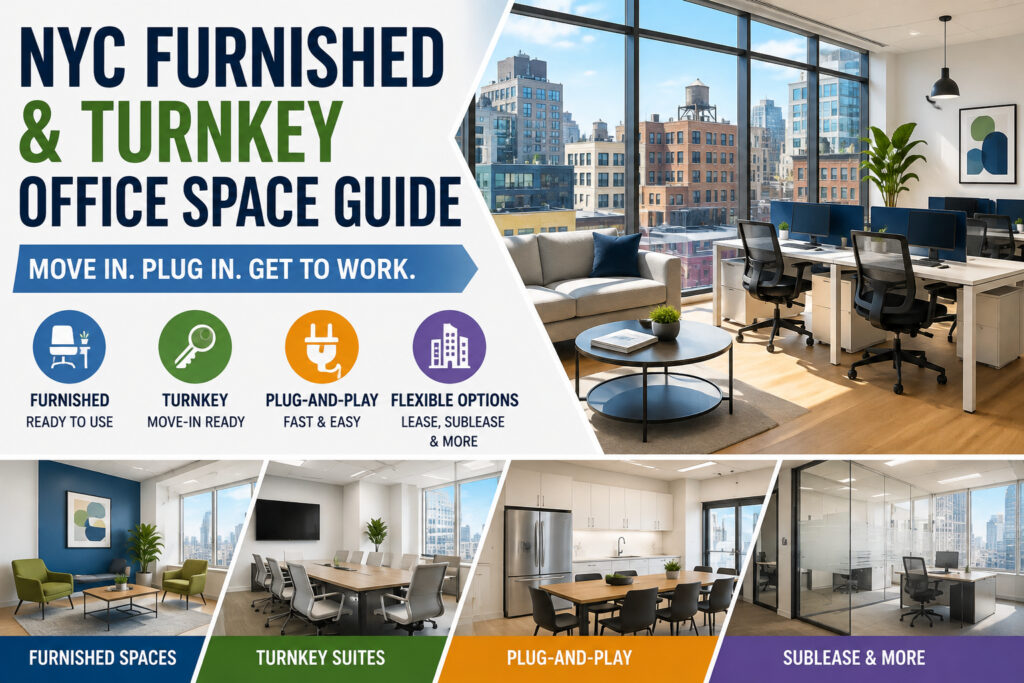
NYC Furnished and Turnkey Office Space Guide
Need an NYC office you can use quickly, without starting a construction project?
New York businesses use “furnished,” “turnkey,” and “plug-and-play” to describe several very different office arrangements. Those terms can overlap, but they do not promise the same occupancy rights or services. Current market offerings range from furnished direct leases to subleases, prebuilt suites, serviced offices, and short-term licenses.
That distinction matters because a desk-filled office can still require internet, cleaning, wiring, insurance, or other setup. Likewise, a “turnkey” suite may come ready for work but follow a conventional commercial lease. The right choice depends on what your business needs on day one and throughout the term.
Our commercial leasing guide explains the wider leasing process. This guide focuses specifically on speed, existing condition, furniture, infrastructure, and occupancy structure.
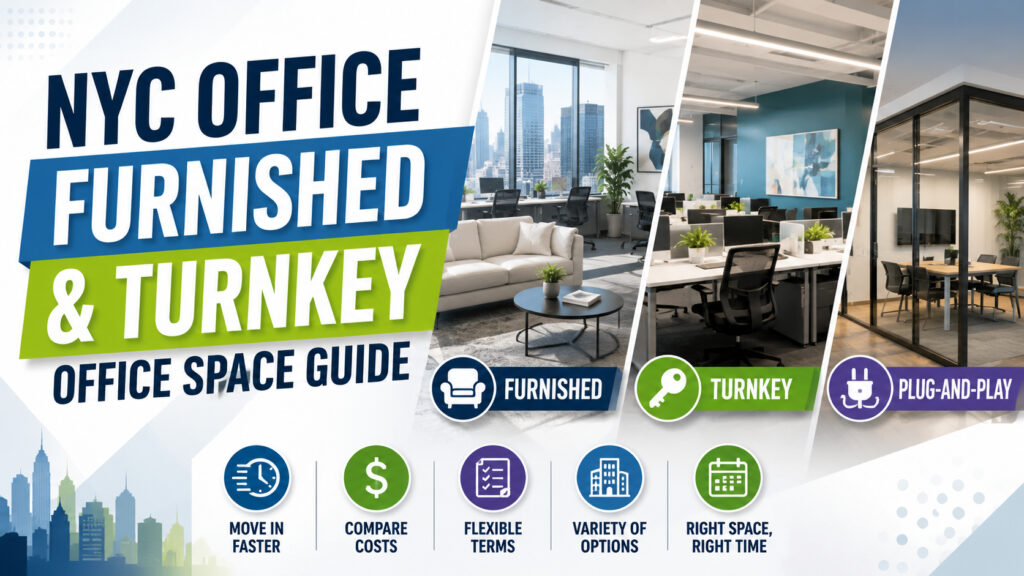
What furnished, turnkey, and plug-and-play office space actually mean
The simplest mistake involves treating every move-in-ready office as the same product. In practice, tenants encounter several different categories.
A furnished office has furniture in place.
Desks, task chairs, conference tables, storage, reception furniture, or lounge pieces may remain. However, furniture alone does not make a suite operational.
A furnished direct lease might still require a separate internet contract. The tenant may also arrange cleaning, phones, security, or pantry service.
Therefore, always ask what “furnished” includes. Confirm quantities, condition, ownership, and removal obligations before signing.
A turnkey office starts with a completed workplace.
Turnkey generally describes a suite that needs little physical work before occupancy. Walls, lighting, flooring, rooms, pantry infrastructure, and furniture may already suit the incoming tenant.
However, “turnkey” does not create a universal checklist. One landlord may mean a finished spec suite. Another may offer furniture and cabling as well.
The safest approach treats turnkey as a condition description, not a complete economic description.
Plug-and-play goes one step closer to immediate operations.
A true plug-and-play office should let your team begin working with minimal setup. Existing workstations, cabling, conference rooms, power, and pantry infrastructure usually support that goal.
Internet service still deserves separate confirmation. Existing data cabling does not guarantee a live internet circuit.
Our guide to plug-and-play office space explains that distinction in more detail.
Prebuilt space describes construction, not furniture.
A landlord may build a suite before finding the tenant. That prebuilt office can include offices, conference rooms, pantry areas, and finished common areas.
Some landlords add furniture. Others deliver an empty but completed workplace.
Consequently, “prebuilt,” “furnished,” and “turnkey” can describe the same suite without meaning the same thing.
A furnished sublease combines existing improvements with another tenant’s remaining term.
Here, your company occupies space from an existing tenant rather than directly from the building owner. Many NYC office sublets include furniture because the outgoing company already equipped the premises.
This arrangement can create strong value. Yet the master lease, landlord consent, remaining term, and furniture rights require careful review.
A flex or serviced arrangement usually packages space with services.
These offerings can combine furniture, internet, cleaning, reception, shared meeting areas, and other services. They also tend to support shorter commitments than conventional leases.
The agreement may use a license rather than a traditional lease. New York law distinguishes occupancy arrangements partly through the rights and control that each agreement grants. Therefore, tenants should have counsel review the actual document instead of relying on its title.
Coworking is not synonymous with turnkey office space.
A company can occupy a private turnkey suite without sharing its workplace. Direct leases and subleases can both offer fully private plug-and-play environments.
Coworking usually introduces a larger shared operating platform. Meeting rooms, lounges, kitchens, reception, and other amenities may serve multiple companies.
That difference affects privacy, branding, security, costs, and day-to-day control.
Swing space solves a temporary timing problem.
A business may need an interim office while construction, relocation, or another transaction runs behind schedule. Furnished space often works well for this purpose.
Our NYC swing space guide covers this temporary occupancy strategy.
The central rule stays simple: do not shop by label alone. Compare the exact premises, furniture, services, legal structure, term, and total cost.
Choose the occupancy structure that fits your company
Two NYC offices can look nearly identical during a tour. Their contracts can produce completely different business outcomes.
That makes occupancy structure just as important as furniture and finishes.
| Office structure | What you receive | Main advantage | Main issue to examine |
|---|---|---|---|
| Furnished direct lease | Existing furniture under a landlord lease | More direct landlord relationship and potential term stability | Furniture ownership, operating costs, lease length, restoration |
| Turnkey direct lease | Completed office requiring little physical work | Fast occupancy with conventional lease control | What “turnkey” actually covers |
| Furnished sublease | Existing office from another tenant | Furniture and improvements can reduce setup costs | Remaining master lease term and landlord consent |
| Plug-and-play sublease | Furnished, wired, operationally ready suite | Particularly fast transition | IT handoff, furniture rights, sublandlord risk |
| Prebuilt or spec suite | Completed landlord-built office | Avoids a ground-up construction schedule | Furniture and technology may not come with it |
| Flex or serviced office | Space plus bundled services | Shorter commitments and simplified operations | Premium pricing, limited control, license terms |
| Swing space | Temporary workplace for a transition | Bridges a timing gap | Short useful life and moving twice |
| Coworking or shared office | Private or open space inside shared facilities | Small-team flexibility | Privacy, branding, shared amenities, recurring fees |
Choose a furnished direct lease when control matters.
A direct relationship can work well for companies that want a recognizable office identity. It also suits tenants that expect to remain in one building.
Many current direct spaces already contain substantial improvements. Some landlords will also modify an existing installation for the right tenant.
For example, this 2,530-square-foot furnished Hudson Square office offers a prebuilt direct lease. Its current plan includes open workstations, a conference room, and pantry space.
A 3,038-square-foot furnished Flatiron office also offers immediate direct occupancy. Its plan combines meeting rooms, phone booths, and communal kitchen space.
Consider a true sublease when term and economics align.
A furnished sublease can eliminate much of the investment that another tenant already made. Furniture, glass offices, conference rooms, pantry infrastructure, and cabling may remain.
Sublease terms also follow the existing lease calendar. That feature can help companies seeking a defined intermediate commitment.
However, a short remaining term can become a disadvantage when relocation costs run high. Renewal rights may also prove limited.
Review our current office sublets alongside direct alternatives before deciding.
Use plug-and-play space when time carries a real cost.
Fast-moving teams often value operational readiness more than design customization. That can include project groups, professional firms, expansion teams, and companies entering Manhattan.
A plug-and-play suite works especially well when the existing layout closely matches your staffing plan. Otherwise, an apparently fast office may require expensive changes.
Flex arrangements fit some small teams, but they solve a different problem.
Short commitments can help uncertain or changing businesses. Bundled services also reduce administrative setup.
Nevertheless, price comparisons require care. A monthly serviced-office price may include expenses that a conventional lease quotes separately.
Compare total occupancy cost for the intended term, rather than comparing headline numbers.
Growth changes the answer.
A ten-person company expecting twenty people soon should not evaluate space only for today. Likewise, a hybrid company should avoid leasing desks that remain unused most weeks.
Look at attendance patterns, recruiting plans, meeting demand, and client use. Then choose an office structure that supports the most probable business scenario.
Our short-term office leasing guide explores that tradeoff further.
What NYC furnished and turnkey office space costs
Furnished office pricing in New York does not follow one universal format.
Traditional direct leases and subleases often quote rent as annual dollars per rentable square foot. Serviced or flexible offices may quote monthly rates instead.
That distinction can make two prices look comparable when they are not.
Start with the current Manhattan market.
During the second quarter of 2026, Manhattan’s overall average asking rent reached $80.17 per square foot. The average asking rent for sublease space reached $59.94 per square foot. Overall availability stood at 14.4%, while sublease availability fell to 2.6%.
Those numbers cover the broader Manhattan office market. They do not represent a single furnished-office price.
Midtown averaged $86.18 per square foot during the same quarter. Midtown sublease asking rents averaged $63.19 per square foot.
Downtown showed a different cost profile. Its overall asking rent averaged $61.34 per square foot, while sublease asking rent averaged $47.13.
Building quality, floor height, views, neighborhood, lease term, installation, and concession package can move actual economics significantly.
Translate annual asking rent into a monthly number.
Consider a 5,000-square-foot office at $80.17 per square foot.
Annual base rent equals roughly $400,850. Monthly base rent equals about $33,404.
At $59.94 per square foot, the same 5,000 square feet equals approximately $24,975 monthly.
Neither calculation represents a complete occupancy budget.
Current furnished inventory shows how individual opportunities can diverge.
One 8,285-square-foot Lexington Avenue turnkey office currently quotes $42 per square foot. The space includes furniture, fixtures, and equipment. Its published sublease term runs through December 2026.
Another current 2,573-square-foot furnished Financial District office quotes $39 per square foot. That offering combines private offices, a conference room, open workspace, and pantry.
These examples show why broad averages cannot replace individual deal analysis.
Calculate total occupancy cost, not merely base rent.
Depending on the agreement, a tenant may face costs for:
Electricity and utility charges. Some structures bundle them, while others meter or allocate them separately.
Cleaning. Verify whether the landlord, sublandlord, operator, or tenant handles routine cleaning.
Internet and telecommunications. A wired suite does not necessarily include active service.
After-hours HVAC. Buildings may charge for heating or cooling beyond standard operating periods.
Furniture. Determine whether rent includes it, a separate sale transfers it, or another party retains ownership.
Security deposits. Deposit structures vary with credit, agreement type, financial strength, and negotiation.
Insurance. Commercial occupancy agreements normally include insurance requirements.
Moving and technology migration. Even furnished offices require computers, files, equipment, connectivity, and staff coordination.
Operating expense or tax escalations. Direct leases may contain additional rent provisions beyond fixed base rent.
Shared-service charges. Some flexible arrangements charge separately for conference rooms, printing, storage, mail services, or extra access.
Because every structure allocates these costs differently, build an apples-to-apples occupancy model.
Furniture has value only when your company can actually use it.
Fifty workstations do not create savings for a company that needs thirty private offices. Likewise, beautiful furniture creates little value if ergonomics or dimensions fail your standards.
Count every usable workstation during due diligence. Inspect private offices and meeting rooms as carefully.
Then assign value only to items your business would otherwise purchase.
Turnkey can reduce capital expenditure without producing the lowest rent.
A more expensive ready-made office can still outperform a cheaper raw space. Construction, architecture, furniture, cabling, project management, and lost time all carry costs.
Conversely, a turnkey premium makes little sense when your company plans a major redesign.
The economic question therefore becomes:
What will this office cost from commitment through exit, including the work required before day one?
That calculation usually gives tenants a better answer than asking which office has the lowest asking rent.
Commercial Rent Tax can affect Manhattan occupancy costs.
New York City applies Commercial Rent Tax under specific conditions for commercial occupancy south of 96th Street. The annualized gross-rent threshold starts at $250,000, subject to credits and exemptions. The city’s definition can include lessees, sublessees, licensees, and concessionaires.
Businesses should confirm their actual tax position with qualified tax or legal advisers.
Where move-in-ready office space works best in NYC
There is no single “best” neighborhood for a furnished office. The correct location depends on employees, clients, travel patterns, building requirements, and budget.
Fortunately, move-in-ready inventory spans several major Manhattan office districts.
Grand Central and Midtown East suit transit-focused professional teams.
Companies that rely on regional commuters often prioritize this area. Professional services firms also value its concentration of conventional office buildings.
Current choices cover both compact and larger formats.
A 3,240-square-foot turnkey Park Avenue office includes 18 workstations, meeting space, a conference room, a phone room, and pantry.
For a larger requirement, this 7,134-square-foot turnkey Vanderbilt Avenue office includes executive offices, private rooms, workstations, and kitchen space.
Teams needing a temporary arrangement can also review this 5,080-square-foot turnkey East 42nd Street office. The current plan supports 26 workstations plus meeting rooms.
Penn Station and Midtown West offer a deep furnished-office lane.
Regional rail access makes the Penn Station area especially practical for commuter-heavy teams. Existing Class A installations also create numerous sublease opportunities.
A 3,378-square-foot furnished Penn Plaza office includes seven private offices and open workstations. Its published sublease term runs through January 2027.
Nearby, a 4,776-square-foot Penn Plaza furnished office offers five private offices, conference areas, kitchen space, and 18 workstations. The published term continues through July 2027.
A 5,170-square-foot furnished Penn Plaza sublet offers a larger plug-and-play layout. Its current published term runs through November 2027.
Further west, this 6,061-square-foot furnished Times Square office offers a direct lease. Its current plan supports approximately 40 people.
Flatiron, Chelsea, SoHo, and Hudson Square favor distinctive existing installations.
Loft buildings can deliver exposed ceilings, polished floors, high ceilings, and open plans. Those characteristics often appeal to creative, media, technology, and design-oriented tenants.
This 4,722-square-foot furnished Chelsea office provides a full-floor penthouse sublease. Its published term runs through December 2027, with shorter terms considered.
A larger 7,000-square-foot furnished SoHo office offers a wired turnkey sublease. Its current published capacity reaches approximately 47 people.
Teams seeking a larger full floor can review this 11,239-square-foot furnished Flatiron office. Its existing plan supports 48 workstations and potential expansion within the installation.
Hudson Yards can suit companies seeking modern buildings and larger prebuilt space.
A 11,907-square-foot furnished Hudson Yards office currently offers direct leasing. The move-in-ready prebuilt plan targets approximately 79 people.
Such spaces can eliminate a substantial initial construction process. However, premium buildings may carry higher overall economics.
The Financial District offers both smaller furnished suites and larger floors.
Downtown’s Q2 2026 average asking rents remained below Midtown’s broad averages. That difference can create useful value comparisons for location-flexible tenants.
A 5,606-square-foot furnished Pine Street office comes wired and move-in ready. Its published sublease term extends through September 2029.
Companies seeking larger direct space can compare this 10,115-square-foot furnished full-floor Financial District office. The direct offering currently provides an existing second-generation installation.
Location should ultimately support the business rather than the furniture package.
Use our guide to NYC office neighborhoods to compare additional submarkets.
Current furnished and turnkey NYC office opportunities
Our broader database provides access to more than 1,400 commercial spaces, with furnished inventory changing as transactions occur.
The examples below show how diverse today’s move-in-ready market can be. They include direct leases, true subleases, compact suites, and full-floor opportunities.
Availability can change quickly. Always confirm current status, pricing, furniture, term, and occupancy timing before relying on a listing.
| Furnished or turnkey office | Size | Structure | Current readiness or published term |
|---|---|---|---|
| Furnished Hudson Square Office | 2,530 SF | Direct lease | Prebuilt and furnished for immediate occupancy. |
| Financial District Furnished Office Space | 2,573 SF | Sublet | Furnished; current asking price lists $39/SF. |
| Tower 56 Office Space Rental | 2,582 SF | Direct lease | Fully furnished contemporary turnkey suite. |
| Small Fifth Avenue Office | 2,791 SF | Direct lease | Prebuilt and move-in ready. |
| Seventh Avenue Furnished Office Space | 2,982 SF | Direct lease | Furnished layout with conference room and workstations. |
| Furnished 21st Street Office Space | 3,038 SF | Direct lease | Furnished and available for immediate lease. |
| Furnished Liberty Street Office Space | 3,138 SF | Sublet | Furnished, wired, and turnkey; published through December 2030. |
| Furnished Varick Street Office | 3,191 SF | Direct lease | Fully furnished and move-in ready. |
| Turnkey Park Avenue Office | 3,240 SF | Direct lease | 18 workstations plus conference and meeting areas. |
| Furnished Office Space in Penn Plaza | 3,378 SF | Sublet | Turnkey furnished; published through January 2027. |
| Furnished Fifth Avenue Office Space | 3,414 SF | Sublet | Furnished; published through August 2027. |
| Furnished Penn Plaza Office Space | 3,456 SF | Sublet | Furnished turnkey layout; published through November 2027. |
| Murray Hill Office for Lease | 3,826 SF | Direct lease | Furnished move-in-ready suite with private rooms. |
| Furnished Seventh Avenue Office | 3,944 SF | Direct lease | Fully built-out full-floor office. |
| Furnished Third Avenue Office | 4,090 SF | Direct lease | Furniture, 24 workstations, offices, and conference rooms. |
| Furnished Chelsea Office Space | 4,722 SF | Sublet | Furnished full floor; published through December 2027. |
| Penn Plaza Furnished Office Space | 4,776 SF | Sublet | Fully furnished and wired; published through July 2027. |
| Turnkey East 42nd Street Office | 5,080 SF | Sublet | Prebuilt turnkey office with 26 workstations. |
| Penn Plaza Furnished Sublet Office | 5,170 SF | Sublet | High-end plug-and-play space; published through November 2027. |
| Furnished Pine Street Office | 5,606 SF | Sublet | Furnished and wired; published through September 2029. |
| Midtown West Office Space for Lease | 5,999 SF | Direct lease | Landlord-furnished; current asking price lists $62/SF. |
| Furnished Times Square Office | 6,061 SF | Direct lease | Fully furnished prebuilt suite for approximately 40 people. |
| Furnished Park Ave Office | 6,131 SF | Sublet | Furnished and move-in ready with multiple enclosed rooms. |
| Furnished Soho Office Space | 7,000 SF | Sublet | Wired turnkey office with published capacity around 47 people. |
| Turnkey William Street Office | 7,090 SF | Direct lease | Existing workstations, offices, meeting rooms, and pantry. |
| Turnkey Vanderbilt Avenue Office | 7,134 SF | Direct lease | Existing private offices, executive rooms, workstations, and kitchen. |
| Lexington Avenue Turnkey Furnished Office | 8,285 SF | Sublet | FF&E included; published term through December 2026. |
| Furnished Full Floor Financial District Office | 10,115 SF | Direct lease | Existing furnished full-floor installation. |
| Furnished Park Avenue South Office | 10,439 SF | Sublet | Furnished larger-floor opportunity. |
| Furnished Penn Station Office | 10,537 SF | Sublet | Move-in-ready full floor with estimated 70-person capacity. |
| Full Floor Flatiron Office | 11,239 SF | Sublet | Fully furnished and wired full floor. |
| Furnished Hudson Yards Office | 11,907 SF | Direct lease | Move-in-ready prebuilt office for approximately 79 people. |
| Full Floor Plaza District Furnished Office | 14,765 SF | Sublet | Entire furnished floor; published term through March 2030. |
| Bryant Park Sublet Office Space | 15,116 SF | Sublet | Furnished two-floor opportunity. |
| Chelsea Office for Lease | 17,610 SF | Direct lease | Larger turnkey direct opportunity. |
The table also demonstrates an important point. “Furnished office space in NYC” does not describe one size category.
A tenant can find a compact 2,500-square-foot suite or a full floor exceeding 14,000 square feet. Likewise, move-in-ready choices appear under direct leases and subleases.
That breadth matters for companies leaving flexible workspace. A team no longer needs to choose between a shared office and a lengthy custom construction project.
Instead, many private offices already occupy the middle ground.
Search our broader New York office space inventory for additional choices. Our types of office space guide also explains other configurations.
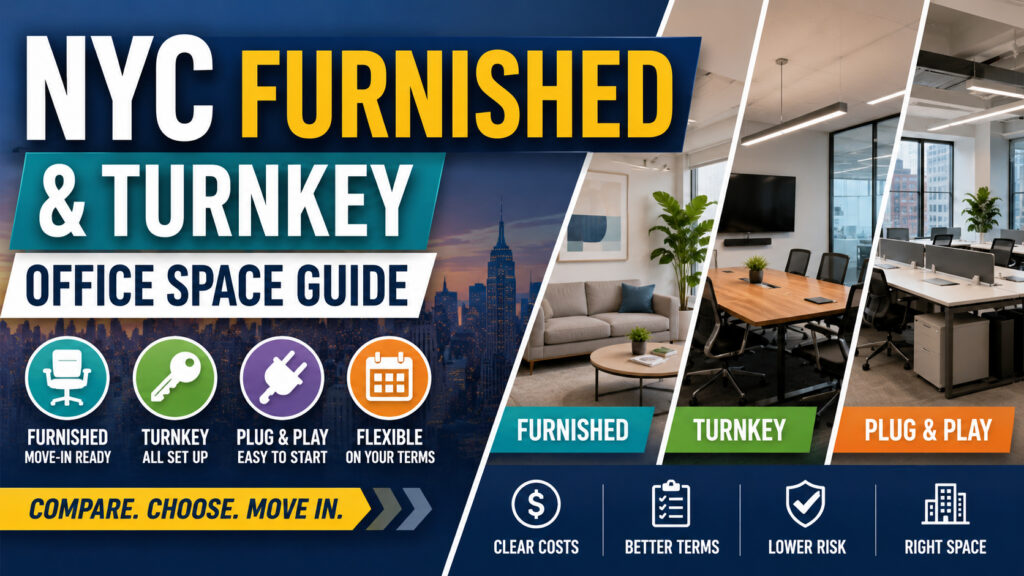
What to inspect before committing to a furnished or turnkey office
A furnished office tour should answer more than one question.
The wrong question asks, “Does this look ready?”
The better question asks, “What must happen between signing and productive occupancy?”
Start with a furniture inventory.
Count workstations instead of relying on a marketing capacity number. Then inspect desks, task chairs, conference tables, storage, reception pieces, and lounge furniture.
Identify anything that appears damaged or unsuitable. Photograph material furniture during due diligence.
Most importantly, determine who owns every important item.
The lease or sublease should address furniture clearly. A separate inventory exhibit can help prevent later disputes.
Match the existing layout against your actual headcount.
A 40-person theoretical capacity does not guarantee a suitable 40-person workplace. Private-office needs can change the effective capacity dramatically.
Conference demand also matters. A company with frequent client meetings may need more enclosed rooms than a hybrid technology team.
Likewise, legal and financial firms may prioritize privacy. Creative groups may prefer larger open collaboration areas.
Do not force the business into a layout merely because the furniture already exists.
Test the technology assumptions.
Ask whether the suite has live internet service or merely cabling. Confirm available providers, riser access, activation timing, and contract responsibility.
Next, review data locations throughout the office. Existing wiring may not support your exact workstation plan.
Phone rooms and conference rooms deserve separate inspection. Verify power, display connections, acoustics, and video-conference needs.
Cybersecurity requirements can also affect the decision. A private network may matter far more than convenient shared Wi-Fi.
Check electrical capacity and outlets.
Modern teams can consume significant power through monitors, laptops, equipment, server hardware, and kitchen appliances.
Older installations may require modifications. Furniture placement can also hide inconvenient outlet locations.
Therefore, have your technology or facilities team inspect critical infrastructure early.
Understand HVAC coverage.
Ask for normal building HVAC hours. Then determine how the building handles after-hours use.
Some businesses operate evenings or weekends. Others coordinate with overseas teams across time zones.
An inexpensive office can become costly when after-hours HVAC charges accumulate.
Confirm building-access rights.
Do not assume “move-in ready” automatically means unrestricted access.
Review security hours, key-card policies, visitor procedures, freight access, elevator reservations, loading rules, and move requirements.
Teams that work late should confirm their actual access rights in writing.
Walk the route from building entrance to desk.
Tenant experience starts before the office door.
Observe the lobby, elevators, security process, restroom access, common corridors, and visitor arrival sequence.
A furnished suite may look excellent while the wider building fails your client-facing needs.
Inspect the pantry and plumbing.
Check appliances, sinks, refrigerators, cabinetry, water lines, and waste arrangements.
Existing appliances may remain without warranties. Clarify maintenance responsibility before assuming they have value.
Pantry condition also affects move-in speed. Replacing appliances after occupancy can disrupt operations.
Clarify cleaning responsibilities.
Ask who cleans private offices, conference rooms, pantry areas, and restrooms.
A serviced workspace may package cleaning into the monthly fee. A conventional direct lease can leave more responsibility with the tenant.
Subleases can follow yet another arrangement.
Review conference-room reality rather than room labels.
A room called a conference room may seat six people comfortably, not ten. Test actual clearances around the table.
Hybrid meetings add more requirements. Screens, cameras, microphones, sound control, and reliable connectivity all influence usability.
The same scrutiny applies to phone booths and focus rooms.
Look at natural light where employees actually sit.
A bright reception area does not guarantee a bright workplace.
Walk through every work zone. Note perimeter offices that block light from reaching interior employees.
Furniture can move. Glass walls usually cannot move without cost.
Ask what the landlord will change.
A furnished office does not always require strict acceptance of the existing plan.
Some landlords will modify flooring, paint, rooms, furniture, or finishes. Direct leases can create more opportunity for these negotiations.
However, every change affects timing. Establish a clear scope before counting on a rapid move.
For subleases, study the master lease early.
The sublease sits beneath the existing lease structure. Therefore, tenant counsel should review relevant master-lease provisions.
Confirm landlord consent requirements. Examine use restrictions, operating rules, insurance requirements, and the master lease expiration.
Also review what happens if the sublandlord defaults.
A good furnished sublease solves an occupancy need. It should not create an avoidable legal dependency.
Confirm the legal use of the premises.
An attractive existing installation does not replace proper legal review. The intended business use must fit applicable occupancy requirements and agreement terms.
Changes to an existing suite can also trigger additional review. That makes major reconfiguration less compatible with a true rapid move.
Build a move-in checklist before signing.
Include furniture, internet, insurance, access cards, movers, address changes, IT migration, signage, phones, security, and employee communications.
Assign an owner and deadline to every task.
A physical office can sit ready while operational details delay the team.
How to negotiate flexibility without creating hidden risk
Move-in-ready space often attracts tenants because it promises convenience. Convenience should not replace negotiation.
In fact, the existing furniture and shorter timeline make certain business terms even more important.
Define “as-is” rather than accepting a vague phrase.
Existing-condition deals often use “as-is” language. Tenants should identify any repairs or changes that must occur before occupancy.
List damaged furniture separately. Address nonworking equipment and missing pieces as well.
The goal is not to redesign the office. It is to avoid inheriting unexpected problems.
Attach a furniture schedule when furniture matters.
The document should identify major FF&E that stays with the premises. It should also explain ownership at lease expiration.
Ask these questions before signing:
Who owns the furniture today?
Who owns it at the end?
Can the tenant remove or replace pieces?
Who repairs damaged furniture?
Does the incoming tenant need to return the furniture?
Who bears removal costs?
These issues can change the value of the package.
Negotiate direct furnished leases as real leases.
Furniture should not distract from core lease economics.
Compare base rent, escalations, free rent, security, term, renewal rights, operating costs, assignment rights, and surrender requirements.
Likewise, evaluate landlord work carefully. A furnished suite may still justify paint, flooring, cabling, or small layout changes.
For a complete framework, use our NYC commercial leasing guide.
Treat sublease expiration as a business event.
A furnished sublease can create excellent interim economics. However, the existing master lease eventually controls the available term.
Plan the exit before moving in.
Does the company expect another relocation? Could a direct deal become available later? Would an expansion option elsewhere in the building help?
Those questions matter when technology and moving costs become substantial.
Ask whether shorter terms improve flexibility enough to justify their cost.
A short agreement reduces commitment. It also means your next move comes sooner.
Companies should compare the value of optionality against repeated relocation expenses.
Sometimes a three-year furnished direct lease can outperform a one-year temporary arrangement. Another business may need only several months.
There is no universal ideal term.
Negotiate expansion before you desperately need it.
Growing companies should ask about contiguous suites, larger spaces elsewhere in the building, or relocation rights.
The answer may simply involve understanding likely building options. Even that knowledge can improve planning.
A flexible workspace operator might offer easier internal expansion. Conventional buildings can provide better long-term control.
Compare both rather than assuming one model wins.
Discuss branding before committing.
Direct leased space normally gives tenants more control, subject to lease and building rules. Subleases can inherit limits from the master lease.
Serviced arrangements may restrict signage even further.
Client-facing companies should confirm reception branding, door signage, directory listings, and exterior opportunities early.
Protect privacy requirements.
Shared reception and conference infrastructure can reduce cost. It can also create confidentiality concerns.
Legal, financial, healthcare, and other privacy-sensitive organizations should review sound separation, data security, visitor controls, and document handling.
A fully private direct or subleased suite may better fit those requirements.
Understand every bundled service.
“All-inclusive” only helps when the agreement defines the package.
Ask about internet speed, meeting-room hours, printing, reception, cleaning, coffee, mail, furniture, utilities, access, and support.
Then ask what triggers additional fees.
The answer turns a convenient package into a usable budget.
Compare effective cost over your intended occupancy period.
Create one model for each serious option.
For a direct lease, include rent, additional rent, setup work, furniture, internet, moving, and professional costs.
For a sublease, include the same items plus furniture-transfer considerations and potential short-term relocation costs.
For a serviced arrangement, multiply recurring fees across the anticipated term. Add meeting-room and other usage charges where relevant.
Only then can you compare structures fairly.
Do not confuse a fast transaction with an instant transaction.
Even a finished office can require documentation, insurance, security approval, landlord consent, technology activation, or moving coordination.
A sublease may also need formal building-owner consent.
Build contingency time into the schedule. Keep your existing occupancy available until the critical approvals become clear.
Use both brokerage and legal review for their proper roles.
Tenant representation helps compare inventory, economics, location, condition, and commercial terms. Legal counsel handles the agreement and legal rights.
Eligible NYC small businesses may qualify for free assistance with certain commercial lease matters. The city program covers activities including signing, amending, renewing, or terminating eligible commercial leases.
Together, those disciplines help convert a visually appealing office into a workable business transaction.
NYC furnished and turnkey office questions tenants ask
What is the difference between furnished and turnkey office space?
Furnished means the office contains furniture. Turnkey generally means the broader workplace requires little physical setup.
A turnkey office may include furniture, but tenants should confirm that point.
Likewise, furnished space may still need internet, cleaning, telecommunications, or other services.
What does move-in ready mean in NYC?
Move-in ready generally describes an existing office that requires little or no construction before occupancy.
However, operational readiness depends on the tenant.
One company may need only laptops and internet. Another needs dedicated telecom systems, security controls, branding, or specialized equipment.
Therefore, determine what your company needs before accepting the term at face value.
Is turnkey office space the same as coworking?
No.
A private direct lease can provide turnkey space. A traditional sublease can also provide a fully private plug-and-play office.
Coworking represents a shared workspace model. Turnkey describes office condition and readiness more broadly.
Are turnkey offices always fully furnished?
No universal rule guarantees that.
Some landlords use turnkey to describe a completed buildout without furniture. Others include desks, chairs, conference furniture, and more.
Ask for a written inventory before assigning value to the furniture package.
Are furnished offices always short term?
No.
Furnished inventory can appear under long-term direct leases, medium-term subleases, and very short flexible arrangements.
Current NYC listings demonstrate all three categories.
Can a company take a normal direct lease on furnished office space?
Yes.
Current NYC inventory includes numerous furnished direct leases. Examples range from small prebuilt suites to full-floor offices.
The furniture does not force a serviced-office structure.
What is a true furnished office sublease?
A current tenant grants occupancy under a sublease. The incoming company becomes the subtenant.
Existing furniture and improvements may stay in place. The transaction remains subject to the relevant lease framework and consent requirements.
That structure differs from renting a private room inside a managed business center.
Is a furnished sublease always cheaper than a direct lease?
No.
Subleases can offer attractive economics because another tenant wants to reduce an existing obligation. Yet pricing varies by building, term, condition, and market demand.
Current Q2 2026 broad asking averages show lower sublease rents than overall Manhattan asking rents. Individual transactions can still differ greatly.
Compare effective economics for the actual spaces under consideration.
How fast can a business move into a turnkey NYC office?
Physical readiness can shorten the schedule dramatically. Documentation and operational requirements still take time.
Internet activation, insurance, building access, movers, furniture review, and approvals can affect the actual date.
A sublease can also require landlord consent.
Therefore, distinguish construction readiness from transaction readiness.
Does a furnished office include internet?
Not necessarily.
Some serviced offices bundle internet. Traditional furnished direct leases and subleases may provide only the physical cabling.
Confirm active service, provider, capacity, cost, installation timing, and network control.
Does turnkey include utilities?
Sometimes, but never assume it.
A flexible package may bundle utilities. Conventional leases can allocate electricity and other costs separately.
Ask for a complete occupancy-cost schedule.
Does turnkey include cleaning?
That depends on the agreement.
Serviced structures often package cleaning. Direct leases and subleases can use different arrangements.
Check both private office cleaning and shared-area maintenance.
Can we bring our own furniture into a furnished office?
Usually that question depends on ownership and agreement terms.
A tenant may replace individual pieces or redesign the entire installation. However, existing furniture may need storage or restoration later.
Confirm removal rights before signing.
Do we own the furniture after the lease ends?
Only when the transaction documents say so.
Sometimes furniture belongs to the landlord. A sublandlord may transfer ownership separately.
Other deals simply permit furniture use during occupancy.
Document the answer rather than relying on tour conversations.
Can we brand a furnished office?
Often, yes, but the degree varies.
Direct leased premises can offer stronger control. Sublease rights may depend on the master lease.
Serviced arrangements can impose additional branding limits.
Ask about reception signs, suite signs, directory listings, and wall treatments.
Can a landlord modify a turnkey office?
Many landlords will consider reasonable changes.
The scope depends on deal size, term, economics, building, and existing installation.
However, major modifications can erase the speed advantage that made the suite attractive.
Focus on changes that materially improve usability.
What happens when a furnished sublease expires?
The subtenant normally needs another occupancy solution unless the parties create a new arrangement.
Do not assume the sublease automatically converts into a direct lease.
Start planning early when the remaining term becomes short.
Can a company renew a furnished sublease?
A renewal depends on the underlying lease, parties, available term, and negotiated rights.
A sublandlord cannot simply create years beyond rights it does not possess.
Tenants seeking long-term location certainty should compare direct options carefully.
Is furnished office space good for a startup?
It can work very well when speed and capital preservation matter.
A startup can avoid buying substantial furniture or waiting through a custom build.
However, the company still needs an occupancy term that matches cash flow and growth expectations.
Flexible does not automatically mean economical.
Is turnkey space good for an established company?
Yes.
Established businesses use turnkey space for relocations, project teams, expansions, temporary headquarters, satellite offices, and permanent workplaces.
The key advantage involves avoiding unnecessary construction when a suitable installation already exists.
What companies benefit most from plug-and-play offices?
Several business situations align well.
Companies entering NYC can establish operations quickly. Project teams can occupy space for a defined assignment.
Growing firms can bridge uncertainty. Businesses displaced during construction can also use swing space.
Professional firms often value existing private offices and meeting rooms.
Should we choose the office with the most furniture?
No.
Choose the installation that best matches your real operating model.
Thirty useful workstations create more value than fifty poorly placed ones. Appropriate conference rooms can matter more than extra desks.
Furniture only saves money when it replaces something you genuinely need.
How much office space does our team need?
Start with your workplace program rather than a generic square-footage ratio.
Count regular attendance, offices, workstations, conference rooms, phone rooms, reception, storage, pantry areas, and growth needs.
Hybrid attendance can reduce desk demand. It can also increase demand for collaboration rooms.
A test fit provides a better answer than multiplying headcount by one universal number.
Is furnished space better than building a new office?
It depends on the business.
Existing space wins when speed, reduced upfront work, and sufficient layout compatibility matter.
A custom build can win when workplace design, specialized rooms, branding, or long-term control justify the investment.
The best transaction fits both the company’s current needs and likely future use.
Should we choose a direct lease or a sublease?
Choose after comparing the actual alternatives.
Direct leases can offer stronger long-term control and a direct landlord relationship. Subleases can deliver existing infrastructure with defined shorter terms.
Neither structure wins automatically.
Compare price, remaining term, furniture, flexibility, landlord relationship, renewal prospects, and exit plan.
When does a serviced office make more sense?
Very small teams may prefer bundled operations and shorter commitments.
Companies entering New York temporarily may value simplicity as well.
As headcount rises, compare the recurring serviced-office premium against private direct and sublease options.
Private plug-and-play space can sometimes provide flexibility without a shared-office model.
What is the biggest mistake tenants make with turnkey office space?
They assume “ready” means everything they need already comes with the deal.
Instead, confirm physical condition, furniture, network service, access, operating costs, legal structure, and required approvals.
The second major mistake involves valuing a beautiful installation that does not fit the team.
What should we ask during the first tour?
Start with the practical questions.
Ask how many workstations remain. Confirm which furniture stays.
Then ask about the lease structure, available term, internet, HVAC, cleaning, access, landlord work, and move-in timing.
Finally, identify any costs or approvals between signing and occupancy.
How should we compare three furnished offices?
Score each space across the same categories:
Location. Measure employee and client convenience.
Layout. Count genuinely usable seats and rooms.
Condition. Identify repairs or modifications.
Term. Match commitment length against the business plan.
Total economics. Include every meaningful occupancy cost.
Technology. Confirm actual readiness rather than assuming connectivity.
Control. Review privacy, branding, access, and agreement structure.
Exit. Understand what happens when the term ends.
The lowest asking rent may lose once those factors enter the comparison.
How current is furnished office availability?
Inventory changes continuously as tenants sign leases, withdraw spaces, extend terms, or add new opportunities.
Our database currently provides access to more than 1,400 commercial spaces overall.
For move-in-ready space, verify availability again before scheduling tours or making business plans.
What is the fastest way to find the right furnished office?
Define five items before reviewing dozens of spaces:
Target neighborhoods, practical size, occupancy date, desired term, and complete budget.
Then separate direct leases from subleases and flexible arrangements. That step prevents fundamentally different transactions from blending together.
Tour the strongest existing installations first. Compare the finalists through one economic model.
Our office sublet inventory and broader NYC office space inventory provide useful starting points.
What matters more: furnished or turnkey?
Neither label matters as much as operational fit.
A properly furnished suite with live technology may work immediately. Another “turnkey” office might require furniture, connectivity, and layout changes.
Focus on what remains to complete before the first workday.
What does the current NYC office market mean for tenants seeking move-in-ready space?
Manhattan availability has tightened from prior levels, while leasing activity remains active. Q2 2026 availability reached 14.4%, down 310 basis points year over year.
That does not eliminate tenant choices. However, unusually strong furnished installations may attract attention quickly.
Tenants should compare the best-fitting spaces decisively while still completing proper diligence.
Should a tenant use a broker for furnished and turnkey space?
A tenant representative can compare multiple occupancy structures rather than presenting one provider’s inventory.
That becomes especially useful when direct leases, subleases, plug-and-play suites, and flexible agreements compete for the same requirement.
The objective should remain tenant-focused: compare alternatives, expose hidden costs, negotiate terms, and protect future flexibility.
Today’s Options Await
We represent office tenants through the search, tour, comparison, and negotiation process. We compare furnished direct leases, true subleases, and other move-in-ready options on equal economics. Our goal remains simple: secure the right condition, flexibility, and occupancy terms for your business.
Fill out our 📋 online form or give us a call today 📞 212-967-2061 — let’s find the right options for your business.