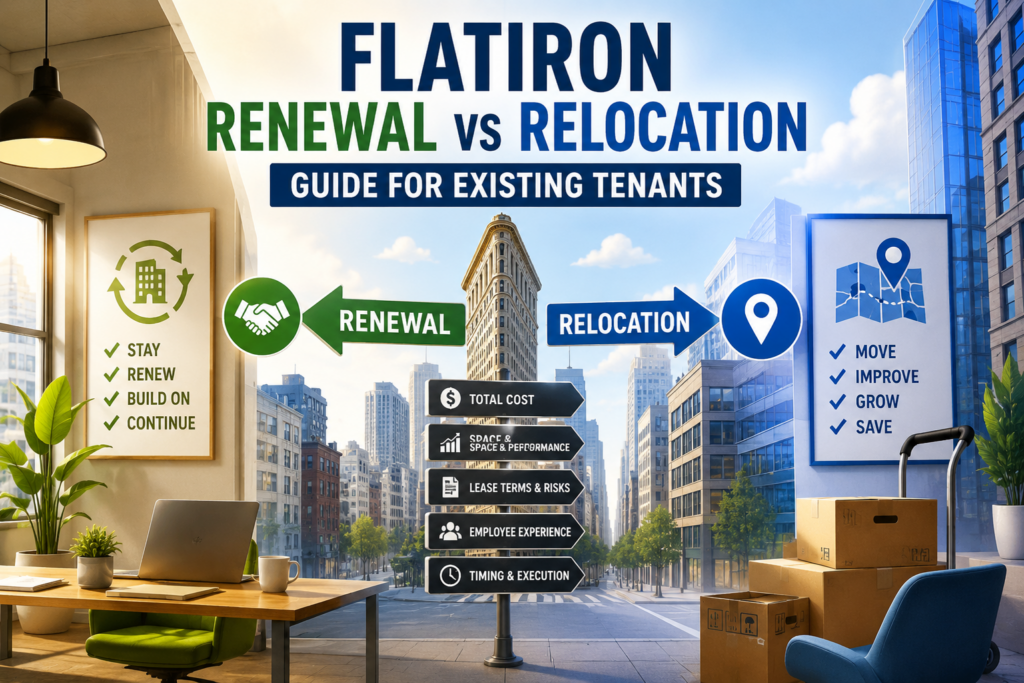
Flatiron Renewal vs Relocation Guide for Existing Tenants
Most Flatiron office tenants should begin this decision 12 to 18 months before lease expiration. Run renewal and relocation tracks together until one path proves stronger. Compare total occupancy cost, space performance, lease risk, employee access, and execution time.
A renewal may protect business continuity and preserve an expensive build-out. However, relocation may improve efficiency, flexibility, amenities, and long-term economics. The right answer comes from comparing both choices under the same assumptions.
This guide concerns commercial office leases for existing Flatiron tenants. It does not address apartment renewals, rent stabilization, or residential tenant protections. Commercial lease rights usually depend on the signed lease and negotiated amendments.
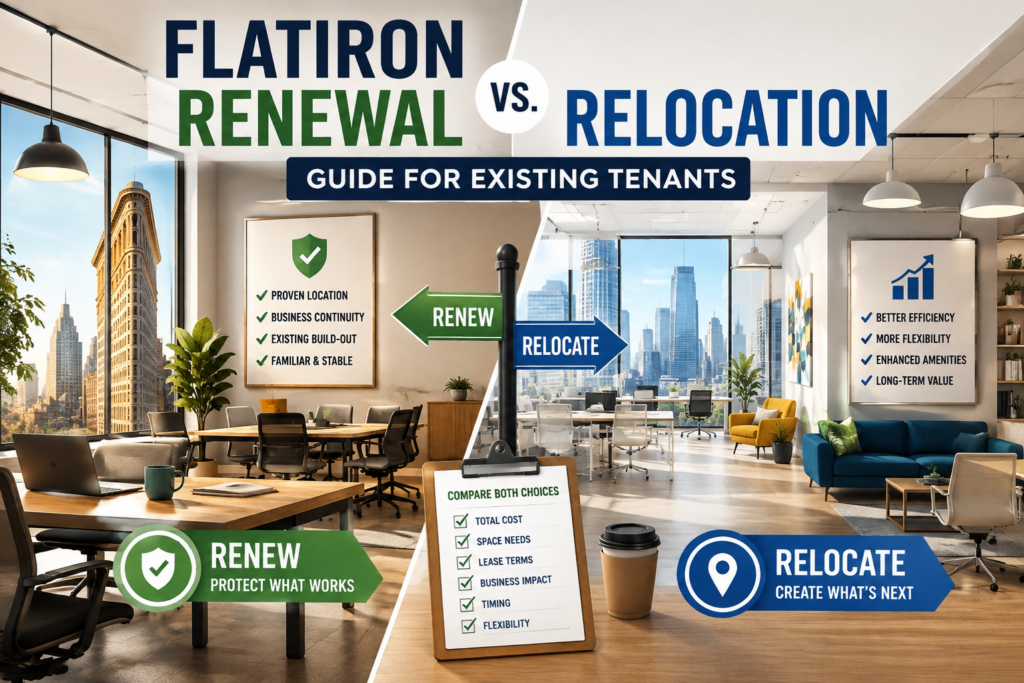
Start With the Real Renewal Versus Relocation Decision
The decision is not simply whether you like your present office. Instead, ask whether that office still supports your business at a competitive total cost.
Your analysis should answer six central questions:
| Question | What you need to determine |
|---|---|
| Who uses the office? | Current employees, projected hires, clients, vendors, and visitors |
| What must the office support? | Focus work, meetings, collaboration, privacy, production, and hospitality |
| Where should the office sit? | Flatiron, an adjacent district, or another Manhattan submarket |
| When must you decide? | Before option deadlines, construction commitments, and holdover exposure |
| How will each path affect operations? | Costs, downtime, employee access, technology, and management workload |
| Why would either path improve the business? | Savings, flexibility, recruitment, efficiency, branding, or continuity |
A useful decision statement should fit within one sentence. For example:
We need an office that supports 45 peak-day users, reduces wasted space, and limits seven-year occupancy costs.
That statement creates a measurable assignment. It also prevents personal preferences from controlling a major financial decision.
What renewing your Flatiron office means
A renewal extends your occupancy in the present premises. The extension may follow an existing option or a newly negotiated agreement.
Some renewals preserve most existing lease language. Others change rent, term, operating expenses, security, improvement allowances, and expansion rights.
Renewal usually works best when the office remains functional. It also helps when relocation costs exceed the value of moving.
However, staying does not mean accepting the landlord’s first proposal. An existing tenant should still test the outside market.
Without alternatives, the landlord may assume that moving feels too disruptive. That assumption can weaken your position before financial negotiations begin.
What relocating means
Relocation replaces the existing premises with another office. The new space may remain inside Flatiron or sit nearby.
A move can support growth, contraction, hybrid work, stronger branding, or better infrastructure. It may also provide a more efficient rentable footprint.
Relocation does not automatically mean choosing a newer building. Many tenants move between loft buildings, converted properties, and prebuilt offices.
The new location could sit several blocks away. Alternatively, it could shift toward Union Square, NoMad, Chelsea, or Park Avenue South.
The middle paths between staying and moving
Renewal and relocation are not the only choices. Several intermediate structures can solve specific business problems.
| Middle path | When it may help |
|---|---|
| Renew and contract | The existing tenant occupies too much space |
| Renew and expand | Adjacent space can support projected growth |
| Short extension | Leadership needs more planning time |
| Early renewal | The landlord offers meaningful value for earlier certainty |
| Renew with renovation | The location works, but the office needs modernization |
| Relocate within the building | Another floor offers better size, light, or efficiency |
| Sublease part of the office | The tenant wants to offset excess capacity |
| Take a furnished sublease elsewhere | The tenant needs a faster or shorter commitment |
| Temporary swing space | Renovation cannot occur around ongoing operations |
| Phased move | Business continuity requires gradual department transfers |
A short extension can protect a tenant with uncertain hiring plans. Yet an expensive extension may only postpone the underlying problem.
Likewise, subleasing excess space can reduce waste. Nevertheless, consent requirements and weak sublease demand may limit that strategy.
Renewal and relocation at a glance
| Decision factor | Renewal | Relocation |
|---|---|---|
| Initial disruption | Usually lower | Usually higher |
| Existing build-out | Retained | Replaced or recreated |
| Layout flexibility | Limited by present conditions | Greater choice |
| Moving expenses | Avoided | Required |
| Construction risk | Lower for light work | Higher for major work |
| Employee adjustment | Usually minimal | Depends on new location |
| Negotiating leverage | Weak without alternatives | Stronger with credible options |
| Space efficiency | Limited by current geometry | Can improve materially |
| Building quality | Remains unchanged | Can improve or decline |
| Lease flexibility | Must be negotiated | Can form part of the new search |
| Management time | Usually lower | Usually higher |
| Long-term fit | Strong only when needs remain stable | Better when requirements changed |
Tenant takeaway: Renewal minimizes change. Relocation creates change. Neither path guarantees the lower total cost.
Read the Flatiron Office Market Before Negotiating
You cannot evaluate a renewal offer against last year’s assumptions. The comparison needs current alternatives, current asking rents, and current concessions.
Recent research places the combined Flatiron and Union Square asking average near $86.96 per square foot. A first-quarter survey measured 13.9% availability in that combined area. Different reports use different boundaries, inventory sets, and vacancy definitions.
For Midtown South, second-quarter research reported an $81.14 overall asking rent. Class A asking rents reached $104.50 per square foot. Midtown South vacancy fell for a seventh consecutive quarter, reaching 21.8%.
Another Manhattan-wide survey reported 14.4% availability and an $80.17 average asking rent. Manhattan sublease asking rent averaged $59.94 per square foot under that methodology.
These numbers do not establish your renewal rent. Instead, they provide context for a building-specific comparison.
Current Flatiron planning benchmarks
| Market benchmark | Recent figure | How a tenant should use it |
|---|---|---|
| Flatiron and Union Square total asking rent | $86.96 per square foot | Broad neighborhood reference |
| Flatiron and Union Square direct asking rent | $88.34 per square foot | Direct-lease comparison |
| Flatiron and Union Square sublet asking rent | $69.00 per square foot | Flexible-space comparison |
| Flatiron and Union Square availability | 13.9% | General supply indicator |
| Midtown South overall asking rent | $81.14 per square foot | Wider submarket reference |
| Midtown South Class A asking rent | $104.50 per square foot | Higher-quality comparison |
| Manhattan overall asking rent | $72.83 to $80.17 per square foot | Broad market context |
The variation between reports reflects different data methods. Therefore, use one consistent source within each financial comparison.
Review our Flatiron office rents guide for a deeper explanation of these pricing differences.
Why Flatiron cannot be reduced to one rent
Flatiron contains several office products within a compact area. A renovated full floor can price differently from an older divided loft.
Building condition also changes value. Efficient elevators, modern HVAC, upgraded windows, and reliable power can justify a premium.
Floor height matters as well. Higher floors often gain better light, views, quiet, and prestige.
However, a premium building may carry greater operating expenses. It may also use a less efficient loss factor.
Typical product categories include:
| Product type | Common characteristics | Renewal comparison |
|---|---|---|
| Older value loft | Basic finishes, limited amenities, variable systems | Compare against renovation needs |
| Built creative office | Open layout, exposed ceilings, meeting rooms | Value existing improvements carefully |
| Modern prebuilt suite | Finished rooms, updated systems, fast occupancy | Compare speed and construction savings |
| Repositioned building | Upgraded lobby, elevators, amenities, systems | Test whether improvements benefit your team |
| Premium Class A office | Strong services, infrastructure, security, image | Compare full occupancy cost |
| Furnished sublease | Existing furniture, wiring, shorter remaining term | Compare flexibility and consent risk |
Current marketed asking rents can range from the low $50s to $120 or more. Product quality, floor position, term, and condition drive much of that spread.
Direct lease versus sublease economics
A recent neighborhood survey showed direct asking rent at $88.34 per square foot. Sublet asking rent averaged $69.00 per square foot.
That spread equals $19.34 per square foot. The sublease figure stood about 21.9% below the direct figure.
For a 5,000-square-foot office, the difference equals approximately:
| Lease type | Asking rent | Monthly base rent | Annual base rent |
|---|---|---|---|
| Direct lease | $88.34 per square foot | $36,808 | $441,700 |
| Sublease | $69.00 per square foot | $28,750 | $345,000 |
| Difference | $19.34 per square foot | $8,058 | $96,700 |
These figures exclude escalations, electricity, cleaning, operating charges, and concessions. They also exclude furniture and construction value.
A lower sublease rent does not guarantee a better deal. The remaining term may end too soon.
Furthermore, the prime lease may contain strict use or consent provisions. The sublandlord’s financial condition can also create risk.
Read the Flatiron office sublease guide before treating sublease pricing as a simple discount.
Asking rent does not equal effective rent
Asking rent represents the landlord’s starting position. Effective rent reflects the deal after concessions and other economics.
Suppose one landlord quotes $92 per square foot. Another quotes $86 per square foot.
The higher quote may include more free rent and greater improvement funding. It may also include better existing construction.
Meanwhile, the lower quote could require significant tenant spending. Higher operating expenses may erase the apparent savings.
Therefore, compare these items together:
| Economic component | Why it matters |
|---|---|
| Starting base rent | Establishes initial annual cost |
| Annual escalation | Compounds throughout the term |
| Free rent | Reduces early cash requirements |
| Improvement allowance | Offsets construction spending |
| Existing installation value | Reduces design and build-out needs |
| Operating expenses | Adds recurring occupancy cost |
| Electricity and overtime HVAC | Can materially affect usage costs |
| Security deposit | Ties up cash or credit |
| Brokerage and legal costs | Adds transaction expense |
| Furniture and technology | Changes the practical move budget |
| Restoration obligations | Creates an exit liability |
| Rent commencement | Determines when payment starts |
| Term length | Changes amortization and flexibility |
Critical distinction: Compare net effective economics and total cash exposure. Do not compare headline rents alone.
How current competition affects renewal leverage
Manhattan leasing remained active during the first half of 2026. Midtown South also recorded stronger year-to-date new leasing than the prior year. Renewals rose within both the broader market and Midtown South.
That activity has two implications.
First, stronger demand may reduce landlord flexibility for desirable space. A well-located, efficient Flatiron office may attract outside interest.
Second, landlords still value reliable existing tenants. A renewal can avoid vacancy, construction, marketing, and turnover risk.
Your leverage therefore depends on your specific premises. General vacancy statistics cannot replace building-level evidence.
Run Renewal and Relocation on One Coordinated Timeline
The best process keeps both options alive. A tenant should not negotiate renewal first and explore relocation later.
That sequence creates a dangerous timing gap. By the time renewal talks fail, relocation may no longer remain practical.
Instead, launch both tracks from one requirements brief. Use identical financial assumptions wherever possible.
The recommended starting point
Most Flatiron tenants should begin 12 to 18 months before expiration. Larger offices and complicated build-outs may require 18 to 24 months.
Use this timing framework:
| Time before expiration | Appropriate approach |
|---|---|
| More than 24 months | Review long-term strategy and unusual infrastructure needs |
| 18 to 24 months | Begin larger, technical, or multi-floor assignments |
| 12 to 18 months | Standard window for most office tenants |
| 9 to 12 months | Compressed process focused on built alternatives |
| 6 to 9 months | Prioritize prebuilt, furnished, and short-term solutions |
| Under 6 months | Seek an extension, bridge space, or immediate occupancy |
| After expiration | Address holdover exposure immediately |
A tenant with specialty construction should lean toward the earlier range. The same applies to regulated uses or complex mechanical needs.
Conversely, a small tenant seeking furnished space may move faster. Yet legal review and building approvals still require time.
Build the internal decision team
A renewal affects more than finance. It also affects operations, employees, technology, and future growth.
Your internal group may include:
| Role | Primary responsibility |
|---|---|
| Executive sponsor | Confirms business priorities |
| Finance | Models costs and cash flow |
| Operations | Plans business continuity |
| Human resources | Measures employee impact |
| Information technology | Audits power, cabling, security, and migration |
| Department leaders | Confirm work patterns and functional needs |
| Legal counsel | Reviews lease rights and risk |
| Tenant broker | Benchmarks the market and negotiates business terms |
| Architect | Tests layouts and occupancy |
| Project manager | Evaluates construction and schedule |
| Accountant | Reviews tax and reporting treatment |
Smaller companies can combine roles. However, someone must own each decision category.
One person should also control the schedule. Otherwise, unanswered questions can quietly consume several months.
Define the office requirement before touring
Do not begin with a square-footage guess. Start with headcount, attendance, work patterns, and functional needs.
Review at least the following:
| Requirement | Questions to answer |
|---|---|
| Current headcount | How many people work for the company today? |
| Peak attendance | How many arrive on the busiest normal day? |
| Growth | What ranges appear realistic over three, five, and seven years? |
| Workstations | Who needs an assigned desk? |
| Private offices | Which roles require visual or acoustic privacy? |
| Meeting rooms | What sizes and quantities match actual demand? |
| Collaboration | Where does informal teamwork occur? |
| Client use | How often do visitors enter the office? |
| Support space | What storage, wellness, pantry, and production areas matter? |
| Technology | What power, cooling, data, security, and redundancy exist? |
| Accessibility | What physical access requirements apply? |
| Schedule | When must the office become operational? |
Use our office space calculator to create an initial range. Then review how much office space you need before approving a final requirement.
A smaller footprint can justify a higher rent per square foot. However, overcrowding can damage productivity and future flexibility.
Audit the current lease before contacting the landlord
The lease audit should precede business discussions. It identifies deadlines, rights, and hidden financial exposure.
Review these provisions:
| Lease provision | Renewal or relocation consequence |
|---|---|
| Expiration date | Sets the ultimate deadline |
| Renewal option | May preserve a contractual right |
| Option notice date | Can expire before negotiations begin |
| Notice method | May require specific delivery |
| Fair market rent language | Controls renewal pricing mechanics |
| Holdover clause | Creates late-exit penalties |
| Surrender clause | Defines removal and restoration duties |
| Alteration provisions | Affect renovation and removal |
| Assignment rights | Influence corporate flexibility |
| Sublease rights | Support contraction or early exit |
| Expansion rights | May solve growth without moving |
| Contraction rights | May reduce excess space |
| Operating expenses | Affect future occupancy costs |
| Security deposit | Influences cash and credit |
| Guaranty | Creates business or personal exposure |
| Exclusivity and use | May limit business changes |
| Signage rights | Affect visibility and branding |
| Access rights | Control nights, weekends, and deliveries |
Calendar every notice date immediately. Do not wait for the landlord to send a reminder.
Study actual use before choosing square footage
Badge data, room bookings, and workstation observations can expose underused areas. Employee surveys can explain why those areas remain empty.
For example, a conference room may show low bookings. Yet teams may avoid it because the room lacks privacy.
Likewise, assigned desks may look vacant on average. Peak-day attendance could still create shortages every Tuesday.
Measure both average and peak demand. Then identify seasonal or project-driven changes.
A good utilization study should answer:
- Which spaces fill first?
- Which rooms rarely support their intended purpose?
- Where do noise and privacy problems occur?
- How many employees attend on peak days?
- Which teams need proximity?
- What space supports visitors?
- What functions could become shared?
- Which infrastructure cannot move easily?
These findings shape both paths. They identify renovation priorities and improve the relocation search.
Tour credible alternatives
A tenant should tour enough space to understand the available product. However, random volume adds little value.
Three to five credible alternatives often create an initial comparison. Complex assignments may require more.
Each option should serve a defined purpose. One may test a lower rent. Another may test greater efficiency.
A third could test stronger amenities. A fourth may reveal whether a nearby submarket improves value.
Record the following during every tour:
| Tour category | What to examine |
|---|---|
| Layout | Column spacing, window line, circulation, and usable depth |
| Condition | Existing rooms, finishes, furniture, and damage |
| Building systems | HVAC, power, elevators, plumbing, and telecommunications |
| Access | Security, freight rules, loading, and operating hours |
| Employee experience | Light, noise, neighborhood services, and commuting |
| Construction | Reuse potential, demolition needs, and code concerns |
| Economics | Asking rent, concessions, expenses, and term |
| Schedule | Delivery condition, approvals, and occupancy date |
| Flexibility | Expansion, contraction, assignment, and renewal rights |
| Risk | Landlord work, unresolved defects, and dependency on approvals |
Current Flatiron listings illustrate how widely space types can vary. Examples include a 5,370-square-foot divisible office and a 5,500-square-foot furnished direct office. Inventory and availability can change without notice.
Browse current Flatiron office options to understand the active product range.
Commission test fits before comparing final economics
A test fit places your requirements into a specific floor plan. It shows whether the advertised square footage supports your operation.
Two equally sized offices can produce different results. Columns, core placement, window geometry, and floor depth affect efficiency.
A proper test fit should show:
| Test-fit output | Why it matters |
|---|---|
| Workstation count | Confirms practical capacity |
| Private office count | Tests perimeter demand |
| Meeting room mix | Matches room supply with usage |
| Circulation | Identifies inefficient corridors |
| Support areas | Confirms storage, pantry, and wellness needs |
| Reception | Tests visitor flow |
| Egress | Flags code limitations |
| Accessibility | Identifies required accommodations |
| Mechanical zones | Affects temperature control |
| Construction assumptions | Supports preliminary budgeting |
Do not rely solely on a landlord’s marketing plan. That drawing may illustrate a generic tenant.
Request simultaneous proposals
Seek a renewal proposal and several relocation proposals within the same decision period. This alignment improves comparison quality.
Each request should address the same business topics:
| Proposal topic | Required response |
|---|---|
| Premises | Exact rentable area and floor |
| Term | Commencement and expiration |
| Base rent | Annual rent schedule |
| Free rent | Duration and conditions |
| Improvements | Allowance or landlord work |
| Delivery | Existing, demolished, white-boxed, or built |
| Operating expenses | Base year and exclusions |
| Electricity | Inclusion or separate charge |
| Security | Cash, letter of credit, or guaranty |
| Expansion | Available rights and timing |
| Contraction | Available rights and timing |
| Renewal | Option structure and rent method |
| Assignment | Consent standard and recapture |
| Surrender | Removal and restoration obligations |
| Schedule | Delivery and construction milestones |
Written proposals prevent memory-based comparisons. They also expose unanswered terms before lease drafting begins.
Establish decision gates
A decision gate is a scheduled point for eliminating weak paths. It prevents endless analysis.
| Decision gate | Required conclusion |
|---|---|
| Requirements approval | Confirm headcount, attendance, functions, and budget |
| Market review | Confirm credible relocation alternatives |
| Test-fit review | Confirm usable capacity |
| Preliminary economics | Eliminate unaffordable options |
| Proposal comparison | Identify leading renewal and relocation choices |
| Technical review | Confirm building and construction feasibility |
| Final approval | Select the preferred path |
| Lease execution | Complete documents and deposits |
| Implementation | Begin renovation or relocation |
Do not exercise a renewal option casually. Depending on its wording, the notice may create a binding commitment.
Likewise, do not abandon renewal too early. A relocation deal can fail during legal, technical, or construction review.
Compare the Full Cost of Staying and Moving
Rent per square foot provides an incomplete answer. A useful comparison converts every material item into cash, timing, and risk.
The core formula is:
Total occupancy cost = recurring lease costs + transaction costs + workplace costs + operational disruption + exit liabilities
Run the model across the full proposed term. Include an additional exit period when restoration could occur after expiration.
Renewal costs that tenants often miss
Renewal can avoid moving costs. Still, staying may require substantial spending.
| Renewal cost | What it may include |
|---|---|
| Base rent | Starting rent and annual increases |
| Operating expenses | Tax and expense escalation |
| Electricity | Direct meter, rent inclusion, or utility charge |
| Overtime HVAC | Nights, weekends, and special use |
| Cleaning | Building service or separate contract |
| Security | Deposit increases or credit enhancements |
| Legal review | Amendment or new lease negotiations |
| Brokerage | Market analysis and negotiation |
| Architectural work | Programming and test fits |
| Renovation | Paint, flooring, partitions, lighting, and millwork |
| Furniture | Replacement, reconfiguration, and storage |
| Technology | Cabling, audiovisual systems, and security |
| Swing space | Temporary accommodation during construction |
| Lost productivity | Noise, dust, phasing, and restricted access |
| Deferred repairs | Problems that remain after renewal |
| Future restoration | Removal duties that survive the extension |
Existing tenants often underestimate renovation disruption. Work performed around employees may require nights, weekends, or multiple phases.
A landlord improvement allowance can offset some costs. However, allowance language may exclude furniture, cabling, design fees, or taxes.
Relocation costs that tenants often miss
A move creates visible and hidden expenses. Some occur months before rent commencement.
| Relocation cost | What it may include |
|---|---|
| New base rent | Rent throughout the new term |
| Operating expenses | Base year and future escalation |
| Design | Architecture, engineering, and workplace planning |
| Construction | Demolition, partitions, ceilings, finishes, and systems |
| Allowance shortfall | Costs above landlord funding |
| Furniture | New, reused, relocated, or stored items |
| Technology | Network, audiovisual, telecom, and security |
| Physical move | Movers, crates, protection, and disposal |
| Overlap rent | Old and new offices operating together |
| Existing lease exit | Restoration, repairs, and surrender |
| Professional fees | Legal, project management, and consultants |
| Insurance | Construction and moving coverage |
| Permits | Filing, inspection, and approval costs |
| Deposits | New security and utility requirements |
| Signage | Design, fabrication, and approvals |
| Employee support | Communication, orientation, and travel changes |
| Business interruption | Downtime, reduced productivity, and management attention |
| Delay exposure | Holdover rent or temporary space |
| Contingency | Unforeseen construction and schedule items |
The new office’s condition drives much of this budget. A furnished office could reduce several categories.
Conversely, an unbuilt floor can create large capital requirements. Delivery language therefore deserves the same attention as rent.
Current fit-out costs justify careful diligence
A standardized 2026 construction benchmark estimated New York office hard costs near $220.62 per square foot. Its all-in benchmark reached $330.92 per square foot after design, technology, furniture, audiovisual, and miscellaneous costs.
Those figures do not describe every Flatiron project. Existing conditions, scope, finishes, labor, and building rules can change the result.
A light refresh may cost far less. Reusing partitions, ceilings, lighting, and furniture can also reduce spending.
However, major mechanical work can increase costs quickly. Older loft buildings may require special attention to power, HVAC, plumbing, and fire protection.
Review our NYC office build-out and furniture budget guide before finalizing relocation assumptions.
Put landlord concessions into the correct category
Free rent and improvement funding both create value. Yet they solve different problems.
Free rent lowers scheduled lease payments. An improvement allowance reimburses qualifying project costs.
A large allowance may not help a tenant seeking minimal construction. Likewise, long free rent may not fund early project invoices.
Compare these items separately:
| Concession | Primary benefit | Common limitation |
|---|---|---|
| Free rent | Reduces lease payments | Usually begins after possession |
| Improvement allowance | Funds eligible construction | Requires documentation and deadlines |
| Turnkey build-out | Transfers project scope to landlord | May limit design control |
| Existing furniture | Reduces procurement cost | Condition and ownership may vary |
| Early access | Supports cabling and setup | May restrict occupancy |
| Reduced security | Preserves cash or credit | Depends on tenant strength |
| Rent cap | Limits future increases | May require higher starting rent |
| Expansion right | Protects growth | Space may not become available |
| Termination right | Protects flexibility | Usually carries conditions or fees |
Never combine free rent and improvement funding into one vague “concession” figure. Their cash-flow effects differ.
Calculate the cost of space efficiency
Rentable square footage does not equal workplace capacity. A better layout can reduce total space without reducing functionality.
Consider two choices:
- Renewal requires 5,000 rentable square feet.
- Relocation delivers the same program in 4,500 rentable square feet.
The relocation uses 10% less space. Therefore, it can support a higher per-square-foot rent.
At $82 per square foot, the renewal starts at $410,000 annually. At $90, the relocation starts at $405,000.
The second space carries a higher rate. Yet its smaller footprint creates a lower initial base rent.
This example explains why test fits matter. Rent comparisons without efficiency can produce the wrong conclusion.
Use a complete hypothetical comparison
The following example illustrates a seven-year decision. It does not represent a live proposal.
| Assumption | Renewal | Relocation |
|---|---|---|
| Rentable area | 5,000 square feet | 4,500 square feet |
| Starting base rent | $82 per square foot | $90 per square foot |
| Annual base escalation | 3.00% | 2.75% |
| Initial free rent | 3 months | 8 months |
| Starting operating charges | $8 per square foot | $9 per square foot |
| Starting services | $6 per square foot | $6.50 per square foot |
| One-time tenant costs | $70,000 | $365,000 |
| Seven-year nominal cost | $3,642,031 | $3,705,999 |
| Average monthly cost | $43,358 | $44,119 |
| Difference | — | $63,968 higher |
| Monthly difference | — | About $762 higher |
Relocation costs only 1.76% more in this example. The efficient footprint and free rent nearly offset its higher rate.
However, one-time moving and construction costs still keep renewal ahead. A small assumption change could reverse the result.
For example, greater renovation costs could weaken renewal. A construction overrun could weaken relocation.
The model should therefore test several cases:
| Scenario | Question |
|---|---|
| Base case | What outcome appears most likely? |
| High-rent case | What happens if renewal rent rises? |
| Low-concession case | What if the new landlord offers less? |
| Construction overrun | What if project costs rise 15%? |
| Delay case | What if occupancy slips two months? |
| Growth case | What if headcount increases faster? |
| Contraction case | What if peak attendance falls? |
| Early-exit case | What if the company needs flexibility? |
Run nominal cash flow and present-value analysis. Finance should also review accounting and tax treatment.
Give disruption a financial value
Operational impact deserves more than a descriptive note. Assign a reasonable dollar estimate where possible.
Possible disruption categories include:
| Impact | Possible measurement |
|---|---|
| Executive time | Hours multiplied by loaded compensation |
| Employee downtime | Lost hours during packing, setup, and adjustment |
| Technology interruption | Revenue or productivity exposure |
| Client disruption | Rescheduled meetings or reduced access |
| Construction noise | Productivity reduction during occupied work |
| Recruitment impact | Acceptance rates or candidate feedback |
| Commute impact | Employee travel-time changes |
| Retention risk | Replacement and onboarding cost |
| Brand impact | Client and employee perception |
Not every impact needs false precision. Still, ignoring disruption assigns it an unrealistic value of zero.
Compare cash timing, not only totals
Two alternatives may have similar seven-year costs. Their early cash requirements can differ sharply.
A relocation may require design deposits and furniture payments before allowance reimbursement. Construction vendors may also require progress payments.
Renewal usually lowers early capital spending. Yet a landlord may demand greater security or earlier rent commencement.
Prepare a monthly cash-flow schedule covering:
- Professional fees
- Construction deposits
- Allowance reimbursements
- Furniture payments
- Technology purchases
- Moving invoices
- Overlap rent
- Free-rent periods
- Security deposits
- Restoration spending
A company with strong long-term economics may still reject a move. Early cash demands might exceed its available budget.
Examine the Lease, Building, and Workplace Risks
A lease renewal decision can fail for reasons unrelated to rent. Building condition, lease language, and operational constraints may control the outcome.
Complete legal and technical reviews before making an irreversible commitment.
Renewal option versus negotiated renewal
A renewal option gives the tenant a contractual extension right. The tenant must usually satisfy notice and lease conditions.
Many office options require written notice six to 12 months before expiration. Missing that deadline can eliminate the right.
A negotiated renewal differs from an option exercise. The parties can agree on new terms even without a contractual option.
However, the landlord may refuse those negotiations. An unexercised option could also expire during informal discussions.
Therefore, determine which process applies:
| Situation | Tenant position |
|---|---|
| Valid renewal option remains open | Tenant may exercise under stated conditions |
| Option deadline passed | Tenant usually needs a voluntary agreement |
| No option exists | Renewal depends on negotiation |
| Option rent has a fixed schedule | Future rent follows the lease formula |
| Option uses fair market rent | Rent requires contractual determination |
| Tenant has an uncured default | Option rights may face restrictions |
| Option remains personal | Assignment or merger may affect the right |
Read what renewal options mean in an office lease before sending notice.
Exercise requirements deserve exact compliance
A valid notice may require more than an email. The lease can specify delivery method, recipient, address, and timing.
Review these details with counsel:
- Earliest exercise date
- Final exercise date
- Required notice wording
- Permitted delivery methods
- Landlord notice address
- Copies required for lenders or managers
- Default conditions
- Occupancy conditions
- Assignment restrictions
- Financial statement requirements
Send notice early enough to correct a rejected delivery. Retain complete delivery evidence.
Learn more about a missed renewal-option notice deadline.
Fair market rent needs a defined process
“Fair market rent” sounds objective. Yet the lease may define it through selected assumptions.
The definition could address:
| Fair market rent issue | Tenant concern |
|---|---|
| Comparable geography | Flatiron only or broader Midtown South |
| Building quality | Similar class and condition |
| Floor characteristics | Height, views, light, and layout |
| Lease term | Matching commitment length |
| Improvements | Existing condition or renovated value |
| Concessions | Whether free rent and allowances count |
| Operating expenses | Gross, modified gross, or net structure |
| Transaction timing | Current market or future commencement |
| Escalations | Included within effective rent |
| Renewal status | Whether existing-tenant value matters |
| Dispute process | Appraisal, arbitration, or negotiation |
| Rent floor | Whether rent can fall below current levels |
| Rent cap | Whether increases face a ceiling |
A vague clause can create disagreement. It can also reduce the practical value of the option.
Review our fair market rent guide before evaluating an option proposal.
Renewal by reference carries old language forward
A renewal “by reference” often uses a short amendment. That amendment incorporates the existing lease except for stated changes.
The new document may update rent, term, concessions, and dates. Everything else can remain effective.
That structure saves drafting time. However, unfavorable language can survive unnoticed.
Review the full original lease alongside every amendment. Do not review the renewal document by itself.
Pay particular attention to:
- Operating expense definitions
- Guaranties
- Restoration duties
- Assignment restrictions
- Holdover penalties
- Option conditions
- Insurance requirements
- Building rules
- Repair obligations
- Indemnities
- Default remedies
Counsel should identify every provision that survives. This page offers leasing guidance, not legal advice.
Automatic renewal is not a tenant option
An automatic renewal clause extends the lease unless someone gives timely termination notice. A tenant option works differently.
The tenant option grants a choice to extend. An automatic clause may extend the lease after inaction.
New York law addresses certain automatic renewal provisions. The landlord generally must provide written notice within a defined 15-to-30-day window before the tenant’s notice deadline.
That statutory rule does not replace legal review. It also should not encourage a tenant to ignore lease deadlines.
Calendar every termination and renewal date. Ask counsel whether the provision and notice satisfy applicable law.
Holdover can destroy relocation economics
Holdover occurs when a tenant remains after lease expiration. Many Manhattan forms impose sharply increased rent.
Some lease provisions call for 200% to 300% of base rent. Others also claim consequential damages or lost leasing profits.
A construction delay can therefore create severe costs. The risk grows when the new lease starts near the old expiration date.
Review these protections:
| Holdover protection | Tenant benefit |
|---|---|
| Short grace period | Covers minor delays |
| Lower initial multiplier | Reduces early holdover cost |
| Graduated penalty | Increases rent only after extended delay |
| Damages waiver | Limits open-ended liability |
| Early access | Creates setup time before commencement |
| Rent overlap | Builds schedule protection |
| Extension right | Creates a backup period |
| Delay remedy | Addresses late landlord delivery |
| Temporary space | Supports emergency continuity |
Read our guide to holdover penalties before approving a relocation schedule.
Surrender and restoration affect both paths
A renewal can postpone surrender costs. A relocation makes them immediate.
Review whether the existing lease requires removal of:
- Wiring and telecommunications equipment
- Supplemental air-conditioning units
- Raised floors
- Staircases
- Internal bathrooms
- Kitchens
- Specialty lighting
- Generators
- Security systems
- Signage
- Furniture
- Alterations
- Hazardous materials
The lease may require broom-clean delivery. Another lease may demand restoration to a prior condition.
Ask the landlord for a written surrender scope well before expiration. Ambiguity can disrupt both budgeting and scheduling.
Photograph current conditions. Preserve alteration approvals and construction records.
Building systems may decide the outcome
The present office may look attractive while its systems create hidden operational problems.
Inspect these conditions before renewing:
| System | Questions |
|---|---|
| HVAC | Does it maintain comfort during occupied hours? |
| Supplemental cooling | Can server and production areas operate safely? |
| Electrical capacity | Does the office support current and future loads? |
| Elevators | Are speed, capacity, and reliability acceptable? |
| Freight access | Can vendors and deliveries operate efficiently? |
| Windows | Do they leak air, water, or noise? |
| Plumbing | Can the space support pantry or wellness needs? |
| Fire protection | Do current layouts meet requirements? |
| Telecommunications | Are multiple providers and risers available? |
| Emergency power | Do critical functions need backup? |
| Security | Do access controls support the company’s policies? |
| Roof and envelope | Have recurring leaks affected the premises? |
A relocation building needs the same review. New finishes do not guarantee strong infrastructure.
Technical diligence should identify required upgrades. It should also allocate responsibility within the lease.
Employee access needs evidence
Flatiron offers broad access to subway, rail, bicycle, walking, and neighborhood services. Yet a few blocks can change individual commutes.
Use anonymized employee ZIP codes or transit origins. Compare realistic morning and evening travel times.
Review these factors:
- Travel time by employee group
- Number of transfers
- Access from major rail terminals
- Late-night transportation
- Bicycle storage
- Showers and lockers
- Accessibility
- Client travel patterns
- Delivery access
- Neighborhood safety perceptions
Avoid relying solely on executive commutes. A location decision affects the entire workforce.
Employee feedback should inform the decision. Still, leadership must weigh cost and long-term strategy.
Amenities need a business purpose
Tenants increasingly compare shared meeting rooms, outdoor space, lounges, fitness facilities, and food service.
An amenity only creates value when employees use it. Otherwise, the tenant may fund it through higher rent.
Ask:
| Amenity question | Why it matters |
|---|---|
| Who will use it? | Identifies actual demand |
| How often? | Measures probable value |
| Is it included? | Reveals hidden charges |
| Can it replace private space? | May reduce the required footprint |
| Does it require reservations? | Affects practical availability |
| Can clients use it? | Influences meeting strategy |
| What are the hours? | Tests operational fit |
| Will it remain available? | Addresses future uncertainty |
A shared conference center could reduce internal meeting-room needs. That benefit should appear in the test fit.
Likewise, an outdoor terrace may improve recruitment. Yet it should not compensate for poor HVAC or unreliable elevators.
Renovating in place creates its own move
A substantial renewal renovation may require swing space, phased work, or temporary remote operations.
Dust, noise, shutdowns, and restricted access can affect employees. Night work may increase construction costs.
Before selecting renewal renovation, answer:
- Can work occur safely around employees?
- Which systems require shutdowns?
- Can departments move in phases?
- Does the building offer swing space?
- Will furniture require storage?
- How will technology remain operational?
- What work must occur after hours?
- Who controls the construction schedule?
- What happens if completion runs late?
A renewal renovation can match relocation complexity. The tenant should price both disruption plans honestly.
Match the Decision to Your Flatiron Tenant Situation
No single rule can decide every renewal. The strongest choice depends on space performance, business plans, and available alternatives.
Use the following scenarios as starting points.
Your present space still fits well
Renewal often deserves priority when the office supports projected needs. Strong infrastructure and employee satisfaction also favor staying.
However, complete a market comparison before accepting terms. The current space may still carry above-market economics.
Seek value through:
- Competitive rent
- Free rent
- Improvement funding
- Updated finishes
- Improved operating language
- Better renewal rights
- Reduced security
- Expansion or contraction flexibility
- Surrender clarification
- Holdover protection
A clean renewal can preserve continuity. It can also avoid unnecessary capital spending.
Your company expects meaningful growth
Relocation may provide a clearer growth path. The current building may lack adjacent inventory.
Before moving, test several growth structures:
| Growth solution | Advantage | Limitation |
|---|---|---|
| Larger office now | Provides immediate capacity | May create early waste |
| Expansion option | Adds future space | Availability may remain uncertain |
| Right of first offer | Creates notice of space | Does not guarantee completion |
| Right of first refusal | Allows matching another offer | Timing may not suit hiring |
| Phased premises | Aligns occupancy with growth | Requires coordinated construction |
| Flexible swing space | Supports short-term growth | May separate teams |
| Partial sublease | Adds temporary capacity | Carries consent and term risk |
Avoid signing for the most optimistic headcount. Use probability ranges and milestone dates.
Your company needs less space
Contraction often creates the strongest reason to test relocation. A smaller, efficient office may beat a discounted renewal.
Still, the landlord may offer several solutions:
- Give back part of the premises
- Relocate within the building
- Renew a smaller suite
- Permit partial subleasing
- Divide the floor
- Shorten the extension
- Add an early termination right
Compare the landlord’s construction and division costs. Those expenses can affect the proposed rent.
A smaller office should not simply remove desks. Redesign meeting rooms, circulation, storage, and shared areas.
Hybrid work changed attendance patterns
Hybrid policies can reduce average attendance. Yet peak-day demand may remain high.
Use peak occupancy rather than weekly averages. Then examine room demand and employee behavior.
A hybrid-focused office may need:
| More of | Less of |
|---|---|
| Small meeting rooms | Permanently empty workstations |
| Video-enabled rooms | Oversized file storage |
| Team neighborhoods | Redundant private offices |
| Acoustic privacy | Formal reception space |
| Shared project areas | Underused executive suites |
| Lockers and personal storage | Fixed departmental boundaries |
| Hospitality areas | Single-purpose rooms |
Renewal works when the present office can adapt economically. Relocation works when its geometry resists the new program.
Your build-out contains expensive infrastructure
Medical, production, media, technology, and other specialized users may have costly installations.
Renewal can extend the useful life of that investment. It may also avoid removal and recreation costs.
Calculate the remaining economic value of:
- Supplemental HVAC
- High-capacity power
- Server facilities
- Sound isolation
- Raised floors
- Specialty plumbing
- Security systems
- Studios
- Kitchens
- Internal stairs
- Custom millwork
Do not let sunk cost control the decision. Instead, compare future value against future constraints.
A specialized build-out can justify staying. Nevertheless, an obsolete installation should not trap the company.
Your building no longer supports the business
Chronic system failures can outweigh renewal savings. The same applies to poor management or limited access.
Document recurring problems through service requests, employee reports, and invoices.
Assess whether the landlord can correct each issue. Then obtain a written scope and completion schedule.
Relocation may become necessary when problems involve:
- Unreliable HVAC
- Insufficient power
- Frequent elevator disruption
- Water intrusion
- Weak security
- Poor accessibility
- Limited after-hours access
- Restricted deliveries
- Inadequate telecommunications
- Ongoing construction disruption
A cosmetic allowance cannot solve structural or service problems.
Your employees value the current location
Location continuity can support retention and recruiting. It may also protect client routines.
Measure that value instead of assuming it.
Compare the current office against each alternative using:
| Location measure | Possible data |
|---|---|
| Commute time | Median and percentile travel times |
| Transfer count | Employees requiring added transfers |
| Client access | Travel time from client clusters |
| Recruitment | Candidate feedback and offer acceptance |
| Retention | Exit interviews and employee surveys |
| Neighborhood use | Food, fitness, errands, and after-work activity |
| Accessibility | Step-free routes and building entrance |
| Transportation resilience | Alternative routes during disruptions |
A nearby move may preserve most location benefits. Explore options around Union Square for Flatiron tenants before assuming relocation requires a major commute change.
Your leadership needs flexibility
A long renewal can create risk when business plans remain uncertain. Relocation into another long lease may create the same problem.
Consider flexible structures:
| Flexibility tool | Potential use |
|---|---|
| Short renewal | Preserves location during uncertainty |
| Early termination right | Creates a defined exit |
| Expansion option | Supports growth |
| Contraction right | Supports downsizing |
| Assignment flexibility | Supports sale or restructuring |
| Sublease rights | Creates an economic release path |
| Furnished sublease | Reduces initial capital |
| Phased premises | Aligns space with growth |
| Multiple renewal options | Preserves future control |
| Predetermined buyout | Quantifies exit cost |
Review short-term Flatiron office space when certainty matters more than long-term pricing.
A furnished alternative may also reduce setup time. See furnished and plug-and-play Flatiron offices.
Your timeline has fallen below nine months
A compressed timeline changes the strategy. Avoid options requiring uncertain design, demolition, or long approvals.
Prioritize:
- Existing built offices
- Furnished direct leases
- Plug-and-play subleases
- Minimal construction
- Short extensions
- Early access
- Lease overlap
- Temporary swing space
- Fast legal review
- Clear landlord delivery
Begin renewal discussions immediately. Simultaneously tour spaces that can support rapid occupancy.
Do not assume the landlord will grant an extension. Negotiate the backup before the existing term expires.
Your landlord offers an early renewal
An early proposal may provide valuable certainty. It can also remove your chance to benefit from future alternatives.
Evaluate the offer against:
- Current market rent
- Expected future rent
- Remaining lease value
- Proposed concessions
- Improvement needs
- Lost flexibility
- Option rights
- Expansion plans
- Building investment
- Competing availability
Early renewal makes sense when the tenant receives measurable value. Convenience alone rarely justifies a long commitment.
Your landlord offers only a rent quote
A rent quote does not constitute a complete renewal proposal. Request the entire business package.
At minimum, obtain:
- Premises
- Term
- Rent schedule
- Escalations
- Free rent
- Improvement funding
- Operating expenses
- Electricity
- Security
- Renewal rights
- Expansion rights
- Surrender terms
- Assignment terms
- Holdover treatment
A landlord may offer an attractive starting rent while preserving expensive lease language. Compare both economics and risk.
Your current rent sits below market
Below-market rent makes renewal attractive. Yet the landlord may seek a significant reset.
Model several outcomes before negotiations. Include the option formula, comparable transactions, and relevant concessions.
A relocation may still win when it reduces square footage. It can also win when the current space needs substantial investment.
Avoid measuring the increase only against your expiring rent. Compare the proposal against current alternatives and total future costs.
Your current rent sits above market
An above-market lease creates a strong case for renegotiation. However, the landlord may not reduce rent without credible relocation evidence.
Tour competing offices and obtain written proposals. Then quantify the landlord’s retention value.
Your request may include:
- Lower starting rent
- A rent blend
- Free rent
- Improvement funding
- Reduced escalation
- Shorter term
- Contraction
- Better options
- Security reduction
- Early amendment
An existing option may set a rent floor. Counsel should confirm whether exercising it helps or hurts.
Resolve the Questions Existing Tenants Ask Most
Should I renew my Flatiron office lease or relocate?
Renew when the present office remains functional, competitive, and flexible. Relocate when another space creates stronger long-term business value.
Do not decide from rent alone. Compare total cost, employee access, infrastructure, timing, and lease risk.
Run both alternatives through test fits and written proposals. Then use the same financial assumptions for each.
What are the main advantages of renewal?
Renewal usually reduces physical disruption. It can preserve furniture, wiring, rooms, and institutional familiarity.
Employees retain their commute and daily routines. Clients also avoid learning a new location.
Furthermore, renewal may require less early capital. Those advantages matter most when the existing space still works.
What are the main disadvantages of renewal?
Renewal can preserve an inefficient layout. It can also extend unresolved building or management problems.
An untested renewal may carry above-market rent. Weak option language can create additional risk.
Staying can also delay a necessary workplace redesign. Convenience should not replace due diligence.
What are the main advantages of relocation?
Relocation can improve layout, capacity, infrastructure, branding, and amenities. It may also reduce the required footprint.
A new lease creates an opportunity to negotiate broader flexibility. Expansion, contraction, assignment, and termination rights may improve.
Current construction or furniture can add value. The right furnished office may also reduce move time.
What are the main disadvantages of relocation?
Moving requires management attention, capital, and schedule coordination. Construction or landlord delivery may also run late.
Employees must adjust to a new commute and workplace. Technology migration can create operational risk.
Finally, the existing lease may require costly restoration. Holdover exposure can magnify any delay.
Can I negotiate the price of a lease renewal?
Yes, a renewal proposal can contain negotiable business terms. Those terms may include rent, escalation, concessions, security, and improvements.
Your leverage improves when you have credible alternatives. Building-level evidence matters more than generic market claims.
Request a complete proposal rather than discussing one rent number. Then compare effective economics across the term.
Can I decline a landlord’s renewal offer?
A tenant can usually reject a voluntary renewal proposal. However, automatic renewal provisions and prior notices may affect that answer.
A tenant may also exercise a contractual option through a binding notice. Review the lease and communications before declining anything.
Counsel should confirm your rights and obligations. Eligible small businesses may qualify for free commercial lease assistance.
Can a landlord refuse to renew a commercial office lease?
The answer depends on the lease. A valid tenant option may require the landlord to honor its stated terms.
Without an enforceable option, renewal generally requires agreement between both sides. Defaults and option conditions may also affect rights.
Review the complete lease with counsel. Do not assume apartment renewal rules apply to commercial offices.
What is a renewal lease by reference?
A renewal by reference incorporates the existing lease into a shorter extension document. The amendment then lists specific changes.
Those changes may cover term, rent, concessions, or other negotiated points. Unchanged language usually continues under the incorporated lease.
Review every prior amendment. An old clause can remain effective even when nobody discusses it during renewal.
What is the difference between a renewal option and automatic renewal?
A renewal option lets the tenant choose whether to extend. The tenant must follow the lease’s exercise requirements.
Automatic renewal extends the term unless the required party gives notice. Inaction can therefore produce a different result.
New York law contains a notice rule for certain automatic renewal provisions. Counsel should determine whether that rule applies.
When should a Flatiron tenant start the process?
Begin 12 to 18 months before expiration for most standard offices. Start earlier for large or technical assignments.
Eighteen to 24 months may suit major construction or multi-floor occupancy. Less than nine months favors built and furnished alternatives.
Never wait until the renewal-option deadline. Strategic analysis should begin before formal notice becomes necessary.
How many alternative offices should I tour?
Tour enough credible choices to understand price, condition, efficiency, and building quality. Three to five alternatives often create an initial benchmark.
More tours may help when requirements remain flexible. Fewer tours may work when the assignment has unusual infrastructure needs.
Quality matters more than volume. Every toured option should test a meaningful decision variable.
Should I tell my landlord that I am considering relocation?
A landlord should understand that the tenant is evaluating alternatives. However, communication requires timing and discipline.
Avoid unsupported threats. Instead, present a professional process with documented requirements and credible market options.
Keep sensitive internal information confidential. Your tenant representative should coordinate business communications.
Can I receive an improvement allowance when renewing?
Yes, tenants can request improvement funding during renewal negotiations. The landlord may prefer funding improvements over losing occupancy.
The amount depends on term, credit, project scope, and market conditions. Existing building plans can also affect the offer.
Clarify eligible costs, payment procedures, deadlines, and unused balances. Do not treat an allowance as unrestricted cash.
Is free rent available on a renewal?
A landlord may offer free rent or another economic credit. The structure can reflect construction disruption or negotiated value.
Compare its timing carefully. Free rent during unusable renovation months may provide less practical benefit.
Also confirm whether operating expenses continue during free-rent periods. Lease language controls the answer.
Can a sublease serve as a bridge?
Yes, a sublease can provide a shorter commitment during uncertain planning. Existing furniture and construction may support faster occupancy.
However, the remaining term may offer limited stability. Consent and prime-lease provisions can also affect the arrangement.
Compare a bridge sublease against a short renewal. Include two moves within the long-term cost analysis.
Should I renew and renovate instead of moving?
That strategy works when the building and location remain strong. The renovated layout must also support future needs.
Price swing space, occupied construction, technology disruption, and after-hours work. Then compare those costs against relocation.
A renewal renovation should receive its own schedule and contingency. Treat it as a project, not a cosmetic allowance.
Should I move outside Flatiron?
A nearby district may offer lower costs, better buildings, or different transportation access. However, building quality often matters more than neighborhood labels.
Compare Union Square, NoMad, Chelsea, and Park Avenue South where relevant. Keep employee and client access central.
The best alternative may sit only several blocks away. A broad search creates leverage without abandoning the area’s benefits.
How should I compare employee commute effects?
Use anonymized employee origins and realistic travel times. Measure median changes and the employees facing the greatest impact.
Consider transfers, rail access, late-night service, accessibility, and walking distance. One average can hide severe individual changes.
Employee surveys can supplement the data. Leadership should still balance preference against financial and operational needs.
Does a better amenity package justify higher rent?
It can, when amenities reduce private space or improve measurable business outcomes. Shared rooms may lower the required footprint.
Employee-facing amenities may support attendance, recruitment, or retention. Nevertheless, actual usage should justify the premium.
Confirm access rules, fees, hours, and reservation requirements. Marketing descriptions do not establish practical value.
How do I compare building quality?
Create a weighted scorecard. Include infrastructure, elevators, security, services, ownership responsiveness, and physical condition.
Ask current occupants about recurring issues where appropriate. Review open work, capital projects, and delivery schedules.
A beautiful lobby cannot offset unreliable HVAC. Likewise, an older façade does not necessarily signal weak systems.
How do I value my existing build-out?
Estimate the cost to recreate its useful components elsewhere. Then reduce that value for age, wear, and functional mismatch.
Include partitions, lighting, wiring, HVAC, furniture, security, and specialty installations. Exclude improvements that no longer support the workplace.
The result represents avoided future spending, not historical cost. Sunk construction spending alone should not control the decision.
What happens if the new office is not ready?
The tenant may need rent overlap, temporary space, remote operations, or a lease extension. Without protection, holdover penalties may apply.
Negotiate delivery milestones and remedies in the new lease. Build schedule contingency before the existing expiration.
Also identify a practical backup plan. Optimism does not protect business continuity.
What happens if I miss my renewal-option deadline?
The contractual option may expire. The tenant could then depend on the landlord’s willingness to negotiate.
Many options require notice six, nine, or 12 months before expiration. Delivery formalities can also control validity.
Contact counsel immediately after discovering a missed date. Do not assume informal discussions preserved the option.
How much overlap should I budget?
The answer depends on construction, technology, furniture, and moving complexity. Minimal-work offices may need a shorter overlap.
Major projects require more protection. One or two months may not cover delayed approvals or building work.
Model the scheduled overlap and a downside case. Compare that cost against potential holdover exposure.
Who pays the tenant broker?
In many Manhattan office transactions, the landlord funds standard brokerage commissions. The exact arrangement should appear in written commission terms.
A tenant representative should disclose relevant relationships. The representative should also remain focused on the tenant’s objectives.
Commission structure does not replace independent judgment. Select representation based on experience, process, and accountability.
What should I bring to the first strategy meeting?
Prepare the current lease, amendments, floor plans, and recent landlord correspondence. Include headcount and attendance information.
Financial records should show current rent, operating charges, electricity, and recurring service costs. Known building issues also matter.
Finally, identify leadership priorities and decision authority. A complete starting package accelerates the entire process.
What should the final recommendation contain?
The recommendation should explain why one path wins. It should not merely label renewal or relocation as cheaper.
Include:
| Recommendation component | Required conclusion |
|---|---|
| Business fit | Which option supports strategy? |
| Workplace fit | Which plan supports actual use? |
| Financial result | What are nominal and present-value costs? |
| Cash timing | When does each option require capital? |
| Employee impact | How do access and experience change? |
| Lease risk | Which provisions create exposure? |
| Technical risk | Which systems or projects need resolution? |
| Schedule risk | Can the company occupy on time? |
| Flexibility | Which option handles future change? |
| Downside case | What happens when assumptions fail? |
| Implementation plan | What must happen after approval? |
The strongest recommendation should survive reasonable changes in assumptions. If small changes reverse the answer, preserve flexibility longer.
Review Local Office Options
Fill out our 📋 online form or give us a call today 📞 212-967-2061 — let’s find the right options for your business.