Consulate Office Space Near the United Nations
Understanding the Diplomatic Office District
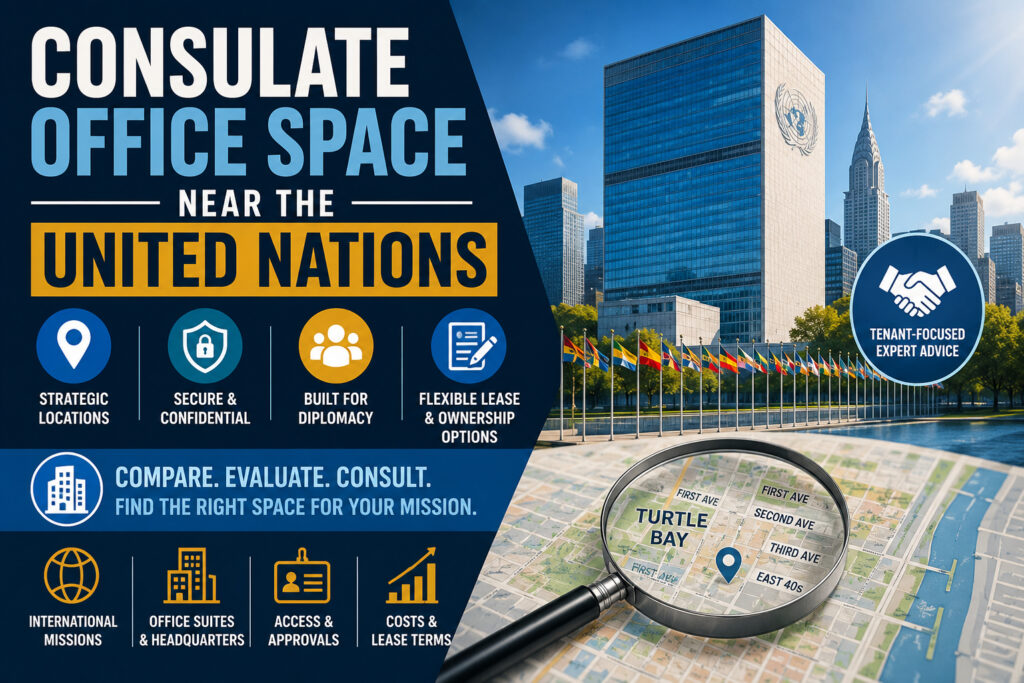
United Nations Headquarters anchors a distinct office corridor along the eastern edge of Midtown Manhattan. Most relevant searches focus on First Avenue, Second Avenue, Third Avenue, and the East 40s. The district extends beyond one landmark or building. It includes commercial towers, office condominiums, institutional properties, converted townhouses, and smaller professional buildings. Turtle Bay forms the neighborhood core. However, many listings also use Midtown East, Grand Central, United Nations Plaza, or Dag Hammarskjöld Plaza. These labels often describe overlapping territory. Therefore, tenants should compare exact addresses instead of relying upon neighborhood names alone.
The practical location hierarchy
| Location zone | General character | Best suited for |
|---|---|---|
| First Avenue and United Nations Plaza | Closest proximity, strong diplomatic identity, limited commercial inventory | Permanent missions, senior delegations, international organizations |
| Second Avenue | Established diplomatic corridor with varied building classes | Consulates, visa operations, trade offices, public-facing services |
| Dag Hammarskjöld Plaza area | Recognized mission cluster with larger office towers | Full-floor missions, expanding delegations, institutional tenants |
| East 43rd through East 49th Streets | Smaller buildings and side-street options | Boutique consulates, administrative teams, nonprofits |
| Third Avenue | Better transit access and broader commercial inventory | Larger staffs, professional services, mixed administrative functions |
| Grand Central edge | Strongest commuter access with less direct diplomatic character | Regional offices, legal teams, support operations |
First Avenue offers unmatched proximity. Yet it also creates greater traffic sensitivity during major diplomatic events.
Second Avenue balances identity and accessibility. Buildings there often understand consular schedules, official visitors, and international tenant requirements.
Third Avenue provides more conventional office choices. It can also shorten employee commutes from Grand Central and Lexington Avenue stations.
A location near the United Nations does not automatically qualify as diplomatic space. Instead, the building must support the tenant’s actual use.
That distinction matters because permanent missions, consulates, and ordinary commercial tenants operate differently.
Permanent missions and consulates serve different purposes
A permanent mission represents its government before the United Nations. It maintains contact with the organization, participates in meetings, and supports accredited representatives.
A consulate functions more like a regional branch office. It assists citizens, handles documents, supports trade, and performs other consular duties.
An embassy usually serves as a foreign government’s principal headquarters within the host country. In the United States, those headquarters generally sit in Washington.
A New York government office may perform both consular and multilateral functions. However, some governments maintain separate offices for each purpose.
The distinction affects the property search.
A mission may prioritize conference rooms, diplomatic reception areas, and rapid access to United Nations meetings. Conversely, a consulate may need public counters, interview rooms, and larger waiting areas.
Trade offices often need presentation space and private meeting rooms. Cultural offices may require event capacity, display areas, or evening access.
International nonprofits usually need secure professional space without formal diplomatic infrastructure. Their priorities often include budget, flexibility, and collaboration space.
Diplomatic premises are not foreign sovereign territory
A consulate or mission does not become foreign territory after occupancy. United States and New York laws still apply.
International agreements can protect mission premises, archives, communications, and diplomatic functions. However, those protections do not replace building codes, permits, zoning rules, or lease obligations.
This distinction should shape every transaction. Tenants must coordinate diplomatic protocol with ordinary commercial real estate requirements.
Defining the Right Consulate Office Space
The strongest search begins with an operational program. Square footage alone cannot describe a diplomatic office requirement.
Two organizations may each request 6,000 square feet. Still, one may serve hundreds of monthly visitors while the other hosts private delegations.
Those offices need completely different entrances, layouts, and building services.
Start with the office’s primary function.
| Office function | Core space requirements | Frequent complications |
|---|---|---|
| Permanent mission | Delegation rooms, leadership offices, secure records, conference facilities | Major-event access, protocol, extended hours |
| Consulate general | Public waiting, service counters, interview rooms, document processing | Visitor volume, queuing, privacy, accessibility |
| Visa or passport office | Controlled intake, payment areas, interview stations, records storage | Daily appointments, screening, public circulation |
| Trade office | Meeting rooms, presentation space, executive offices | Events, visiting business groups, flexible schedules |
| Cultural office | Reception areas, multipurpose rooms, display space | Evening events, assembly limits, audiovisual needs |
| International nonprofit | Offices, meeting rooms, collaborative space | Budget, grant cycles, growth flexibility |
| Delegation support office | Temporary workrooms, briefing areas, rapid access | Short terms, seasonal demand, intensive meeting schedules |
Public access changes the entire floor plan
A public-facing consulate needs separation between visitors and staff. Without that separation, daily operations can disrupt confidential work.
The ideal layout creates a clear sequence. Visitors enter, check in, wait, receive service, and exit without crossing internal work areas.
Interview rooms should protect private conversations. Meanwhile, service counters should support orderly document exchange.
Staff should reach records, offices, and support rooms without entering public circulation. This separation improves security and efficiency.
A dedicated entrance can provide the strongest control. However, many multitenant buildings cannot offer one.
In those properties, the lobby arrangement becomes critical. Tenants should study visitor identification, elevator access, queuing capacity, and package procedures.
Delegation space needs a different approach
A permanent mission may receive fewer unscheduled visitors. Still, it can host ministers, representatives, security personnel, interpreters, and technical advisers.
Such use requires a formal arrival experience. It also demands reliable conference facilities and private movement between key rooms.
Large boardrooms should support hybrid meetings, interpretation equipment, secure communications, and flexible seating.
Smaller briefing rooms can reduce pressure on the primary conference room. Likewise, private holding rooms can support visiting dignitaries.
The reception area should provide dignity without wasting rentable space. Thoughtful planning can achieve both goals.
Estimate space by function, not headcount alone
A conventional administrative office may use between 150 and 225 rentable square feet per employee. Office-intensive layouts may require more.
Consulates usually need additional public and secure areas. Therefore, a simple headcount calculation can understate the requirement.
Use this planning formula:
Staff workspace + public service area + secure rooms + meeting space + support space + growth allowance
A 25-person administrative team might function within 4,000 to 5,500 rentable square feet. Public counters and waiting rooms could add substantial space.
A 50-person mission may need 8,000 to 15,000 square feet. The final number depends upon meeting volume and office hierarchy.
Full-floor occupancy can improve privacy and circulation. However, it may also create unused space and higher operating costs.
Partial floors can reduce rent. Yet they require careful planning around shared corridors, restrooms, elevators, and neighboring tenants.
Confirm the usable area
New York leases usually quote rentable square footage. That measurement includes a share of common building areas.
The tenant actually occupies the usable area. Consequently, two equal rentable suites can feel very different.
Columns, interior setbacks, mechanical rooms, and unusual floor shapes can reduce planning efficiency. Large public areas may magnify that problem.
Ask for test fits before selecting a suite. A test fit shows how the program works within the actual floor.
The drawing should include visitor flow, staff circulation, conference rooms, storage, accessible routes, and emergency exits.
Choosing the Best Location and Building
Proximity should support the office’s mission. It should not become an expensive symbol without operational value.
Some tenants need a two-minute walk to United Nations meetings. Others gain more value from Grand Central access.
Therefore, the search should compare east-west travel against staff commuting needs.
First Avenue and United Nations Plaza
This zone offers the strongest institutional identity. It also provides direct access to the diplomatic campus and the East River corridor.
Properties here can suit permanent missions, international organizations, law offices, and government support operations.
866 United Nations Plaza deserves careful clarification. It is not the same property as 866 Second Avenue.
The United Nations Plaza address forms part of a mixed-use complex between East 48th and East 49th Streets. Its office component operates as a commercial condominium.
That ownership structure can create leasing and purchasing options. It can also produce unit-specific management, renovation, and approval requirements.
Prospective occupants should review the exact unit. Building-wide descriptions cannot replace unit-specific diligence.
Second Avenue and Dag Hammarskjöld Plaza
Second Avenue forms the heart of the commercial diplomatic corridor. Several buildings there have housed missions, consulates, and international organizations.
885 Second Avenue occupies the block between East 47th and East 48th Streets. The property offers large floor plates and continuous security access.
The building’s size can support substantial missions. Nevertheless, large floors may require subdivision or phased growth planning.
820 Second Avenue provides another recognized diplomatic location. Its scale can suit mid-sized consulates, missions, and administrative offices.
866 Second Avenue should not be confused with 866 United Nations Plaza. The Second Avenue property offers commercial condominium opportunities near East 47th Street.
A current Second Avenue condo office for sale contains 7,663 rentable square feet. The asking price equals $4.5 million.
Ownership may suit a government seeking long-term control. However, the purchaser must examine approvals, taxes, operating costs, and renovation rights.
Third Avenue and the Grand Central edge
Third Avenue offers more inventory than First Avenue. It also provides shorter walks to major subway and commuter lines.
This corridor can suit consulates with larger local staffs. Professional services, NGOs, and administrative offices also benefit from the location.
A current turnkey Third Avenue office contains 5,077 square feet at 675 Third Avenue.
The furnished layout includes private offices, workstations, meeting rooms, a pantry, and a wellness room.
Another furnished Turtle Bay office contains 7,367 square feet. Its quoted asking rent equals $45 per square foot.
Larger users can review a full-floor Third Avenue office containing 10,929 square feet.
That space offers direct leasing, immediate availability, building security, and tenant amenities.
Building pages can also reveal broader size ranges. Review 777 Third Avenue and 757 Third Avenue when comparing the corridor.
Transit and vehicle access
Grand Central provides subway, commuter rail, and regional connections. Those links help staff arriving from Manhattan, Westchester, Connecticut, Long Island, or other boroughs.
The Lexington Avenue subway corridor remains several blocks west of First Avenue. Therefore, walking time increases for properties nearest the river.
First and Second Avenue bus routes can improve north-south access. Crosstown buses also support travel between the diplomatic corridor and central Midtown.
Vehicle access matters for official visitors. The FDR Drive, Midtown Tunnel, Queensboro Bridge, and nearby garages can support regional movement.
However, tenants should never assume unrestricted curb access. Street closures, security zones, and major events can change arrival plans.
Tour the location during ordinary weekdays. Then review how the block operates during high-level diplomatic sessions.
Comparing Direct Leases, Subleases, and Ownership
The correct transaction structure depends upon time, budget, authority, and expected occupancy.
A short-term delegation office should not follow the same strategy as a permanent national mission.
Likewise, a recognized government office may face different approvals than an independent nonprofit.
Direct leases
A direct lease creates a contractual relationship with the building owner. It usually offers the strongest control over term, construction, signage, and renewal rights.
Landlords may provide free rent or construction allowances. Those concessions can offset the cost of a specialized buildout.
Longer terms often support larger allowances. Still, they also create greater commitment and less relocation flexibility.
Direct leases work well for established tenants with predictable staffing. They also suit organizations needing extensive alterations.
The tenant should negotiate expansion rights whenever possible. Adjacent options can protect future growth without forcing an early move.
Contraction rights remain harder to obtain. Nevertheless, tenants can seek sublease rights, assignment flexibility, or partial surrender options.
Subleases
A sublease transfers occupancy rights from an existing tenant. The building owner usually retains approval rights.
Subleases can offer furniture, wiring, and completed construction. Therefore, they may reduce both cost and move-in time.
However, a diplomatic tenant must confirm that the existing layout supports its function. A corporate office rarely contains suitable public-service circulation.
The sublease term may also end too soon. Expensive security or records improvements seldom make sense within a brief term.
Review the prime lease before signing. Its restrictions can affect alterations, access, signage, assignment, and restoration.
Sublease rent should not drive the decision alone. A cheap suite can become expensive after required modifications.
Office condominium ownership
Ownership can provide long-term control over occupancy costs and improvements. It may also support a permanent institutional presence.
Yet an office condominium does not provide unlimited autonomy. The purchaser still follows condominium rules, building procedures, and applicable laws.
Monthly common charges can rise. Capital assessments may also fund elevators, façades, roofs, or mechanical systems.
A purchaser must review the building’s financial statements. Counsel should also examine bylaws, insurance, litigation, and planned projects.
The available Grand Central condo office offers 3,125 square feet near East 44th Street.
That option may suit a smaller diplomatic, international, or professional office seeking ownership.
Diplomatic property approval
Foreign mission property transactions can require federal review. The relevant authority oversees acquisition, leasing, use, renovation, and disposition.
Its review can consider reciprocity, national security, international law, domestic law, and proposed property use.
Tenants should begin that coordination before final lease execution. A late approval issue can delay possession or invalidate assumptions.
The transaction timeline should account for internal government authority. Budget approval, ministry consent, and procurement rules can add further stages.
Tax treatment requires formal authorization
Foreign-government ownership does not create automatic real estate tax exemption. Eligibility can depend upon use, ownership, recognition, and reciprocity.
Property used as official mission or consular premises may qualify under applicable federal procedures. Service charges and other expenses may still apply.
The lease or purchase model should never rely upon assumed tax treatment. Counsel must confirm the position before financial approval.
Evaluating Rent and Total Occupancy Cost
Published rent figures can create false precision. The United Nations corridor contains several building classes, ownership structures, and suite conditions.
No single public average accurately describes every block. Therefore, tenants should combine market benchmarks with live availability.
Current Midtown benchmarks
During the second quarter of 2026, one major Midtown dataset reported an $86.18 average asking rent. It reported a 12.7% availability rate.
Another major report placed Midtown’s overall asking rent at $76.98. Its Class A average reached $88.50 per square foot.
The second report measured a 17.7% vacancy rate. These figures differ because research firms use different inventories and definitions.
Availability and vacancy do not always mean the same thing. Furthermore, neither Midtown average isolates the United Nations corridor.
Premium views and renovated diplomatic buildings can exceed broad averages. Older side-street space may price below them.
Use live proposals to establish the real market. A dated neighborhood average cannot replace current landlord terms.
Convert annual rent into monthly cost
New York office rents usually appear as annual dollars per rentable square foot.
Use this formula:
Rentable square feet × annual rent ÷ 12 = monthly base rent
| Suite size | Annual asking rent | Annual base rent | Monthly base rent |
|---|---|---|---|
| 2,500 SF | $60 per SF | $150,000 | $12,500 |
| 5,000 SF | $70 per SF | $350,000 | $29,167 |
| 7,500 SF | $80 per SF | $600,000 | $50,000 |
| 10,000 SF | $90 per SF | $900,000 | $75,000 |
| 15,000 SF | $100 per SF | $1,500,000 | $125,000 |
These examples show base rent only. Actual occupancy cost can include several additional expenses.
Review every cost component
| Cost item | Questions to ask |
|---|---|
| Base rent | Does the rate apply to rentable or usable square feet? |
| Annual increases | Are increases fixed, compounded, or tied to another formula? |
| Real estate taxes | Which base year applies, and how does the landlord calculate increases? |
| Operating expenses | Which costs can pass through to the tenant? |
| Electricity | Does the building use direct metering, submetering, or rent inclusion? |
| HVAC | What hours come standard, and what does overtime service cost? |
| Security | Does the tenant fund guards, equipment, or additional lobby procedures? |
| Cleaning | Does rent include cleaning, or must the tenant contract separately? |
| Construction | What work does the landlord provide, and what work remains tenant-funded? |
| Furniture and technology | Can existing items stay, or must the tenant purchase replacements? |
| Legal and professional fees | Which reviews, filings, consultants, or approvals require payment? |
| Restoration | What must the tenant remove before lease expiration? |
Concessions can outweigh a small rent difference
Tenants often focus on reducing the quoted rent. Yet free rent and construction contributions can create greater savings.
Consider two 10,000-square-foot options. One landlord quotes $75 per square foot without construction funding.
Another quotes $80 but offers free rent and a substantial allowance. The higher asking rent may produce the lower effective cost.
Calculate the entire lease term. Include escalation, concessions, construction, operating expenses, and restoration.
A complete financial comparison should show:
Gross obligation − free rent − landlord contributions + additional expenses = effective occupancy cost
The analysis should also assign timing. A reimbursement received after construction does not solve an immediate cash-flow requirement.
For broader lease guidance, review our Commercial Leasing Guide. It explains planning, proposals, buildouts, risk, and lease terms.
Specialized construction can change the budget
A standard office buildout may include partitions, flooring, lighting, ceilings, and pantry work.
Consular construction can add public counters, controlled doors, privacy improvements, supplemental power, and secure records areas.
Technology can create another major expense. Conference systems, interpretation equipment, audiovisual controls, and protected communications require early planning.
Do not assume the landlord’s allowance covers every item. Many leases exclude furniture, cabling, security equipment, and specialized systems.
The tenant should prepare a preliminary construction budget before finalizing the letter of intent.
Planning Security, Access, and Interior Operations
Security must support operations without creating an intimidating or inefficient workplace.
The strongest plan uses layers. It does not rely upon one locked door or one lobby guard.
Building-level security
Start with the building’s existing procedures. Review lobby staffing, visitor identification, package screening, elevator controls, and after-hours access.
A building with 24-hour access may still restrict visitors after business hours. Likewise, weekend HVAC may require advance notice.
Ask how the property handles official vehicles, large delegations, media activity, and unexpected crowds.
The building should also explain emergency communication. Tenants need clear contacts for fire alarms, medical events, access failures, and utility problems.
Review loading procedures before signing. Secure documents, furniture, and technology may require controlled deliveries.
Suite-level security
The suite should separate public, semi-private, and restricted areas.
Public areas may include reception, waiting, service counters, and accessible restrooms.
Semi-private areas can include interview rooms, meeting rooms, and controlled consultation spaces.
Restricted areas may include staff offices, records rooms, communications rooms, and leadership suites.
Doors should support the circulation plan. Too many access points can weaken control and confuse visitors.
Conversely, excessive barriers can slow staff and create unsafe emergency conditions.
An architect should coordinate security with egress, accessibility, fire safety, and building rules.
Records and document operations
Consulates may handle passports, applications, certificates, correspondence, and personal records.
Those functions need secure storage and organized movement. Documents should not cross public waiting areas without control.
Records rooms need appropriate shelving, ventilation, fire protection, and access policies.
Digital systems may reduce paper volume. However, technology can increase electrical, cooling, and communications requirements.
Confirm riser access and provider availability. Also ask how the building handles redundant internet service.
Public waiting areas
Waiting space should reflect realistic peak volume. Designing around an average day can create dangerous congestion.
Appointments can reduce peaks. Nevertheless, emergencies and seasonal demand can still increase visitors.
The waiting room needs accessible seating and clear circulation. It should also preserve privacy at service counters.
Acoustical treatment can limit overheard conversations. Simple design decisions often improve confidentiality without excessive cost.
Tenants should confirm restroom access. A high-volume public office may place unusual pressure on shared floor facilities.
Conference and delegation rooms
One oversized boardroom cannot solve every meeting need. A balanced plan usually combines one formal room with smaller briefing rooms.
Furniture should support different formats. The room may host negotiations, presentations, interpretation, or hybrid meetings.
Lighting must work for both in-person discussions and video calls. Window shades can improve screen visibility and privacy.
Acoustics deserve early attention. Glass-heavy rooms can look impressive while performing poorly.
Accessibility and code compliance
Public-facing offices must review accessibility from the sidewalk through the service area.
The analysis should include entrances, elevators, door clearances, counters, restrooms, and emergency routes.
Older buildings may contain conditions that require modification. A tenant should identify those costs before lease execution.
The lease must clearly allocate responsibility. Never assume the landlord will complete every compliance item.
Building hours and diplomatic schedules
International work rarely follows a simple weekday schedule. Time zones, special sessions, and visiting delegations can create evening demands.
Confirm 24-hour staff access. Then review overtime HVAC, freight access, cleaning schedules, and visitor procedures.
A building may advertise continuous access while charging heavily for essential services.
Ask for current fee schedules. Those expenses should enter the financial comparison.
Managing the Search and Lease Process
A disciplined process protects confidentiality, budget, and timing.
Large missions may need more than one year. Smaller turnkey requirements can move faster.
Specialized construction, official approvals, and procurement rules usually extend the schedule.
Build the requirement before touring
The tenant should prepare a written requirement covering:
| Requirement category | Information to define |
|---|---|
| Location | Maximum walking distance, preferred avenues, transport needs |
| Size | Current staff, public areas, meeting rooms, growth |
| Use | Mission, consular, visa, trade, cultural, or administrative |
| Security | Visitor control, records, access layers, delivery procedures |
| Term | Desired commencement, lease length, renewal needs |
| Budget | Base rent, construction, operating costs, furniture |
| Authority | Signatory, internal approvals, federal coordination |
| Technology | Connectivity, power, cooling, conferencing |
| Building operations | Hours, HVAC, loading, cleaning, parking |
| Ownership preference | Lease, sublease, condominium, or building purchase |
This requirement should remain functional. Avoid rejecting a property because it lacks decorative features.
A suitable building with flexible economics can often support the right design. An impressive lobby cannot cure operational failure.
Tour a controlled shortlist
Touring too many spaces can blur meaningful differences. Instead, compare a focused group across several location and price bands.
Include one closest-proximity option. Add one strong Second Avenue choice and one transit-oriented Third Avenue alternative.
Ownership candidates should form a separate comparison. Their financial structure differs from leased options.
During each tour, follow the visitor’s route. Then walk the staff route and delivery route.
Photographs can help, subject to security restrictions. Floor plans should record exact conditions and dimensions.
Request comparable proposals
Each landlord should respond to the same business terms. Otherwise, tenants cannot compare offers fairly.
A proposal should address rent, increases, term, free rent, construction, security deposit, taxes, and operating expenses.
It should also cover possession timing, renewal rights, assignment, subletting, signage, and building services.
For diplomatic occupiers, include required approvals and credit structure. The proposal should not assume an ordinary personal guaranty.
Complete technical diligence before commitment
An architect should inspect the leading choices. That review can test layout, code, accessibility, and construction feasibility.
Technology consultants can examine connectivity, power, cooling, and communications pathways.
Security advisers may review circulation and operational controls. However, their work should remain coordinated with the architect.
Counsel should review the proposed use and transaction structure. Government representatives should also confirm required internal authority.
Verify the property’s legal use
A commercial office address may not support every public-facing operation without additional review.
Confirm the certificate of occupancy, permitted use, and relevant building rules. Also investigate alteration permits and assembly limits.
Signage may require landlord and municipal approval. Exterior flags, plaques, lighting, or security features can face additional restrictions.
A diplomatic tenant should not rely upon a previous mission’s occupancy. Building conditions and regulations can change.
Negotiate the letter of intent carefully
The letter of intent guides the lease. Although parties often label it nonbinding, weak terms can create later disputes.
Address the following items before lease drafting:
| Lease issue | Tenant objective |
|---|---|
| Permitted use | Cover every present and planned diplomatic function |
| Possession | Tie delivery to agreed conditions and landlord work |
| Rent commencement | Allow enough time for approvals and construction |
| Alterations | Permit security, technology, and layout improvements |
| Access | Protect staff access during required hours |
| Visitors | Confirm workable lobby and elevator procedures |
| Assignment | Allow reasonable government restructuring or related occupancy |
| Subleasing | Preserve flexibility where permitted |
| Expansion | Secure rights on adjacent or future space |
| Renewal | Establish timing and rent methodology |
| Restoration | Limit costly removal obligations |
| Confidentiality | Protect sensitive transaction and operational information |
Review the full lease economics
Base rent does not show the whole obligation. Counsel and the broker should review every additional payment.
Escalations may compound over time. Tax clauses can also create substantial exposure.
The lease should describe electricity, overtime HVAC, cleaning, freight, and building charges.
Security-related work deserves special treatment. The tenant should retain suitable control over its equipment and confidential systems.
Coordinate approvals before construction
Federal authorities oversee foreign mission property matters within the United States. Their responsibilities include acquisition, leasing, renovation, taxation, and compliance coordination.
Local permits can remain necessary. Therefore, the tenant should coordinate federal requirements with ordinary construction filings.
A landlord’s consent does not replace governmental approval. Likewise, governmental recognition does not replace landlord consent.
The project schedule should identify every required decision. It should also assign responsibility for each filing.
Common Questions About Consulate Office Space Near the United Nations
What does “consulate office space near the United Nations” usually mean?
The phrase can describe several uses. It may refer to a consulate, permanent mission, visa office, delegation suite, or international organization.
Some users seek formal diplomatic premises. Others need ordinary offices within the surrounding diplomatic district.
The search should begin by identifying the office’s legal and operational function.
Is a permanent mission the same as a consulate?
No. A permanent mission represents its government before the United Nations.
A consulate generally provides regional services and assistance to its country’s citizens. It may also support trade, culture, and official relations.
Some governments combine functions within one property. Others maintain separate mission and consular offices.
Where should a consulate search near the United Nations?
First Avenue provides the closest proximity. Second Avenue offers the strongest concentration of diplomatic office buildings.
Dag Hammarskjöld Plaza can support larger mission requirements. Third Avenue provides broader inventory and easier commuter access.
The best location depends upon visitors, staff commutes, meeting frequency, and budget.
How close should the office be to United Nations Headquarters?
Frequent meeting participants may need a short walk. Administrative teams may gain more from transit access and lower occupancy costs.
Measure door-to-door travel. Do not rely solely upon map distance.
Security procedures, elevators, crosswalks, and event closures can increase practical travel time.
What is the difference between 866 United Nations Plaza and 866 Second Avenue?
They are separate properties.
866 United Nations Plaza sits near First Avenue between East 48th and East 49th Streets. Its office component forms part of a mixed-use complex.
866 Second Avenue sits farther west near East 47th Street. It contains commercial condominium space.
Tenants should use complete addresses when requesting information.
How much does office space near the United Nations cost?
Pricing changes by building, floor, view, condition, size, and transaction type.
Current Midtown benchmarks span the upper $70s through upper $80s per square foot. Individual options can fall below or exceed that range.
Landlord concessions can materially change effective rent. Therefore, compare total occupancy cost instead of asking rent alone.
Can a consulate purchase its office instead of leasing?
Yes, subject to legal authority, governmental approvals, and available inventory.
Office condominium ownership can provide long-term control. However, the purchaser must review taxes, common charges, bylaws, and capital obligations.
Federal property procedures can also apply to foreign mission acquisitions.
Does foreign-government ownership eliminate property taxes?
Not automatically.
Certain officially recognized properties may qualify for exemptions based upon ownership, use, and reciprocity.
The relevant authority must authorize the treatment. Separate service charges may remain payable.
Can a consulate use an ordinary commercial office building?
Often, yes. The building must support the intended use, security, visitor traffic, and alterations.
Public-facing services may require more diligence than private administrative operations.
Confirm the lease, building rules, legal use, accessibility, and construction feasibility before committing.
Does the space need a separate entrance?
Not always. A separate entrance can improve public flow and security.
Many consulates operate successfully through attended commercial lobbies. Their suites use controlled elevator and internal access.
The decision depends upon visitor volume, sensitivity, budget, and building configuration.
What building features matter most?
Important features include lobby control, reliable elevators, flexible access, visitor procedures, loading, and suitable HVAC.
Efficient floor plates can matter more than decorative amenities.
Public-facing offices should also evaluate waiting capacity, restrooms, accessibility, and street-level congestion.
How much space does a consulate need?
There is no universal standard. Staff headcount represents only one component.
The program should include public waiting, interview rooms, conference areas, secure records, technology, and support functions.
A test fit provides a better answer than a general ratio.
Should the tenant choose a full floor?
A full floor can improve privacy, circulation, and identity. It may also simplify internal access control.
However, full-floor occupancy can increase rent and create excess space.
A well-planned partial floor may provide the same operational benefits at lower cost.
Can a mission or consulate sublease space?
A sublease may work for temporary or administrative needs. It can offer furniture and faster occupancy.
Still, the remaining term must justify any required improvements.
The tenant must also confirm landlord consent, prime lease restrictions, and governmental approvals.
How long does the leasing process take?
A straightforward turnkey lease may take several months. Specialized construction and official approvals can extend the timeline considerably.
Large requirements should begin early. Ownership transactions generally require additional legal and financial diligence.
Starting early also improves negotiation leverage.
What happens during major diplomatic events?
Street traffic, security activity, deliveries, and visitor procedures can change.
Tenants should ask buildings about prior event operations. They should also test alternate arrival and communication plans.
A close address creates convenience. It can also increase sensitivity to closures.
How can a tenant compare competing options objectively?
Use one requirement document and one financial model.
Compare usable layout, location, security, construction, services, approvals, and total occupancy cost.
Each finalist should receive architectural, legal, financial, and operational review.
Identify Consulate Office Locations Available
We represent office tenants, not landlords, throughout the search, comparison, and lease process.
Our role includes confidential tours, proposal analysis, operational diligence, and coordinated negotiations.
Contact us for a curated shortlist matched to your location, security, budget, and timing requirements.
Fill out our 📋 online form or give us a call today 📞 212-967-2061 — let’s find the right options for your business.