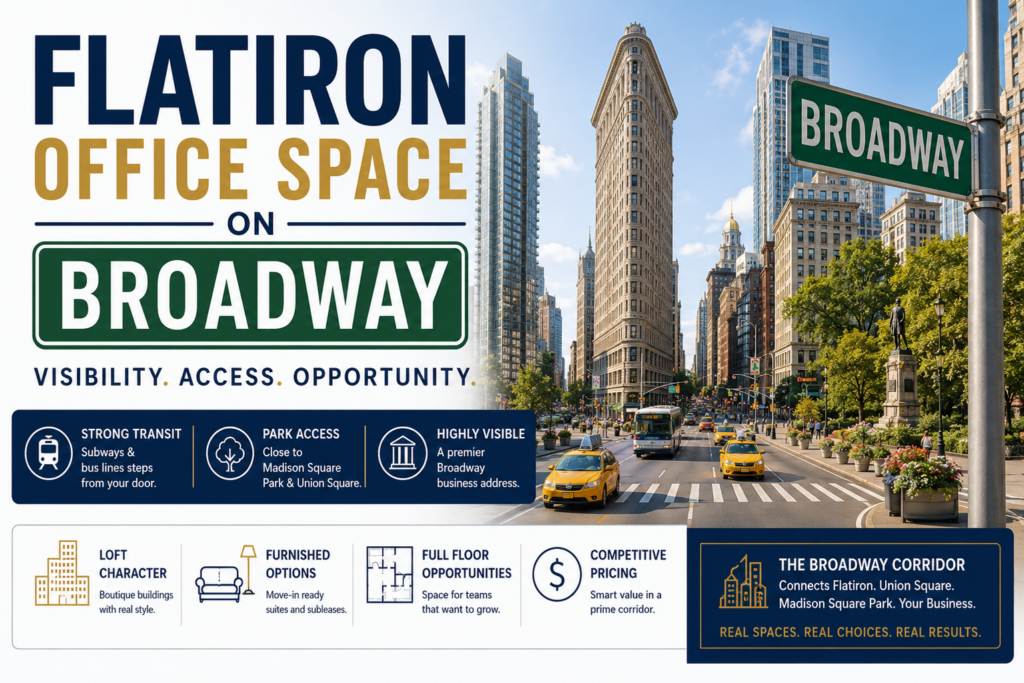
Flatiron Office Space on Broadway
Flatiron office space on Broadway is not one building, one block, or one lease type. In practice, most tenants use this phrase to describe the Broadway corridor that runs through the Flatiron and Union Square edge, where boutique loft buildings, larger creative assets, furnished suites, and park-adjacent offices sit within a short walk of major transit. That is why you will see this search pull in broad district inventory, individual Broadway addresses, serviced suites, and nearby landmark buildings all at once.
Broadway matters here for a simple reason. It gives you visibility, cleaner wayfinding for clients, and a better daily experience than many side-street options. The corridor also connects Union Square, Madison Square Park, and several of Flatiron’s most recognizable office clusters, which helps employers balance identity, commute strength, and operating efficiency in one compact search area.
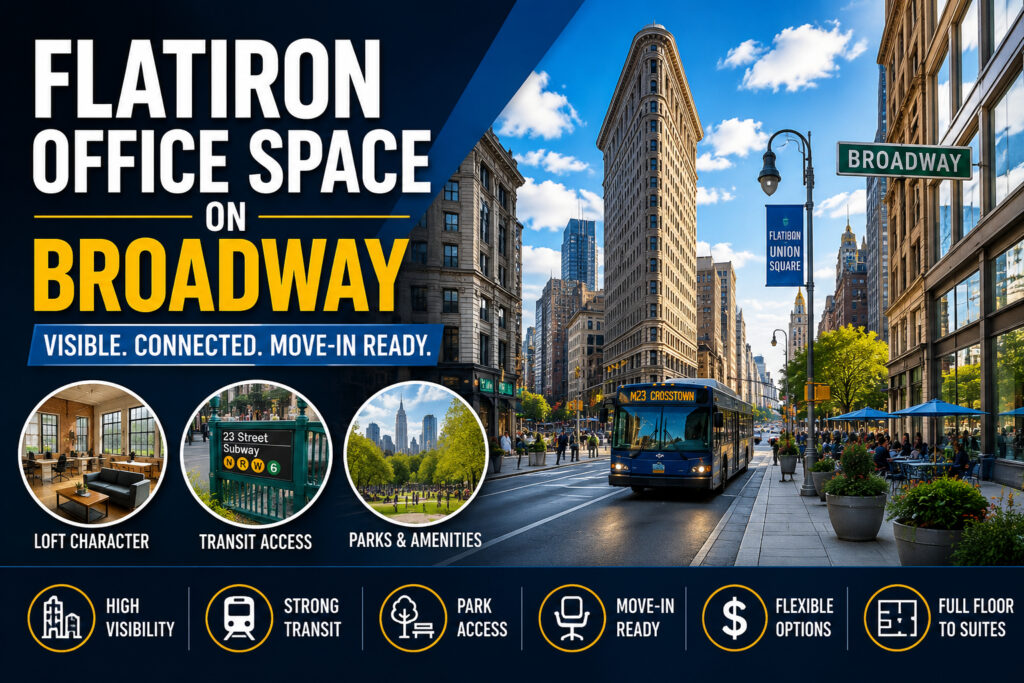
Broadway here works like a corridor, not a pin on a map.
If a tenant says, “I want Flatiron office space on Broadway,” that can mean several valid things. One company may want a smaller loft near Union Square. Another may want a full floor around 20th to 23rd Street. A third may want a polished furnished suite close to Madison Square Park. The phrase covers all of those needs, which is exactly why a useful page must explain the corridor before it talks about a single address.
The strongest way to understand the corridor is by block pattern. South Broadway, near Union Square, offers the best transfer-heavy commute and many smaller team options. The middle stretch, around 19th through 23rd Streets, gives you some of the classic Flatiron office stock that tenants actually picture when they say “Broadway loft office.” North of there, the conversation shifts toward park adjacency, stronger frontage, and a more polished Madison Square edge.
That difference matters because “Flatiron on Broadway” is usually not a generic neighborhood search. It is a corridor search. Tenants want to know which part of Broadway feels fastest to reach, easiest to brand, most practical for clients, and smartest for budget. They also want to know whether a visible Broadway address is worth paying for when a side-street loft may cost less. That is the real decision lane.
What tenants can actually lease along this stretch today
The corridor offers more variety than many pages admit. Small teams can still find compact loft product and efficient boutique suites. Mid-size firms can target prebuilt floors with meeting rooms, pantry space, and furniture already in place. Larger users can pursue full-floor layouts, higher-capacity prebuilds, or building-by-building searches that prioritize branding and expansion room.
If you want a recognizable Broadway building with range, start with 888 Broadway, which currently shows inventory spanning roughly 1,025 square feet up to about 19,338 square feet. That matters because it gives tenants multiple size bands inside one address rather than forcing a neighborhood change as the company grows. If you prefer a more corner-driven identity, 902 Broadway stands out for visibility, efficient loft-style floor plates, and a strong Flatiron position at 20th Street.
Broadway also serves teams that want plug-and-play occupancy. A current full-floor furnished office at 1115 Broadway offers about 12,530 square feet in turnkey condition. Meanwhile, full-floor space at 920 Broadway shows a 6,500-square-foot sublease with natural light, built rooms, and faster move-in logic than a blank direct lease. Those are two very different deals, yet both answer the same tenant question: how fast can we occupy quality Broadway space without a long construction cycle?
Some tenants do not need a traditional lease at all. They want a private office now, a desk solution for a growing team, or a short-term bridge while the company decides on a larger footprint. That is why serviced suites and flexible operators appear so often around Broadway, especially near 1115 Broadway, 895 Broadway, and the Union Square edge. Those options are not the whole story, but they are part of the real Broadway inventory ladder.
If speed is your priority, browse our furnished and plug-and-play office space in Flatiron guide. If lease control matters more, compare direct leased office space with our office sublets to see where the deeper value may sit. The point is not to force one path. The point is to match term length, move-in speed, and capital exposure to your business stage.
Why Broadway performs so well for visibility and commuting
Few Midtown South corridors solve the commute problem as cleanly as this one. Union Square alone brings together the 4, 5, 6, L, N, Q, R, and W lines, and the surrounding district also benefits from nearby Sixth Avenue service, PATH access, and bus routes that make cross-town travel easier. For teams hiring across Manhattan, Brooklyn, Queens, and New Jersey, that reach is not a luxury. It is a daily operating advantage.
Broadway’s public realm has also improved in ways tenants actually feel. The Flatiron and NoMad stretch now includes pedestrian plazas, shared-street treatments, bike connections, widened public space, shorter crossings, and curb changes designed to calm traffic and improve pick-up and delivery flow. That work makes the corridor easier to navigate, more comfortable for staff, and better for client arrival than an older office map would suggest.
The corridor benefits from scale as well. The Flatiron and NoMad district contains about 36 million square feet of commercial office space and more than 100,000 workers, while official district reporting showed 15.88 million subway riders in the local area during Q2 2025. In the same period, district-wide office availability across all classes fell to 16 percent, and Class A and B leasing topped 1 million square feet, the highest level since 2014. Those numbers tell tenants something important: Broadway here is not a nostalgia play. It still functions as an active business corridor.
That business activity supports a stronger everyday ecosystem. Staff get park access, reliable food options, after-work convenience, and better meeting logistics without stepping far from the office. Leaders get an address that clients can find quickly and remember easily. Recruiting teams get a location that intersects several live-work patterns instead of favoring only one commuter path.
What Broadway space costs now, and why pricing looks inconsistent
Flatiron pricing only looks simple when pages flatten everything into one average. In reality, Broadway inventory falls into several bands. A broad public listing snapshot for the Flatiron District currently shows about 60 office listings with an average asking rent near $73 per square foot, with lower-cost examples around $57 and higher examples around $87. That is useful as a market snapshot, but it does not capture the premium built into stronger Broadway locations, furnished suites, or top-end park-adjacent assets.
For the broader Midtown South backdrop, Colliers put average asking rent at $80.27 per square foot in the first quarter of 2026, with availability at 13.4 percent. Within the more local Flatiron and Union Square band, our current rent guide cites Newmark at about $88.34 per square foot for direct asking rent, $69.00 for sublet asking rent, and $87.18 overall. That spread explains why one Broadway page can look expensive while another feels surprisingly attainable. They may be describing different products altogether.
Subleases often create the cleanest entry point. A tenant that wants the address, the buildout, and the faster timeline may find better economics in a prebuilt sublease than in a raw direct lease. That category matters even more on Broadway because many of the most appealing loft and full-floor spaces already have conference rooms, furniture, wiring, and pantry buildouts in place. Saving months of construction can matter as much as a lower quoted rent.
Flexible suites form another pricing lane. Current Broadway-adjacent options in Flatiron show access memberships from about $399 per month, dedicated desks from about $850, and private offices for two starting around $1,590 per month in one nearby building. Those numbers do not compete with a 5,000-square-foot direct lease on the same basis. They solve a different need. They help very small teams buy speed, services, and location without taking on a multi-year commitment too early.
A better tenant question is not, “What is the Broadway average?” Ask this instead: what is the right Broadway product for my headcount, term, image, and capital budget? Once you frame the search that way, the corridor gets much easier to evaluate. Use our Flatiron office rents explained guide if you want a deeper pricing breakdown, then compare live Broadway options against the wider Flatiron furnished and plug-and-play market.
What to compare before you choose a Broadway office
Start with frontage and arrival. Broadway offices usually win on recognition, but not every visible address delivers the same user experience. Corner exposure, lobby feel, elevator ratio, signable presence, and window line all shape how the office works day to day. An efficient side-street loft may still beat a Broadway suite if the layout wastes less space or the building runs better.
Next, judge the floor plate honestly. Prewar Broadway stock often gives tenants high ceilings, bigger windows, and stronger character. Yet those same buildings can vary on HVAC control, restrooms, freight access, storage, and loss factor. A beautiful loft only helps if the team can use it without constant operational friction. That is why we compare the economics of space efficiency, not just the headline rent.
Then pressure-test expansion logic. Some companies should choose a smaller, more polished address now and revisit the market later. Others need a building with future contiguity or several size bands already trading in the same asset. Broadway is especially good at offering that upgrade ladder, from private suites to boutique full floors to larger multi-room sublets. The key is choosing the ladder before you choose the lease.
Finally, compare the real monthly exposure. Convert quoted annual rents into monthly base rent, then add the soft costs. Furniture, wiring, buildout time, rent abatement, and move timing can change the true cost dramatically. Broadway rewards tenants who compare complete deal structures instead of chasing whichever page posts the lowest visible number.
FAQ copy
What does “Flatiron office space on Broadway” usually include?
Most tenants mean the Broadway run through the Flatiron corridor near Union Square and Madison Square Park, not one isolated property. In practice, that includes the mix of Broadway buildings, adjacent park-front options, and nearby ready-built suites that solve the same location problem.
Is Broadway better than a side street in Flatiron?
Not automatically. Broadway usually wins on visibility, address recognition, and easier client wayfinding. Side streets can win on value, quieter floors, and sometimes better efficiency. The best choice depends on whether your business values exposure more than cost control.
Can small teams still find real office space here?
Yes. The corridor still supports small loft suites, flex options, and furnished private offices. It also gives growing teams a path into larger Broadway space without leaving the neighborhood.
Are furnished Broadway offices common in Flatiron?
They are common enough to matter, especially for teams that want speed. Current examples include turnkey full floors at 920 Broadway and 1115 Broadway, along with broader local furnished inventory across the district.
Is a sublease the smarter move here?
Often, yes. Local market guides show sublet asking rent well below direct asking rent in the Flatiron and Union Square band. On top of that, many subleases already include buildout and furniture, which lowers capital exposure and shortens move time.
Why does the landmark wedge building appear in this conversation?
Because it sits at the same major crossroads and shapes how people think about the area. Still, that building is only one nearby asset. It does not define the full Broadway office corridor, and it should not replace a real comparison of actual leasing options.
What should a tenant do first?
Start with size, timing, budget, and term. After that, decide whether you want a direct lease, a sublease, or a plug-and-play office. Then compare live Broadway inventory by commute, layout, visibility, and total monthly exposure, not just by quoted rent. You can begin with 888 Broadway, 902 Broadway, 915 Broadway, 200 Fifth Avenue, our Broadway full-floor listing at 920 Broadway, and our Flatiron rents guide.
Tenant Assistance
A strong Broadway office in Flatiron should do four things at once. It should read clearly for clients, commute well for staff, fit the team without waste, and make financial sense over the actual lease term. When those pieces line up, the corridor becomes one of Manhattan’s most practical office searches, not just one of its most recognizable.
We represent tenants, not landlords. Our role is to compare direct leases, subleases, and ready-to-use offices across the Broadway corridor so you can see the real tradeoffs clearly. Then we negotiate economics, flexibility, and risk so your final choice fits your team instead of a listing headline.
If you want help narrowing the field, send us your size, timing, and budget. We will compare direct leased office space, subleases, and furnished Flatiron options against the Broadway addresses that actually fit your use case. That keeps the decision grounded in transit, visibility, layout, and economics rather than guesswork.
Fill out our 📋 online form or give us a call today 📞 212-967-2061 — let’s find the right options for your business.