Penn Station Office Space for Media and Creative Firms
The right way to read this market
Penn Station office space for media and creative firms does not mean one narrow building type. In practice, this requirement usually blends four different tenant needs: station-front offices, nearby loft floors, polished prebuilt suites, and short-horizon private office inventory. Current benchmark and index in this lane mix general Penn Station inventory, building-specific office listings, flexible workspace directories, and nearby Herald Square, Garment District, and Midtown South-edge spaces.
That matters because a creative tenant rarely wants “an office near a train station” in the abstract. A media team usually wants a faster commute, better natural light, a layout that supports collaboration, and an address that still feels energized. Some firms need a polished client-facing front door. Others need a loft office near Penn Station with stronger daylight, more texture, and better lease math. Many need both.
So the real tenant question is simple: Which version of Penn fits the way your team works? If your firm pitches often, edits often, hosts often, or hires across New Jersey and Long Island, Penn Station can be a very strong answer. If your team also wants the feel of Midtown South, the best fit often sits one to three blocks from the station, not directly on top of it.
Penn Station is not one thing.
It is a station-front trophy zone, a commuter-first core, and a loft-heavy creative band that reaches into the West 20s, West 30s, Herald Square, and the Garment District.
We represent tenants, not landlords. That keeps the advice grounded. Our job is to sort the options, translate the real differences, and negotiate from your side.
Why Penn Station works for media and creative teams
Penn Station remains one of Manhattan’s strongest commuter locations because it concentrates regional rail and major subway access in one place. Moynihan Train Hall provides direct access to Amtrak and the Long Island Rail Road, while current Amtrak station details also list NJ Transit, PATH, subway, and bus connections through the broader Penn complex. That reach shortens the last transfer and widens the hiring map for firms drawing staff from New Jersey, Long Island, Westchester connections, and the broader Northeast Corridor.
The office market has also changed around Penn. Colliers reported 11.78 million square feet of Manhattan office leasing in the first quarter of 2026, the strongest first quarter since 2014, with availability down to 13.7% and average asking rent up to $77.55 per square foot. Cushman & Wakefield separately reported that Penn captured more than 3.5 million square feet of relocations from 2023 through 2025, and that roughly 23 million square feet in the submarket has been developed or fully renovated over the past decade.
That shift matters for creative firms because Penn is no longer only a value commute story. Today the district offers two distinct advantages at once. First, high-end stock now competes with other prime Midtown addresses on amenity depth and arrival quality. Second, loft-style and repositioned Class B inventory still gives media firms a more flexible path to light, layout freedom, and lower occupancy cost than many trophy corridors.
Premium station-connected towers now offer large conference centers, tenant lounges, flexible workspace, fitness space, hospitality-driven food offerings, and major outdoor areas. One redeveloped tower advertises more than 160,000 square feet of amenities, while another highlights more than 73,000 square feet of outdoor tenant space plus a 280-person town hall. That product fits firms that host clients, recruit aggressively, or want a cleaner corporate frame around creative work.
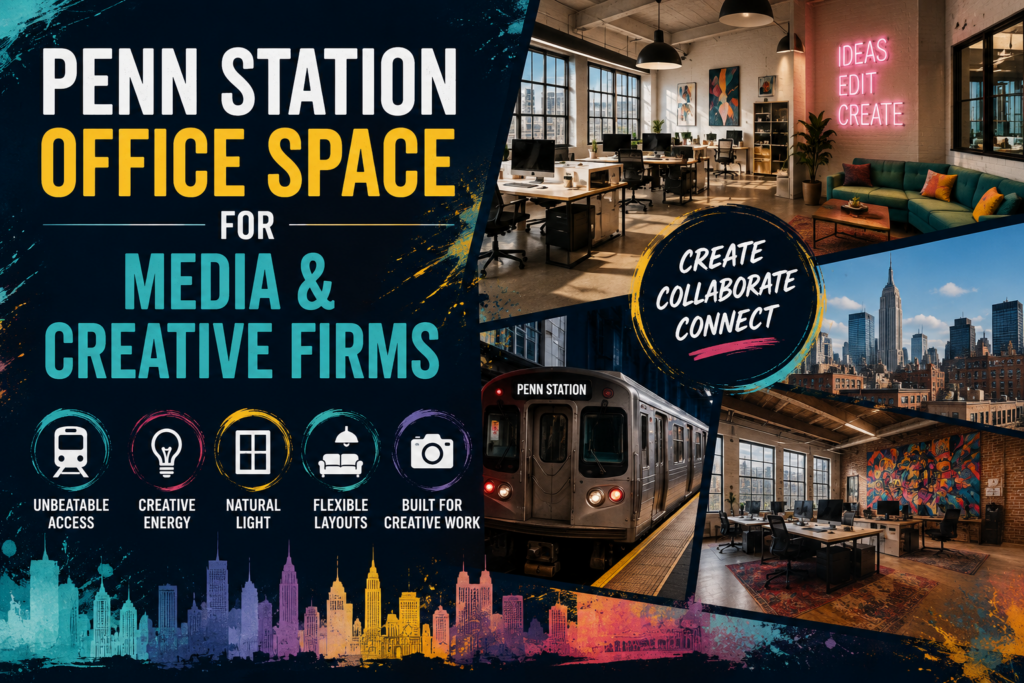
Creative users, however, often choose Penn for a different reason. They can still find open floors, exposed ceilings, hardwood or polished concrete, multiple exposures, wet pantries, breakout rooms, and full-floor identity within walking distance of the station. That blend of speed, character, and flexibility is exactly why Penn keeps showing up for media, fashion, production, design, and growth-stage teams.
The office types that usually fit this search
Loft-style creative floors
If your team wants a true creative office near Penn Station, start with loft-style floors. This is where Penn often performs best for media users. Current live examples on our site include a 5,875 RSF full-floor loft with windows on three sides, a 7,769 RSF loft office with open planning flexibility, and 6,745 RSF loft-style full floors with high ceilings and strong light. That is the product type that best supports editorial teams, production groups, agency pods, collaborative creative departments, and firms that want visible brand energy inside the office itself.
A loft floor also solves a common creative problem. It gives you a space that can change without fighting the building. Open worktables, edit bays, podcast rooms, huddle areas, pin-up walls, internal screening zones, and soft lounge seating all fit more naturally inside this product than inside a traditional corridor-heavy office. When a team’s workflow changes every six months, that flexibility matters.
Prebuilt creative suites
Many firms do not want to build from scratch. They want a strong visual look, fast move-in timing, and a lease that does not require a full design process up front. Penn offers plenty of that product too. Current examples include a 4,599 RSF creative suite with high ceilings, hardwood floors, glass rooms, and oversized windows, a 7,675 RSF Penn Station office with polished concrete floors and high open ceilings, and a 7,815 RSF furnished full floor with terrace access, exposed ceilings, and a move-in-ready layout.
This category fits agencies, content teams, branded hospitality groups, fast-growing digital media companies, and creative departments that need to be productive right away. It also works well for firms that want an impressive office without losing months to design, approvals, and construction coordination. For a tenant, that speed can be worth more than chasing the perfect blank box.
Station-connected premium towers
Some media firms need more polish than patina. If the office doubles as a client venue, recruiting platform, executive hub, or cross-regional headquarters, station-connected premium towers deserve a serious look. Current owner materials market direct access to Penn Station and Moynihan Train Hall, plus extensive conference, wellness, lounge, food, and flexible workspace offerings. That product tends to cost more, yet it can justify the premium for firms whose brand depends on arrival quality and commuter ease.
This is not the only answer for creative firms. Still, it is the right answer for some of them. If your team pitches large accounts, runs high-value client meetings, or hires nationally, the smoother front door can create real business value.
Flexible private office inventory
A different set of tenants uses this search for very small private offices, satellite teams, or swing space. That is one reason flexible-space pages show up so often. One large current marketplace around Penn lists 273 private offices, eight coworking locations, and 55 meeting rooms, with private office pricing averaging about $789 per desk per month. Another current page shows very small private office options at a Penn-area Broadway address from roughly $1,200 to $2,000 per month.
That lane is real, but it is not the heart of this topic. If your firm needs a true media office Penn Station users can brand, configure, and grow inside, flexible space usually serves as a bridge, not the end state.
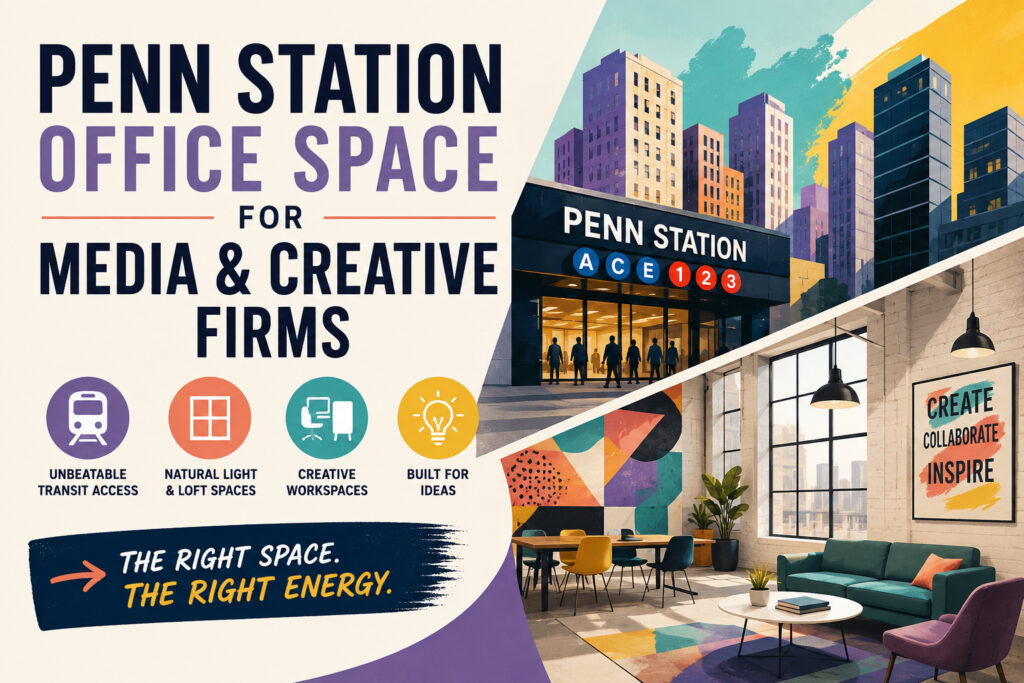
The best Penn Station blocks for creative users
The station-front core
The most commuter-efficient band sits on and around West 33rd and West 34th Streets, especially near Seventh and Eighth Avenues. This zone works best for firms that value the shortest possible walk from train to desk. It also suits teams with frequent out-of-town visitors, frequent same-day client traffic, or heavy New Jersey and Long Island commuting patterns. Current station materials and nearby office pages support that logic clearly.
The trade-off is feel. Station-front space often skews more polished and more expensive. You gain convenience and a cleaner image. You may give up some of the raw loft character that creative teams still want.
The Midtown South edge
For many media and creative firms, the smartest Penn search begins a little south of the station. West 29th through West 31st Streets often delivers a better balance of texture, light, and flexibility while keeping Penn highly workable. Current live examples in this band include 6,800 RSF plug-and-play space, 6,810 RSF furnished prebuilt space, and 7,815 RSF furnished full-floor space.
This is the zone that feels closest to a “Midtown South creative office near Penn Station” answer. You still get the rail logic. At the same time, you gain better odds of finding open plans, stronger daylight, cleaner branding opportunities, and floorplates that do not feel overly corporate. For many creative tenants, this is the sweet spot.
The Garment District creative band
Move a little north and you enter a different creative lane. West 36th through West 38th Streets often give you loft-heavy product, solid value, and a little more separation from the station crush. Current listings in that band include 6,745 RSF full floors with strong light and flexible lease terms, while general Garment District market pages still frame the area as a place where many tenants pay roughly $55 to $90 per square foot depending on building class.
This band works well for firms that want room to spread out without paying for station-connected branding. It also tends to fit groups that value collaboration over formal reception space.
The Herald Square overlap
Some Penn Station searches land on Herald Square addresses for a reason. That overlap zone offers a very useful middle ground between Penn, Midtown South, and broader Midtown access. A current 4,599 RSF Penn Station office for lease in that band illustrates the point well. It pairs character, natural light, and glass rooms with fast access to both Penn and the surrounding Midtown subway network.
If your team splits its time between West Side commuting and East Side meetings, this belt can work extremely well. You give up literal station-front adjacency. In return, you gain optionality.
What creative firms should demand before they tour
Light, ceiling height, and visual depth
Creative firms feel a space before they measure it. Good Penn Station creative product usually wins on natural light, multiple exposures, ceiling height, and a floor that reads clearly from entry to perimeter. That is why so many strong current examples emphasize oversized windows, light on three sides, exposed ceilings, and open planning potential. If the floor looks flat, dark, or over-partitioned, it will not get better after the lease.
Quiet rooms and acoustic control
Open space helps collaboration. It does not solve sound. Media and creative firms should require the ability to create at least some acoustic separation for calls, edit work, recording, focused design sessions, review meetings, and private client conversations. Glass offices, phone rooms, and enclosed conference rooms already exist in many current Penn-area prebuilts. That can save meaningful build cost and real move time.
Freight access, power, and after-hours function
A creative office often uses the space harder than a standard professional suite. Equipment moves in. Production days run late. Clients show up at uneven hours. So check the basics early: freight rules, service elevator access, after-hours HVAC, electrical capacity, internet path diversity, and building policies around filming, heavy deliveries, and weekend use. A beautiful floor can still fail a creative team if the back-end logistics fight the workflow.
Pantry, breakout, and informal client space
Many media firms do not need a formal boardroom culture. They do need strong informal hosting. A good pantry, lounge edge, internal touchdown area, and flexible meeting zone often matter more than excess private office count. Current Penn-area prebuilts lean into exactly that setup, with collaborative pantries, breakout rooms, open work areas, and glass meeting rooms appearing again and again.
A future-proof deal
Do not decide only on the layout. Decide on the lease structure that gives your firm room to change. Creative teams grow in bursts. They also reorganize quickly. Expansion rights, contraction strategy, sublease flexibility, furniture treatment, signage rules, and delivery timing all deserve attention before the final shortlist, not after.
What Penn Station office space costs right now
The first mistake many tenants make is trusting one headline Penn number. Penn is really several pricing bands stacked on top of one another. Our current tenant pricing guide places many station-area Class A towers around $85 to $110 per square foot, repositioned Class B buildings around $55 to $75 per square foot, and older loft or value-oriented space around $40 to $55 per square foot. The same guide notes concessions often running from roughly six to twelve months of free rent and tenant improvement packages from about $40 to $100 per square foot, depending on product and term.
That wide spread explains why Penn works so well for creative users. A media firm can choose between brand, value, or flexibility without leaving the same broad commuting ecosystem. In tenant terms, you are not buying “Penn Station” once. You are choosing which Penn you want to pay for.
Headline submarket data also shows why the district feels competitive. Cushman & Wakefield says Penn’s transformation has helped push submarket asking rents well above the Midtown average while keeping vacancy lower, and that the area has drawn heavy relocation demand over the last two years. Colliers’ first-quarter Manhattan report points the same way, with stronger leasing momentum, tightening availability, and rising average rents across Manhattan as a whole.
For tenant planning, that means two things. First, the best creative Penn space does not sit forever. Second, the older assumption that Penn is simply the cheap answer is no longer true at the top of the market. The deals still exist, but they live in the loft and repositioned bands, not automatically in the most visible towers.
If you are shopping for very small team space, the pricing language shifts. Flexible inventory around Penn currently averages about $789 per desk per month on one large marketplace, with day offices and meeting rooms mixed into that ecosystem. That route can work for project teams, temporary swing space, or very small creative groups. It usually does not replace a proper leased office if your firm needs branding, studio functionality, layout control, or long-term occupancy economics.
For deeper neighborhood pricing, start with How Much Does Office Space Near Penn Station Cost Today?. If you want live supply, browse Penn Station Offices.
Frequently asked questions
Is Penn Station actually good for a media or creative firm?
Yes, if your firm values speed, hiring reach, and layout flexibility. Penn works especially well when your staff commutes from more than one direction, your office doubles as a client venue, or your team needs a creative floor without giving up Midtown convenience. The market now supports both polished tower space and loft-style creative space in the same wider district.
What counts as a creative office near Penn Station?
For most tenants, it means one or more of the following: open planning, strong window lines, exposed or high ceilings, flexible collaboration areas, glass meeting rooms, polished concrete or hardwood floors, and a layout that can support both focused and social work. Current Penn-area listings on our site show all of those traits across both loft spaces and prebuilt suites.
Is a loft office near Penn Station better than a polished prebuilt suite?
Not automatically. A loft wins when your brand wants texture, your planning needs may change, or your team thrives in open space. A polished prebuilt wins when speed matters, your clients visit often, or you want fewer upfront decisions. The better answer depends on workflow, not taste alone.
Is direct station access worth paying more for?
Sometimes. It usually is worth paying for if your roster leans heavily on regional rail, if client meetings stack tightly, or if weather-proof arrival matters to your team. It is less important when your firm comes in a few days each week, values loft character more than trophy arrival, or can save materially by moving one to three blocks away.
Which Penn area feels most creative?
For many firms, the strongest creative feel sits just south or slightly north of the station core, especially on the Midtown South edge and in the better loft stock across the West 20s and West 30s. Those blocks keep rail access workable while improving the odds of finding light, texture, and more flexible floorplates.
Should a media firm choose direct lease, sublease, or flexible space?
Choose a direct lease when you want brand control, a longer runway, and the freedom to shape the office. Choose a sublease when you need speed, furniture, or a shorter commitment. Choose flexible private office space when the team is small, temporary, or in transition. Each format has value, but they solve different business problems.
Find the right Penn Station office for your team
The best Penn Station office for a media or creative firm is usually the one that matches workflow before image and commute before marketing copy. When that happens, the office feels right fast.
We represent tenants only. That means we compare station-front towers, loft floors, prebuilts, and faster-turn options side by side, then negotiate the strongest terms from your side of the table.
Start broad with Penn Station Offices. If you want a live creative example, review Penn Station Office for Lease. If pricing comes first, use How Much Does Office Space Near Penn Station Cost Today?. For additional live examples that match this exact search, see Full Floor Penn Station Office, Penn Station Loft Office, and Seventh Avenue Office for Lease.
Fill out our 📋 online form or give us a call today 📞 212-967-2061 — let’s find the right options for your business.