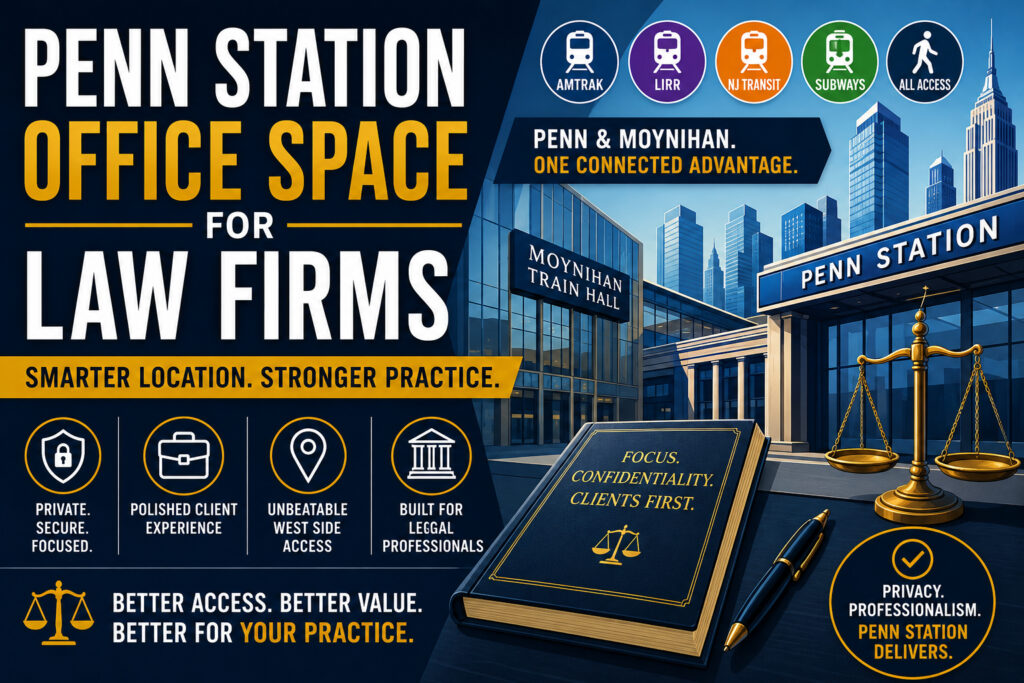
A law firm does not choose Penn Station for novelty. It chooses Penn when the office must work hard every day. Client arrival feels simpler here, regional access stays strong, and many firms can secure a sharper value-to-location ratio than in legacy legal corridors. Penn and Moynihan together connect Amtrak, LIRR, NJ Transit, PATH, subways, and street access in one concentrated zone, while Moynihan adds a 255,000-square-foot train hall, more concourse space, and direct access to the Eighth Avenue subway.
Bottom line:Penn works best for firms that want privacy, polished client handling, and a West Side commute that does not punish attorneys or staff.
Why Penn Works for Legal Work
Penn Station solves a problem that many law firms still face. Attorneys, staff, experts, and clients often come from different directions. Some travel from New Jersey. Others come from Long Island. A few arrive on Amtrak. Many need a short subway finish or an easy car drop-off. Penn handles that mix better than most Midtown locations because the transportation stack sits directly under, beside, or just outside the office cluster.
That advantage matters more for law than it does for many other industries. A legal office does not just need desks. It needs controlled arrival, quiet meeting space, predictable travel, and an address that feels credible before the first conversation starts.
Penn also fits firms that want a West Side position without giving up a professional image. The corridor around the station has changed quickly. Cushman says more than 3.5 million square feet of relocations flowed into the Penn Station submarket between 2023 and 2025, and that new wave of product pushed asking rents there to levels far above the Midtown average while drawing financial, professional, technology, and media tenants at scale. At the broader Manhattan level, Q2 2026 leasing stayed strong, Midtown asking rents sat near $77 per square foot overall, Midtown Class A reached $88.50, and Midtown availability tightened to 12.7%.
That does not mean Penn is the answer for every firm. If your practice depends on classic Sixth Avenue clustering, East Midtown social gravity, or faster access to Grand Central-heavy commuter patterns, another corridor may fit better. Still, for many attorney offices on the West Side, Penn offers the cleaner daily match. If you want the older legal context, review our Sixth Avenue law corridor guide. Sixth Avenue remains deeply tied to the legal market, but that tradition does not erase Penn’s current advantages for firms whose map, talent pool, and client base now lean west.
What Firms Usually Mean by This Search
Not every firm asking for Penn Station office space wants the same thing. That is why the market feels confusing. The phrase usually points to one of four real-world needs.
The first need is a shared attorney office inside another professional suite. This suits a solo practitioner, a satellite partner, trial counsel who only need a Manhattan foothold, or a lawyer who wants conference-room access without taking a full unit. That option appears often because it is quick, small, and transit-friendly. However, it rarely gives you full brand control, total confidentiality, or a reception experience that feels fully yours. The benchmark pages in the submitted PDF show exactly this pattern, with shared legal suites, generic marketplaces, and broad Penn inventory pages all competing for the same phrase.
The second need is a boutique legal suite around 2,000 to 6,000 square feet. This is the sweet spot for many firms. One reception zone, several perimeter offices, one or two conference rooms, a support bay, and a pantry often cover the requirement. In Penn, this format can be found in Class A towers, repositioned buildings, and prebuilt suites near both the station and the Sixth Avenue edge. Our current Penn-area examples include spaces around 1,947, 2,982, 3,109, 3,378, 4,694, 4,776, 5,170, 5,875, and 5,990 square feet, which shows how much choice now exists in the mid-block range.
The third need is a midsize private law office in the 6,000 to 10,000 square foot range. Firms in this lane usually need a true front-of-house, better internal separation, and a stronger ratio of partner offices to open seats. Penn supports this format well because many current suites already include multiple offices and conference rooms, or they can be converted without tearing apart a creative loft that never wanted private rooms in the first place. Our live examples in this range include a 6,000-square-foot sublet with 10 private offices and three conference rooms, a 7,447-square-foot sublet with nine windowed offices plus three internal offices and two conference rooms, and a 9,450-square-foot suite with 12 windowed offices, two conference rooms, formal reception, and front-desk presence.
The fourth need is a custom direct lease for a mature firm that wants its own legal layout from the start. That usually begins above 8,000 square feet, though some firms start smaller. Penn now offers enough high-quality inventory for that strategy too, including blocks large enough to build a partner-heavy perimeter plan, separate litigation rooms, dedicated support zones, secure records areas, and private staff circulation. Our current direct-lease example at 18,641 square feet shows that level of optionality clearly.
The Penn Zones That Matter for Law Firms
Penn is not one uniform office pocket. For law firms, the area divides into three practical bands, each with a different legal feel.
Penn zone
Best fit for law firms
What it feels like
Why it works
Direct Penn and Moynihan core
Client-facing boutiques, regional practices, firms with heavy NJ or Amtrak traffic
More polished towers, stronger amenities, cleaner rail arrival
Best transit concentration and strongest image lift
Seventh Avenue and Sixth Avenue edge
Firms that want balance
More classic Midtown mix, easier office-heavy layouts, strong subway overlap
Good compromise between legal functionality and rent discipline
Side-street Penn and loft-value stock
Cost-sensitive firms, support-heavy practices, internal teams
More flexible, less formal, often better value
Useful when layout matters more than trophy optics
The first band sits closest to the station and the largest redeveloped buildings. This is the strongest answer when commuter friction must stay low and client handling matters. It also tends to support the best amenity package, the most formal lobby sequence, and the easiest “walk off the train and into the office” story. That is why Penn has become more competitive for professional users over the last few years.
The second band covers the Seventh Avenue and Sixth Avenue edge near Herald Square. This zone matters for law firms because it often produces the most practical built spaces. You get Midtown density, station access, and a stronger chance of finding perimeter offices in buildings that do not price like the newest trophy stock. Many attorney offices near Penn fall into this band because it balances image and function without drifting too far east. The legal history of Sixth Avenue reinforces that appeal, even for firms that no longer need to sit inside the old legal epicenter.
The third band includes side-street value product and loft-style buildings. These offices can work well for back-office-heavy practices, immigration teams, plaintiff-side groups, or firms that prioritize cost control and interior efficiency over formality. Even here, the location still helps because Penn keeps the region connected. Yet a cheaper layout is not automatically a better legal office. If the suite lacks sound control, real reception, or enough enclosed rooms, the bargain can disappear fast.
The Legal Layout That Actually Works Here
A law firm office near Penn Station should not be planned like a generic startup suite. Legal work needs a stronger front-to-back sequence.
Start with arrival. Guests should move from elevator to reception without passing staff seating first. A clean front desk, a visible waiting area, and a conference room near the entrance matter. Those elements control the first five minutes. They also reduce the awkwardness that happens when a client walks into the middle of operations.
Next comes attorney privacy. Partner offices do not all need to sit on the windows, but the perimeter should carry the most client-facing rooms whenever possible. A good Penn legal office usually has a mix of windowed offices, internal partner or associate rooms, and at least one larger room that can flex between boardroom, mediation, or case strategy use.
Then comes support logic. Copy, mail, scanning, IT, and document handling should sit near the administrative core, not inside client sightlines. A litigation group also benefits from one extra room that can become a war room, records room, or overflow office during peak case periods.
Finally, there is acoustic control. This point gets missed. Glass fronts look sharp. They also leak sound if the installation is weak. In a legal office, phone calls, privileged discussions, and tense negotiations happen all day. That means door seals, wall construction, room placement, and corridor noise deserve real attention before a firm signs anything.
A strong Penn legal suite often follows a simple formula: reception, one or two conference rooms, a perimeter line of offices, a compact support core, a pantry that stays out of the client path, and enough flexible rooms to absorb growth. That formula works across boutiques, midsize firms, and satellite Manhattan offices because it serves both professionalism and daily use.
What to watch closely: after-hours HVAC rules, lobby and freight access, floor-sharing conditions, signage policy, phone-room quality, file-storage capacity, and how much of the office remains truly private after a full workday begins.
Lease Structure and Budget
Penn gives law firms more than one pricing lane. That is one reason the area keeps drawing professional tenants. Our current Penn cost guide breaks the market into three broad tiers: trophy and direct-access product around $85 to $110+ per square foot, repositioned Class B and strong prebuilt stock around $55 to $75, and older loft or value product around $40 to $55. The same guide shows concession ranges that can run from roughly 6 to 12 months of free rent and $40 to $100 per square foot of improvement allowance, depending on building quality and term.
For law firms, those numbers matter less in the abstract than in relation to layout efficiency. A law office with too little privacy needs more square footage than a hybrid creative office. That changes the effective economics. A slightly higher face rent can win if the space already includes real offices, reception, and conference rooms. By contrast, a cheaper raw floor can become expensive if you must add heavy partitioning, millwork, upgraded doors, and better acoustic treatment.
The lease type matters just as much.
A shared legal office works when you need speed, a Manhattan foothold, or a lighter monthly commitment. It fails when you need your own identity, predictable visitor experience, or stricter document and confidentiality control.
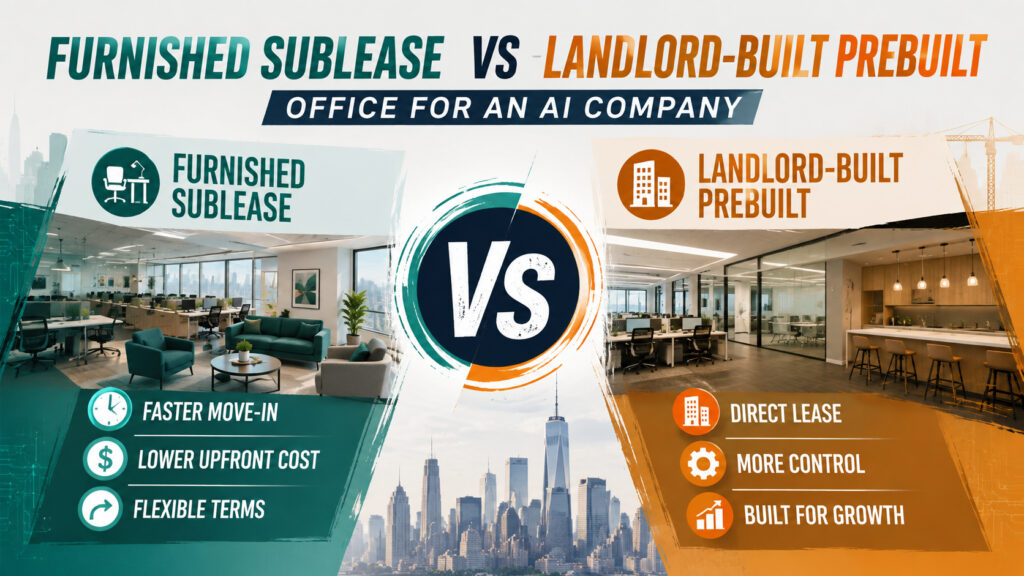
A sublease works when you want a faster move, shorter term, and existing furniture or legal-style rooms. It is often the best route for firms that want Penn today but are still testing headcount, practice growth, or long-term seating ratios.
A direct prebuilt works when you want better control without waiting through a full custom build. Many law firms should start here. It offers the cleanest middle ground.
A raw direct lease works when the firm is large enough, stable enough, and committed enough to build exactly what it needs. That is usually the right move for a growing practice with a real Manhattan plan, not a temporary foothold.
If you want to browse broader inventory after that, start with Penn Station office space for lease and then work outward by size, term, and layout rather than by brand or building hype alone.
Common Questions Law Firms Ask
Is Penn Station a good location for a law firm?
Yes, when your team or client base leans west, regional, or rail-dependent. Penn is especially strong for New Jersey commuters, many Long Island commuters who still arrive through Penn, and firms that host out-of-town clients. It is also a serious option for any law office that wants Midtown access without defaulting to a more expensive legacy legal corridor. Penn’s transformation, Moynihan’s addition, and sustained tenant migration have made that case much stronger than it was a few years ago.
What size office does a boutique law firm usually need near Penn?
That depends on room count more than headcount. A five-lawyer firm with support staff may need 3,000 to 5,500 square feet if it wants true private offices, reception, one conference room, and growth space. A more open advisory-style practice may fit smaller. A litigation-heavy group usually needs more enclosed rooms than its raw headcount suggests.
Should a law firm pick a shared suite or a private office?
Choose a shared suite only when speed, cost control, and a light footprint matter more than brand control. Choose a private office when confidentiality, client handling, staffing, and growth matter more than short-term convenience. Many firms start in the first model and outgrow it quickly.
Does direct access to Penn or Moynihan really matter?
For many firms, yes. The shorter the last walk, the smoother the day feels. That is true for partners arriving from New Jersey, clients coming in on Amtrak, and staff moving in and out during bad weather. Moynihan also changed the perception of the west-side arrival sequence by improving light, space, and station circulation.
Is Penn cheaper than the classic legal corridors?
Often, yes, but not always. Trophy Penn product can be expensive. Even so, Penn still offers a broader range of pricing lanes than many prestige-heavy legal corridors, which lets firms match layout and image more precisely to budget. The key is to compare usable legal functionality, not just the quoted rent.
What makes an attorney office near Penn feel credible to clients?
A clean building entrance, controlled elevator arrival, real reception, quiet conference space, and a direct route from station to suite. The office does not need to be flashy. It needs to feel organized, private, and intentional.
When should a firm leave Penn for another corridor?
Move away from Penn only when the daily map says so. If your attorneys, clients, and referral network cluster in East Midtown, downtown court corridors, or a long-established legal pocket, another location may reduce friction. If your practice runs west, regional, or cross-market, Penn often remains one of the smartest legal office choices in Midtown.
Find Penn Station Office Space Today
We represent tenants, not landlords. We compare direct leases, subleases, and law-friendly layouts across the Penn Station area. Our role is to help you secure the right space, the right term, and the right economics without wasting tours on offices that look better online than they work in practice.
Fill out our 📋online form or give us a call today 📞212-967-2061 — let’s find the right options for your business.