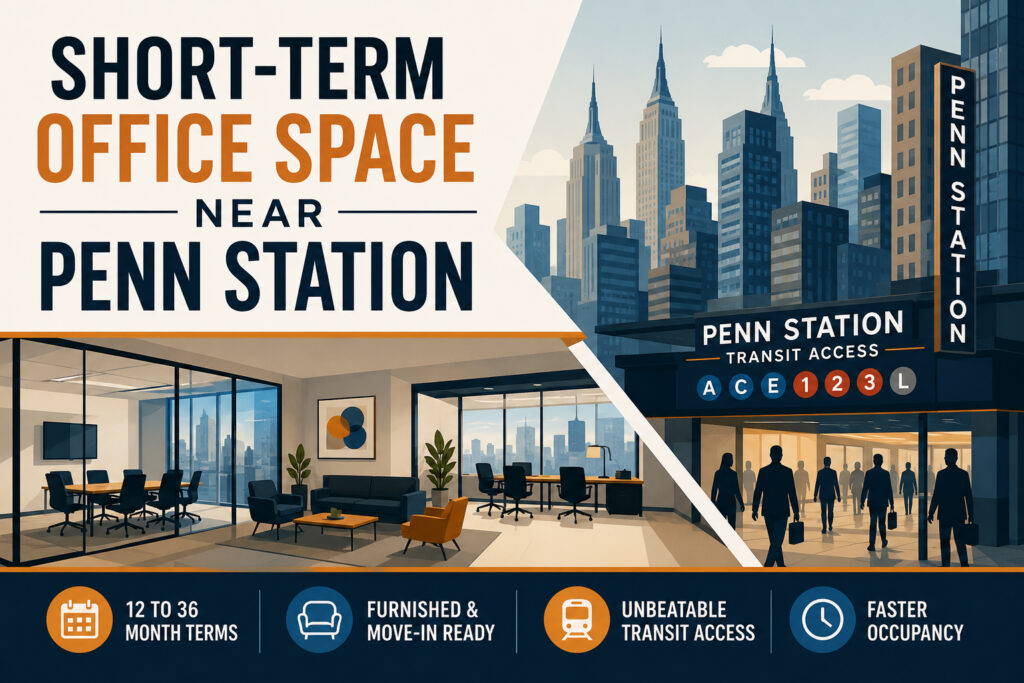
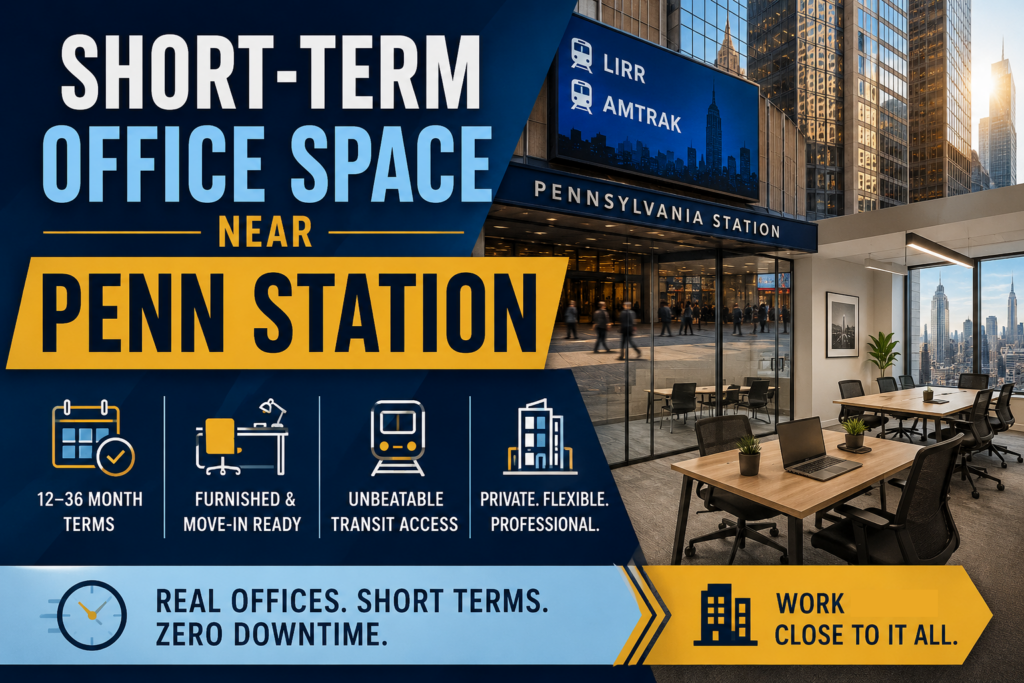
If your company wants a real office near Penn Station, start with Penn Station offices for the broadest inventory. Then compare office sublets near Madison Square Garden if speed and value lead the search. Finally, use move-in-ready office space to screen for suites that need little or no downtime before occupancy. Those three internal paths cover the most useful decision points for this search.
The winning move near Penn Station is simple. Choose a real office with a short enough term, not a desk product with office language.
What Short-Term Means Near Penn Station
In Manhattan, “short-term” means different things to different tenants. A day room or hourly suite serves a meeting need. A monthly membership serves a flexible attendance pattern. A true short-term office lease serves a company that needs a private workplace for at least a year, but not a decade. That third category fits this page best.
For Penn Station tenants, the sweet spot usually falls between 12 and 36 months. That range gives you enough time to stabilize headcount, test a neighborhood, bridge a future headquarters move, or handle a project-driven need. It also opens more inventory than a six-month search. Nearby public examples on our site include furnished and prebuilt direct or sublease options around 2,982 square feet, 7,815 square feet, 9,450 square feet, 10,537 square feet, and 18,641 square feet, with some subleases already running through 2027.
A tenant should also separate product types before touring. A private leased office gives you stronger control over noise, guests, branding, storage, and daily workflow. By contrast, a membership-style setup often prices by desk or by room. It can work for tiny teams. Still, it rarely feels like your own office. That gap explains why many renters start with a broad phrase, then narrow quickly once they define the actual requirement.
Where These Offices Sit and Who They Fit
Near Penn Station does not mean one exact block. In practice, most live options cluster within a short walk of the station entrances and Moynihan Train Hall. That usually places the strongest inventory around the low 30s through mid 30s, with practical choices stretching through Penn Plaza, Herald Square, the Garment District, and the eastern edge of Midtown West. Moynihan Train Hall sits between Eighth and Ninth Avenues and 31st to 33rd Streets, while New York Penn Station centers on 33rd Street and Seventh Avenue across from Madison Square Garden.
That geography helps several kinds of tenants. New Jersey commuters value the rail convenience. Long Island teams appreciate quick access to both Penn and Moynihan flows. Companies with frequent Amtrak travel benefit too. Smaller firms often favor side-street or garment-district value. Larger firms often lean toward Penn Plaza and more institutional buildings. Teams that meet clients often like the walking simplicity of a true Penn address.
This area also fits different business moments. A growing firm may need a stopgap office before a larger relocation. Another team may want a project office close to regional staff. Some companies simply need a polished space now, without waiting for permits, plans, and construction. That is why short-term Penn Station demand often centers on speed, commute logic, and operational control more than lifestyle amenities.
Your Best Options by Lease Structure
Not every short-term office near Penn Station solves the same problem. Use the matrix below to match term, cost, control, and speed.
What you need most
Best fit
Typical term
Why tenants choose it
Main tradeoff
Fastest move with the least setup
Furnished sublease
12–36 months
Existing layout, furniture, and wiring shorten downtime
The term end may dictate your exit
More control over specs and identity
Prebuilt direct lease
24–60 months, sometimes shorter
Cleaner tenancy, stronger control, and possible concessions
Direct terms often run longer
Lowest upfront disruption
Move-in-ready direct or sublet suite
12–36 months
Minimal construction and faster occupancy
Layout may not fit perfectly
Best value near the station
Older loft or repositioned Class B
12–36 months or longer
Lower rent bands and efficient layouts
Amenity packages vary
Tiny team with uncertain usage
Managed suite or membership product
Monthly to 12 months
Good for short bursts or very small headcount
Less privacy and weaker office control
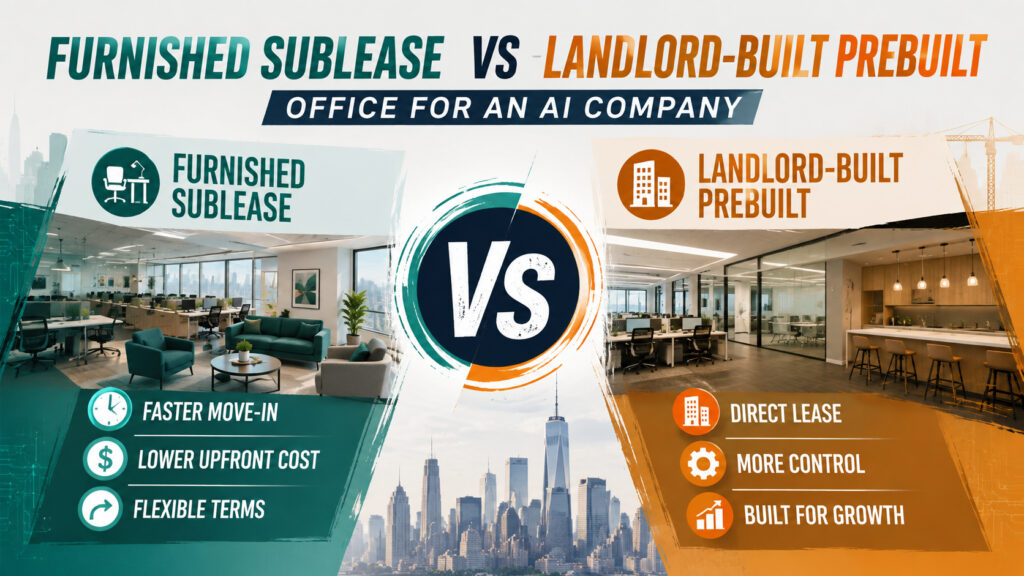
For most tenants, the best balance comes from the first three rows. A furnished sublease works when you need speed and a known end date. A prebuilt direct lease works when you want more control and may stay longer if the office performs. A move-in-ready suite works when you need both speed and a professional presentation. That is why this page focuses on real suites, not shared desk products.
If you want to narrow options fast, begin with Penn Station offices for broad coverage. Shift to office sublets near Madison Square Garden if you want better value and immediate usability. Then use move-in-ready office space to screen for the fastest occupancy path. Those three routes match the most common tenant priorities in this corridor.
What You Will Pay and What You Get
Price near Penn Station depends more on building type and buildout than on the phrase “short-term.” Current guidance on our site places many Class A towers near Penn around $85 to $110 per square foot, repositioned Class B properties around $55 to $75 per square foot, and older loft or value space around $40 to $55 per square foot. That spread matters because many tenants compare a private office lease with a desk-based product that uses a completely different pricing model.
Nearby desk and suite products often headline low monthly starting prices. Those numbers can mislead tenants who actually need a private suite. A real office cost analysis should include square footage, layout efficiency, term length, furniture, cabling, meeting rooms, pantry, after-hours HVAC, and the cost of downtime before move-in. Once you run that full comparison, a furnished sublease or prebuilt direct lease often becomes the smarter answer for a real team.
What should you expect inside the better Penn-area short-term offices today? Public examples on our site show strong availability in fully furnished suites, prebuilt layouts, conference rooms, breakout areas, kitchens, 24/7 access, key-card entry, and immediate or near-immediate occupancy. Current public sizes on our site range from smaller direct suites near 1,500 square feet to Penn-area opportunities above 18,000 square feet. Some subleases already run through late 2027, which sits squarely inside the target term for many short-term tenants.
How to Choose the Right Space Fast
Start with the term, not the tour. If your likely stay ends inside three years, focus first on subleases and move-in-ready direct suites. That filter saves time. It also removes raw space that adds cost and delay. Next, set a real walk radius. A five-minute walk feels very different from a ten-minute walk in bad weather or evening traffic. Penn Station and Moynihan access should feel easy, not theoretical.
Then test the layout against your team, not against a brochure. Ask four questions. Does the office support your current headcount? Can it absorb modest growth? Does it include enough meeting space? Can your team work there on day one? A short-term office should reduce friction. It should not create hidden buildout work.
After that, decide whether your priority is value, speed, or polish. Value often points toward older loft or repositioned Class B inventory. Speed often points toward furnished sublets. Polish may justify a stronger building package if the budget allows it. None of those answers is universal. The right answer depends on whether commute, image, layout, or cash control matters most.
One final rule helps almost every tenant. Do not confuse flexible access with office control. If you need your own culture, your own meetings, and your own daily rhythm, choose a real suite. Use a shared product only when the team is very small or attendance stays light.
Questions Tenants Ask Before They Tour
What counts as short-term office space near Penn Station? For a real tenant requirement, the strongest definition is a private office on a 12- to 36-month sublease or shorter direct lease. Day rooms and monthly memberships may help some users, but they usually serve a different need.
Is a sublease better than a direct lease? A sublease often wins on speed and lower setup costs. A direct lease often wins on control and longer-term flexibility. If your team needs a bridge solution, subleases usually deserve the first look. If you may stay longer, a prebuilt direct lease can make more sense.
How much office can you find near Penn Station right now? Current public examples on our site run from smaller suites around 1,500 square feet to larger Penn-area opportunities above 18,000 square feet. That range gives real depth for small, midsize, and larger teams.
Are furnished offices common in this corridor? Yes. Furnished and move-in-ready options show up often in the Penn Station area, especially in subleases and prebuilt suites. That is one reason the corridor works so well for 12- to 36-month searches.
What should “near Penn Station” mean in real life? It should mean an easy daily walk to Penn Station or Moynihan Train Hall, not a map-based stretch. For most tenants, that means focusing on the blocks where the station still shapes the commute, the client arrival, and the workday feel.
Tenant-Only Guidance
We represent tenants, not landlords. We compare direct leases, subleases, and move-in-ready offices through the lens that matters most to your company. Our job is to narrow the field to the spaces that actually fit your term, budget, headcount, and commute pattern.
If you want the cleanest path forward, start with Penn Station offices. Move next to office sublets near Madison Square Garden if speed or value carries more weight. End with move-in-ready office space if you want the shortest path from tour to occupancy.
The right short-term office near Penn Station should do three things well. It should shorten the commute. It should fit the team now. It should leave you enough flexibility for what comes next.
Fill out our 📋online form or give us a call today 📞212-967-2061 — let’s find the right options for your business.