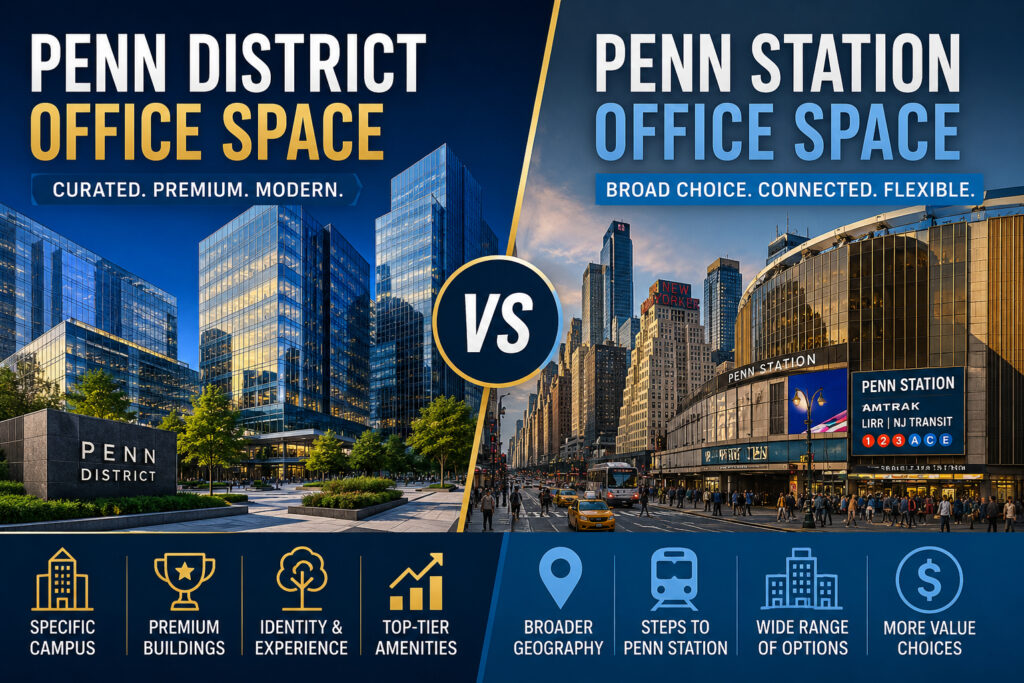
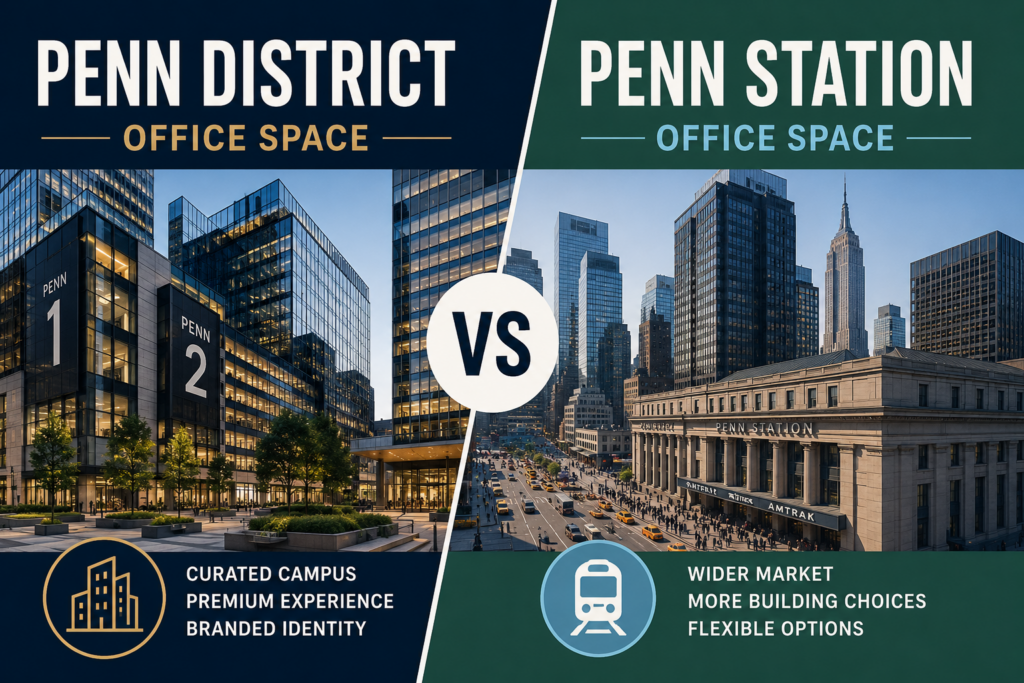
The short answer is this: Penn District office space usually means a specific branded cluster of redeveloped buildings centered on PENN 1, PENN 2, and the Farley/Moynihan block, while Penn Station office space means the broader office market around the station, including Penn Plaza towers, nearby Class A stock, repositioned mid-block buildings, and value-oriented loft space within a short walk of the rail hub. That distinction matters because one term points to a curated campus experience, while the other points to a wider menu of buildings, rents, layouts, and lease strategies.
Tenant takeaway:Penn District is a narrower, premium subset of the broader Penn Station office market. Penn Station is the geography. Penn District is the branded product inside part of that geography.
Start With The Real Distinction
Many tenants search these two phrases as if they mean the same thing. They do not. One describes a specific office campus and identity story. The other describes a larger commuter-centered office zone whose buildings range from trophy to practical to value-driven.
Here is the cleanest way to think about it:
Term
What it usually means
What you are really shopping
Penn District office space
A branded west-side office cluster built around major redevelopments and the Farley/Moynihan side of the station
The wider market around Penn Station and its entrances
Everything from top-tier redevelopment to Penn Plaza workhorses to loft-style value space
The branded district currently spans roughly 9 million square feet across more than a dozen buildings and land sites around Penn Station, while the broader Penn Station office market reaches much farther across the surrounding grid and includes many buildings that tenants use every day without ever calling them “Penn District” buildings.
That is why this topic creates confusion. A tenant may say “Penn District” when they really mean “modern office space near Penn.” Another tenant may say “Penn Station office space” when they really want one very specific building with direct station access and hospitality-grade amenities. Same commute spine. Different office search.
What Each Name Covers On The Ground
Penn Station is the easier term. It is the transportation hub and the office geography that surrounds it. In tenant language, it usually means the blocks around Seventh Avenue, Eighth Avenue, West 31st through West 34th, the Penn Plaza cluster, nearby Herald Square edges, and parts of the Garment District and Midtown West that still trade on Penn access.
Penn District is narrower. It is the branded redevelopment story attached to the station area. Current owner materials describe it as a campus-like district surrounding Penn Station, and official property pages place PENN 1, PENN 2, and the Farley Building squarely inside that frame. PENN 2 totals 1,619,000 square feet and currently surfaces 15 availabilities ranging from 5,070 to 63,180 square feet. PENN 1 totals about 2,524,000 square feet. The Farley Building adds about 740,000 square feet of office space plus 120,000 square feet of retail.
That narrower definition matters because it changes what a tenant expects before touring. When someone hears “Penn District,” they often expect a campus feel, coordinated public realm, stronger amenity programming, and newer common areas. When someone hears “Penn Station office space,” the expectation broadens. That search can include everything from a major redeveloped tower to a straightforward prebuilt two blocks away.
A practical example helps. 1 Penn Plaza is one of the classic Penn Station office addresses. It sits on West 34th Street between Seventh and Eighth Avenues, rises 57 stories, contains more than 2.7 million square feet, and functions as core Penn Station office inventory. Yet many tenants would still describe it as Penn Station office space first, not Penn District office space first. That single building shows why the broader term matters.
Why Geography, Branding, And Access Do Not Mean The Same Thing
Penn Station is a transit node. Penn District is an office identity layered onto part of the surrounding area. Moynihan Train Hall adds another layer, because it sits across Eighth Avenue in the Farley Building and changes how tenants experience arrival, frontage, and the west side of the station complex. Official Moynihan materials say the train hall sits between Eighth and Ninth Avenues and West 31st to West 33rd Streets, provides direct access to Amtrak and the Long Island Rail Road, and connects cleanly to the A, C, E and 1, 2, 3 subway lines.
That means a tenant can be “near Penn Station” in three very different ways. One office may sit directly over the station. Another may sit on the Moynihan side with a much better arrival experience for intercity or Long Island riders. A third may sit a few minutes away, still benefit from Penn access, and cost far less. All three can be rational choices.
This is also where search confusion turns into leasing confusion. A building can benefit from Penn Station without being inside the branded Penn District. A building can also trade heavily on Moynihan proximity without offering the same identity as a flagship redevelopment. That is why “near Penn” is not precise enough for a tenant with a real requirement. Exact entrance pattern, final walk, and building position all change the answer.
If the west-side entrance and upgraded train-hall arrival matter to your team, read How Does Moynihan Train Hall Affect Office Space?. If you want the broader neighborhood lens, start with Penn Station Offices. Both matter here because this decision usually starts with a map, then moves to building quality, then ends with economics.
Costs, Product Types, And What You Actually Get
The broad Penn Station market gives tenants the widest pricing spread. Current New York Offices guidance pegs many Penn-adjacent Class A towers around $85 to $110 per square foot, repositioned Class B space around $55 to $75, and older loft or value space around $40 to $55. In the strongest branded product, rents can press materially higher, with recent New York Offices market commentary noting that top Penn District product is nearing $130 per square foot on the best floors.
That spread is the whole point. When tenants say “Penn Station office space,” they often want access first and price flexibility second. When they say “Penn District office space,” they usually mean they are willing to pay more for a sharper image, larger blocks, stronger common areas, and a more managed experience. Those are different briefs.
The broader market data backs up the premium. Cushman & Wakefield’s Penn Station submarket research says the area captured more than 3.5 million square feet of relocations from 2023 through 2025, or nearly one-quarter of Manhattan relocation activity. That same research says 14 buildings totaling roughly 23 million square feet were developed or fully renovated in the submarket over the last decade, lifting inventory by 124.2%. It also says Penn asking rents run 37.8% above the Midtown average, with vacancy 3.1 percentage points lower than Midtown overall.
At the city level, Manhattan’s leasing market stayed firm into Q2 2026. Cushman reported Manhattan asking rents at $72.83 per square foot overall in Q2 2026, with Midtown at $76.98, while CBRE separately put Midtown at $86.18 with availability at 12.7%. Different firms use different methodologies, but both show the same direction: strong central corridors, tighter quality inventory, and a meaningful premium for the best-connected space. That context helps explain why the Penn corridor now prices like a first-choice location rather than a fallback.
Which Choice Fits Which Tenant
Choose Penn District office space when your company cares about three things at once: regional commute power, premium arrival, and stronger building identity. That profile often fits headquarters users, larger professional teams, firms that entertain clients often, and groups that want a more unified campus environment instead of a single isolated office floor. The official property materials reinforce that positioning through large floor plates, shared terraces, event space, conferencing, food programs, and direct station integration.
Choose broader Penn Station office space when your priority stack looks different. Many tenants care more about easy rail access, flexible pricing, quick occupancy, and broad inventory depth than about a branded district label. That is where Penn Plaza towers, prebuilt suites near Seventh and Eighth, and nearby loft-style inventory can beat the premium campus answer. You still keep the commute story. You simply buy it at a different product level.
Smaller and midsize tenants often benefit most from keeping the wider term in play. New York Offices’ current Penn listings show active blocks around 1,537, 2,500, 4,600, 5,875, 7,769, 8,724, 9,450, 13,996, and 18,641 square feet, which tells you something important: the Penn Station search is not only for large headquarters users. It is also one of the easiest places in Manhattan to compare multiple sizes and lease structures without giving up commuter convenience.
Large users should not force a false choice either. Some teams start with Penn District for flagship tours, then widen the search to Penn Station inventory for price discipline and fallback leverage. Others do the opposite. They start with Penn Station because the brief is broad, then move into the branded district once they see how much campus quality changes recruiting, attendance, and client impression. Both paths are valid.
How Moynihan Train Hall And 1 Penn Plaza Change The Answer
Moynihan Train Hall matters because it upgraded the west side of the station from a purely functional commute zone into a stronger office arrival experience. Official state materials describe the train hall as a 255,000-square-foot facility that expanded total concourse space by 50% and gave Penn’s west side a more visible and dignified front door. Official visitor information also confirms direct Amtrak and LIRR access and simple subway connectivity on the west side of Eighth Avenue. That improvement affects how tenants, clients, and recruits feel about offices on that side of Penn.
That does not mean every Penn Station office suddenly became Penn District office space. It means the best-positioned buildings now trade on a better transportation experience and a better neighborhood impression than the station area carried in the past. The Farley Building expresses that shift most clearly. Official materials describe it as a converted civic structure with 740,000 square feet of office space, 120,000 square feet of retail, very large floor plates, and direct access to the rail complex.
Now bring 1 Penn Plaza back into the picture. It is not the same office story as the Farley/Moynihan side, and it does not rely on the same branding. Yet it remains a core Penn Station address because it puts tenants exactly where many commuter-heavy companies want to be: on West 34th, between Seventh and Eighth, with scale, visibility, and station convenience. That is the clearest proof that “Penn Station office space” is the broader call, while “Penn District” is the more selective one.
Future infrastructure supports the same long view. Official state material for the Penn Station Access project still targets 2027 completion for Metro-North service into Penn, which would deepen the terminal’s regional pull even further. When tenants price space here today, they are not only paying for today’s rail map. They are also pricing in a larger commuter future.
Questions Tenants Usually Mean When They Search This
Is Penn District the same as Penn Station? No. Penn Station is the transportation hub and the broader office geography around it. Penn District is a branded redevelopment district within part of that geography. One term is wider. The other is more selective.
Is Penn District more expensive than Penn Station office space? Usually, yes, because Penn District points you toward stronger redevelopment, larger blocks, coordinated amenities, and more premium positioning. Penn Station office space includes those buildings, but it also includes many less expensive alternatives nearby.
Does Penn Station still offer lower-cost space, or is everything premium now? Yes, lower-cost options still exist. The broader Penn area still includes repositioned Class B buildings and older loft-style inventory that can price well below trophy redevelopment. That is one reason the broader term remains useful.
Is Moynihan Train Hall the same thing as Penn Station? Not exactly. Moynihan is part of the Penn Station complex and improves access on the west side, especially for Amtrak and LIRR users. It changes the commuting experience, but it does not replace the full Penn Station geography or every Penn Station office option.
Where does PENN 1 fit? PENN 1 sits inside the Penn District redevelopment story and also sits inside the broader Penn Station office market. That dual role is why this topic confuses so many tenants. The building itself totals about 2.5 million square feet, completed a major renovation in 2023, and official materials emphasize direct access to Penn Station and Moynihan Train Hall.
Where does 1 Penn Plaza fit? 1 Penn Plaza fits the broader Penn Station side of the comparison best. It is a major Penn-adjacent office address, not the neatest expression of the newer branded campus idea. That is exactly why it belongs in this conversation.
Why do both names keep appearing in the same conversation? Because tenants use commute language and branding language interchangeably. One person searches by district name. Another searches by station name. A third searches by a single building. In practice, all three searches overlap around the same west-side office grid.
The Tenant-Side Bottom Line
If you want the clearest possible answer, use this rule: shop Penn District when you want a premium, branded, campus-style office experience; shop Penn Station when you want the full universe of commuter-friendly choices around the terminal. That framing keeps the geography straight and keeps your office search tied to the thing that actually matters, which is not the label alone but the combination of commute, image, space quality, and economics.
For most tenants, the smartest process is not to pick a label first. Start with the staff map. Then test final walk, station entrance, building type, concessions, and growth path. That approach usually turns the question from “Penn District or Penn Station?” into the better question: which exact building solves the commute without overpaying for the wrong kind of prestige?
If you want to keep comparing the corridor from a tenant-first angle, start with Penn Station Offices, review How Does Moynihan Train Hall Affect Office Space?, and then look at 1 Penn Plaza as one of the clearest examples of where the broader Penn Station market keeps its own identity. We represent tenants only. We help you compare live options, not brochure language, and we negotiate the rent, concessions, layout, and flexibility that turn a good location into the right lease.
More Information
We represent tenants, not landlords. That means we compare location, commute friction, concessions, floor plates, and long-term flexibility from your side of the table. If you are trying to decide where your team should actually work, this page is built to clear up the naming confusion fast and then carry you into the real leasing question.