Best Hudson Yards Offices for Tech Companies
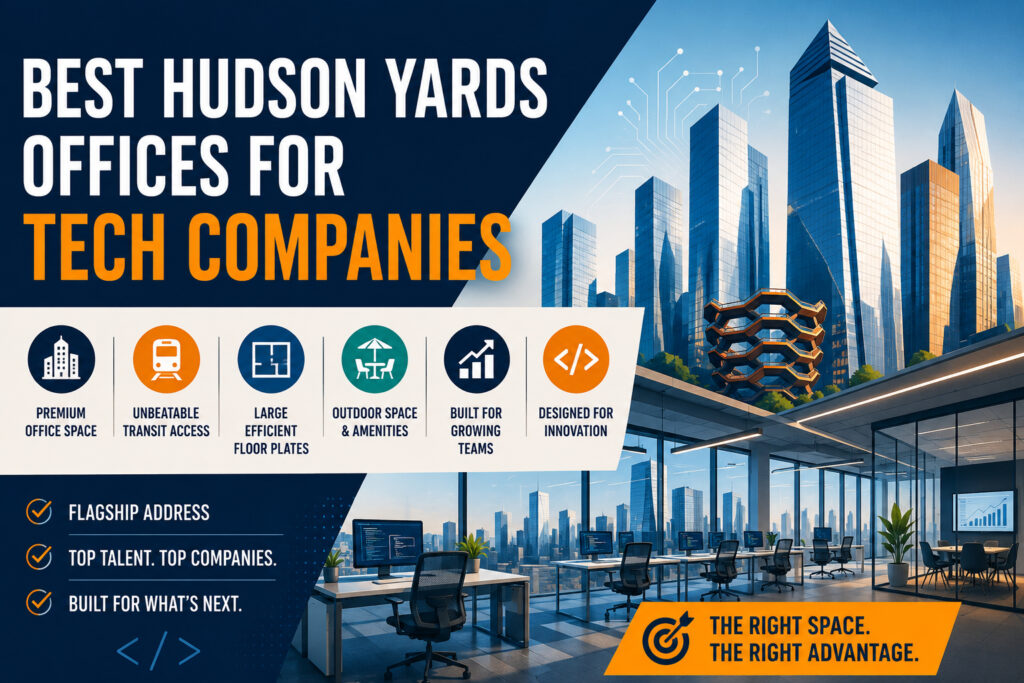
Hudson Yards deserves serious attention from technology firms for a simple reason. It offers some of Manhattan’s newest office product, strongest regional transit access, and largest efficient floor plates in one district. At the same time, it also carries a real pricing premium, so the right answer depends on how your team works, not on skyline appeal alone.
For a tech company, the “best” office in Hudson Yards usually comes down to six questions. How fast do you need to move. How many people must sit on one floor. How much privacy do product, engineering, or sales teams need. How important are outdoor spaces and daily amenities. How much capital do you want in buildout. How much rent can the business justify for a flagship address.
That framework matters because Hudson Yards is not one office type. It includes true headquarters towers, polished midsize suites, turnkey subleases, high-end prebuilts, terrace-heavy floors, and a smaller flex layer for teams that need speed more than permanence. A page that treats all of those paths as the same thing does not help a tenant make a smart decision.

Why tech companies keep narrowing in on Hudson Yards
Modern technology firms usually want three things from a workplace. They want strong infrastructure, a better commute than the address suggests, and a layout that supports both focus and collaboration. Hudson Yards keeps showing up because the district delivers that package at a very high level.
Infrastructure comes first. One major tower in the district offers 100 percent raised floors, underfloor air distribution, advanced lighting controls, and a robust telecom platform with site-wide Wi-Fi and fiber connectivity. That matters to engineering-heavy tenants, hardware teams, dense workstation plans, and any company that wants future flexibility without rebuilding the whole office later.
Scale comes next. The district includes towers with large, column-free floors, wide open bays, direct subway access, and the ability to support very large headcounts on single levels. That combination helps product, engineering, operations, and go-to-market teams stay connected instead of spreading across several inefficient floors.
Commute logic seals the deal. Hudson Yards sits beside the 7 train and remains within walking distance of Penn Station, Moynihan Train Hall, NJ Transit, LIRR, and Amtrak. For firms hiring across the city, Westchester, Long Island, New Jersey, and beyond, that reach can matter as much as the building itself.
Employee experience also plays a larger role here than many tenant guides admit. Outdoor terraces, park adjacency, direct High Line access, hospitality-style amenity floors, wellness components, bike facilities, and food options can improve attendance and retention when the market gives employees a choice. Tech firms feel that pressure more than most sectors.
Still, none of that means every tech company should lease in Hudson Yards. Early-stage teams can overspend here. Smaller users can struggle with minimum suite sizes in the core towers. Lean product companies may also prefer a more creative texture elsewhere. Hudson Yards works best when a firm values performance, polish, and commute breadth enough to pay for them.
The buildings that win for different tech use cases
For infrastructure-heavy and product-led teams, 10 Hudson Yards remains one of the strongest answers. Its raised-floor system, underfloor air, strong telecom backbone, floor-to-ceiling glass, column-free interiors, and direct High Line relationship make it unusually compelling for companies that need both technical performance and a modern employee experience. If your team wants a premium, wired, efficient environment without drifting into pure trophy theater, this building often lands near the top of the shortlist.
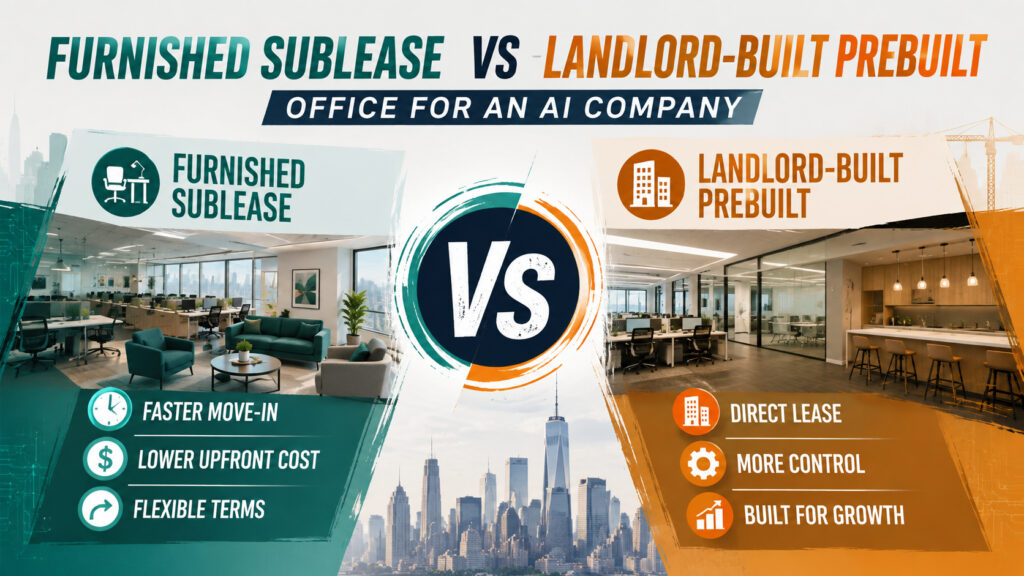
That matters even more for firms that want speed. Current live examples on our site include a 20,222 SF furnished sublet and a 23,324 SF furnished sublet, both positioned for faster occupancy than a raw direct floor. For a scaling company that wants to avoid a long design cycle, that is a major advantage.
For a true flagship headquarters, 30 Hudson Yards stands out. This tower rises more than 100 stories, offers river-to-river views, direct underground subway access, outdoor terraces, and one of the strongest client arrival experiences in the district. It fits best when a tech company needs a visible New York headquarters, large team continuity, executive presence, and event-quality shared spaces.
That is why the building makes the most sense for mature companies, large platform businesses, or a New York office that functions as a major regional hub. A current 45,942 SF headquarters-style opportunity on our site captures that logic well, with double-floor scale, 18-foot ceilings, branding potential, and access to terrace, conferencing, and wellness amenities.
For giant floor plates and high-density planning, 50 Hudson Yards often wins. Official materials describe it as New York City’s fourth-largest commercial office tower, with 2.9 million gross square feet, direct 7 train access, private sky lobbies, strong amenity spaces, and the ability to accommodate more than 500 people per floor. That makes it the cleanest answer for enterprise tech occupiers that need scale first.
The current examples on our site confirm that profile. There is a 67,058 SF multi-floor opportunity, a 30,314 SF full-floor direct lease, and an 11,907 SF move-in-ready high-floor office. In other words, the tower supports both true headquarters scale and faster premium occupancy for smaller groups within the same address.
For a premium midsize tech suite, 55 Hudson Yards deserves more attention than it usually gets. This building sits at the intersection of the district, the High Line, and the park. Official descriptions emphasize indoor-outdoor space, efficient interior planning, floor-to-ceiling glass, and adjacency to the 7 train. For teams that want quality without the biggest block requirement, that mix can be ideal.
That is exactly where many growth-stage software, data, and digital service firms land. The live inventory on our site includes a 10,680 SF prebuilt suite, a 10,853 SF furnished partial-floor option, and another 10,853 SF turnkey sublet. Those sizes work well for firms that want a polished office for roughly 40 to 80 people without taking on huge excess square footage.
For wellness-led design, terraces on every level, and smaller direct opportunities, 66 Hudson Boulevard stands out. The Spiral combines cascading landscaped terraces, indoor-outdoor work zones, flexible open plans, and a strong hospitality package. It also offers a broader menu of smaller suites than many Hudson Yards towers, which matters for tech companies that want the district but do not need a giant floor.
That smaller-suite story matters more than most pages explain. Official availability at the building includes suites around 5,700 RSF, 8,968 RSF, 10,517 SF, and 13,850 SF, while many full floors run from roughly 43,000 to 48,000 RSF. On our site, that range appears through Office Space at the Spiral, plus adjacent Hudson Boulevard options that support direct leasing without sacrificing the same commute pattern.
For very small teams, premium flex can still play a role, but only in a narrow lane. Searchers often use this topic when they really want a turnkey private office for two to twenty people, not a traditional multi-year direct lease. That is why premium flexible workspace keeps appearing around the district and the Penn edge. It matters for temporary launches, swing space, hiring pods, and short-term satellites. It does not replace a real headquarters search.
If that is your need, start with our small offices in Hudson Yards page rather than forcing a full-building search to answer a smaller problem. That route usually saves time, capital, and tour fatigue.
For long-range planning, 70 Hudson Yards belongs in the conversation. It adds about 1.4 million square feet, sits beside the 7 train entrance, and will include large terraces, efficient floor plates, conferencing space, wellness facilities, and a multimedia studio. Move-ins are anticipated in late 2028, so this is not the answer for an immediate requirement. Yet it matters for large tech firms with a longer planning window.
What the market looks like right now
Hudson Yards sits at the premium end of Manhattan office pricing. Savills data reported in July 2026 placed Hudson Yards as Manhattan’s priciest submarket, with asking rents around $153 per square foot. Metro Manhattan’s June 2026 market update also described trophy asking rents in Hudson Yards in the $120 to $150-plus range, while broader Penn-Hudson Yards Class A asked about $90.52 per square foot.
That premium sits well above Manhattan’s wider Class A context. Cushman & Wakefield put Manhattan Class A asking rents at $84.79 per square foot in Q2 2026. CBRE reported a borough-wide average asking rent of $80.17 in the same quarter. In other words, Hudson Yards commands a clear premium even against a strong wider market.
Supply also remains tight where tenants actually want to be. Metro Manhattan’s latest neighborhood page placed Penn-Hudson Yards Class A availability at 9.9 percent. At the borough level, market reports continue to show tightening Class A and sublease supply as demand concentrates in high-quality product. Tech and AI leasing have been a meaningful part of that flight to quality.
For tenants, the practical takeaway is simple. Hudson Yards still offers available options, but the best blocks, best views, and best turnkey suites do not sit around for long. Timing, term, and readiness now matter almost as much as your target rent.
The size mix on our current live pages tells the same story. Visible examples range from about 8,968 square feet and 10,517 square feet on Hudson Boulevard to 10,680 and 10,853 square foot prebuilts, 11,907 square foot direct space, 20,222 and 23,324 square foot turnkey sublets, a 30,314 square foot full floor, a 45,942 square foot headquarters block, and a 67,058 square foot multi-floor opportunity. That is a much wider size mix than most summaries suggest.
Why tenants often get mixed answers to this topic
This topic creates confusion because different searchers use the same phrase for different needs. One group wants the best building for a major headquarters. Another group wants a move-in-ready suite. A third group wants a map of which towers truly fit tech workstyles. A fourth group simply wants to know whether Hudson Yards suits a technology company better than older Midtown or loft-style neighborhoods. The uploaded search snapshot reflects all of those lanes at once.
That is also why you see a blend of campus pages, building pages, listing portals, map results, flexible workspace providers, and nearby Penn-edge options instead of one clean answer. Smaller teams often trigger flex results. Larger users trigger tower pages. General researchers trigger neighborhood summaries. Only a tenant-side page that explains all three can answer the topic fully.
Another issue adds noise. Some pages describe buildings that look ideal for tech culture, but do not always speak clearly to current availability, typical suite sizes, or fit by company stage. Others provide inventory, but say little about infrastructure, employee experience, or whether the building actually suits the way a software or AI team works. Tenants need both layers together.
That is why the right way to read Hudson Yards is by tenant profile, not by tower prestige alone. A 40-person software team should not search the same way as a 500-person platform company. Likewise, a venture-backed startup seeking a 24-month runway should not shop the district like a public company planting a ten-year flag.
How a tech company should narrow the field
Choose 10 Hudson Yards first if your team values infrastructure, adaptable fit-out, strong wiring capacity, and a polished but not overly formal identity. That profile fits product, software, digital platform, and research-heavy groups that expect the office to evolve over time. Start with our Hudson Yards furnished office space and furnished Hudson Yards space pages if speed matters.
Lean toward 30 Hudson Yards if you need headquarters presence, executive arrival, major client-facing capability, and a block that can support long-term scale. That is the right answer for a business that wants authority, not just efficiency. The best internal path here is our Hudson Yards office space headquarters page, which already reflects a real large-block use case.
Favor 50 Hudson Yards when the brief centers on density, big blocks, or a floor plate that can hold a large engineering or operations population together. Few West Side buildings match its scale. Compare our large Hudson Yards office rental, Hudson Yards full floor unit, and furnished Hudson Yards office pages to see how that flexibility works in practice.
Target 55 Hudson Yards if you want a highly polished midsize office with outdoor access, efficient planning, and a more measured scale. This is often the sweet spot for a profitable growth company that wants quality and privacy without carrying 30,000 square feet. Start with our Hudson Yards prebuilt suite, furnished partial-floor Hudson Yards office, and furnished Hudson Yards office for rent listings.
Go to 66 Hudson Boulevard if your company prizes terraces, wellness, fresh air, and a more flexible size ladder. This tower works especially well for culture-focused firms, design-forward teams, and companies that want a strong employee experience without jumping straight to a giant headquarters block. Begin with Office Space at the Spiral, then compare nearby office space in Hudson Yards options for smaller direct suites.
Use shorter-term or smaller-suite paths when your headcount sits below traditional tower economics. In that case, the real question is not “Which trophy building is best.” The real question is “How do we secure speed, privacy, and a strong address without overcommitting.” Our small offices in Hudson Yards and Hudson Yards sublease office space pages answer that lane directly.
Frequently asked questions
Is Hudson Yards only for very large tech companies
No. The district clearly favors larger users, but current live options and official availability show smaller paths as well, especially around prebuilt suites, partial floors, subleases, and the Hudson Boulevard inventory. You can still find real choices in the high-single-thousand to low-teens-thousand square foot range if you search by tenant fit instead of only by the most famous towers.
Are move-in-ready offices available now
Yes. Hudson Yards is no longer only a raw-space district. The visible market now includes furnished direct leases, furnished subleases, prebuilts, and full-floor installations that can shorten the timeline dramatically. That matters for companies hiring quickly, exiting another lease, or opening a New York office on a fixed launch schedule.
What drives rent the most in Hudson Yards
Base building quality starts the conversation, but it does not finish it. Floor size, view line, term length, buildout level, scarcity, and immediate occupancy can all shift economics. In practice, tenants pay the highest premiums here for large efficient blocks, newer systems, premium arrivals, and the strongest commute package on the West Side.
How does Hudson Yards compare with older tech districts
Hudson Yards usually wins on new systems, floor efficiency, transit breadth, polish, and amenity depth. Older tech districts often win on character, loft inventory, and sometimes price. If your company values raw creativity more than infrastructure, another neighborhood may fit better. If you value performance, recruiting range, and a modern operating environment, Hudson Yards usually comes out ahead.
Which Hudson Yards buildings fit the widest range of tech tenants
Today, the broadest fit range comes from four addresses. 10 Hudson Yards works for infrastructure-first teams. 55 Hudson Yards serves premium midsize occupiers well. 50 Hudson Yards handles enterprise scale. 66 Hudson Boulevard bridges culture, wellness, and more flexible size paths. 30 Hudson Yards remains the flagship headquarters answer.
Does future supply matter for a current search
It does if your timeline runs longer than twelve months or your requirement exceeds current best-in-class availability. 70 Hudson Yards adds an important future option, but it does not solve an immediate need. For most firms searching now, the smarter move is to compare today’s direct, prebuilt, and sublease inventory first, then keep the future pipeline in mind only if your move date allows it.
Finding an Office in the Hudson Yards Today
We represent tenants, not landlords. Our job is to measure fit, not repeat building marketing. That means we look at commute quality, infrastructure, speed to occupancy, space efficiency, growth room, and total occupancy cost before we call any office “best.”
Fill out our 📋 online form or give us a call today 📞 212-967-2061 — let’s find the right options for your business.