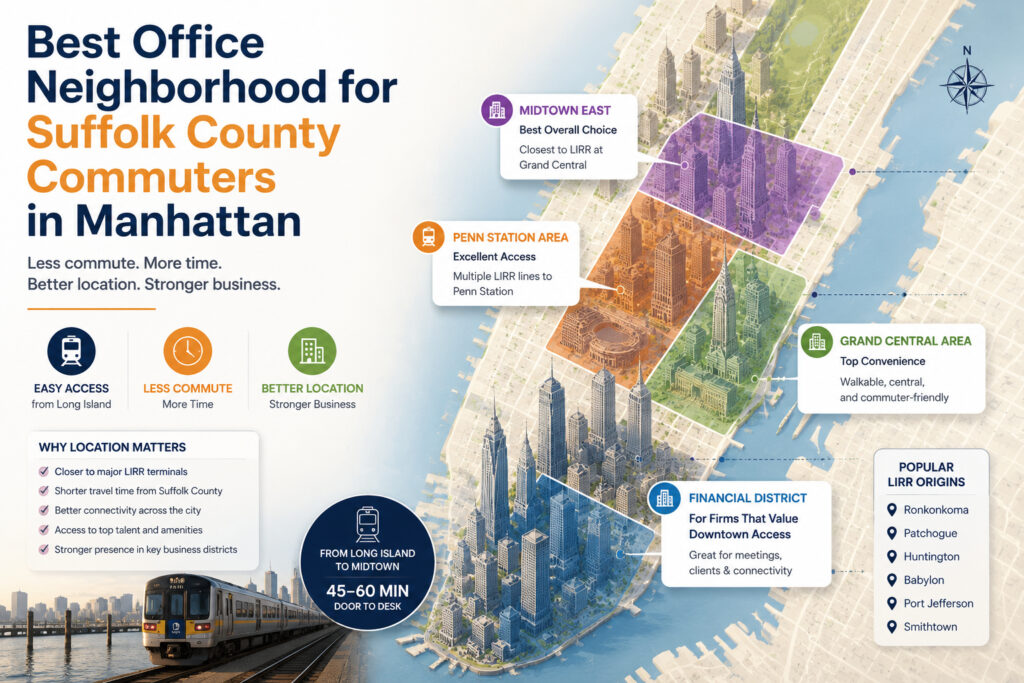
Midtown East around Grand Central is the best Manhattan office neighborhood for most Suffolk County commuters. That answer fits most teams because Long Island Rail Road service now reaches Manhattan’s East Side directly, Grand Central gives immediate access to the 4, 5, 6, 7, and Shuttle, and the surrounding submarket carries current asking rents that sit close to Penn District pricing rather than elite Park or Plaza pricing. In Q1 2026, the Grand Central submarket averaged $75.56 per square foot with 12.0% availability, while Penn District averaged $74.27 per square foot with 12.8% availability. In plain English, Suffolk riders can often cut the last transfer without paying a dramatic rent premium.
That said, Penn Station wins when your office sits on the West Side, west of Sixth Avenue, or near West 30s to West 40s corridors. Penn links directly to the 34 St-Penn subway complex, sits close to 34 St-Herald Square, and gives riders broad access to the 1, 2, 3, A, C, E, B, D, F, M, N, Q, R, W network nearby. Penn also stays open later for LIRR riders. The LIRR concourse runs 24 hours, while Grand Central Madison closes daily from 2:00 a.m. to 5:30 a.m., with overnight Manhattan service shifting to Penn.
Bottom line: If your Suffolk-heavy team works on the East Side, choose Grand Central. If your office lives on the West Side, choose Penn. If your staff sits deep in Suffolk and your budget matters, test Queens before you assume Manhattan must win.
Why Suffolk Needs a Different Manhattan Office Strategy
Suffolk commuters do not behave like closer-in Long Island riders. The railroad itself stretches from Manhattan to the eastern tip of Suffolk County, and several Suffolk-facing branch timetables tell riders to use TrainTime for transfer options west of Jamaica. On the Port Jefferson timetable, the railroad flags transfers at Jamaica and Huntington. On the Montauk timetable, it flags transfers at Jamaica and Babylon. That means a Suffolk commute can already include a long line-haul before the Manhattan leg begins. One extra subway ride, one bad transfer, or one long terminal exit can turn a tolerable trip into a grind.
That is why last-walk friction matters more here than it does for Nassau. Grand Central gives many Suffolk riders a direct East Side arrival, but the station itself adds internal travel time. The MTA tells riders to allow extra time because the LIRR platforms sit below the concourse. Depending on your entry point, platform access can take about 4 to 5 minutes from 47th or 48th Street, 6 to 8 minutes from 42nd or 43rd Street, and 10 to 12 minutes from the terminal or Metro-North side. Penn, by contrast, now offers a renovated concourse, a widened corridor, and direct access from the East End Gateway at 33rd Street and Seventh Avenue. For Suffolk riders, that tradeoff matters every day.
The big strategic shift came when LIRR reached Grand Central Madison. The MTA says the project brought LIRR to Grand Central for the first time, increased train capacity to and from New York City by 50%, and created more peak service. That changed the Manhattan office map for Long Island riders. Before that shift, many firms defaulted to Penn because they had no East Side rail arrival. Today, Suffolk teams can finally choose the terminal that matches the final office walk.
Grand Central Versus Penn Station
Grand Central works best when you want to remove the in-city transfer for East Side staff. The terminal connects directly to Metro-North, LIRR, and the 42 St-Grand Central subway complex. That stack helps companies hiring from Long Island, Westchester, and Connecticut at the same time. It also places many Midtown East offices within a straighter walk of the rail arrival. The catch is simple. Grand Central’s LIRR platforms sit deeper in the station, so the internal walk can erase part of the gain if your office sits too far west or too far south.
Penn works best when the office sits where Penn already wants to send people. The station connects LIRR riders to 34 St-Penn, 34 St-Herald Square, Amtrak, NJ TRANSIT, and PATH, while the renovated LIRR concourse now offers easier circulation and a direct street-to-subway connection from the East End Gateway. In real tenant terms, Penn often wins for offices near Seventh Avenue, Eighth Avenue, Herald Square, the Garment District, and the west side of Midtown South. Suffolk riders still reach Manhattan efficiently there, and they avoid a crosstown backtrack.
The best answer, then, is not “East Side” or “West Side” in the abstract. The best answer is the terminal that matches the final office walk. Suffolk commuters already spend meaningful time on rail. A no-transfer arrival to the wrong side of Midtown can lose to a slightly longer rail arrival that drops riders almost at the elevator bank. That is the core decision rule for this page.
Best Manhattan Neighborhoods by Commuter Pattern
For most Suffolk-heavy teams, the neighborhood ranking looks like this:
Neighborhood
Best fit for Suffolk commuters
Why it works
Q1 2026 average ask
Q1 2026 availability
Midtown East / Grand Central
Most East Side office users
Direct East Side arrival, strong subway overlap, broad regional reach
Very strong address value and short East Side walks
$107.38/SF
12.5%
Park Avenue corridor
Prestige-led tenants near Grand Central
Excellent commuter logic, but major pricing jump
$117.30/SF
8.2%
Downtown
Budget-led users with true Downtown business needs
Lower average rent, but usually adds another city leg
$62.81/SF
19.0%
Q1 2026 submarket asking rents and availability come from Manhattan market data. Neighborhood fit reflects terminal access, subway connections, and Suffolk timetable realities.
So where should tenants actually focus? Start with Midtown East around Grand Central. That area gives most Suffolk riders the cleanest final trip and avoids paying Plaza or Park premiums unless your business truly needs them. Shift to Penn District when the office must live west of Sixth Avenue or when your staff needs simpler overnight coverage. Avoid defaulting to Downtown unless the business case points there for clients, team geography, or rent savings. Downtown’s pricing can look attractive, but Suffolk riders usually feel the extra in-city leg more than closer-in commuters do.
When Manhattan Loses to Long Island City or Jamaica
Manhattan does not always win. Regional planning research shows that Long Island City and Jamaica function as important job centers for regional in-commuters, not just as overflow markets. Jamaica deserves special attention because the area carries 10 LIRR lines, 4 subway lines, 50+ bus lines, and roughly 60,000 jobs. That matters for Suffolk teams because Jamaica can cut the Manhattan premium while keeping the railroad front and center. Long Island City can also work when you want fast access to Queens, a shorter city leg, or a more budget-conscious office plan.
In practice, Jamaica or Long Island City can beat Manhattan in three cases. First, the company mostly needs Long Island access, not Manhattan prestige. Second, the team works on a hybrid schedule, so daily client-facing address value matters less. Third, the workforce sits deeper in Suffolk, where even a “good” Manhattan commute still feels long. Those markets will not fit every brand. Still, they can improve retention and lower occupancy cost at the same time.
That does not weaken the Manhattan answer. Instead, it sharpens it. If you truly need Manhattan, choose the terminal-matched neighborhood. If you do not, test Queens before you lock yourself into a longer and pricier daily trip.
What Suffolk Teams Should Expect on Rent and Space
Grand Central and Penn District sit much closer on price than many tenants expect. In Q1 2026, Newmark pegged Grand Central at $75.56/SF and Penn District at $74.27/SF. That narrow spread creates a real opportunity. You can often choose the better commute before you pay a major premium. Meanwhile, elite East Side choices rise fast. Plaza District averaged $107.38/SF, and Park Avenue reached $117.30/SF. So the smart question is not “East or West?” alone. Ask, “How much commute relief do we buy per rent dollar?”
Local tenant-facing pricing guides point to a similarly wide product spread. Near Grand Central, many conventional leases now cluster around $55 to $90/SF, with trophy space moving above $100/SF and some discounted subleases falling into the low $30s to mid-$40s. Around Penn, local pricing bands still show premium projects around $85 to $110/SF, repositioned Class B around $55 to $75/SF, and older value stock around $40 to $55/SF. That means a Suffolk-led search should often start with three buckets: value-prebuilt, balanced Class B+, and premium commuter-first Class A.
For most tenant groups, the sweet spot sits in the middle. Repositioned Midtown East and Penn District buildings usually offer the right blend of cost, layout speed, and commuter sanity. That is especially true for firms seeking 2,000 to 20,000 square feet, furnished or prebuilt layouts, and enough flexibility to grow without overspending on pure prestige. To price current choices, use Grand Central pricing, Penn pricing, and office subletting before you tour.
FAQ And Tenant Next Step
Is Grand Central always better than Penn for Suffolk riders? No. Grand Central usually wins for East Side offices, but Penn wins for West Side offices, simpler late-night coverage, and teams whose daily walk already points west. Grand Central Madison closes overnight, while Penn’s LIRR concourse stays open 24 hours.
Why does Suffolk behave differently from Nassau? Suffolk trips start farther east, and several branch timetables still require careful transfers or transfer planning west of Jamaica. That makes each added subway leg matter more.
What is the best office neighborhood for eastern Long Island staff? For a true Manhattan answer, Midtown East usually gives the cleanest result. Yet deep Suffolk teams should also test Jamaica or Long Island City, especially on hybrid schedules or cost-led searches.
How much should we budget? A realistic current planning range runs from about $55 to $90/SF near Grand Central for much of the market, with Penn showing a value-to-premium spread from roughly $40 to $110/SF depending on product type. Market averages for the core commuter submarkets sit in the mid-$70s.
So what should a Suffolk-heavy company do first? Map the home stations. Match those stations to Grand Central, Penn, or Jamaica. Then shortlist a few Grand Central options, a few Penn Station options, and one Queens fallback. After that, compare the final office walk before you compare lobby finishes. That sequence usually saves more time than any brochure ever will. If you want tenant-only help, use Contact a Broker to compare live choices by commute pattern, size, and budget.
If you lease office space in Manhattan, your address should help your team, not drain it. We represent tenants, so we start with commute pain, budget, and leverage. Then we match those facts to live inventory and negotiate from the rider’s point of view.
Fill out our 📋online form or give us a call today 📞212-967-2061 — let’s find the right office for your business.