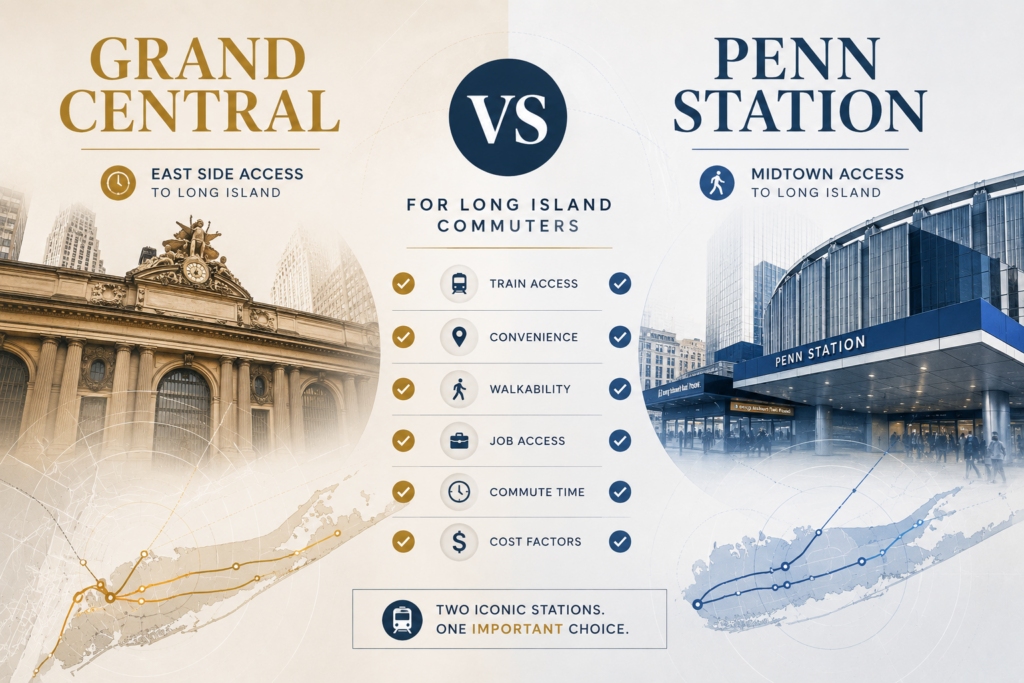
Grand Central vs Penn Station for Long Island Commuters
Quick answer
If your office sits in Midtown East, Grand Central usually wins. If your office sits in Midtown West, Penn usually wins. The better station depends less on rail trivia and more on the last walk after the train.
Grand Central now matters far more for Long Island riders than it did before 2023. The MTA says all 11 LIRR lines now connect to Grand Central, though some trips still require a transfer. The same project can save riders up to 40 minutes per day, depending on origin and destination.
For tenants, that shift changes Manhattan office strategy. A team can now choose Midtown East without forcing every Long Island commuter into a subway transfer from Penn. At the same time, Penn still holds major advantages for West Side offices, regional travel, and riders whose best train still lands there.
We represent tenants, not landlords. We compare commute friction, rent, concessions, and layout quality before you commit. That tenant-first approach helps you avoid choosing the wrong side of Midtown for years.
Tenant verdict:
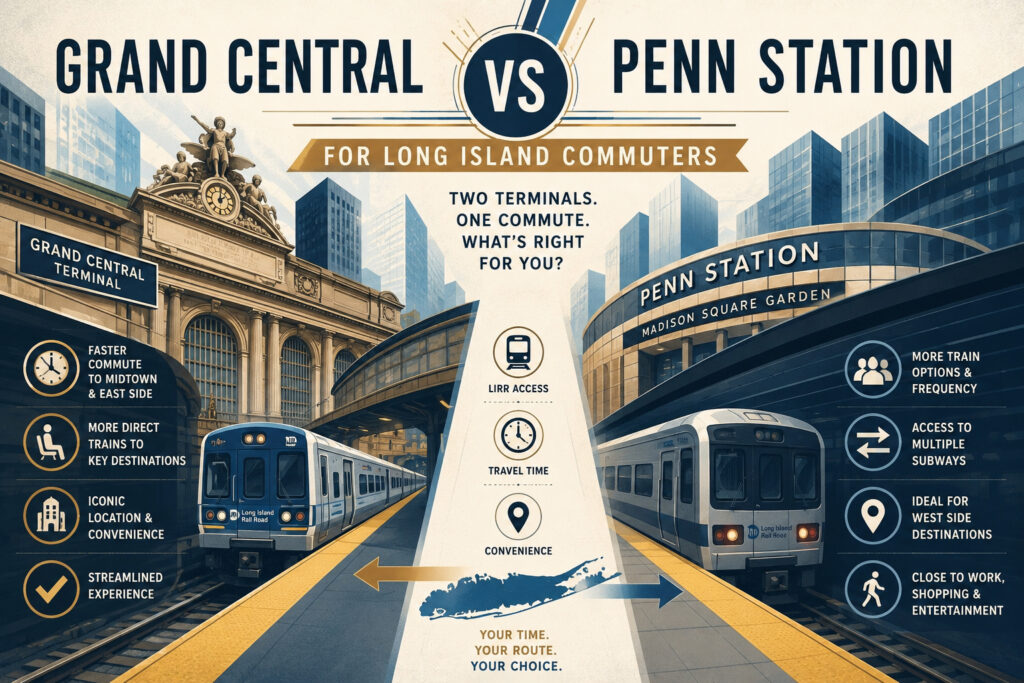
Choose Grand Central for East Midtown workforces.
Choose Penn for West Midtown workforces.
Split teams should test real door-to-door times, not just rail times.
What changed for Long Island riders
The old one-answer rule no longer works. Grand Central Madison opened in January 2023, and full LIRR service followed in February 2023. The MTA says the project added a new terminal under Grand Central and increased train capacity to and from Manhattan by 50 percent.
That change did not erase Penn. Instead, it split Manhattan service between both terminals. The MTA’s current timetable hub, updated June 18, 2026, shows regular branch timetables effective May 11 through September 7, 2026, plus a separate City Terminal Zone timetable for Manhattan service.
Current branch timetables make the point clearly. Port Washington shows direct weekday service to both Penn Station and Grand Central. Babylon, Long Beach, Hempstead, Ronkonkoma, and West Hempstead also show Penn and Grand Central options, while repeatedly telling riders to use TrainTime or the City Terminal Zone timetable for full west-of-Jamaica service and transfer choices.
So the right question is not, “Does LIRR go to Grand Central or Penn?” The right question is, “Which terminal gives my team the fastest, easiest, and most reliable final leg?” That is the question the lease should answer.
When Grand Central wins
Grand Central wins when your staff works near Madison, Vanderbilt, Park, or Lexington in the 40s and low 50s. The most direct LIRR street entrance sits at 383 Madison Avenue on East 47th Street. The MTA says riders can usually reach LIRR platforms in about four to five minutes from 47th or 48th Streets, and six to eight minutes from 42nd or 43rd Streets.
That geography matters. A Long Island rider who exits near 47th and Madison already lands inside the East Midtown office grid. By contrast, a Penn rider headed there still faces a cross-town walk, a subway ride, or both.
Grand Central also wins when indoor access matters. The MTA says Grand Central Madison has direct street entrances at 42nd, 43rd, 44th, 47th, and 48th Streets, plus interior links from Grand Central Terminal and Grand Central North. That layout favors rainy days, winter commutes, and client-facing teams that value a smoother daily arrival.
The East Side argument gets even stronger for mixed commuter pools. Grand Central Terminal already serves Metro-North and connects to Grand Central Madison for LIRR riders. That means one East Midtown address can work for Long Island, Westchester, Connecticut, and East Side subway commuters at the same time.
This is why so many tenant searches start with Grand Central offices, Midtown East office space, and Grand Central office space for rent. The commute story lines up with the office inventory story.
If true direct access matters, the shortlist should get tighter. Current research on connected buildings points first to What Office Buildings Have Direct Access to Grand Central?, where the strongest current options include directly connected and near-direct towers, with documented availabilities from roughly 5,000 square feet to more than 39,000 square feet.
A few live examples show the range. A Turnkey Vanderbilt Avenue Office offers about 7,134 square feet with a furnished, client-ready layout. A Grand Central Double Corner Unit offers 12,826 square feet with six offices, three conference rooms, and 61 workstations. Another current guide notes immediate options in one directly connected East Midtown building at 5,772, 11,590, and 39,556 square feet.
Best fit for Grand Central: law, finance, advisory, family office, medical-adjacent, and executive teams that want East Midtown identity, cleaner arrivals, and shorter final walks. Strong hybrid teams also benefit because fewer transfers make in-office days feel easier.
When Penn wins
Penn wins when the office sits west of Sixth Avenue or near the Penn Plaza corridor. The MTA’s East End Gateway gives riders direct street access at 33rd Street and Seventh Avenue into the LIRR concourse and subway. Penn also connects directly to Amtrak, NJ Transit, PATH, and major subway lines at 34th Street.
That west-side edge stays practical. A rider whose office sits in Penn Plaza, the Garment District, Herald Square, the low 30s, or the low 40s near Eighth Avenue usually saves a lot of last-mile hassle by arriving at Penn. In that case, Grand Central can turn into an unnecessary crosstown leg.
Penn also wins for teams with frequent regional movement. If lawyers, sales staff, project managers, or executives often continue to New Jersey, Philadelphia, Boston, or Washington, Penn’s Amtrak and NJ Transit links add real value. Grand Central cannot match that regional reach today.
Another Penn advantage involves schedule fit. Long Island branch service now splits between both terminals, and some trips still work better through Penn at certain hours. Riders on Babylon, Hempstead, Long Beach, Ronkonkoma, and West Hempstead all have current Penn options in official weekday timetables. The MTA still tells riders to check TrainTime for precise west-of-Jamaica planning.
Penn also gives tenants more building variety than many people assume. You can target modern towers, repositioned mid-block product, or older loft-value space within one commuter-centric district. That is why many searches start at Penn Station offices and then widen into Midtown West.
Live inventory shows that range. Current Penn area examples include a 2,500-square-foot lease, a 4,776-square-foot turnkey sublet, a 5,755-square-foot direct lease, a 7,675-square-foot office, a 7,815-square-foot lease, and a 9,450-square-foot offering. Several current Penn Plaza examples also show furnished, wired space for fast occupancy.
A few internal pages help narrow the search. Review How Much Does Office Space Near Penn Station Cost Today?, then compare 1 Penn Plaza, Penn Plaza Furnished Office Space, and One Penn Plaza 5755 SF. Direct Lease Office Space. Those pages cover both trophy-adjacent and practical commuter plays.
Best fit for Penn: operations teams, media, recruiting-heavy groups, West Side client service firms, and any workforce that still leans on Penn-timed LIRR trips or regional rail connections. Penn also works well for firms that need larger blocks and faster move-ins.
Midtown East vs Midtown West for the actual commute
For Long Island commuters, train time alone rarely decides the issue. The final walk decides it. A seven-minute longer walk, twice a day, can wipe out the gain from a faster rail run. That is why station choice and office submarket cannot sit in separate buckets.
Grand Central sits in the East Midtown office core. The MTA says Grand Central Madison stretches along Madison Avenue between 43rd and 48th Streets. That places arriving riders close to Park Avenue towers, Madison Avenue boutiques, and Lexington corridor offices without forcing a subway transfer.
Penn sits in the West Midtown office core. The MTA’s renovated LIRR concourse and East End Gateway place riders at 33rd and Seventh, close to Penn Plaza, Herald Square, and nearby Midtown West buildings. The station also reaches subway lines at both Penn and Herald Square.
So the practical dividing line stays simple. If your team works roughly east of Fifth or Sixth Avenue, Grand Central often feels better. If your team works roughly west of Sixth Avenue, Penn often feels better. Firms near Bryant Park, Times Square, or the central spine should test both routes against the exact building entrance.
This is where the search should turn concrete. A commuter-heavy East Midtown search should usually start with Grand Central offices and Midtown East office space. A West Midtown search should usually start with Penn Station offices and nearby Midtown West options.
Cost, building style, and what tenants gain
Grand Central and Penn do not compete on commute alone. They also compete on cost and building character. That tradeoff matters because many tenants can afford either area, but not every product type inside each area.
Near Grand Central, current tenant planning guidance suggests many conventional lease options fall around $55 to $90 per square foot per year. Trophy product often climbs above $100, while some discounted subleases drop into the low $30s or mid $40s. Current planning examples place a 2,000-square-foot budget around $9,000 to $15,000 per month before extras, and a 5,000-square-foot budget around $22,900 to $37,500 per month.
The broader submarket picture supports that. One current Grand Central guide places Q1 2026 overall asking rent around $69.93 per square foot and Class A around $74.18. Another Grand Central guide places typical Class A around the high $70s, depending on boundaries and datasets. Even so, the area still undercuts prime Park Avenue and some Penn trophy corridors while preserving a strong East Midtown address.
Penn tells a wider pricing story. A current Penn pricing guide puts Class A towers around $85 to $110 per square foot, repositioned Class B around $55 to $75, and older loft-value space around $40 to $55. Another current local guide places the Penn submarket near $105.81 overall, with Class A around $125.96, which reflects how expensive the best West Side towers have become.
That mix creates two different tenant plays. Grand Central gives you polished East Midtown identity, strong commuter optics, and directly connected options at rent levels that can still beat prime trophy corridors nearby. Penn gives you more ways to trade style against savings, especially if you like prebuilt suites, loft conversions, larger floor plates, or fast occupancy.
The citywide market also matters. Colliers says Manhattan posted its strongest first quarter of leasing demand since 2014 in Q1 2026, with average asking rent up to $77.55 per square foot. Midtown itself rose to $84.74 per square foot in the same quarter, while CBRE put Midtown South at $84.37. In plain terms, strong commuter locations still lease fast, so tenants should move decisively once the right floor appears.
Here is the cleanest way to frame the tradeoff:
Choose Grand Central if you want a better East Side arrival, more direct indoor access, stronger Metro-North overlap, and a classic Midtown East business identity. Current direct-access building research and live suites make that case especially strong for client-facing users.
Choose Penn if you want a better West Side arrival, stronger regional rail integration, more large-block options, and a broader spectrum from premium towers to value lofts. Current Penn inventory supports both turnkey and cost-conscious searches.
Frequently asked questions
Is Grand Central or Penn Station better for Long Island commuters?
Grand Central usually works better for East Midtown offices. Penn usually works better for West Midtown offices. The MTA now serves both terminals, so the winning answer depends on the final walk, not just the train ride.
Does LIRR go to Grand Central or Penn?
It goes to both. The MTA says all 11 LIRR lines connect to Grand Central, though some trips require transfers. Current branch timetables also show Penn and Grand Central service across major branches, with TrainTime used for exact west-of-Jamaica planning.
Which branches favor Grand Central most?
No branch gives one universal answer for every rider. Port Washington clearly offers direct weekday service to both terminals. Several other major branches show both Penn and Grand Central options plus transfer planning through Jamaica, so the better terminal changes by station, hour, and train pattern.
Which teams still need Penn?
West Side teams still need Penn most often. The same goes for firms that use Amtrak, NJ Transit, PATH, or Penn-timed LIRR service. A West Midtown office can turn Grand Central into an extra daily transfer.
Is Grand Central easier to navigate than Penn?
Many riders feel that way, but ease depends on destination. Grand Central Madison sits deep below street level, and the MTA says platform access can take four to five minutes from 47th or 48th Streets and longer from the lower numbered streets. Penn feels flatter and closer to street level, especially through the East End Gateway, but it also handles more regional modes in one place.
How much does office space near Grand Central cost in 2026?
A realistic planning range for much of the market sits around $55 to $90 per square foot. Trophy space can run higher, and discounted subleases can run lower. For live pricing guidance, start with How Much Is Office Space Near Grand Central? 2026 Prices.
How much does office space near Penn Station cost today?
Current Penn guidance places many Class A towers around $85 to $110 per square foot, repositioned Class B around $55 to $75, and older loft-value space around $40 to $55. For a tenant-focused breakdown, review How Much Does Office Space Near Penn Station Cost Today?.
What office buildings have direct access to Grand Central?
Current high-confidence connected options include several directly linked buildings in the 42nd Street and Vanderbilt corridor. Documented current availabilities on related pages range from about 5,000 square feet to more than 39,000 square feet. Start with What Office Buildings Have Direct Access to Grand Central?.
What if my workforce splits between Grand Central and Penn?
Then run a building-by-building test. Compare the staff origin mix, the best morning trains, the last walk, weather exposure, and any same-day regional travel needs. A central Midtown address can work, but only if the building entrance supports both groups well.
The tenant-first move
The best Manhattan office for Long Island commuters is not “Midtown” in the abstract. It is the building that cuts the final leg, fits the train pattern, and supports your budget. That answer often points to Grand Central for East Midtown and Penn for West Midtown, but the exact winner still depends on your staff map.
If you want the shortest path to a smarter search, start with the station that matches your office side of Midtown. Then compare live options, not generic neighborhood pages. For East Midtown, begin with Grand Central offices, Midtown East office space, and What Office Buildings Have Direct Access to Grand Central?. For West Midtown, begin with Penn Station offices, How Much Does Office Space Near Penn Station Cost Today?, and 1 Penn Plaza.
We help tenants test this choice before they sign. We map the workforce, compare both station paths, and narrow the tour list fast. That process turns a vague commute question into a sharper lease decision.
Office Accessibility Options
Long Island commuters no longer face a simple choice between one Manhattan rail terminal and another. Since Long Island Rail Road service now reaches both Grand Central and Penn Station, the smartest office location depends on where employees work after they leave the train, making the final walk, transfer requirements, and neighborhood access far more important than the station itself.
For most Long Island-based workforces, Grand Central delivers the strongest advantage for Midtown East offices, while Penn Station remains the better fit for Midtown West offices. Choosing the right side of Midtown can save employees time every day, improve attendance, strengthen recruiting efforts, and create a more practical long-term office strategy.
Fill out our 📋 online form or give us a call today 📞 212-967-2061 — let’s find the right office for your business.