A private office means you control an enclosed workspace instead of sharing an open desk. In flexible settings, that usually includes furniture, internet, utilities, secure access, and use of shared amenities. In a leased suite, it can also mean a fully self-contained office with your own reception area, pantry, conference room, and branding.
That difference matters. A one-person office inside a managed center solves a very different problem than a prebuilt suite for ten people. One gives you speed and simplicity. The other gives you more privacy, more control, and often a better long-term cost structure if your team uses the office heavily.
Tenant takeaway:Small teams do best when they match the office format to how they work. Privacy, speed, budget, and term length should drive the choice.
The main formats you can rent
Flexible private offices work best when you want fast move-in, all-in pricing, and short terms. Current operators in NYC market private offices by the day, week, month, and in some cases from month-to-month up to three years. Some providers quote specific term options such as three, six, and twelve months, while others market agreements from three to twenty-four months.
Plug-and-play subleases fit tenants who want a private suite with existing furniture and wiring. They often come in below direct market rent, and they usually let you move faster than a fresh build-out. Still, subleases limit control because the term, layout, and extension rights depend on the original tenant’s lease.
Direct leases suit tenants who want the widest building choice, the strongest branding control, and the best shot at landlord concessions. In Manhattan, direct office leases most often run three to ten years, with five- and ten-year deals still very common. Smaller prebuilt suites can shorten that path, yet the deal still works very differently from a flexible office agreement.
Current NYC pricing and what changes it
Traditional Manhattan asking rents sat in a broad low-to-high $70s range in the first quarter of 2026, depending on the source and methodology. At the same time, average private office desk pricing sat around $778 citywide and $785 in Manhattan. That gap explains why tenants must compare two separate markets: square-foot leases and all-in desk or suite pricing.
Pricing by team size
The fastest way to budget a private office for one to twelve people is to start with current marketplace snapshots, then adjust for location, windows, conference rooms, and term. Recent NYC examples show a clear step-up as you move from a solo room to a real team suite.
Team size
Current flexible-market snapshot
What that usually means
One person
about $900–$1,615/month
Small lockable room, shared amenities, fast move-in
Two to three people
about $995–$1,995+/month
Compact office, usually shared conference access
Four to five people
about $2,000–$4,500/month
True small-team office, often better with window or larger common areas
Six to eight people
about $4,000–$6,800/month
Team room or suite, often quoted with stronger furniture and meeting access
Nine to twelve people
often custom team-suite pricing
Many operators shift to bespoke suite quotes instead of simple desk pricing
These figures come from current marketplace examples, not from one building or one corridor. Therefore, they work best as starting points. Window lines, trophy addresses, internal meeting rooms, and shorter terms usually push pricing higher. Downtown value product, older stock, and hybrid-use options can bring pricing down.
What direct lease math looks like
Once you move from a flexible office to a leased suite, the math flips to square feet times annual rent divided by twelve. Using current submarket asking rents, a 1,500 RSF office at today’s Grand Central average pencils near $9,445 per month before extras. The same size at today’s Downtown average sits near $7,851 per month, while a Chelsea average lands near $10,589 per month.
That distinction gives small tenants real leverage. If you only need privacy for a few people and you value speed, a flexible office may win. If your team needs daily occupancy, internal rooms, and stronger brand control, a direct or plug-and-play suite may price better over time.
Why the price moves so much
Four factors change private office pricing fastest in NYC. First, location drives the biggest spread. Second, layout matters because a dense room prices differently from a suite with a conference room. Third, lease type changes the quote structure. Finally, term length affects discounts, concessions, and how much risk a landlord or operator carries.
The neighborhoods that make the most sense
Small tenants rarely need “the best” neighborhood. They need the right one. In practice, that usually means balancing commute, client impression, budget, and how much privacy you need for the price.
Area
Best fit for small teams
Q1 2026 asking rent
Q1 2026 availability
Smart internal link
Grand Central
Heavy commuter access, client-facing teams, East Side convenience
Direct lease asking rents and availability come from current Manhattan submarket data. Flexible private office cost and amenity patterns come from current private office marketplace data and neighborhood pricing guides.
Where small tenants usually find the best value
Grand Central still works extremely well for small firms because it blends prestige, transit, and a wide mix of office types. Availability there sits near twelve percent, and asking rents sit well below Park Avenue or the Plaza District. That combination helps small teams find prebuilt or flexible space without paying top-of-market trophy pricing.
Financial District space usually gives small tenants the strongest value. Current private office pricing there runs meaningfully below the city average, and Downtown direct asking rents also sit below Midtown. If your team cares more about cost control than a Midtown mailing address, Downtown deserves a serious look.
Chelsea, NoHo, and SoHo usually attract tenants who care about atmosphere and brand feel. Those neighborhoods can make sense for boutique firms, creative teams, and client-facing groups that sell taste as much as service. However, they rarely win the budget contest.
How much space you really need
The difference between room size and leased size
A flexible private office often uses less enclosed space per person because the kitchen, lounge, phone booths, and large meeting rooms sit outside your room. Current private office guides peg many serviced offices near 40 to 60 square feet per desk inside the enclosed office itself. Traditional leased offices, by contrast, usually require far more area because you fund your own circulation, support rooms, and internal common space. Manhattan planning guides still place many teams around 100 to 250 RSF per person, depending on layout and work style.
That gap explains why a six-person flex room may feel normal at a provider, while a six-person direct office often wants much more footage. Shared infrastructure compresses the private room. Your own suite expands the footprint.
A practical planning guide for one to twelve people
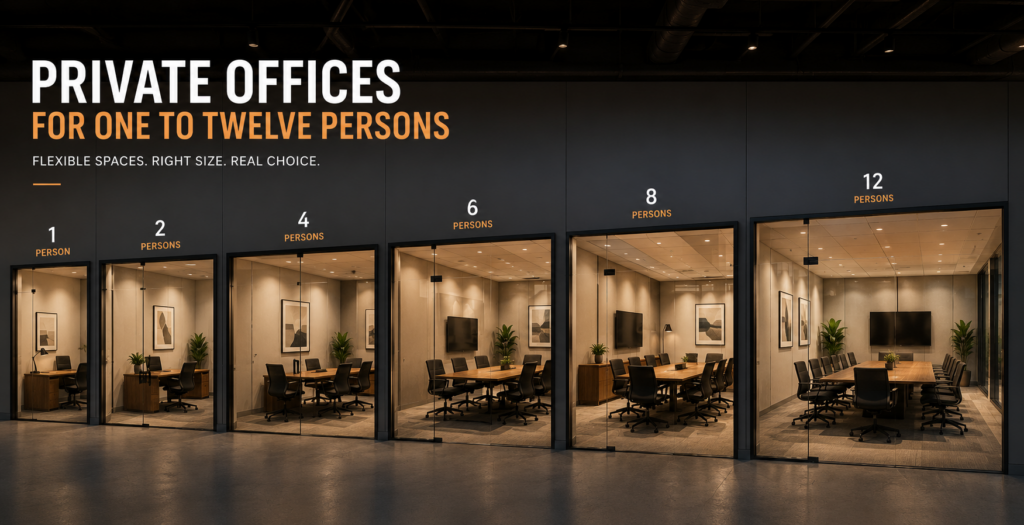
If you want a one- or two-person private office, you can usually stay inside a compact managed room unless you need frequent private meetings. If you want a three- to five-person office, shared conference rooms often keep your private footprint efficient. Once you reach six to eight people, an internal meeting room or a wider layout starts to matter much more. By nine to twelve people, many tenants do better in a true team suite or a small prebuilt office rather than one oversized room inside a coworking floor. That is exactly why flexible operators market team suites up to twelve people, and why small direct listings around 1,600 to 1,900 square feet commonly fit eleven to thirteen users.
If you want to pressure-test your own headcount, start with the office space calculator and then compare assumptions against this square feet per person guide. Those tools help you avoid the two mistakes that hurt small tenants most: taking too little space and outgrowing it fast, or taking too much space and paying for empty seats.
Tenant takeaway:The right office size depends less on raw headcount and more on how many people show up together, how often you host clients, and whether you need an internal meeting room.
What your rent usually includes
What flexible private office pricing often bundles
Flexible office pricing usually includes the big operating basics. Current NYC providers commonly bundle furniture, internet, utilities, secure access, and shared amenities such as meeting rooms, kitchens, lounges, printing, package handling, and on-site staff. That is why flexible pricing feels high on a per-desk basis yet often simplifies the real monthly bill.
You should still check the details. Some operators include a meeting-room allowance, while others charge overages. Some offer true month-to-month use. Others discount harder if you commit for several months. A room that looks cheap can get expensive if your team lives inside conference rooms or needs many guest passes.
What direct and sublease spaces may leave out
Headline rent never tells the full story in a leased office. Tenants should ask about electricity, nightly cleaning, after-hours HVAC, internet setup, tax escalations, and any operating-cost pass-throughs. Long-term direct leases also often leave furniture and wiring to the tenant, while short-term subleases more often deliver these items as part of an as-is package.
Security deposits also matter. Current tenant budgeting guidance notes that landlords commonly ask for meaningful security, and newer or weaker-credit companies may face much larger upfront requirements than established firms. That can change the real cash burden of a “cheap” office very quickly.
One New York cost that small teams often miss
Commercial Rent Tax can affect tenants in Manhattan south of 96th Street once annual rent reaches the qualifying level. The city states that the tax applies when annual gross rent is at least $250,000, with a partial credit between $250,000 and $300,000. Many one- to twelve-person users stay below that line, yet premium small suites or multiple combined spaces can edge closer than tenants expect.
If you are comparing furnished space against direct space, use total occupancy cost, not just headline rent. Speed, bundled services, and zero furniture spend can justify a higher monthly quote. On the other hand, a direct lease can win if you use the office heavily, plan to stay longer, and negotiate build-out help or free rent.
How to choose the right lease path
Choose flexible when speed matters most
Choose a flexible private office when you need to move fast, want minimal setup, and do not need a heavily branded suite. This path works especially well for solos, partnerships, satellite teams, and firms that value convenience over customization. It also helps when your headcount may change soon.
A flexible office also makes sense if your usage pattern changes week to week. Current NYC providers market day offices, hybrid-use plans, and short commitments that let small teams pay for access without locking into a long long-term lease.
Choose plug-and-play when you want privacy without a full build-out
Choose plug-and-play or furnished sublease space when you want more control than coworking gives you, but you still want speed. This format usually gives you a private suite, existing furniture, and a usable layout from day one. In many cases, it also gives you a shorter commitment than a brand-new direct lease.
Choose direct when control and long-term economics matter more
Choose a direct lease when you want the broadest building selection, a more tailored layout, and real negotiating leverage on build-out and free rent. This path often works best for firms that expect steady daily use and want to stay put long enough to amortize setup costs.
If that sounds like your profile, compare a few small direct examples such as this small Midtown office option and this small Plaza District office option. Both show how a true small-team suite can support roughly eleven to thirteen people without forcing you into a full-floor commitment.
Questions every tenant should ask
Access: Can your team enter nights and weekends, or only in staffed hours? Flexible buildings vary more than tenants expect.
Meeting rooms: Do you get included credits, or do you pay each time? Shared conference rooms can decide whether a smaller office still works.
Internet and telecom: Does the room include internet from day one, or do you pay separate install and monthly charges?
Cleaning and HVAC: Are they included in rent, billed separately, or charged after hours? Those items often distort comparisons.
Growth rights: Can you take nearby space later, renew on reasonable terms, or expand without moving floors? Renewal and expansion flexibility matter more for small teams than most first-time tenants realize.
Questions tenants ask most often
Can I rent a private office in NYC by the day or month? Yes. Current NYC inventory includes day-use, hybrid-use, month-to-month, and longer flexible commitments. Some marketplaces advertise terms from one hour up to three years, while others offer month-to-month or fixed multi-month agreements.
Can I still find a private office under $500 per month? Sometimes, but Manhattan makes that difficult. Current guidance says sub-$500 private offices are rare in Manhattan, though outer-borough or heavily limited options may appear, and hybrid plans can start much lower. One current Midtown hybrid option starts at $349 per month, but that is not the same thing as a full-time dedicated private office.
Is Downtown cheaper than Midtown for a small private office? Usually, yes. Current flexible private office data places the Financial District below the city average on a per-desk basis, and current direct asking rent data also shows Downtown below Midtown. That does not make Downtown “better,” but it often makes it easier on a small monthly budget.
Are furnished offices worth it? They usually are when speed matters, cash flow matters, or your team may resize soon. Furnished and move-in-ready space cuts setup time and avoids immediate spending on desks, wiring, and a full fit-out. Direct space can still win if you need stronger identity, deeper customization, or longer-term control.
Can one office really fit ten to twelve people? Yes, but the format matters. Flexible operators actively market team suites for groups up to twelve, and small direct listings in the market already show layouts of roughly 1,664 square feet for eleven people and 1,928 square feet for thirteen people. If your team needs an internal meeting room or many perimeter offices, do not judge the office by desk count alone.
Start with your real daily headcount, your target move speed, and the image you need to project. Then compare private offices, furnished suites, and small direct spaces side by side instead of assuming one product type will win every time. If you want a clean starting point, begin with Grand Central offices, Midtown East office space, and Financial District office space, then pressure-test your size with the office space calculator.
We represent tenants in the New York office market. Our job is to compare private offices, expose hidden costs, and negotiate terms that fit your team. You keep control of the decision while we help you secure the right office, not just the first one you tour.
If you want a private office in NYC for a solo practice, a small partnership, or a growing team, you now have more paths than ever. Today’s market spans day-use rooms, month-to-month private offices, team suites for up to twelve people, plug-and-play subleases, and longer direct leases from landlords. That wider range helps small tenants move faster, compare more clearly, and match space to real headcount instead of guessing.
Fill out our 📋online form or give us a call today 📞212-967-2061 — let’s find the right office for your business.