5,000 SQ FT Office Rent NYC
How Much Does a 5,000-Square-Foot Office Cost in NYC in 2026?
November 9, 2026 · Manhattan office leasing and occupancy costs
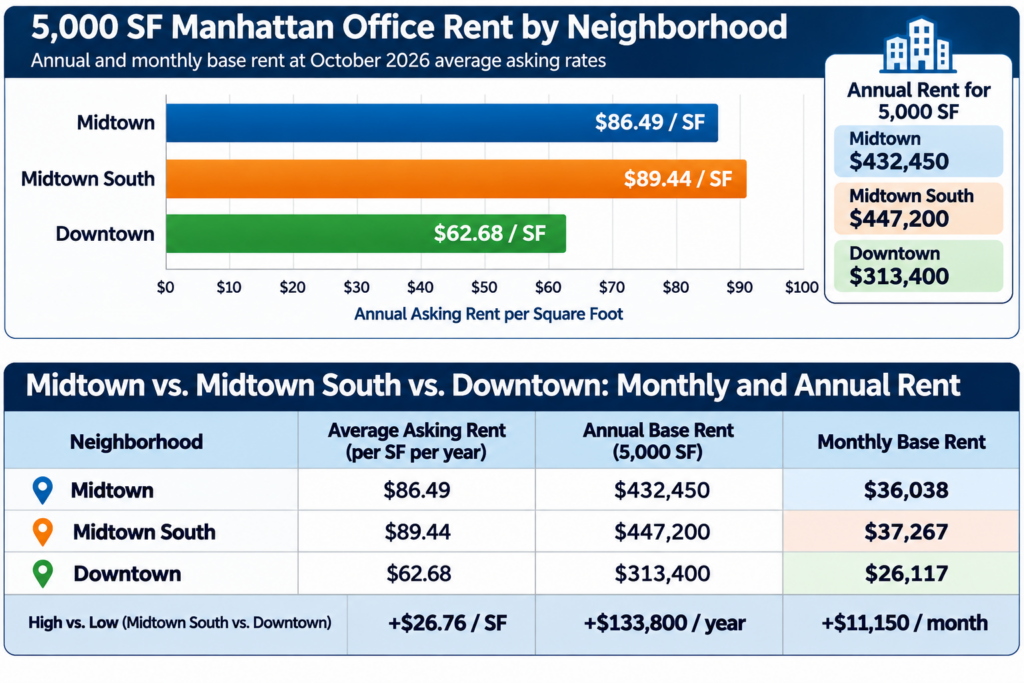
A 5,000-square-foot Manhattan office translates to approximately $26,117 per month in Downtown, $36,038 in Midtown, or $37,267 in Midtown South when calculated using October 2026 average asking rents. Those amounts represent annual base rents of $313,400, $432,450, and $447,200, respectively—not complete occupancy budgets or quotes for specific available suites.
The amount your business actually needs to budget depends on more than the location and advertised rental rate. Electricity, cleaning, internet, insurance, landlord reimbursements, and applicable Commercial Rent Tax can increase the recurring expense. Furniture, technology installation, alterations, moving, and security requirements create a separate upfront cash requirement.
For that reason, a useful answer to “How much does a 5,000-square-foot office cost in NYC?” should distinguish three numbers: the monthly rent, the recurring occupancy budget, and the cash needed to take possession and begin operating.
This guide focuses specifically on 5,000 rentable square feet in Manhattan, comparing Midtown, Midtown South, and Downtown. Published market figures are identified separately from hypothetical budgeting assumptions so that a market benchmark is not mistaken for a landlord proposal.
What Is the Monthly Rent for a 5,000-Square-Foot Manhattan Office?
CBRE’s reports published on November 4, 2026, provide a consistent October comparison across the three Manhattan markets.
| Manhattan market | Average annual asking rent per square foot | Calculated annual base rent for 5,000 square feet | Calculated monthly base rent |
|---|---|---|---|
| Midtown | $86.49 | $432,450 | $36,038 |
| Midtown South | $89.44 | $447,200 | $37,267 |
| Downtown | $62.68 | $313,400 | $26,117 |
Sources: CBRE’s November 2026 Midtown, Midtown South, and Downtown office reports. Monthly amounts are rounded to the nearest dollar. These are broad asking-rent benchmarks, not averages limited to 5,000-square-foot suites or completed transactions.
The comparison establishes a starting point, not a required spending level. A particular office may be quoted above or below its market’s average. The task is to identify which actual spaces satisfy the company’s requirements and then compare their complete financial proposals.
Midtown: Evaluate What the Location Is Worth to the Business
At the published Midtown benchmark, a 5,000-square-foot requirement produces approximately $432,450 in annual base rent.
Compared with the Downtown benchmark, that is an additional $119,050 annually, or approximately $9,921 per month.
For a company considering Midtown, that difference provides a concrete decision question: Does the particular location offer enough value through employee access, client convenience, recruiting, or proximity to business partners to justify the additional commitment?
The answer should come from the business’s operations—not simply from the prestige of an address.
Midtown South: Do Not Assume It Is the Less Expensive Midtown Alternative
In this dataset, Midtown South’s average asking rent exceeds Midtown’s. Applied to 5,000 square feet, the difference amounts to $14,750 annually.
That does not establish that every Midtown South office is more expensive than every Midtown office. It does mean a tenant should not begin its search with an automatic assumption that moving farther south produces a lower rent.
Compare the specific installation, building services, usable layout, and proposed lease. An attractive loft and a conventional office suite may answer very different requirements even when their advertised sizes are identical.
Downtown: Test the Savings Against the Actual Space Requirement
The Downtown benchmark produces the lowest base-rent calculation in this comparison: $313,400 annually.
That is $133,800 less per year than the Midtown South calculation, before differences in services, taxes, delivery condition, and lease terms.
For a location-flexible company, Downtown deserves a serious comparison. But the savings should be evaluated using equivalent requirements. A larger office with unnecessary rooms is not automatically a better financial choice than a smaller, more efficient alternative.
How Do You Calculate Rent for 5,000 Square Feet?
New York City’s commercial leasing guide explains that base rent is commonly calculated using an annual rate multiplied by the rentable area. Rentable area includes the usable premises together with an allocation of common space; it is not necessarily the amount of interior floor area available for employees.
The calculation is:
Annual base rent = 5,000 rentable square feet × annual rental rate
Monthly base rent = annual base rent ÷ 12
At $80 per square foot annually, the calculation is:
5,000 × $80 = $400,000 per year
$400,000 ÷ 12 = approximately $33,333 per month
Small changes in the rental rate become meaningful at this size. Every $1 per square foot changes annual base rent by $5,000. A $10-per-square-foot difference changes it by $50,000 annually, or approximately $4,167 monthly.
Make Sure “5,000 Square Feet” Means the Same Thing in Every Proposal
Request both the quoted rentable area and a usable floor plan. Ask how the area was measured and whether the figure can change before lease execution. BOMA’s office measurement standard specifically addresses rentable-area calculations and provides measurements useful for space-utilization analysis.
Do not assume two offices advertised at 5,000 square feet will accommodate the same number of workstations, private offices, meeting rooms, and support functions.
Have the layout tested against the company’s requirements before deciding that a lower rate represents better value.
What Should You Budget Beyond Base Rent?
For a transparent comparison, the following model assumes $60,000 annually—or $5,000 per month—in expenses and reserves beyond base rent.
These amounts are illustrative planning assumptions, not surveyed Manhattan averages, vendor quotes, or charges applicable to every building. Their purpose is to show how a complete budget can be assembled. Replace each line with the actual lease obligation or supplier proposal.
Illustrative Annual Operating Budget for a 5,000-Square-Foot Office
| Expense or reserve | Annual assumption | Monthly equivalent |
|---|---|---|
| Electricity | $20,000 | $1,667 |
| Internet and connectivity services | $7,200 | $600 |
| Cleaning contracted by the tenant | $12,000 | $1,000 |
| Tenant insurance | $4,800 | $400 |
| Supplemental heating, cooling, or after-hours service reserve | $6,000 | $500 |
| Landlord operating-expense and real-estate-tax reimbursement reserve | $10,000 | $833 |
| Total beyond base rent, before Commercial Rent Tax | $60,000 | $5,000 |
Monthly amounts are rounded. The model assumes these expenses are additional to the quoted rent. Remove or adjust any item already included in the lease.
A reserve is not proof that an expense will be incurred. It is a budgeting placeholder until the relevant obligation can be priced accurately.
Electricity: Confirm the Billing Method, Not Just the Allowance
The model uses $4 per rentable square foot annually for electricity, producing a $20,000 allowance.
Actual billing arrangements matter. The city’s leasing guide distinguishes direct utility metering from landlord submetering, which can include an administrative charge. It also explains that heating and cooling service hours depend on the lease and that service outside those hours may incur additional charges.
Request the electrical billing terms and available usage history. Identify separately any cooling equipment serving the tenant’s technology or equipment.
A team working ordinary weekday hours should not automatically use the same allowance as a business operating evenings, weekends, or continuously.
Cleaning, Internet, and Insurance: Price the Required Service
Use the cleaning schedule the company actually needs. Obtain an internet proposal for the required bandwidth, reliability, installation, and any backup connection. Ask an insurance broker to price the coverage limits required by the proposed lease.
The figures in the model are placeholders for those decisions.
Also check for duplication. A tenant should not add a full cleaning budget when the landlord already provides the required cleaning within rent, or budget for a new furniture purchase when usable furniture is included in the transaction.
Landlord Reimbursements: Do Not Add an Entire Building Expense Budget Automatically
Some office leases pass through increases in operating expenses above an agreed base year rather than charging the tenant a separate share of every building expense from the outset. The precise structure determines the obligation.
Ask for the proposed base years, the tenant’s proportionate share, and an explanation of how additional charges are calculated. Request historical statements where available.
The $10,000 reserve used here is not a statement that every 5,000-square-foot office owes that amount in its first year. A particular lease might produce a lower charge, no initial charge, or a materially higher obligation.
What Is the First-Year Occupancy Budget in Midtown, Midtown South, and Downtown?
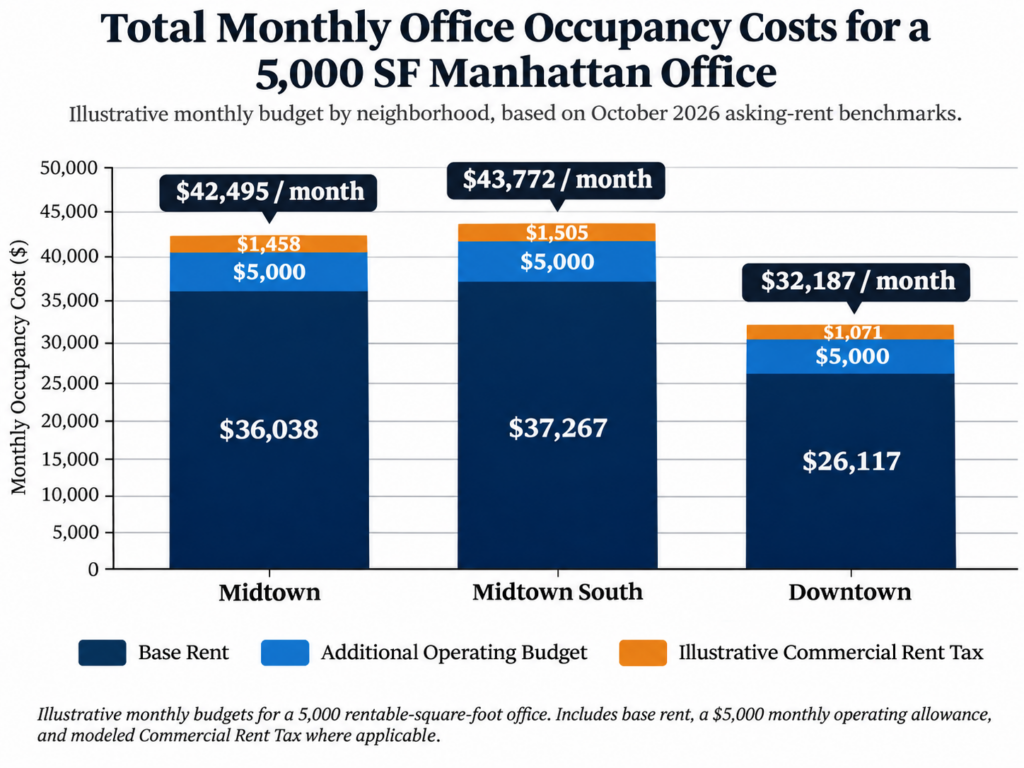
Applying the same $60,000 operating allowance to each location isolates the effect of the different asking-rent benchmarks.
The table also shows an illustrative tax-paying case. For that case, Commercial Rent Tax is calculated at the effective 3.9% rate, with no credits or exemptions, on base rent plus $16,000 of assumed taxable landlord reimbursements. The other modeled expenses are assumed to be separately contracted tenant services. Actual tax treatment must be reviewed for the specific lease.
| First-year budget measure | Midtown | Midtown South | Downtown |
|---|---|---|---|
| Base rent using published benchmark | $432,450 | $447,200 | $313,400 |
| Assumed additional operating budget | $60,000 | $60,000 | $60,000 |
| Annual budget before Commercial Rent Tax | $492,450 | $507,200 | $373,400 |
| Monthly budget before Commercial Rent Tax | $41,038 | $42,267 | $31,117 |
| Illustrative annual Commercial Rent Tax | $17,490 | $18,065 | $12,847 |
| Annual budget with illustrated tax | $509,940 | $525,265 | $386,247 |
| Monthly budget with illustrated tax | $42,495 | $43,772 | $32,187 |
Calculations combine CBRE’s October 2026 asking-rent benchmarks with the expressly stated assumptions above. Figures exclude upfront preparation costs, deposits, concessions, and subsequent-year increases. Tax-paying totals are calculated before rounding.
Under these assumptions, the recurring monthly budget is approximately $31,117 to $42,267 before Commercial Rent Tax, or $32,187 to $43,772 in the illustrated tax-paying case.
Those are modeled results—not a universal price range for every 5,000-square-foot Manhattan office.
Does a 5,000-Square-Foot Office Have to Pay NYC Commercial Rent Tax?
Not automatically.
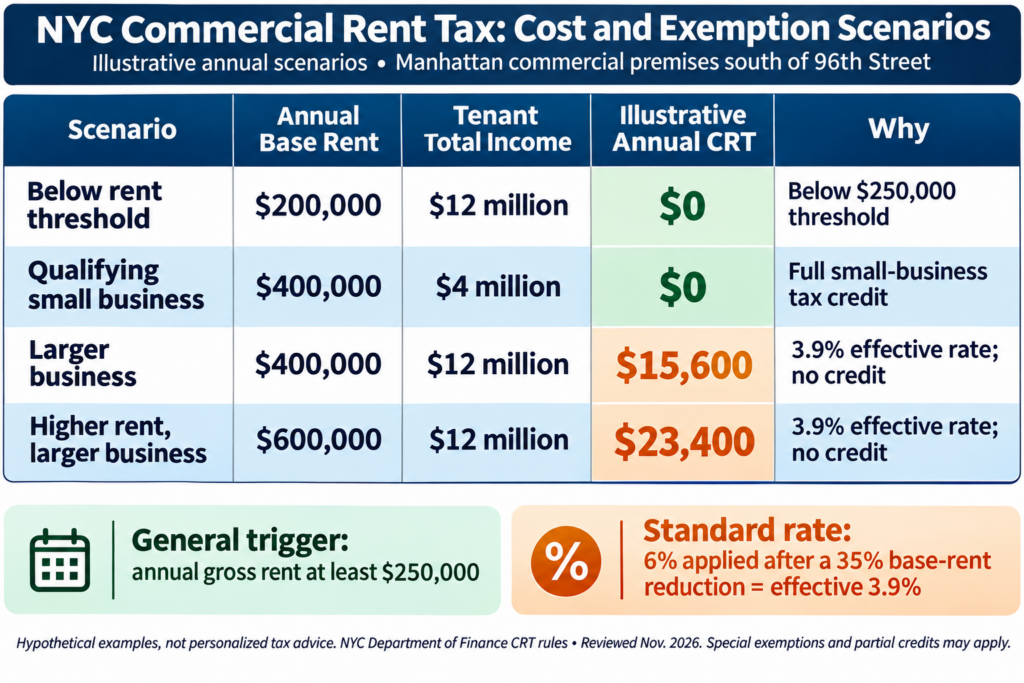
The general rules apply to commercial premises in Manhattan south of the center line of Ninety-Sixth Street when annual or annualized gross rent reaches $250,000, subject to exemptions and credits. The statutory rate is 6%, with a 35% base-rent reduction producing an effective rate of 3.9% before applicable credits.
For a 5,000-square-foot office, $250,000 equals a contractual base-rent rate of $50 per square foot annually. However, that calculation alone does not determine liability.
The Tax Definition of Rent Can Include More Than Contractual Base Rent
The city’s instructions include certain payments made on the landlord’s behalf, such as real-estate-tax reimbursements, within the definition of rent. Consequently, a calculation based only on the advertised rental rate can understate the tax base.
Consider a hypothetical office with:
$400,000 in annual contractual base rent + $16,000 in taxable landlord reimbursements = $416,000 in assumed taxable rent before the standard reduction
With no credits or exemptions, the resulting tax is:
$416,000 × 3.9% = $16,224 annually
That is an average monthly budget provision of $1,352. It is not a statement that the tax is billed monthly.
The Small-Business Credit Can Change the Result Substantially
The Department of Finance states that the small-business credit effectively eliminates the tax for qualifying tenants with total income of $5 million or less and annual base rent before the rent reduction of less than $500,000.
A qualifying business in the $416,000 example could therefore have a very different result from a larger business occupying the identical premises.
“Total income” has a defined tax meaning; it should not be substituted casually with net profit or bank balance. Partial credits may also apply, depending on the income and rent calculations.
Downtown Is Not Automatically Exempt
Premises within the legally defined World Trade Center Area qualify for a geographic exemption. That does not mean every Financial District or Downtown office qualifies. Confirm the actual address against the applicable boundaries.
Filing obligations also differ from payment obligations. NYC311 notes that a return is required when annual gross rent paid exceeds $200,000, even though the general payment threshold is higher.
Have an accountant review the actual lease, reimbursements, business income, and eligibility. Revisit the calculation when rent increases rather than assuming a first-year credit remains unchanged throughout the lease.
How Do Lease Escalations Affect a Five-Year Office Budget?
A starting rental rate is only the opening line of the financial commitment. Lease provisions can impose scheduled increases and additional reimbursements.
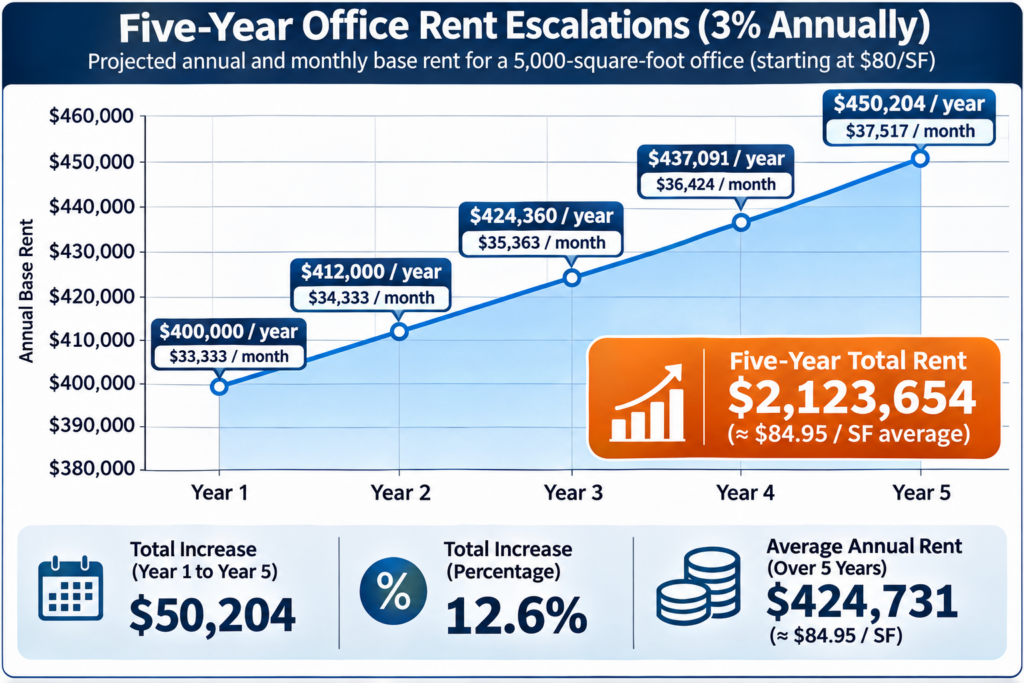
Consider a hypothetical five-year lease for 5,000 square feet beginning at $80 per square foot, with 3% annual increases in base rent.
The 3% increase is an assumption for this example—not a required or universal Manhattan lease term.
| Lease year | Annual base rent | Monthly base rent |
|---|---|---|
| Year one | $400,000 | $33,333 |
| Year two | $412,000 | $34,333 |
| Year three | $424,360 | $35,363 |
| Year four | $437,091 | $36,424 |
| Year five | $450,204 | $37,517 |
| Five-year total | $2,123,654 | — |
Amounts are rounded individually; the total is calculated from unrounded figures.
Without increases, five years at $400,000 annually would total $2 million. The assumed escalation adds approximately $123,654.
By the fifth year, monthly base rent is approximately $4,184 higher than in the first year.
That increase does not include changes in electricity, insurance, cleaning, taxes, or other charges.
A Base-Rent Increase Is Not Necessarily the Only Increase
Operating-expense provisions can create a separate obligation beyond scheduled base rent. In a base-year structure, the comparison between current expenses and the agreed base year becomes important.
Request a year-by-year schedule for the full term. Model variable expenses separately rather than assuming a fixed rent increase absorbs every future cost.
The practical affordability test is not simply whether the company can pay the first month. It is whether the company can support the expected commitment throughout the lease.
How Does Free Rent Change the Cost?
Free rent should be evaluated using its actual timing and scope.
Using the same five-year example, assume the landlord grants three months of first-year base-rent abatement within the sixty-month term.
At $400,000 in first-year annual base rent, that abatement is worth $100,000.
The resulting scheduled base-rent payments become:
$2,123,654 − $100,000 = approximately $2,023,654 over five years
A simplified average effective base rent is then:
$2,023,654 ÷ 5,000 square feet ÷ five years = approximately $80.95 per square foot annually
That figure averages the assumed increases and abatement. It does not replace the payment schedule.
The business still needs to budget for the applicable contractual rent during paying months. It must also verify whether the concession covers only base rent or other charges.
Keep three numbers visible: the regular monthly payment, the amount payable during the concession period, and the average cost across the full term.
Is a Furnished 5,000-Square-Foot Office Cheaper Than an Unfurnished Office?
It can require less money at the beginning without being the less expensive option over the entire occupancy period.
A furnished description also does not establish that every expense is included. Furniture rights, active connectivity, installation work, and the delivery condition still require verification. NewYorkOffices.com’s furnished-office guide distinguishes those items from the advertised rental rate.
The following comparison deliberately separates upfront savings from long-term cost.
Hypothetical Furnished Versus Unfurnished Comparison
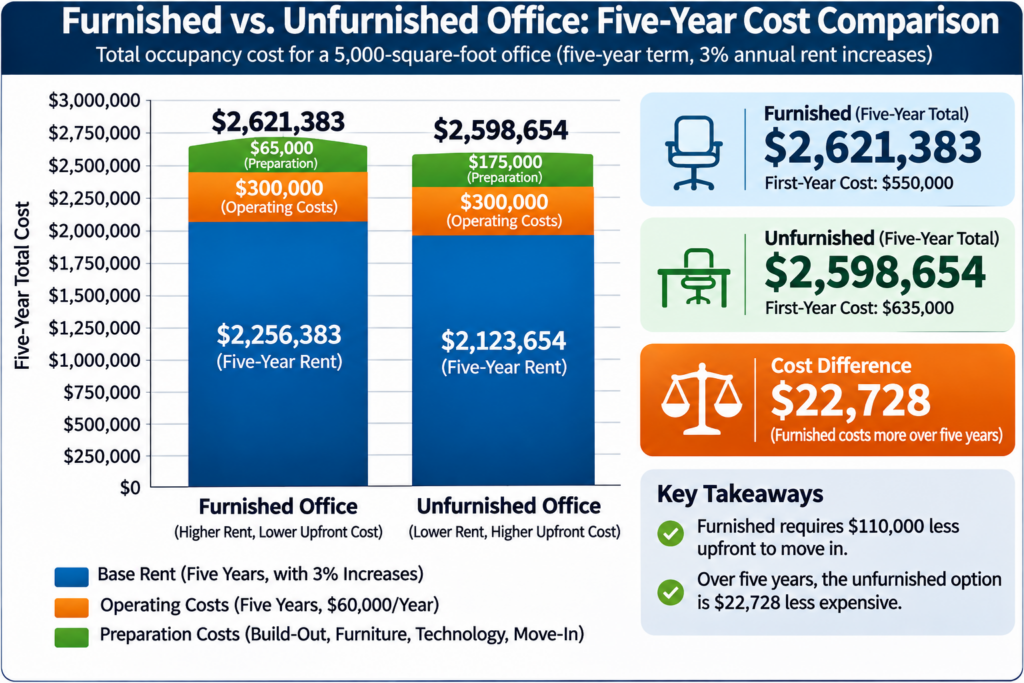
Assume both offices contain 5,000 rentable square feet, meet the same operational requirements, and have existing completed office installations. The unfurnished office is not raw space.
Assume a five-year term, 3% annual base-rent increases, no free rent, and the same $60,000 annual operating allowance held constant for comparison. Commercial Rent Tax is assumed to be eliminated by a qualifying credit throughout the modeled period.
All preparation figures below are hypothetical budgets, not contractor or furniture quotations.
| Cost component | Furnished office | Unfurnished existing office |
|---|---|---|
| Starting annual rent per square foot | $85 | $80 |
| First-year annual base rent | $425,000 | $400,000 |
| First-year monthly base rent | $35,417 | $33,333 |
| Minor alterations and preparation | $15,000 | $35,000 |
| Furniture purchases or replacements | $5,000 | $75,000 |
| Technology, cabling, and meeting-room setup | $20,000 | $35,000 |
| Moving, legal, and other professional costs | $15,000 | $15,000 |
| Preparation contingency | $10,000 | $15,000 |
| Total upfront preparation budget | $65,000 | $175,000 |
| First-year rent, operations, and preparation | $550,000 | $635,000 |
| Five-year base rent with assumed increases | $2,256,383 | $2,123,654 |
| Five-year operating allowance | $300,000 | $300,000 |
| Five-year modeled cost, including preparation | $2,621,383 | $2,598,654 |
The comparison excludes refundable security, financing costs, discounting, residual furniture value, and end-of-term obligations. It assumes no additional furniture charge beyond the amounts shown.
Furnished Space Preserves More Cash Initially
The furnished option requires $110,000 less in upfront preparation.
Its higher first-year base rent absorbs $25,000 of that advantage, leaving the furnished option $85,000 less expensive during year one under the stated assumptions.
For a business prioritizing near-term cash preservation, that difference may be more important than the starting rental rate.
The Lower-Rent Office Wins Over Five Years in This Example
Over the full five-year period, the furnished office’s higher rent accumulates.
Under the assumed 3% increases, it generates approximately $132,728 more in base-rent payments. That exceeds the $110,000 preparation savings, leaving the furnished option approximately $22,728 more expensive overall.
Neither result is a general rule about furnished offices.
The conclusion changes when rent, preparation costs, concessions, financing, or the occupancy period changes. A furnished office offered at a discount could perform better on both measures. An unfurnished office requiring substantially more work could perform worse on both.
Compare the move-in cash requirement and the full-term cost separately.
What Changes When the Office Requires a Major Build-Out?
An unfurnished completed office and an unfinished construction project should not share the same budget.
Cushman & Wakefield’s 2026 New York City fit-out example identifies $220.62 per square foot in hard construction costs and $330.92 per square foot in an expanded project model that includes additional categories such as professional costs, technology, audiovisual systems, and furniture.
Applied to a hypothetical 5,000-square-foot construction scope, those rates produce approximately $1,103,100 in hard costs or $1,654,600 using the expanded model.
Those are benchmark calculations—not quotations for every 5,000-rentable-square-foot office. The measured construction area and actual scope must be established before applying a construction rate.
They illustrate why a business should not treat an inexpensive unfinished office as financially equivalent to a completed suite.
Request a project-specific scope, budget, schedule, and explanation of landlord funding. Determine which costs the landlord pays directly, which the tenant must advance, and which remain the tenant’s responsibility.
Keep construction cash separate from recurring occupancy costs so that a low monthly rent does not conceal an unaffordable opening budget.
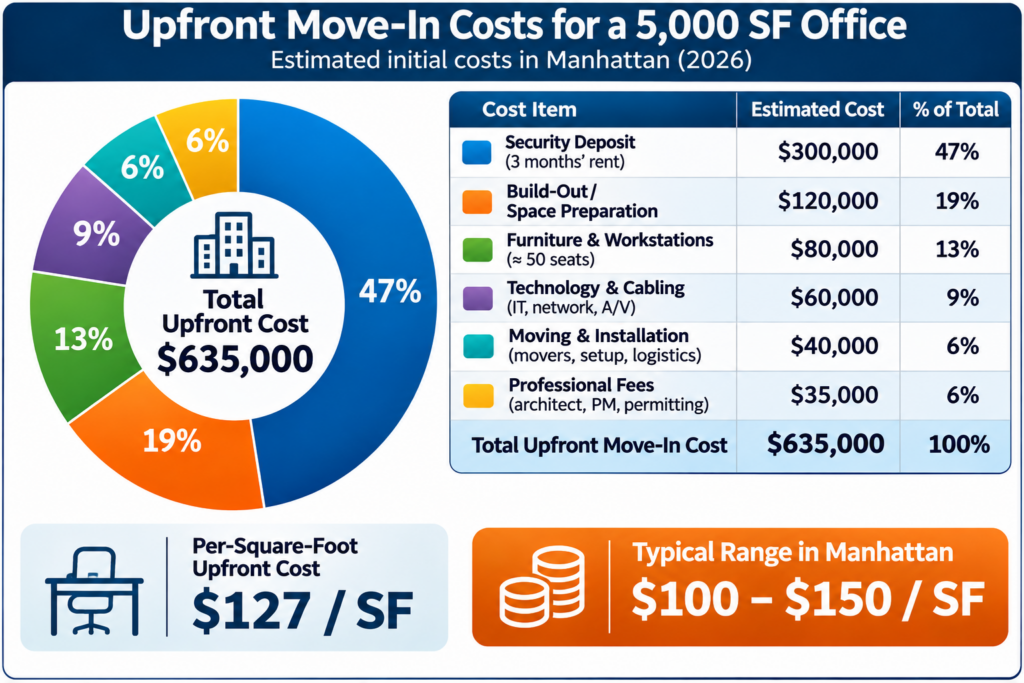
How Much Cash Is Needed Before Moving In?
The recurring monthly budget does not answer how much money must be available to complete the transaction.
Security requirements create an additional cash commitment. The city’s leasing guide explains that the amount depends on factors including the rent and the tenant’s financial condition; refundable security is held separately from ordinary rent payments.
Consider the hypothetical unfurnished office at $80 per square foot.
Assume the negotiated security equals six months of starting base rent. That is an example—not a statement of standard requirements.
The cash components would be approximately:
$200,000 in security + $175,000 in preparation + $33,333 in prepaid first-month base rent = $408,333
Actual payment dates depend on the transaction and preparation schedule. Additional operating cash may be needed.
The distinction matters: the $200,000 security is cash tied up, not an ordinary expense if it is ultimately returned. The prepaid first month is part of the annual rent budget, not another month added to it.
Track cash timing and economic cost separately to avoid both understating the funding requirement and double-counting expenses.
What Rental Rate Fits a Fixed Monthly Budget?
A company with a firm spending ceiling should calculate backward from that ceiling.
Using the illustrative $60,000 annual operating allowance, the calculation before Commercial Rent Tax is:
Maximum annual base rent = annual occupancy budget − $60,000
Maximum annual rate per square foot = maximum annual base rent ÷ 5,000
For a company with a $30,000 monthly recurring budget, the annual ceiling is $360,000. Subtracting the $60,000 operating allowance leaves $300,000 for base rent.
That supports a starting rate of $60 per square foot, before Commercial Rent Tax and upfront costs.
For a company with a $40,000 monthly recurring budget, the same calculation supports $84 per square foot before Commercial Rent Tax.
Using the tax-paying assumptions in this guide—3.9% on base rent plus $16,000 of taxable reimbursements—the $40,000 monthly ceiling supports approximately $80.73 per square foot, rather than $84.
These are first-year calculations. Subsequent increases must also fit the company’s financial plan.
How Can a Company Reduce Its 5,000-Square-Foot Office Cost?
Begin by testing whether 5,000 rentable square feet is the correct requirement.
At $80 per square foot, reducing the requirement to 4,500 square feet saves $40,000 annually in base rent. That is equivalent to negotiating an $8-per-square-foot reduction on a 5,000-square-foot office.
That reduction is useful only when the smaller layout still supports the business.
Next, compare preparation costs before dismissing a higher-rent office. An existing installation that fits the team may avoid work the business would otherwise fund.
Finally, compare the entire proposal: scheduled rent, service obligations, taxable reimbursements, concessions, delivery condition, preparation funding, security, and term.
A small improvement in several of those items can matter more than a modest reduction in the headline asking rent.
Frequently Asked Questions About 5,000-Square-Foot NYC Office Costs
Can You Rent 5,000 Square Feet in Manhattan for Less Than $25,000 Per Month?
A rate below $60 per square foot produces base rent below $25,000 monthly.
For context, CBRE reported Downtown average sublease asking rent of $48.12 per square foot in October 2026. Applied to 5,000 square feet, that equals $240,600 annually or $20,050 monthly. It is a segment benchmark, not a quote for a particular furnished suite or a complete occupancy budget.
Does a $400,000 Annual Rent Budget Mean the Office Costs $400,000 Per Year?
Only when that figure genuinely includes every expense the business intends to count.
In the illustrative operating model, $400,000 of base rent becomes $460,000 before Commercial Rent Tax. In the illustrated tax-paying case, adding $16,224 produces $476,224 annually, or approximately $39,685 monthly, before preparation and security.
Should Furniture Be Spread Across the Lease Term When Comparing Costs?
For an economic comparison, it can be useful to show both the upfront payment and its equivalent over the intended occupancy period.
A hypothetical $75,000 furniture purchase equals $15,000 annually when spread evenly across five years. But the business may still need to fund the purchase before occupancy. Averaging the cost does not change the cash requirement.
How Many Employees Can Use a 5,000-Square-Foot Office?
Do not use a universal headcount assumption to approve the budget.
Prepare a test layout showing the required workstations, private offices, conference rooms, phone rooms, pantry, storage, and circulation. Then evaluate the cost per employee actually supported by that plan.
An office that appears inexpensive per square foot can be expensive per employee when too much of its layout is unsuitable.
Budget for the Office You Will Occupy, Not Just the Rent You Are Quoted
A 5,000-square-foot Manhattan office is a multi-year operating commitment with a separate startup funding requirement.
The useful comparison is not simply Midtown versus Midtown South versus Downtown. It is the actual monthly payment, additional operating obligations, tax treatment, future increases, preparation costs, and cash tied up in the transaction.
Start with dated market benchmarks, then replace every assumption with a current proposal or verified cost. Compare each finalist over the same period and keep upfront cash separate from recurring expenses.
For a focused search, provide us with your preferred locations, required layout, move-in date, intended lease term, maximum monthly occupancy budget, and preparation budget. Those requirements create a more useful shortlist than square footage and asking rent alone.
Fill out our 📋 online form or give us a call today 📞 212-967-2061 — let’s find the right office for your business.