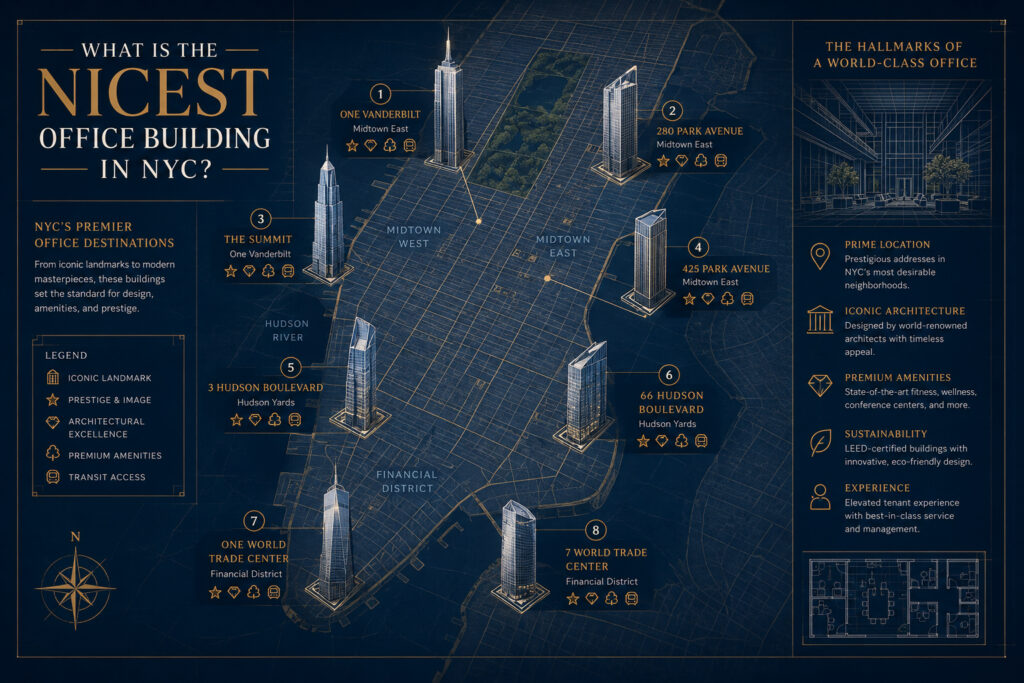
The nicest office building in NYC usually is not one single famous tower.
For most tenants, the best answer is a new or fully reinvented Class A building in a prime Midtown corridor. It should offer direct commuter access, strong light, modern air systems, hospitality-grade amenities, flexible layouts, and a brand-worthy arrival experience. Demand in Manhattan now concentrates in top-quality space, while older commodity stock still struggles. Prime buildings also tend to win because they pair transit access with wellness, sustainability, retail, and service.
Still, the nicest choice depends on your team. Some finance firms prize Park or Madison prestige. Many creative companies prefer loft character in Midtown South. Others chase Downtown views, larger blocks, and lower rent. Current market data shows that these submarkets behave differently in both pricing and demand.
We represent tenants, not landlords. From our side of the table, we compare buildings, rents, concessions, and layouts through your lens. If you want to upgrade, right-size, or tour premium options, we can help you shortlist space and negotiate better terms.
Short answer: The nicest office building in NYC is the one that makes work easier every day. Prestige matters. Yet commute time, light, air, service, layout, and lease economics matter more.
What actually makes an office building feel nicest
Transit first. Nice starts before the elevator ride. Buildings near major rail and subway hubs remove friction from the workday. That advantage helps attendance, punctuality, recruiting, and client access. It also supports the premium on top space in core corridors.
Arrival and image. A strong lobby shapes first impressions. So does a clean frontage, fast security process, and polished elevator experience. The nicest building should feel calm, bright, and organized from street to suite. Workplace research now treats that emotional response as part of performance, not just decoration.
Light and floor efficiency. Tenants notice daylight, ceiling height, and plan efficiency fast. Large, bright floors feel better because they work better. Top-end office design now leans toward lighter, brighter environments that support better in-person work.
Amenities that earn the commute. Fitness centers, terraces, conference centers, lounges, food options, and hospitality services now matter. Properties with a broader amenity mix show stronger tenant demand. Workers also respond to offices that support better in-person experiences.
Comfort and control. Strong HVAC, modern filtration, dependable power, and good acoustic separation still decide daily satisfaction. Nice looks good. Great space also feels steady all day. That matters because employees value offices that support focus, connection, and reliable comfort.
Sustainability and compliance. Premium tenants now care about emissions, reporting, and future readiness. In New York, most buildings over 25,000 square feet face emissions caps. Owners can face annual penalties if they miss the limit. A nicer building can therefore reduce operational risk, not just improve image.
Which type of building usually wins
If prestige leads the search, the nicest option usually sits in the Plaza District or near Grand Central. Those buildings command premiums because tenants buy image, access, walkability, and client-facing presence.
If employee convenience leads, terminal-connected or very short-walk Midtown East buildings often win. Small time savings compound over a year. Faster commutes also help firms that want more in-person work.
If culture leads, Midtown South often feels nicest. Many teams prefer loft floors, higher ceilings, exposed structure, and a more relaxed street scene. In prime pockets, that format can cost as much as Midtown because demand stays strong.
If budget leads, Downtown deserves attention. Class A rents stay far below Midtown South and below Midtown. Tenants often gain better views, larger floor plates, and turnkey value.
If flexibility leads, subleases and furnished suites can outperform direct space. They cut setup time, reduce capital spend, and let tenants test a premium location before making a longer commitment.
So, nice is not one universal address. Instead, it is the best fit between your talent map, budget, image goals, and daily operations.
Where the nicest offices cluster right now
Grand Central and the Plaza District fit firms that want prestige, commuter ease, and polished building stock. Current local inventory stretches from smaller walkable suites to major headquarters blocks. Many tenants start here because the district offers image and practicality together. You can compare current Grand Central office space and Plaza District office space before touring.
Midtown South fits creative, tech, branding, and client-service teams that want more texture. The nicest options here often mix loft identity with upgraded systems. Current local examples include furnished and full-floor opportunities from roughly 3,826 to 14,739 square feet. If that profile fits your brand, review Midtown South office space and a furnished NoMad office.
Penn Station and Hudson Yards fit firms that prioritize regional access and newer large-block product. Current local Penn inventory ranges from about 1,537 square feet to 18,641 square feet. Larger users can also study a Hudson Yards headquarters block for a newer, long-term option.
Downtown fits tenants who want strong value without giving up stature. The area offers large floor plates, strong views, and better rent efficiency. Current local options include Financial District office space and several turnkey furnished suites.
What the nicest offices cost in 2026
Manhattan pricing still rewards quality. Major market reports show one of the strongest first quarters for leasing in years. Demand also keeps favoring higher-end stock over older commodity space.
In the first quarter of 2026, one major market report put Manhattan asking rent at $77.55 per square foot. Another report placed Midtown Class A at $86.57. That same report put Midtown South Class A at $104.38 and Downtown Class A at $61.77. Those spreads explain why many tenants debate prestige against practicality.
At the very top, trophy asks in the Plaza District can still reach roughly $150 to $200 plus. Current local guidance, however, shows many small private offices near Grand Central clustering around 800 to 2,000 square feet. Realistic pricing there often lands in the mid $40s to low $70s per square foot. That range gives smaller teams a realistic way into premium corridors without flagship rates.
Monthly math matters just as much. Using a planning rule near 150 square feet per employee, a 10-person team near Grand Central may start around 1,500 square feet and roughly $6,875 to $11,250 per month. A 20-person team may start near 3,000 square feet and roughly $13,750 to $22,500 per month.
Face rent is only the start. In premium corridors, annual escalations, utilities, cleaning, and tax pass-throughs can lift true occupancy cost by 15% to 20%. Concessions can offset part of that burden, especially outside the trophy tier.
Turnkey space can sharpen value further. One current furnished Plaza District option supports about 26 people. Another current Grand Central furnished option spans 4,731 square feet for about 32 people. A current Financial District furnished option offers 2,573 square feet at $39 per square foot.
How to choose the nicest building without overpaying
Start with the commute, not the skyline. Map where your people live. Then decide whether your team needs direct rail access, a short subway walk, or stronger end-of-trip support. If the daily trip feels hard, even a beautiful office fades fast.
Next, define the workday mix. Teams that host clients need stronger arrival sequences and conference support. Heads-down teams need acoustics, focus rooms, and efficient desk planning. Creative teams may trade marble for texture and flexibility. Worker research now frames office success around the full workplace experience, including building and neighborhood effects.
Then stress-test the economics. Compare face rent, free rent, improvement money, furniture savings, and buildout time together. A furnished sublease may beat a direct lease for speed. On the other hand, a direct deal may win if you need branding control or a longer term.
Also, ask hard questions on operations. Review air delivery, after-hours HVAC, freight process, loading, security, backup power, and elevator traffic. Confirm sustainability posture too. Current city rules cover most large buildings over 25,000 square feet. Owners can face fines if their building exceeds the annual emissions limit.
Finally, tour with a scorecard. Rate each option on commute, image, layout, comfort, amenity value, and total occupancy cost. The nicest building should win on the whole experience, not one dramatic view.
FAQ copy
Is the nicest office building in NYC always the most expensive? No. Some of the nicest spaces sit in Downtown or in smaller Midtown buildings that deliver more value per square foot.
What is the most prestigious office location in NYC? For office tenants, the Plaza District usually holds that title. Grand Central follows closely because it blends prestige with commuter practicality.
Is Midtown always nicer than Downtown? Not always. Midtown wins on prestige and commuter density. Downtown often wins on views, floor size, and rent efficiency.
Are newer buildings always better? Newer towers usually lead in systems and amenities. Still, deeply renovated legacy buildings can feel just as strong for many teams.
When should a tenant pay for premium space? Pay up when brand, recruiting, and client experience drive revenue. Save more when flexibility matters most.
What size team benefits most from premium space? Every size can benefit. Smaller firms often use premium small suites to buy image. Larger firms use premium space to support attendance and recruiting.
Do amenities really matter? Yes. The right amenities can raise tenant demand and improve daily experience. Wellness, hospitality, and outdoor space matter most.
Can a sublease be the nicest option? Absolutely. Turnkey subleases can offer premium design, faster occupancy, and lower upfront cost.
What NYC area gives the best balance of nice and practical? For many tenants, the Grand Central corridor is the strongest answer. It blends image, transit, and a wide mix of suite sizes.
Finding the nicest office building in New York City can feel overwhelming. Thousands of buildings compete for attention, yet only a small percentage truly deliver the combination of prestige, convenience, amenities, workplace experience, and long-term value that modern tenants seek.
Our team represents tenants throughout Manhattan and helps companies evaluate office buildings from a business perspective, not a landlord’s perspective. If you are searching for a premium office environment, we can help you compare options, negotiate favorable lease terms, and identify spaces that align with your budget, growth plans, and workplace goals.
Fill out our 📋online form or give us a call today 📞212-967-2061 — let’s find the right office for your business.