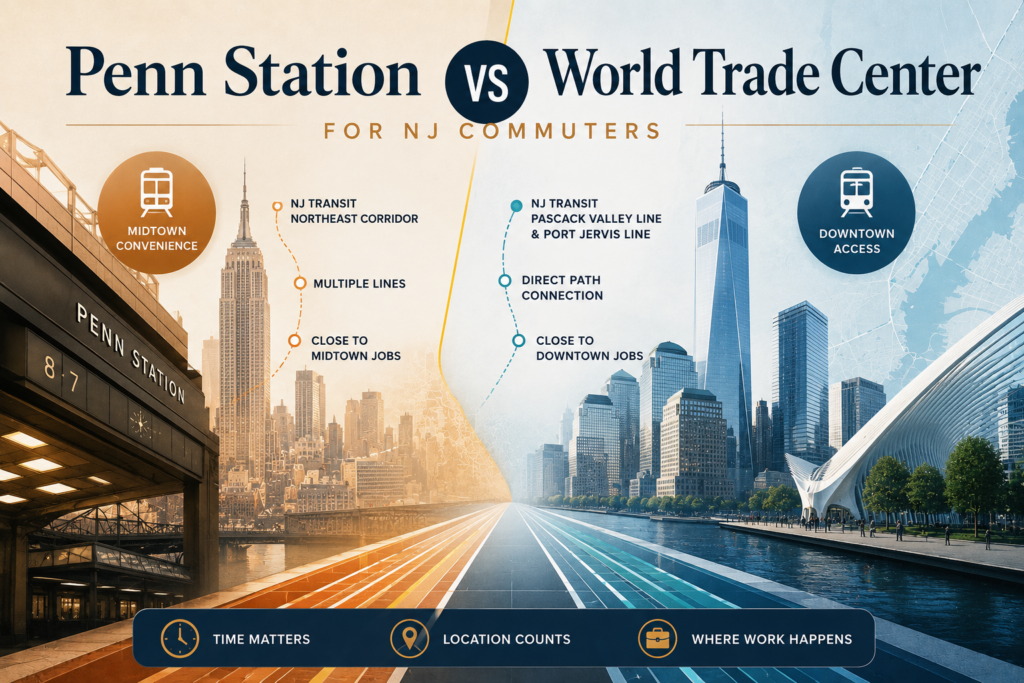
Penn Station vs World Trade Center for NJ Commuters
Quick answer: Penn Station usually wins for teams that ride NJ TRANSIT into Manhattan. World Trade Center usually wins for teams that already live on the PATH map. The better office is the one that removes the last transfer and shortens the final walk.
| Factor | Penn Station | World Trade Center | Best edge |
|---|---|---|---|
| Core commuter fit | Best for direct NJ TRANSIT riders into Manhattan | Best for direct PATH riders from Newark, Hoboken, and the Hudson waterfront | Depends on where your staff starts |
| Direct rail logic | Five NJ TRANSIT rail lines serve Penn Station New York | PATH connects New Jersey stations straight into the WTC complex | Split |
| Representative direct ride | Newark Penn to New York Penn runs about 15 to 20 minutes | Newark to WTC is about 22 minutes, while Hoboken to WTC is about 11 minutes | Corridor-specific |
| Transit web after arrival | Strong West Side access, plus direct A/C/E and 1/2/3 access from Moynihan | Massive Lower Manhattan network with 12 subway lines, 2 PATH lines, 17 ferry routes, and 30 bus routes | WTC |
| Q1 2026 asking rent | $105.81 PSF overall in the Penn Station submarket | $69.04 PSF overall in the World Trade submarket | WTC |
| Q1 2026 vacancy | 14.7% | 17.0% | WTC |
| Current examples on your site | 5,755 RSF at One Penn Plaza, 7,675 SF near Penn, and 5,999 SF in Midtown West at $62 PSF | 10,000 SF at 1 World Trade Center, 34,328 SF at One World Trade Center, and 42,647 SF plus 43,019 SF at 4 World Trade Center | WTC for larger listed blocks today |
The table above blends official transit data, current market reports, and live examples from your own listings. It reflects the question tenants actually ask: which terminal makes the workday easier, and which district keeps the lease economics sane.
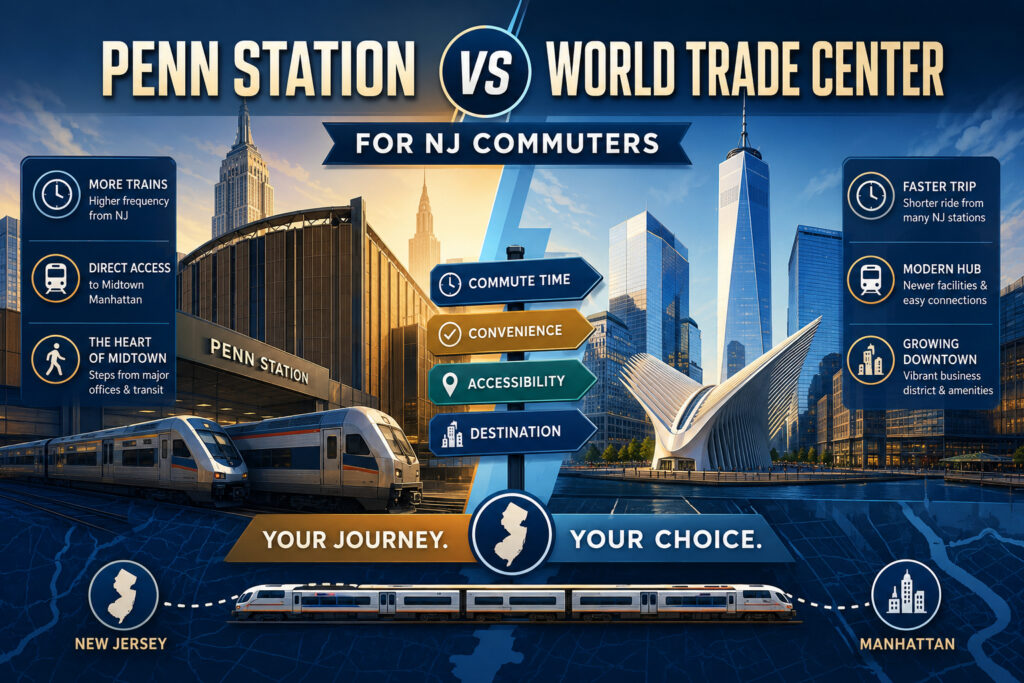
Why Penn Station wins for many suburban NJ riders
Penn Station wins when your team arrives on NJ TRANSIT and wants a true one-seat ride. NJ TRANSIT says five rail lines serve Penn Station New York directly. The station page also shows the five lines that touch Penn today: Montclair-Boonton, Morris & Essex, Northeast Corridor, North Jersey Coast, and Raritan Valley. That direct arrival matters more than most lease tours admit.
Another point matters just as much. Newark Penn to New York Penn runs about 15 to 20 minutes on frequent service. That makes Penn the clean answer for many riders coming from the west, southwest, and shore-oriented NJ TRANSIT map. If the office then sits near Penn or Moynihan, the commuter often finishes the trip without another paid leg.
Penn also delivers raw regional scale. Amtrak says New York Penn Station serves more than 630,000 passengers on 1,345 trains per day, which keeps it the busiest passenger transportation facility in North America. Moynihan adds direct access to the A, C, E, 1, 2, and 3 lines. That combination gives Penn a deep Midtown transit web, even before you count the nearby West Side office stock.
For a tenant, that means one simple thing. If most people already land at Penn, forcing them downtown often adds a second leg that they feel twice each day. The office may look better on a brochure, yet the commute gets worse in real life. That trade rarely ages well.
Why World Trade Center wins for PATH-heavy teams
World Trade Center wins when your workforce already lives on the PATH network. PATH serves 13 stations, with seven in New Jersey and six in New York. The system also operates 24 hours a day, seven days a week. That matters for firms with early starts, late finishes, or staff who do not keep a clean nine-to-five pattern.
The direct ride is the real advantage. The Port Authority pegs Newark to World Trade Center at about 22 minutes. It also lists Hoboken to World Trade Center at about 11 minutes during weekday daytime and evening service. For riders who already start in Newark, Harrison, Hoboken, or the Jersey City waterfront, WTC cuts out the extra Midtown step.
Once the train arrives, the WTC campus offers unusual distribution power. Official WTC guidance says the campus gives access to 12 subway lines, 2 PATH lines, 17 ferry routes, and 30 MTA bus routes. The complex also ties directly into the Oculus and the Fulton transit network. In plain English, WTC is not just a terminal. It is a full Lower Manhattan movement system.
That last point matters at the building level. Your current 10,000-square-foot sublet at 1 World Trade Center advertises direct access to the Oculus. The site also shows major listed blocks downtown, including 34,328 square feet at One World Trade Center and direct floors of 42,647 and 43,019 square feet at 4 World Trade Center. When the office sits inside the same arrival ecosystem, the “station to desk” path gets much cleaner.
The real tradeoff is not Midtown versus Downtown
The real tradeoff is rail-to-door friction. Penn Station solves the trip for direct NJ TRANSIT riders. World Trade Center solves the trip for direct PATH riders. That is why the wrong choice punishes attendance, punctuality, and morale faster than a rent premium often does.
A common mistake follows the wrong metric. Some teams compare only in-train minutes. They ignore the extra transfer, the long mezzanine, the weather walk, or the station exit that sends people the wrong way. Those “small” add-ons create the real burden. A one-seat ride to the wrong district can still fail. A slightly longer train run to the right front door can still win.
That is why Penn usually fits offices near Penn, Penn Plaza, Midtown West, and close West Side Midtown South. Meanwhile, WTC usually fits the Financial District, the World Trade Center district, and nearby Downtown locations that plug into the Oculus or Fulton. Geography should follow the arrival pattern, not the other way around.
Rent and inventory do change the answer
Penn is the more expensive answer on headline rent. Cushman & Wakefield put the Penn Station submarket at $105.81 per square foot in Q1 2026, with Class A at $125.96 and vacancy at 14.7%. The same report put the World Trade submarket at $69.04 overall, with Class A at $71.81 and vacancy at 17.0%. That is a spread of about $36.77 per square foot in favor of WTC.
The broader district data points the same way. CBRE’s June 2026 figures show Midtown asking rents at $86.55 with 12.8% availability. Downtown sat at $61.14 with 16.9% availability. That wider market spread comes to about $25.41 per square foot. So a tenant does not pay more at Penn by accident. The market prices that direct NJ TRANSIT convenience in.
Inventory depth matters too. Penn offers strong demand, but the submarket stays tighter. WTC and Downtown usually offer more choice and larger blocks at lower ask levels. Cushman’s Q1 data shows the World Trade submarket logged 2.31 million square feet of leasing activity, while Penn logged 437,489 square feet. Downtown also carried more vacancy, which can help tenants push harder on options and economics.
Your own live listings reinforce that difference. On the Penn side, current examples include 1 Penn Plaza, a Penn Station office space for lease at 7,675 square feet, and a Midtown West office space for lease at 5,999 square feet and $62 per foot. On the Downtown side, your site currently shows much larger listed blocks in the WTC cluster, including 1 World Trade Center, 4 World Trade Center, and a World Trade Center sublet office for rent.
So which location should a tenant choose
Choose Penn Station if most staff rides NJ TRANSIT into Manhattan, if the office sits on the West Side, or if you want the fewest transfers for suburban rail commuters. Penn also works better when the team needs Midtown client access and still wants large-scale regional rail in one place. Start with Penn Station office space, then compare 1 Penn Plaza and current Penn-adjacent lease options.
Choose World Trade Center if most staff already rides PATH, if the office needs direct Lower Manhattan access, or if rent discipline matters more than a Midtown address. WTC also fits teams that want broader downtown transit after arrival, especially if the suite plugs into the Oculus or nearby Fulton access. Start with Downtown Manhattan office space, then review 1 World Trade Center, 4 World Trade Center, and your current World Trade Center sublet office.
Mixed teams need a harder look. If your headcount splits between NJ TRANSIT suburb riders and PATH riders, the answer often comes down to weighted pain. Count how many people arrive at Penn. Count how many arrive at WTC. Then test whether Downtown rent savings offset the extra transfer for the Penn group, or whether Penn convenience justifies the rent premium for the PATH group.
Bottom line
Penn Station is the best Manhattan office location for many NJ TRANSIT commuters. World Trade Center is the best Manhattan office location for many PATH commuters. The winner is not the prettier tower or the louder neighborhood. The winner is the office that removes the final commute mistake.
We represent tenants only. We compare Penn and WTC options through commute maps, live inventory, rent bands, and negotiating leverage. If your team sits between both corridors, we can narrow the shortlist quickly and keep tours focused on the offices that actually fit.
FAQ
Is Penn Station or World Trade Center better for NJ commuters?
Penn Station is usually better for direct NJ TRANSIT riders. World Trade Center is usually better for direct PATH riders. The dividing line is the rail map, not the neighborhood name.
Does NJ TRANSIT go directly to World Trade Center?
Not as a regular direct Manhattan rail terminal. NJ TRANSIT says five rail lines serve Penn Station New York directly. WTC guidance says PATH connects to NJ TRANSIT at Hoboken and Newark, which means many WTC trips from suburban New Jersey involve an NJ TRANSIT leg and a PATH leg.
Does PATH go to Penn Station?
PATH does not list New York Penn Station as a station. Its Manhattan stations include 33 Street and World Trade Center. If your office goal is Penn itself, PATH creates a Midtown arrival, not a Penn track arrival.
Which option is cheaper for office rent right now?
World Trade Center is cheaper on current asking rent. Q1 2026 data showed Penn Station at $105.81 per square foot and World Trade at $69.04. June 2026 district figures also showed Midtown above Downtown on average asking rent.
Which location offers more inventory and larger current options?
World Trade Center looks deeper today, especially for larger listed blocks. Your current Downtown inventory includes floors above 34,000 square feet at One World Trade Center and 4 World Trade Center. By contrast, your current Penn examples skew smaller in the listings surfaced here.
What if most of my team commutes from Jersey City or Hoboken?
World Trade Center usually wins that map. PATH serves the New Jersey waterfront directly, and Hoboken to WTC runs about 11 minutes in the Port Authority’s route data.
What if most of my team commutes from Morris, Essex, Union, Middlesex, or the Shore corridor?
Penn Station usually wins that map because NJ TRANSIT’s direct Penn service covers the major Manhattan-bound rail corridors that feed those riders. Newark Penn to New York Penn also runs about 15 to 20 minutes, which keeps the final Manhattan leg simple.
Suggested Links
Penn-focused links
Penn Station office space
1 Penn Plaza
Penn Station office space for lease
Midtown West office space for lease
Downtown and WTC-focused links
Downtown Manhattan office space
Office space Downtown Manhattan options
1 World Trade Center
4 World Trade Center
World Trade Center sublet office for rent
Broader supporting link
Best Office Neighborhood for NJ Commuters in Manhattan for readers who want a wider neighborhood view beyond this head-to-head comparison.
Looking for Offices Nearby
You do not need to guess through this decision. We represent tenants, not landlords. We compare commute maps, rents, concessions, and live space so your team does not inherit the wrong daily routine.
Fill out our 📋 online form or give us a call today 📞 212-967-2061 — let’s find the right office for your business.