Office Space Near Madison Square Park in Flatiron
Why this location pulls so much tenant demand
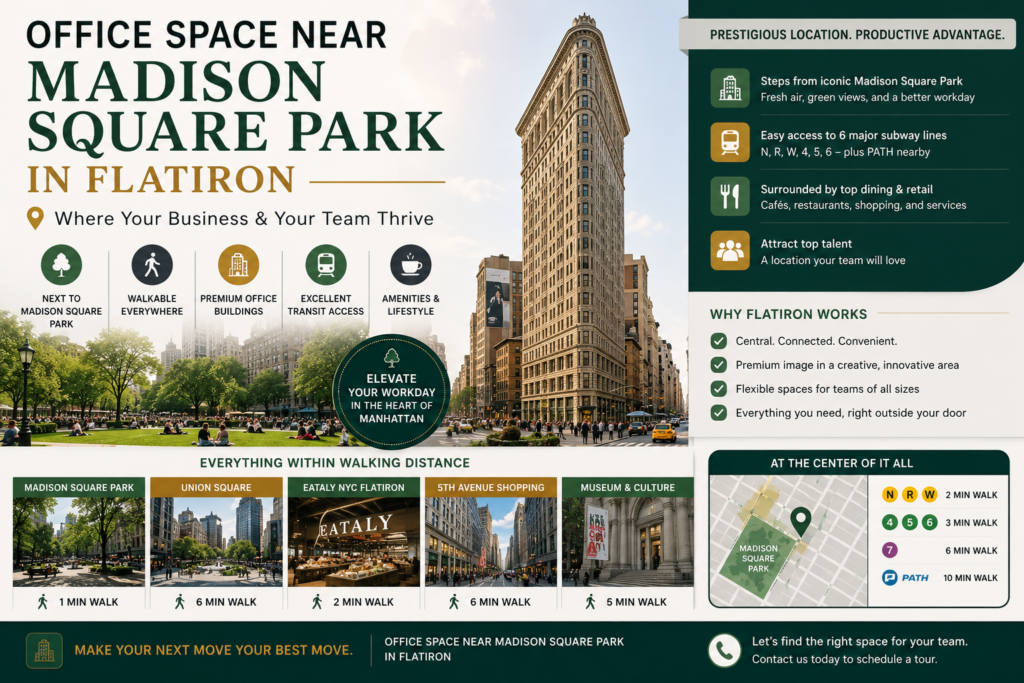
Few Manhattan office locations carry a stronger image signal than this one. A Madison Square Park address gives tenants Flatiron brand value, Midtown South energy, and immediate access to a real urban park. Madison Square Park spans 6.2 acres and draws roughly 60,000 daily visitors, which gives nearby offices a daily amenity that most business districts cannot match.
That advantage shows up in how tenants use the area. Teams can step outside for lunch, take walking meetings, meet clients in a visually recognizable setting, and offer staff a better office day. Park-front buildings also sit in one of Manhattan’s most connected office pockets, with short walks to the Broadway, Sixth Avenue, Lexington Avenue, and Union Square subway corridors.
When most tenants say “near Madison Square Park,” they usually mean one of three zones. Direct park frontage covers the addresses that face the park and command the strongest image premium. The one-to-three block ring captures nearby Fifth Avenue, Madison Avenue, Broadway, and Park Avenue South options. The south side of Flatiron gives you a slightly longer walk, but often a better value and more loft-style character.
What office inventory actually looks like near the park
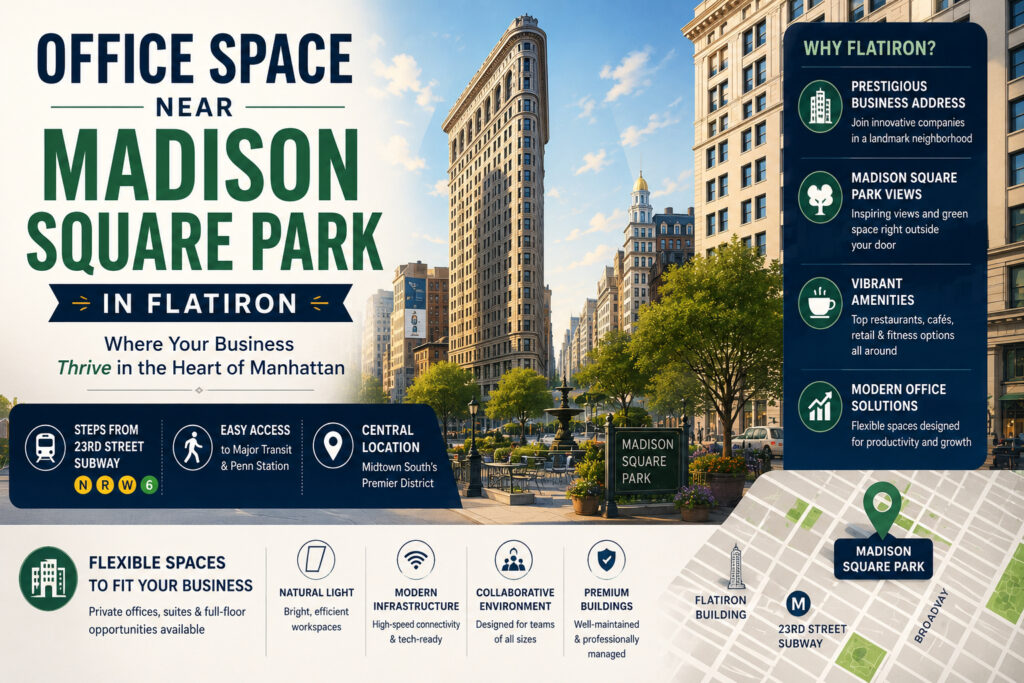
This micro-market gives tenants three main product types. First, you have park-front Class A inventory with bigger floor plates, stronger branding, and a higher rent profile. Second, you have boutique Fifth Avenue and Broadway buildings with more prewar character and efficient mid-size layouts. Third, you have plug-and-play sublets and prebuilt suites that let teams move faster with less upfront build-out.
If brand identity comes first, start with park-front Class A inventory, institutional-scale tower floors on the park, and large park-edge floors with unusual scale for Midtown South. Those options lean toward larger tenants, polished build-outs, and stronger reception value. They also sit at the top of the location hierarchy because they pair direct park access with major floor depth and high visibility.
If character matters more than sheer scale, review high-identity Fifth Avenue loft inventory. That product type attracts tenants who want a recognizable address, better natural light, and a less corporate feel. It also bridges the gap between Union Square and Madison Square Park, which helps teams that want both transit strength and neighborhood life.
Move-in-ready inventory also exists in real, workable sizes. Current examples on our site include a boutique 2,600 RSF loft sublet with park views, a divisible direct lease from 1,060 to 5,370 RSF, a 6,500 RSF full-floor creative sublet, an 11,239 RSF furnished sublease with room to densify, a 12,530 RSF turnkey floor close to the park, and a 17,500 RSF furnished direct lease on Park Avenue South. That size spread matters because it means small, mid-size, and scaling teams can all compete here.
The nearby building mix also helps this search term hold real intent. You are not only looking at one trophy block. You are choosing between classic loft buildings, full-block Class A assets, mid-rise Fifth Avenue inventory, and larger Madison Avenue or Park Avenue South floors that can support growth. That mix gives tenants more flexibility than many park-adjacent submarkets.
How pricing works near Madison Square Park in Flatiron
Budget planning should start with current market data, not stale neighborhood guides. In the latest published major-broker snapshot, Q1 2026, Midtown South asking rents averaged $80.94 per square foot. Class A asking rents averaged $104.38 per square foot. Manhattan’s overall vacancy rate stood at 19.9%, while quarterly net absorption remained positive at 1.7 million square feet.
Those averages do not price every near-park option the same way. Direct frontage or top-tier park-adjacent Class A space usually sits above the Midtown South mean because tenants pay for image, views, floor depth, and immediate park access. One clue appears in the same Q1 2026 report, which notes that high-priced space at major park-adjacent towers absorbed during the quarter, pulling Midtown South Class A averages lower. That pattern suggests demand still concentrates in the best-located stock.
By contrast, value often improves once you move one to several blocks away from the park. On Broadway and in the loft-heavy inventory nearby, tenants can still find strong layouts without paying park-front rates. One current sublet page notes that Broadway asking rents can start around the $50 to $60 per square foot range, depending on lease terms and size, which gives smaller or mid-size tenants a realistic path into the neighborhood.
Headline rent also tells only part of the story here. Near Madison Square Park, tenants should compare effective rent, build-out cost, furniture value, remaining term, landlord work, and speed to occupancy. A furnished sublease can beat a lower direct rent if it saves months of construction. On the other hand, a white-box direct lease can outperform a sublet if your team needs a custom plan and a longer stay.
In practical terms, think about the area this way. Park-front Class A gives you prestige and scale. Boutique avenue or Broadway stock gives you identity and relative value. Plug-and-play sublets give you speed. The right answer depends less on the glamour of the address and more on how your team plans to use the space.
Which tenants fit this micro-market best
This location works best for teams that care about attendance, recruiting, and client-facing credibility. It also works for firms that pull staff from several boroughs because the transit map gives employees multiple ways to arrive. If your office strategy depends on people actually showing up, a short walk to the park helps.
Small teams can succeed here if they resist chasing only trophy space. A better fit often looks like a boutique sublet, a smaller prebuilt floor, or a divisible loft-style direct lease. Today’s local examples include space at 2,600 RSF and a divisible option that can carve down to 1,060 RSF, which makes the area more accessible than many tenants assume.
Mid-size teams usually get the best balance of choice. They can target a full-floor boutique suite around 5,000 to 7,000 RSF, a polished sublet around 6,500 RSF, or a furnished installation above 11,000 RSF if they need a faster move. This bracket often captures the strongest mix of image, efficiency, and negotiation leverage.
Larger users should not assume Flatiron means only chopped-up loft inventory. Park-adjacent and Park Avenue South options can support serious scale, including current examples around 12,530 RSF, 17,500 RSF, and tower product with much larger floor plates. That matters for companies that want Midtown South culture without giving up operational efficiency.
This submarket also suits tenants who value a strong workday rhythm. Staff can commute easily, drink coffee outdoors, take quick meetings in the park, and step into a dense amenity district without a long walk. That kind of daily convenience improves the office experience in simple, visible ways.
Tenants who should think twice usually have one of two profiles. Some need the cheapest Midtown South option available. Others need enormous contiguous space at a heavy discount. Both groups may find better economics farther from the park edge, even if they still stay in the wider neighborhood.
What the commute and daily experience look like
Access remains one of this location’s strongest arguments. Official MTA line maps show the 6 at 23rd Street on Park Avenue South, the F and M at 23rd Street on Sixth Avenue, and the Broadway local service at 23rd Street near Fifth Avenue and Broadway. Union Square then adds one of Manhattan’s biggest transfer hubs with the 4, 5, 6, L, N, Q, R, and W.
For many near-park addresses, those stations sit within a short walk. Park-front inventory can place tenants directly next to the Broadway station, about two to five minutes from the other 23rd Street lines, and roughly six to ten minutes from Union Square. That range helps employers recruit from Midtown, Downtown, Brooklyn, Queens, and New Jersey without forcing one single commute path.
Regional access also stays strong. Penn Station and Grand Central both remain easy to reach by subway, bus, bike, or a short car ride. Nearby protected bike lanes and Citi Bike stations widen the commuting mix further, which helps teams with hybrid attendance patterns.
The street-level experience then does the rest. Madison Square Park offers a real green break in the workday, not a token plaza. The Conservancy describes the park as a public garden, urban forest, art space, and wildlife habitat, and it logged more than 3.5 million annual visits in its peak year. That level of use helps explain why offices nearby feel more alive than generic Midtown corridors.
Leasing questions tenants ask before they choose this area
What counts as “near Madison Square Park” for office space?
In tenant terms, “near” usually means direct park frontage or a short walk south and east through Flatiron. If your staff can reach the 23rd Street stations in a few minutes, you are still in the zone most searchers mean. Once the walk feels more like a different neighborhood routine, the park loses some of its daily utility.
Can small tenants still find space here?
Yes. The local inventory includes smaller sublets and divisible direct leases, not only giant headquarters floors. Current examples on our site range from 1,060 RSF up to 2,600 RSF and beyond, which means smaller firms can still secure a practical foothold near the park.
Should I choose a direct lease or a sublease?
Pick a direct lease when you want a longer term, custom layout, and more control. Choose a sublease when speed, furniture, and lower setup friction matter more. Near Madison Square Park, both paths exist in useful sizes, so tenants should compare move-in timing and total occupancy cost before choosing.
Do park views actually matter?
They matter most when your office depends on recruiting, attendance, or client impressions. Park views can improve light, meeting quality, and the perceived value of the office. However, many tenants win by staying close to the park without paying for direct frontage.
How early should I start the search?
Start earlier if you want park-front space, a full floor, or a built office that fits unusual headcount needs. Start fast if you need a turnkey sublet. The right schedule depends on whether you value customization or speed, but the best-located options near the park rarely reward delay.
If you want office space near Madison Square Park in Flatiron, begin with four variables: team size, budget, delivery date, and lease structure. Then compare park-front identity against one-block-back value. From there, we can narrow the field, line up the right tours, and negotiate from a clear tenant position.
Explore Area Options?
We represent tenants, not landlords. We compare direct leases, subleases, and flexible options across the park-front and wider Flatiron pocket. Our job is to protect your leverage and help you secure the right office on the right terms.
Fill out our 📋 online form or give us a call today 📞 212-967-2061 — let’s find the right office for your business.