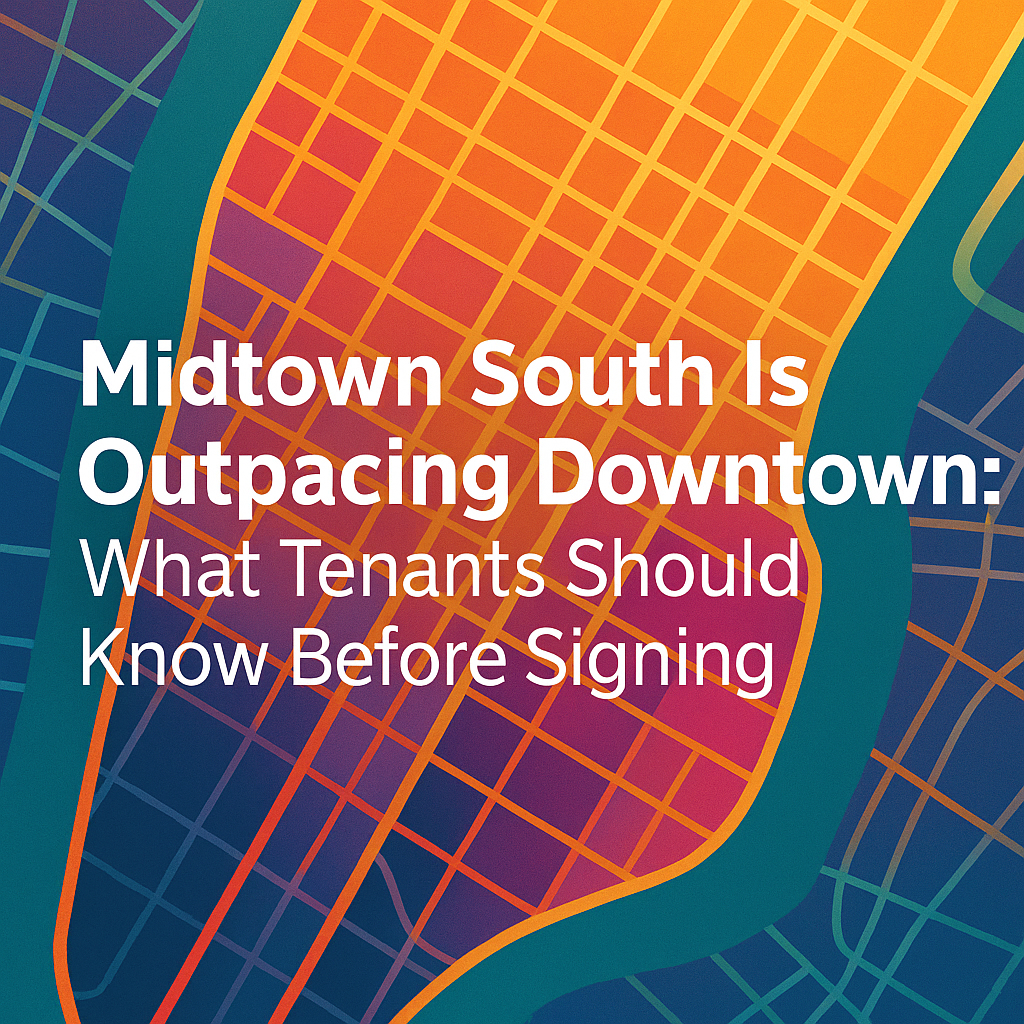
Midtown South Is Outpacing Downtown: What Tenants Should Know Before Signing
Midtown South is driving NYC’s office recovery with record leasing activity. Learn why tenants should consider Midtown South over Downtown, and how to leverage market momentum when negotiating leases.
Why Midtown South Is Leading the Pack
The numbers don’t lie: in August 2025, Midtown South leased 2.2 million square feet of office space, outpacing both Midtown and Downtown. By contrast, the Downtown submarket barely cracked 191,000 square feet of deals — less than a tenth of Midtown South’s volume. For tenants, this isn’t just market trivia. It’s a clear signal about where demand is flowing, where competition is heating up, and where strategy matters most.
Midtown South has long been the magnet for creative industries, tech firms, and fast-growing startups. Its blend of renovated loft buildings, transit access, and lifestyle amenities has carved out a unique appeal. Now, with corporate relocations and hybrid-friendly tenants doubling down on flexible layouts, Midtown South’s resurgence is pulling even more attention.
What This Means for Office Tenants
If you’re weighing a move in 2025 or 2026, Midtown South’s momentum changes the game:
- Stronger Demand = Tighter Availability
Spaces that fit midsize tenants (10,000–50,000 SF) are seeing more tours, faster decisions, and fewer incentives than they did last year. Landlords here can afford to be choosier. - Downtown Still Has Bargains
The same report shows Downtown leasing activity dropping compared to both last year and last month. That translates into landlords offering steeper concessions, more flexible terms, and an eagerness to fill space. - Image and Talent Attraction Diverge
Midtown South carries cachet with younger workforces and firms in branding-sensitive industries. Downtown still signals value, accessibility, and space-for-dollar efficiency. The trade-off is real and should align with your hiring and client-facing goals.
Strategy Guide: How to Navigate This Market
1. Pre-Lease Early in Midtown South
If Midtown South is your target, don’t wait until your back is against a lease expiration. Tenants are already pre-leasing 12–18 months out to secure quality floors. The earlier you start, the more choice you’ll have.
2. Play Both Sides of the Market
Savvy tenants tour Midtown South and Downtown options in parallel. That way, you can leverage Downtown concessions as a negotiating chip, even if you ultimately land in Midtown South.
3. Focus on Building Quality, Not Just Neighborhood
In both Midtown South and Downtown, the spread between Class A and older stock is widening. Tenants that prioritize amenities, wellness, and tech infrastructure will secure long-term competitive advantages.
4. Weigh the Real Cost of Talent
If your business depends on in-office culture and attracting younger professionals, Midtown South’s premium may be justified. But if your team values cost efficiency and transit, Downtown’s relative softness could save you millions over a 10-year lease.
Midtown South and Downtown Manhattan: A Comprehensive Overview
Midtown South and Downtown Manhattan represent two dynamic office submarkets in New York City, each with distinct characteristics. Midtown South – encompassing areas like Chelsea, Flatiron/Nomad, SoHo, and Tribeca – has evolved from former industrial lofts into the creative heart of “Silicon Alley,” attracting tech, media, and startups. Downtown Manhattan – including the Financial District and World Trade Center area – blends historic “Wall Street” finance legacy with modern redevelopments, offering comparatively affordable rents and extensive transit access. In this long-form analysis, we detail current office rental pricing for Class A, B, and C spaces, highlight prominent business addresses and landmark properties, identify key anchor tenants and their exact locations, outline neighborhood Business Improvement Districts (BIDs), and discuss on-site management, security upgrades, and business programs for startups in these areas.
Office Space Pricing: Class A, B, and C in 2025
Midtown South – Premium Prices for Creative Space: Midtown South has some of the priciest office space outside of Midtown’s core. As of 2025, average asking rents in Midtown South hover around the high $70s per square foot for all classes combined. Class A offices in this submarket command top dollar – roughly in the $78–$85 per sq. ft. range on average. Newer or recently upgraded Class A towers and “trophy” spaces (for example, a premium building addition at 61 Ninth Avenue in Chelsea) push the average upward. It’s not uncommon for prime Class A space in Midtown South – especially around Fifth Avenue, Park Avenue South, or overlooking Madison Square Park – to ask rents in the $90s per sq. ft., approaching Midtown levels. In contrast, Class B buildings (often older loft-style properties with decent amenities) see asking rents generally in the mid-$50s to $60s per sq. ft.. More basic Class C offices (older, fewer amenities) average in the $50s per sq. ft. or below. In fact, citywide data shows median rents around $85 for Class A, $63 for Class B, and $56 for Class C space, and Midtown South’s stock of converted industrial buildings largely falls into Class B/C – offering slightly more budget-friendly options for small firms and startups. Notably, many attractive Class B/C loft spaces in side-street Flatiron or Gramercy Park can be found in the $40s–$50s per sq. ft., a relative bargain for the location.
Downtown Manhattan – Value Pricing with Upside: Downtown office rents are generally lower than Midtown South’s, reflecting the area’s efforts to attract a wider range of tenants post-9/11. As of early 2025, overall asking rents downtown averaged around $55 per sq. ft. – a significant discount versus Midtown areas, widening Downtown’s price advantage over other submarket. Class A space in Lower Manhattan averages roughly $59–$60 per sq. ft.. For example, at the end of Q1 2025 Class A Downtown rents stood near $59.17 per sq. ft. on average, essentially flat over the past year. High-end Downtown towers (World Trade Center buildings, or top-tier FiDi skyscrapers) might ask in the $70s for upper floors with panoramic views, but many quality Class A buildings trade in the $50s–$60s. Class B buildings downtown often list in the $40s to low-$50s per sq. ft., making the Financial District appealing to cost-conscious firms. And Class C spaces – older 20th-century buildings or those needing upgrades – can dip into the $30s–$40s per sq. ft., some of the cheapest office rents in Manhattan. This pricing gap has led to a “two-tier” market: trophy Class A towers citywide are setting record-high rents above $100 or even $200 in rare cases, while a large swath of Class B/C buildings (especially downtown and in older Midtown South corridors) compete by lowering rents and offering generous concessions. For tenants, this means Midtown South offers trendy space at a premium, whereas Downtown offers significant value – roughly half the cost of Midtown trophy rents – with landlords often sweetening deals via free rent and build-out allowances.
Street-by-Street Variations: Within these areas, location matters. In Midtown South, Park Avenue South and Fifth Avenue addresses near Flatiron/NoMad are highly coveted, pushing Class A rents to the top of the range (and often full asking rates). By contrast, side streets in the 20s or parts of SoHo will host mostly Class B lofts at lower rents – attractive to creative firms on a budget. Downtown, a Water Street or Broadway high-rise might offer Class A space around the $60s per sq. ft., while older side-street buildings east of Broadway can be considerably cheaper. Notably, Downtown’s overall vacancy has improved (falling to ~23.9% in early 2025) even as asking rents ticked down slightly. This indicates landlords are holding rents relatively steady but remain open to negotiations, preserving Downtown as an affordable alternative. In summary, Midtown South commands a creative-tech premium for its loft ambiance and centrality, whereas Downtown Manhattan provides more bang-for-buck for firms willing to trade a prestigious Midtown address for a lower cost footprint.
Prominent Business Addresses and Reputable Buildings
Both submarkets feature buildings that are considered prestigious or highly desirable corporate addresses, conferring a reputational boost on businesses located there:
- Flatiron & Nomad (Midtown South): The Flatiron District is home to the iconic Flatiron Building (175 Fifth Ave) – a triangular 1902 landmark that, while boutique in size, remains an “iconic commercial landmark in Midtown South”. Around Madison Square Park, a cluster of distinguished buildings has become top choices for major tenants. 11 Madison Avenue, a massive Art Deco tower overlooking the park, long housed Credit Suisse and now hosts big finance and tech firms. Next door, One Madison Avenue (at Madison & E.23rd) is a newly redeveloped 1.4-million-sq.ft. tower featuring state-of-the-art offices – IBM chose this building for its new NYC headquarters (as detailed later) and it boasts high-end amenities and a coveted address on Madison Square Park. 200 Fifth Avenue (the former Toy Building, facing Madison Square Park’s south) is another prestigious Flatiron address; its blend of pre-war architecture and modern upgrades attracted tenants like Grey Advertising and Tiffany & Co., and in 2025 it landed law firm Goodwin Procter as a major anchor tenant. Being located on Fifth Avenue or Broadway in this area carries cachet due to the neighborhood’s trendy image and central location. 770 Broadway (at 9th St., a Vornado-owned landmark) is another prized address – a full-block historic building in NoHo that became a tech hub (formerly housing Facebook/Oculus and now master-leased by NYU). Its large floor plates and location by Astor Place make it a “core campus” building, illustrating how even century-old structures in Midtown South are seen as good homes for business once modernized. Additionally, Chelsea and the Meatpacking District offer hip business addresses: Google’s NYC campus at 111 Eighth Avenue (an entire city block of Art Deco building) and its nearby buildings (Chelsea Market at 75 Ninth Ave, and newly the St. John’s Terminal at 550 Washington) have turned that area into a magnet for tech companies. A $2.1 billion acquisition of the St. John’s Terminal building by Google – a 1.3 million sq. ft. purpose-built office campus in West SoHo/Hudson Square – underscored the desirability of Midtown South for major corporate investments. Prominent addresses in SoHo (e.g. 375 Hudson St or 161 Avenue of the Americas) and Tribeca (e.g. 388 Greenwich St, Citigroup’s headquarters) also carry strong business reputations, though Tribeca’s office inventory is smaller. In summary, Midtown South’s most reputable buildings are often those that combine historic character with modern infrastructure – landlords have converted warehouses and pre-war towers into high-end offices that house marquee tenants from Google to Estee Lauder. The “cool factor” of neighborhoods like Flatiron, Chelsea, or SoHo – with their cafes, startups, and loft aesthetics – further boosts the prestige for companies located there.
- Financial District & WTC (Downtown): Lower Manhattan’s prominent business addresses are a mix of brand-new skyscrapers and century-old icons. On the modern end, the World Trade Center complex has several premier towers: One World Trade Center (the tallest building in the Western Hemisphere at 1,776 feet) is not just an engineering marvel but a symbol of resilience, with Condé Nast as a high-profile anchor tenant. Nearby Three World Trade Center (175 Greenwich St, opened 2018) and Four World Trade Center (150 Greenwich St, opened 2013) are cutting-edge Class A towers attracting global companies (GroupM, Spotify, etc.) – their advanced design and direct transit access make them highly reputable business addresses. These WTC buildings, along with 7 World Trade Center, have drawn a diverse tenant mix (media, tech, finance) and are regarded as trophy properties downtown. Equally prestigious in the FiDi area is 55 Water Street, a 53-story, 3.5 million sq. ft. behemoth that is one of downtown’s largest office buildings (housing firms like S&P Global); its size and East River views keep it in demand. Historic prestige is embodied by buildings like 40 Wall Street (the 1930 skyscraper now known as the Trump Building) and 28 Liberty Street (formerly Chase Manhattan Plaza) – both landmarks that confer a certain gravitas on their tenants (though they’ve been partly repositioned or sold in recent years). Perhaps the best-known Downtown landmark office is the Woolworth Building (233 Broadway), nicknamed “The Cathedral of Commerce” for its neo-Gothic grandeur. Completed in 1913, it was once the world’s tallest building and remains an official National Historic Landmark, offering roughly 899,000 sq. ft. of Class A office space alongside luxury condos. Companies that secure space in such a storied address (the Woolworth Building counts the NYPD Pension Fund and innovative firms like architecture studio ShoP among its tenants) signal a blend of tradition and ambition. Other landmark Downtown properties include 120 Broadway (Equitable Building) – a 1915 Beaux-Arts tower that was so influential it spurred NYC’s setback zoning law – now home to various financial firms; 140 Broadway – a modernist black-glass tower famous for the Red Cube sculpture on its plaza, now housing high-profile tenants like Deloitte and Brown Brothers Harriman; and One Wall Street – the Art Deco former Irving Trust headquarters, partly converted to residential but still an iconic business address facing the New York Stock Exchange. In Lower Manhattan, being located on or near Wall Street itself, or in the World Trade Center, carries significant prestige for financial and professional firms. The New York Stock Exchange building (11 Wall) and Federal Reserve Bank (33 Liberty) are unique addresses that some financial firms cluster around for cachet. Overall, Downtown’s reputation hot-spots are those blending modern infrastructure with historic significance – leasing space in a landmark property or a trophy tower signals credibility. Fortunately for tenants, many such buildings have seen extensive renovations (for example, 140 Broadway underwent $21 million in upgrades to meet modern standards) while still offering lower rents than uptown, making them attractive and practical homes for business.
Landmark Properties in Each Neighborhood
Both Midtown South and Downtown boast landmark properties that define their neighborhoods’ skylines and character:
- Midtown South Landmarks: In the Flatiron/Nomad area, the Flatiron Building stands out as an architectural icon recognized globally. Though relatively small and currently under renovation, it remains a symbol of the district and is often sought by boutique firms for its cachet. A few blocks east, the Metropolitan Life Insurance Tower (clock tower at 1 Madison Ave) is another historic landmark (completed 1909) that has been integrated into the new One Madison Avenue development. In Chelsea, the art deco Google Building at 111 Eighth Avenue (formerly the Port Authority Commerce Building, 1932) is a landmark by sheer presence – its block-long footprint and status as Google’s NYC HQ make it a tech landmark if not an official historic one. Farther west, the Starrett-Lehigh Building (601 W.26th St., 1931) is an industrial landmark known for its freight-elevator ramps and creative tenants; it anchors the West Chelsea gallery district and remains a coveted address for design and fashion companies. In SoHo/NoHo, aside from 770 Broadway (the grand 1907 Wanamaker’s department store building, now an office landmark), many cast-iron loft buildings are landmarked within the SoHo historic district. One example is Holmes Building at 55 Crosby – home to several creative firms – which typifies SoHo’s 19th-century charm. Meanwhile, Hudson Square (West SoHo) has the newly minted landmark St. John’s Terminal after its transformation by Google, signaling how even non-designated buildings can become “landmarks” in a business sense through transformative investment. Midtown South’s neighborhoods each offer a few signature buildings that are neighborhood landmarks – be it the Chelsea Clocktower (former Metropolitan Life Annex at 346 W 17th) or the Little Flatiron Building at 1170 Broadway in NoMad. These properties not only have architectural significance but also often anchor their local business communities, attracting companies that want a unique space with character. The Flatiron NoMad area specifically is now subject to a rezoning plan to allow more development, so it’s poised to gain future landmarks as new towers rise.
- Downtown Landmarks: Lower Manhattan’s Woolworth Building is arguably the most famous landmark office tower in the area, celebrated for its neo-Gothic design and historic status. Nearby, 233 Broadway (Woolworth’s address) literally helped give the surrounding area the moniker “Insurance District” back in the day, due to clustering of finance and insurance firms. Another historic gem is the Equitable Building (120 Broadway) – with its massive footprint and 40-story bulk, it was the largest office building in the world upon opening and remains a designated NYC landmark. The Trump Building at 40 Wall Street (originally the Bank of Manhattan Trust Building, 1930) is a slender neo-Gothic spire that competes with the Chrysler Building in age and style – it’s a landmark that still houses many offices (albeit under a somewhat controversial owner’s name). Several Downtown landmarks have been repurposed: 1 Wall Street (the 1931 Irving Trust HQ with a famous red mosaic lobby) is mostly converted to condos now, and 195 Broadway (the AT&T Building, with its majestic Doric columns) now hosts office tenants in a landmark setting. Even modern structures like One World Trade Center have quickly become landmark symbols – One WTC’s spire and height make it a new icon on the skyline (it’s listed and marketed as a symbol of New York’s resilience), and it anchors the WTC campus much as the Twin Towers once did. Notably, the entire World Trade Center site is considered a landmark in a broader sense due to the 9/11 Memorial – companies there are conscious of the address’s significance. Another noteworthy landmark is 26 Broadway (Standard Oil Building) with its pyramid-capped roof; it’s a NYC landmark and still an office address, bridging old and new Downtown. Guild Hall (15 Broad Street), attached to the former JPMorgan bank across from the NYSE, is yet another small landmark (now partly residential) that denotes the financial heritage of the area. Additionally, Federal Hall National Memorial at 26 Wall (site of George Washington’s inauguration) isn’t an office building but lends prestige by proximity – e.g. 14 Wall Street (the 1912 Banker’s Trust Tower) is next to it and benefits from the historic environs. In summary, Downtown Manhattan’s neighborhoods – from the canyon of Wall Street to City Hall Park – are filled with landmark buildings. Being located in one can burnish a company’s image, and many such properties (like Woolworth or 140 Broadway) have been upgraded so that tenants enjoy modern Class A conditions within historic shells. This fusion of history and modernity is a hallmark of Downtown’s appeal.
Anchor Tenants and Key Locations (Address, Floor, Square Footage)
Large anchor tenants can define a building’s identity. Below we identify major anchor tenant deals in Midtown South and Downtown, including exact locations, floors, and square footages:
- NYU at 770 Broadway (NoHo) – In 2025, New York University executed a headline-grabbing deal at 770 Broadway (near Astor Place). The university paid $935 million upfront for a 70-year masterlease of the entire 15-story building, totaling ≈1,100,000 sq. ft. of space. With this transaction, NYU became the sole anchor tenant, taking control of 770 Broadway’s 1.1 million sq. ft. to expand its campus adjacent to Washington Square. The space (formerly housing Facebook and other tech/media tenants) spans virtually the whole building, giving NYU a vertical campus. This kind of educational anchor is unusual in a commercial office tower, but as a “super-credit” tenant NYU de-risks the property for the owner (Vornado) while cementing the building’s reputation as an institutional hub.
- Condé Nast at One World Trade Center (285 Fulton St) – The publishing giant Condé Nast became the anchor tenant of One WTC and famously moved into the skyscraper in November 2014. Condé Nast’s lease is for approximately 1.2 million sq. ft., occupying floors 20 through 44 of the 104-story tower. This represented about one-third of One WTC’s 3.5 million sq. ft. of offices, firmly establishing the building’s credibility at launch. The floors 20–44 give Condé Nast a contiguous campus (housing magazines like Vogue and The New Yorker), and their presence was pivotal in attracting other media and tech firms to the World Trade Center. (In recent years, Condé Nast has subleased some floors to other companies as it downsized, but it remains the anchor.) The prestige of having a major media anchor in One WTC, with over a million square feet, signaled that Downtown’s newest landmark tower was open for business.
- GroupM at 3 World Trade Center (175 Greenwich St) – Global advertising and media conglomerate GroupM (part of WPP) is the anchor tenant of 3 World Trade Center. GroupM initially signed on for about 516,000 sq. ft., then expanded to ~700,000 sq. ft. across 13–15 floors of the tower. By January 2016, GroupM had committed to roughly 700k sq. ft. on 14 floors (high-rise floors for its various agencies). This massive block let GroupM consolidate its agencies in a single campus and gave 3 WTC a 25% occupancy from day one. In fact, GroupM’s lease was critical for the tower’s financing and construction resumption. The company’s occupancy (from the mid-floors upward) also means it enjoys a 5,000 sq. ft. outdoor terrace on the 17th floor that partly is reserved for GroupM’s use. As anchor, GroupM’s presence attracted other notable tenants like consulting firm McKinsey and tech unicorn Uber to the building. Having GroupM’s 700k sq. ft. headquarters (the North American HQ for WPP agencies) in 3 WTC firmly positioned the tower as a prime media industry address in Lower Manhattan.
- Spotify at 4 World Trade Center (150 Greenwich St) – Music streaming leader Spotify established its U.S. headquarters as the anchor tenant of Four World Trade Center. In 2017 Spotify signed leases for floors 62 through 72 of the tower – initially 378,000 sq. ft. and later expanding by another 100,000 sq. ft. – totaling roughly 478,000 sq. ft.. This gave Spotify the top 11 floors of 4 WTC, complete with sweeping views and modern build-outs. By taking nearly half the building, Spotify’s deal brought 4 WTC to full occupancy at the time. The company’s logo on the tenant roster also signaled Downtown’s diversification, showing a major tech firm anchoring a tower alongside government agencies (the Port Authority took lower floors) and finance firms. Spotify’s space is not only large at ~0.48 million sq. ft., but also notable for its position: floors 62–72, i.e. the very top of the building, which typically command premium rents for the views. This anchor tenancy reinforced 4 WTC’s identity as a hub for TAMI (technology, advertising, media, information) tenants in the Financial District.
- IBM at One Madison Avenue (Madison Sq. Park) – In Midtown South, tech and corporate anchor tenants are also staking claims. A marquee example is IBM’s lease at One Madison Avenue. In March 2022, IBM signed on as the anchor tenant for SL Green’s then-under-construction One Madison redevelopment, taking 328,000 sq. ft. across multiple floors. The 16-year lease gives IBM a “building within a building” feel: IBM occupies a private lobby and much of the base (parts of the ground and 2nd–7th floors, plus all of floors 8, 9, 10). This amounts to 328k sq. ft. over eight full floors and parts of several others. With its own entrance and branding, IBM’s space will serve as its new NYC headquarters and client center. Asking rents for IBM’s floors were reportedly $115/sf for mid-level floors and $160/sf for the signature 10th floor with outdoor terrace. By securing IBM early, One Madison Avenue signaled to the market that this 1.4 million sq. ft. Flatiron tower would be a top-tier tech-oriented office location. IBM’s presence anchored the project’s credibility and likely helped attract other tenants for the remaining space. This deal underscores how even in Midtown South, large corporates (not just startups) are locking in significant footprints to access the area’s talent and vibe.
- Goodwin Procter at 200 Fifth Avenue (Flatiron) – Leading law firm Goodwin Procter chose 200 Fifth Ave in the Flatiron District for a major office in 2025, highlighting Midtown South’s allure beyond tech. Goodwin signed a 20-year lease for ~244,000 sq. ft. in the building. This lease covers multiple floors (essentially a quarter of the 800k sq. ft. building) and makes Goodwin the anchor tenant alongside existing major occupants like Tiffany & Co. The choice of 200 Fifth – a pre-war building renovated into a LEED Gold office – by a prestigious law firm demonstrates that “heritage buildings can go toe-to-toe with glass towers when done right,” as observers noted. Goodwin’s space overlooks Madison Square Park, and likely spans contiguous floors to house the firm’s attorneys and staff (~250k sq. ft. suggests around 8–10 floors, though exact floors aren’t public). By anchoring this Flatiron property, Goodwin Procter is clustering near other law firms and tech firms in Midtown South, marking a trend of professional services migrating to the area for its lively environment. The ~245k sq. ft. commitment is one of the largest recent leases in Midtown South, reinforcing the building’s reputation and contributing significantly to its occupancy.
- Google at St. John’s Terminal – 550 Washington St (Hudson Square): Tech giant Google solidified its expansion in Midtown South by anchoring the St. John’s Terminal redevelopment at 550 Washington Street. Google initially leased the entire 1.3M sq. ft. complex, then in 2022 exercised its option to purchase it for $2.1 billion. The building, newly expanded and renovated, now serves as Google’s New York City megacampus for its Global Business Organization, providing 1.3 million sq. ft. across just 6 enormous floors. In essence, Google is the sole occupant (anchor) of 550 Washington, with over 3,000 employees expected on site and six floors of open-plan “super floors” each larger than a football field. This anchor occupancy gave Google a contiguous horizontal layout rare in Manhattan and cemented Hudson Square (West SoHo) as Google’s territory (complementing its ownership of 111 Eighth Ave and Chelsea Market a bit uptown). The St. John’s Terminal project is notable in that Google’s commitment was the largest single-tenant office deal in NYC during the pandemic, and by effectively anchoring the entire building, Google transformed a former freight terminal into a high-tech HQ. The facility opened in 2023–24 and is a flagship anchor location representing Google’s long-term bet on NYC.
(For additional examples of anchor tenants and their exact spaces, see Appendix – Anchor Tenant Deals.)
These anchor tenants illustrate how major space users are distributed in Midtown South vs. Downtown. Midtown South’s anchors tend to be tech, law, or education (IBM, Goodwin, Google, NYU) occupying portions of buildings, whereas Downtown’s anchors often involve finance or media giants (Condé Nast, GroupM, Spotify) taking huge blocks or entire buildings. Each anchor deal often comes with naming rights or branding and typically solidifies the building’s market status (e.g., a prestigious tenant can drive up a building’s appeal for others). Moreover, anchors often enjoy special build-outs: for instance, IBM’s lease at One Madison includes its own lobby and entrance for a campus-like feel, and GroupM’s at 3 WTC involved customizing 15 floors for its agencies. Anchor tenants can also spur building improvements (landlords invest in amenities to land them) and even influence neighborhood perceptions (NYU’s move into 770 Broadway further ties NoHo/Greenwich Village to the tech and academic sector).
Business Improvement Districts (BIDs) in Each Area
Both Midtown South and Downtown Manhattan benefit from active Business Improvement Districts (BIDs) or similar organizations that support local businesses and maintain the commercial districts. These BIDs are nonprofit organizations funded by local property owners to provide services like street cleaning, security, marketing, and events to enhance the neighborhood’s appeal.
- Midtown South BIDs: Given Midtown South spans multiple neighborhoods, several BIDs operate in different sections:
- The Flatiron/NoMad Partnership is the BID serving the Flatiron District and newly extended north into NoMad. It helps keep the area’s streetscape vibrant and sponsors events (e.g. holiday installations in Madison Square). The Flatiron NoMad Partnership is explicitly the local BID, covering one of Manhattan’s “most iconic and authentic” districts.
- The Union Square Partnership is another long-standing BID just to the south of Flatiron, covering Union Square and parts of 14th Street. It manages the famous Greenmarket and has been integral in making Union Square a tech and startup hub (providing networking events, safety patrols, etc.). Many tech firms near Broadway/14th benefit from its advocacy.
- Chelsea is served in part by the Meatpacking District Management Association, effectively the BID for the Meatpacking/West Chelsea area. This BID, often just called the Meatpacking BID, is “powerful, active, and well-funded” – it has helped transform the neighborhood with pedestrian-friendly streets (like the plazas around Gansevoort Street) and marketing campaigns. The Meatpacking BID supports the many upscale retailers and tech offices (such as Google’s) in that area.
- Hudson Square (the West SoHo area) has the Hudson Square BID. Since 2009, the Hudson Square BID has guided the area’s change from the old printing district into a “thriving creative hub,” improving streetscapes and even facilitating its recent rezoning. It covers roughly from West Houston down to Canal, between 6th Avenue and Greenwich Street, thus including Google’s new campus and many ad agencies. The BID provides area-specific programs (greening projects, traffic mitigation, etc.) to keep Hudson Square attractive to media and tech firms.
- SoHo Broadway Initiative is a smaller BID focused on the Broadway corridor of SoHo (roughly Houston to Canal). It handles the unique needs of a mixed retail/office area like SoHo – managing pedestrian traffic, sanitation, and advocating for the local businesses.
- Village Alliance serves 8th Street and parts of Greenwich Village (bordering Midtown South). While more retail-focused, it does contribute to the environment that smaller offices and startups in the Village find themselves in.
- There are also BIDs for Herald Square and 34th Street just north of Midtown South’s core, which indirectly support the southern edge of Midtown (e.g., around Sixth Avenue in the 20s). However, the main Midtown South neighborhoods (Flatiron, Union Sq, Chelsea, SoHo) are covered by the BIDs mentioned above. Each BID provides a forum for local businesses (from startup offices to big anchors like IBM or Disney which has offices in Hudson Square) to collaborate on quality-of-life issues. Collectively, these Midtown South BIDs ensure that the area remains clean, safe, and attractive to companies and their employees – for example, every office in Flatiron and NoMad benefits from the BID’s efforts, as one local property manager noted.
- Downtown Manhattan BIDs: Lower Manhattan is primarily served by a single, very large BID:
- The Alliance for Downtown New York, often simply called the Downtown Alliance, covers the Financial District and Lower Manhattan below roughly City Hall and east of Battery Park City. It is the city’s largest BID by budget. The Downtown Alliance’s mandate is to make Lower Manhattan “a thriving business district” – it provides supplemental security, sanitation, operates streetscape improvements, and runs research on the real estate market. For instance, the Alliance publishes a quarterly Lower Manhattan Real Estate Market Overview with data on leasing, vacancy, rents, and development in the FiDi area. This helps prospective tenants understand downtown’s trends. The Alliance also funds local parks, and runs events (like Dine Around Downtown food festival) to enhance the area’s livability. Its presence has been crucial post-9/11 in revitalizing downtown as a 24/7 neighborhood with not just offices but also residents and tourists.
- Other BIDs downtown include the Battery Park City Authority (quasi-government managing that specific area) and the Chinatown BID/Partnership just to the northeast of FiDi. While Chinatown is not a major office center (mostly small businesses), its BID helps improve conditions on Canal Street and could indirectly support any nearby offices in e.g. 125 Worth St or 375 Pearl. Additionally, the Brookfield Place complex in Battery Park City has its own privately managed public spaces, akin to a BID function.
- It’s worth noting that subsections of downtown like Water Street corridor had targeted programs (the Water Street POPS improvements) backed by the Alliance and city, and the WTC campus itself has a dedicated security and maintenance operation by the Port Authority and Silverstein Properties. Though not a BID, this functions similarly for those 16 acres, ensuring a clean and secure environment for tenants.
- Nearby Areas: Just north of traditional downtown, areas like TriBeCa and Civic Center don’t have formal BIDs, but benefit from civic associations. For example, the lower Broadway corridor in TriBeCa/Hudson Square is partly under the Hudson Square BID’s expanded boundaries.
In summary, nearly every neighborhood in Midtown South and Downtown has an active BID or similar organization. From the Flatiron NoMad Partnership uptown to the Downtown Alliance in FiDi, these entities play a key role in business retention and attraction – they keep the sidewalks tidy, help with public safety, add amenities like pedestrian plazas, and brand the neighborhoods as distinct, attractive places to work. Companies moving into an area often coordinate with the local BID for introductions to the community and to take advantage of programs (such as business promotion events or district-wide discount programs). For instance, the Downtown Alliance runs programs to support storefront retailers (useful for office landlords who want a vibrant ground floor mix), and has even operated a free coworking space (LMHQ) to encourage startups to set up in Lower Manhattan. Likewise, the Flatiron Partnership heavily markets the area’s tech scene and offers networking events. Thus, these BIDs effectively serve as quasi-chambers of commerce for their neighborhoods, enhancing the reputation of the districts in which major office buildings reside.
On-Premises Building Management
For many companies, the quality of property management is a significant factor in choosing an office building. Having the building’s management on-site (as opposed to managed remotely) is seen as a mark of a well-run property that can swiftly address tenant needs. In Midtown South and Downtown, most Class A and many Class B buildings feature an on-premises management office.
- Class A Towers: It is standard for large Class A skyscrapers to have a management office and building staff on the premises daily. For example, 140 Broadway (the 50-story Grace Building downtown) highlights “on-site management and security” among its tenant amenities. This means the property manager’s team and security personnel are in the building at all times, offering added convenience and safety for occupants. Similarly, the World Trade Center towers have extensive on-site management and operations teams (Silverstein Properties maintains property management offices within the WTC complex, and the Port Authority has management staff for One WTC). At 3 World Trade Center, for instance, the combination of advanced security and on-site building engineers provides 24/7 support to tenants. Midtown South’s newer developments like One Madison Avenue will also have on-site management given the building size (SL Green as landlord typically staffs their major properties directly). The same goes for large multi-tenant tech hubs: 111 Eighth Avenue (Google’s building) still has on-site management for the portions leased out, and 200 Fifth Avenue’s owner (Boston Properties) keeps a management office in the building to serve tenants like Tiffany’s and Goodwin.
- Class B/C and Loft Buildings: Many of Midtown South’s Class B loft buildings are owned by smaller landlords who may not have a full management office in each property, but they often have a superintendent or building engineer on-site. For example, a boutique building might have a daytime super to handle repairs and an off-site managing agent firm for administrative matters. However, higher-end Class B buildings do advertise on-site management. A Garment District building listing boasts “there is on-site management office, 24/7 access to the building” as a selling point. In Downtown’s Class B towers (e.g., 100 William St or 160 Broadway), on-site management is common as well – these buildings compete by offering professional management and quick response times. Indeed, an office listing for 160 Broadway notes the building features on-site management and security as a tenant convenience. Even the historic Woolworth Building (233 Broadway), while partly residential, retains “Dedicated Management: The Lawrence Group ensures everything runs smoothly” on-site for its commercial portion. This presence reassures tenants that even an old landmark has modern attentive management.
- Benefits of On-Premises Management: On-site management means that if an HVAC issue arises or a light bulb needs replacing, building staff are right there to address it swiftly. It also fosters a sense of community; tenants get to know the property manager, concierge, and security by name. Many large buildings have management-hosted tenant events (especially those with many smaller tenants, like holiday gatherings or fire safety seminars). With the heightened emphasis on health and safety post-Covid and after incidents like the 2025 shooting (discussed below), immediate on-site management is even more valued. Tenants feel that an on-site team can coordinate emergency response, implement security protocols, and communicate quickly in real time.
- Notable Examples: Beyond 140 Broadway and 160 Broadway cited above, 525 Seventh Avenue (a Midtown South/garment area building) explicitly promotes its on-site management and full lobby staff. 22 Cortlandt Street (a Downtown office property) similarly offers an on-site management team plus concierge. In the Flatiron District, renovated loft buildings that target tech tenants often bring in quality management – they might not have a large staff, but they maintain an on-site presence especially during business hours. Overall, having building management on-premises is considered a hallmark of well-run buildings in NYC. Most Class A offices in Midtown South & Downtown definitely meet this criterion, and even many Class B buildings in these areas do, as landlords know tenants expect it. If a building lacked on-site management, it would likely be positioned at the lower end of the market (and possibly classed as C). Fortunately, Midtown South and Downtown’s competitive office market has pushed even smaller buildings to professionalize management in recent years.
Building Security and Safety Upgrades (Post-2025 Considerations)
In the wake of a violent incident at a Park Avenue office tower in mid-2025, building security practices across Manhattan have come under fresh scrutiny. Security has long been a priority, especially in high-profile buildings, but now both landlords and tenants are ramping up measures to ensure safety against modern threats.
- The Park Avenue Attack, 2025: In July 2025, a tragic shooting occurred at 345 Park Avenue (a major Midtown East tower), where a gunman entered the lobby with a rifle, killing several people. This event – described as “the deadliest shooting in New York City in 25 years” – sent shockwaves through the business community. It was particularly unsettling because 345 Park is home to influential companies (including a prominent investment firm’s HQ) and had notable security systems in place. According to Reuters, cameras at 345 Park Ave. did flag the approaching gunman using AI-powered video analytics (highlighting him with a yellow alert box seconds before he opened fire). However, the response could not be mobilized in time to prevent the shooter from entering. This detail raised questions about the efficacy of even advanced surveillance if not paired with rapid physical countermeasures. The incident has since prompted many New York office buildings to re-evaluate their security protocols.
- Security Enhancements and Best Practices: Experts note that modern security systems can do more than passively record – they can enable instant lockdowns of doors, turnstiles, and elevators when a threat is identified. Some Class A buildings already have such capabilities: for example, newer towers like One Vanderbilt or Hudson Yards buildings have turnstile entry with badge access and the ability to bar entry quickly. 3 World Trade Center touts its “advanced systems [that] protect your team 24/7”, which likely include blast-resistant glass, biological/chemical air filters, and integrated surveillance given the World Trade Center site’s high-security design. Post-incident, many landlords are now working with global security firms (like Kroll) to audit and upgrade measures. Buildings in Midtown South and Downtown are installing or enhancing:
- AI-driven video analytics in lobbies (to automatically detect weapons or suspicious behavior, as 345 Park had).Visitor pre-registration and screening: Many buildings require visitors to be pre-announced and show ID, getting photo badges. Enhanced systems might include running names against watchlists.Package scanning and vehicle screening: Especially downtown, towers like One WTC and Goldman Sachs’s 200 West have loading dock x-ray machines and even street bollards. We may see more Midtown South buildings adopt stricter package scanning in mailrooms.Turnstile gates with faster lockdown: Upgrading turnstiles to ones that can all lock simultaneously at a security guard’s emergency button push.Drills and training: Property managers are now training their security staff (often retired law enforcement) on active shooter scenarios. Tenants, too, are being briefed on emergency action plans.Lobby design changes: Some buildings are considering creating double-door vestibules or adding mantrap systems where one set of doors must close before another opens – containing potential threats. Also, lobby reception desks are being fortified or repositioned for better control.
- Most Secure Buildings Today: Generally, newer Class A skyscrapers are built with higher baseline security:
- The World Trade Center towers (1, 3, 4 WTC) and the entire WTC campus were designed post-9/11 with hardened structures, limited underground parking, and vehicle checkpoints. These are among the most secure, with both private security and NYPD counterterrorism presence. For instance, 4 WTC has its lobby one level up from street, with controlled escalator access.Bank headquarters like JPMorgan’s facilities have top-tier security. (JPMorgan’s new HQ under construction at 270 Park will reportedly have fortress-like features.) In Midtown South, you see this at places like 111 8th Ave (Google’s building has security desk and keycard entry given tech assets inside) and at financial firm offices like 388 Greenwich (Citigroup’s Tribeca tower has heavy security since it’s effectively a bank HQ).345 Park Avenue itself (despite the incident) had a sophisticated system and now, after the attack, Rudin Management and its tenants likely augmented security further before reopening. Expect 345 Park to implement even tighter screening (e.g., armed guards at the entrance, bag checks for visitors) as it reopens.Many class A Midtown South towers like One Madison, 11 Madison, or the GM Building (on 59th, but an example) employ 24/7 lobby security, turnstiles, and sometimes canine units for random sweeps. In Downtown, buildings like 140 Broadway mention on-site security explicitly, and 55 Water Street has a security command center for its huge footprint. The presence of governmental tenants also raises security: if a building has a federal agency (some downtown buildings do), you often see magnetometers and federal guards (e.g., at 290 Broadway, which houses IRS and EPA offices).
- Tenant Perspective: Companies, especially large corporates, now actively inquire about building security features during site selection. They may favor buildings that have modernized security systems or are willing to implement them. After the Park Ave incident, some firms in Midtown reportedly revisited their office emergency procedures and even briefed employees on “Run-Hide-Fight” protocols for active shooter events. Landlords are sensitive to these concerns; a secure building can be a selling point. Anecdotally, some tenants in older buildings without robust security are pushing landlords to invest in upgrades like CCTV coverage on every floor, alarmed stairwell doors, etc.
In conclusion, post-2025, the “most secure” buildings are those combining advanced technology with trained personnel and clear procedures. Midtown South and Downtown’s top-tier properties are largely in this category or moving toward it. The Park Avenue tragedy served as a wake-up call that even high-end addresses are not immune, leading to a citywide reinforcement of safety measures. Tenants can take comfort that many buildings now have systems that, for example, can automatically recognize a weapon and initiate lockdown within seconds – though the human element remains key. Prospective tenants should evaluate a building’s security infrastructure (turnstiles, visitor policy, emergency drills, etc.) as part of their leasing due diligence, something that is increasingly common.
Business Programs and Incubators for Startups in the Area
New York City actively fosters a startup ecosystem, and both Midtown South and Downtown Manhattan benefit from numerous business programs, incubators, and incentives aimed at startups and entrepreneurs. These resources help early-stage companies grow and often encourage them to set up in these neighborhoods:
- City-Sponsored Programs: The NYC Economic Development Corporation (EDC) and Department of Small Business Services (SBS) offer citywide programs that startups in Midtown South/Downtown can tap into. One flagship initiative is Venture Access NYC, a suite of programs to build a more inclusive tech startup ecosystem in the city. Through Venture Access and related efforts, the city provides mentorship networks, founder bootcamps, and matchmaking with investors – accessible to any NYC startup regardless of location. Additionally, SBS runs NYC Business Solutions Centers (the Manhattan center is not far from Midtown South) which provide free consultations on business plans, accessing loans, and recruitment – useful for new companies getting started. The city and state also designate “Certified Business Incubators” – for example, there was an incubator in Lower Manhattan sponsored after 9/11 (the Hive at 55 on Broad Street, launched in 2009) and later the Lower Manhattan HQ (LMHQ) co-working space at 150 Broadway backed by the Downtown Alliance. While the physical LMHQ space closed in 2022, the Downtown Alliance continues to run entrepreneurial networking events (now dubbed LM Live) to connect and support startups in the area. On the state level, Empire State Development (ESD) supports incubators like the Urban Tech Hub (at Company’s space in Midtown) and others – startups in Manhattan can join these incubators to get subsidized space and mentorship. For example, New York State’s Certified Incubators program includes several in NYC that focus on industries from biotech to fintech.
- Accelerators and Incubators (Private): Manhattan is home to a myriad of renowned startup accelerators and incubator programs, many of which operate in Midtown South:
- Techstars NYC – A highly regarded accelerator that runs cohorts in New York, typically based out of a Manhattan office (in recent years often near Union Square or Flatiron). Techstars provides seed funding and 3-month intensive mentorship, and has produced successful NYC startups. Founders going through Techstars benefit from its network and often remain in Midtown South after graduation.
- Entrepreneurs Roundtable Accelerator (ERA) – One of NYC’s top accelerators, ERA is based in Midtown and runs two cohorts per year, offering funding and co-working space to startups. ERA’s office has been in the Flatiron area historically. It’s highlighted among the top 10 incubators in NYC and has a strong alumni community that tends to cluster around Flatiron/Nomad.
- Betaworks – A startup studio/accelerator located in the Meatpacking District. Betaworks runs programs (like Betaworks Camp) focusing on areas such as artificial intelligence and media. Their open workspace on Little West 12th Street has been a launching pad for companies like Giphy. Being in Midtown South (Meatpacking), Betaworks contributes to the creative tech vibe of the area.
- AlleyCorp – A venture studio (founded by Kevin Ryan) that both incubates its own companies and invests in others. AlleyCorp is headquartered in SoHo; it continuously spawns new startups (MongoDB, Business Insider were AlleyCorp companies). Startups under its wing often work out of its Soho office initially.
- WeWork Labs and Other Co-working Incubators – WeWork Labs (the incubator arm of WeWork) has several Manhattan locations that serve as incubator spaces for early-stage companies (one Labs location was near Union Square). Co-working spaces across Midtown South – Galvanize (SoHo), Serendipity Labs, TechHub NYC, Nomadworks – create communities where startups can collaborate. For example, BuiltInNYC lists coworking/incubator hubs like Nomadworks and Blender Workspace (NoMad), and Freelancers Hub.
- Corporate and University Incubators: Downtown Manhattan hosts the FinTech Innovation Lab (an accelerator for fintech startups, often held at offices in FiDi in partnership with big banks). There’s also the NYC Media Lab (with NYU) and CUNY’s Startups incubator which sometimes use space in the downtown or midtown south vicinity. Pace University in the Financial District has a small incubator program for students and alumni. And not far away in Lower Manhattan, Tribeca has New York Law School’s innovation center which intersects with legal tech startups.
- Incentives for Startups in Downtown: Post-9/11, Lower Manhattan benefited from various incentive programs, such as rent subsidies or tax credits (the Lower Manhattan Relocation and Employment Assistance Program, LMREAP, offered tax credits to companies – including startups – that moved to designated downtown zones). Some of those programs have sunset, but one enduring advantage is that commercial rents and utility costs are lower in Downtown, which the Downtown Alliance actively markets to startups as a cost-saving (Downtown’s rents are ~30% lower than Midtown as noted, which for a bootstrapped startup is significant). The state also occasionally offers World Trade Center tenant incentives to encourage leasing there. For example, early tenants at the rebuilt 7 World Trade got discounted rents via government grants. While not startup-specific, these incentives made downtown space affordable to young tech firms (Spotify’s initial lease at 4 WTC may have benefited from such incentives).
- Local Networking and Meetups: Both Midtown South and Downtown have become hotbeds for tech meetups, hackathons, and industry events. The presence of accelerators and big tech companies means there are frequent events (many free) where entrepreneurs can learn and network. For instance, the Flatiron School (coding bootcamp on Broadway) and General Assembly (formerly in Flatiron, now Nomad) host community workshops that draw startups. In Downtown, the NYC Blockchain Center opened on Chambers Street in 2019 to foster the blockchain startup community (supported by NYCEDC). Such centers often provide co-working desks and regular programming for startups in niche sectors.
- BID and Community Support: The local BIDs also support startups indirectly. As noted, the Downtown Alliance’s LMHQ was essentially a free workspace and event venue to encourage creative and tech companies in Lower Manhattan. They also publish a guide to incentives (including for small businesses) on their website. The Flatiron Partnership similarly promotes the area as “Silicon Alley” and lists local incubators/co-work spaces on its site. There’s a recognition that nurturing startups contributes to filling office vacancies and energizing the neighborhood.
Overall, startups in Midtown South and Downtown Manhattan have access to a robust support ecosystem – from formal accelerators pumping seed capital and mentorship into promising companies, to city-driven initiatives ensuring underrepresented founders get opportunities (e.g., programs for women and minority entrepreneurs under NYCEDC). Notably, Manhattan remains a top destination for venture capital investment, and being located in these neighborhoods often means close proximity to investors (many VC firms are in Flatiron, Soho, or Tribeca). For example, Union Square Ventures (a major VC) is, as its name suggests, near Union Square; Thrive Capital is in SoHo, etc. Some accelerators themselves are run by VC funds (e.g., Forum Ventures in NYC focuses on B2B SaaS and provides funding/space). Startups benefit from these dense networks.
In conclusion, Midtown South offers a fertile ground for startups with its concentration of incubators and tech community (hence the moniker Silicon Alley), while Downtown Manhattan provides space at attractive costs and its own growing tech scene (especially in fintech, media, and non-profits). Through a combination of public programs (like Venture Access NYC) and private initiatives (Techstars, ERA, etc.), the city ensures that entrepreneurs in these areas have the resources to launch and scale their ventures without needing to leave Manhattan. The presence of such programs also signals to any company considering a move here that they will be joining a supportive, innovative business community rather than going it alone.
Appendix – Major Anchor Tenant Deals in Midtown South & Downtown
The table below summarizes several major anchor tenants in Midtown South and Downtown Manhattan office buildings, including their locations and the scope of their leases:
| Building (Address) | Neighborhood | Anchor Tenant(s) | Square Footage (Floors) | Details / Notes |
|---|---|---|---|---|
| 770 Broadway (Wanamaker Building) | NoHo/Greenwich Village (Midtown South) | New York University (NYU) | ~1,100,000 sq. ft. (entire building) | 70-year master lease signed 2025; NYU paid $935 M upfront to occupy the full 15-story building adjacent to its campus. Converted former department store, now an NYU academic and office center. |
| One World Trade Center (285 Fulton St) | Financial District (Downtown) | Condé Nast (publisher) | ~1,200,000 sq. ft. (floors 20–44) | 25-year lease as anchor tenant (signed 2011); Condé Nast moved HQ to 1 WTC in 2014. Occupies 24 floors (20th–44th) in the 104-story tower, the largest tenant in the building. |
| 3 World Trade Center (175 Greenwich St) | WTC Downtown | GroupM (WPP media agencies) | ~700,000 sq. ft. (~13–15 floors) | Anchor tenant; expanded from initial 516k to ~700k sq. ft. by 2016. Occupies roughly 14 consecutive floors (high-rise floors) for its agencies. Lease helped 3 WTC open in 2018. |
| 4 World Trade Center (150 Greenwich St) | WTC Downtown | Spotify (streaming media) | ~478,000 sq. ft. (floors 62–72) | U.S. headquarters for Spotify. Initial 378k sq. ft. lease (floors 62–72) in 2017, plus +100k exp. later in 2017. Gave Spotify the top 11 floors of 4 WTC, making it the largest tenant and filling the tower. |
| One Madison Avenue (Madison Ave & E.23rd) | Flatiron District (Midtown South) | IBM (IBM Corporation) | 328,000 sq. ft. (parts of ground & 2–7; all of 8–10) | Anchor lease (16-year) signed 2022 for new tower redevelopment. IBM consolidates multiple offices here, with a private lobby entrance. Asking rents were $115–$160/sf for IBM’s floors. |
| 200 Fifth Avenue (Toy Building) | Flatiron District (Midtown South) | Goodwin Procter (law firm) | ~244,000 sq. ft. (multiple floors) | 20-year lease signed 2025. Goodwin anchors this 800k sq. ft. building, taking ~245k sq. ft. for its NYC offices. Notable for a law firm choosing a Flatiron location overlooking Madison Sq Park. |
| 550 Washington St (St. John’s Terminal) | Hudson Square/SoHo (Midtown South) | Google (Alphabet Inc.) | 1,300,000 sq. ft. (entire complex: 6 large floors) | Google’s new West SoHo campus. Initially leased, then purchased for $2.1 B in 2022. Opened 2023 as Google’s North American HQ for ~3,000 employees; 1.3 million sq. ft. high-tech office space (LEED Platinum) across 6 stories. |
Each tenant listed is the primary space holder in the building, often occupying a significant percentage of the total area, and typically has been instrumental in the building’s leasing and status.
The Bottom Line
Midtown South’s momentum is real — and it’s shaping how tenants should approach lease strategy heading into 2026. Whether you chase the energy of Midtown South or capitalize on Downtown’s softness, the key is to align real estate choices with business goals, talent strategy, and long-term positioning.
As always, having a tenant-focused broker who represents your side only — not the landlord — can be the difference between chasing trends and making the market work for you.
Fill out our 📋 online form or give us a call today 📞 212-967-2061 — let’s find the right office for your business.