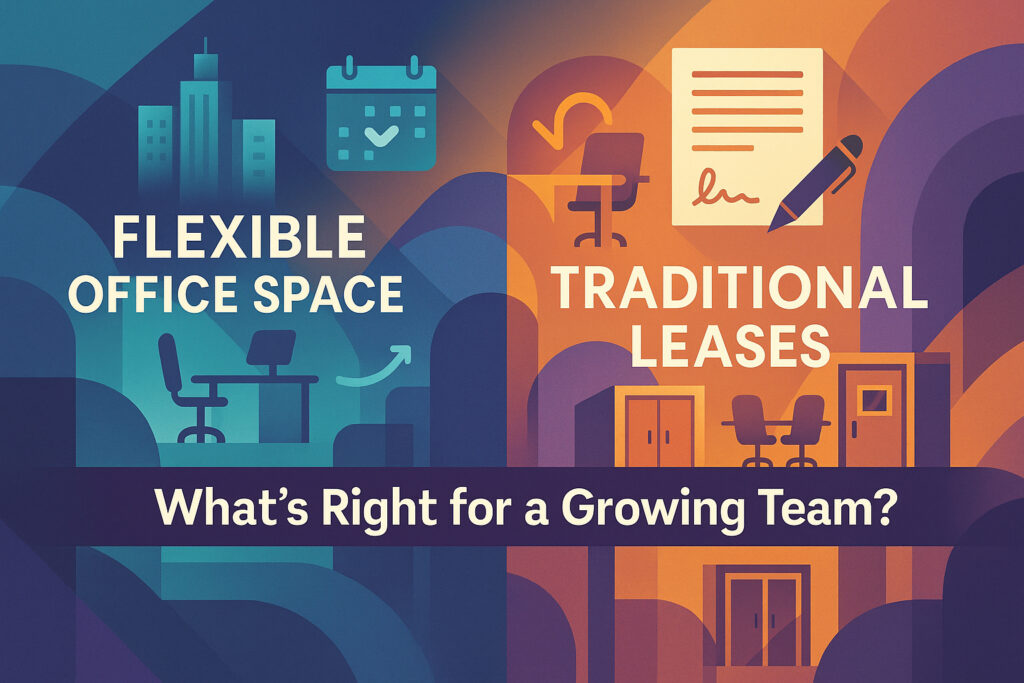
Flexible Office Space vs Traditional Leases: What’s Right for a Growing Team?
Startups evolving from incubators or coworking hubs into their first real office often face a pivotal decision: Should we stick with flexible, short-term space or commit to a traditional long-term lease? This question is crucial for a growing team. Many new businesses in growth mode (especially in Manhattan) find themselves Googling things like “short term office space NYC” or “when to leave coworking space.” These searches reflect a common journey – companies start out needing flexible rentals, then later consider longer-term leases as they mature. In this comprehensive guide, we’ll break down who benefits from each option, what flexible vs. traditional office leases entail, why and when you might choose one over the other, where each approach makes sense (with NYC as our example), and how to successfully transition when the time comes. The goal is to empower you as a tenant with knowledge – and help you leverage the option that best fits your team’s needs, budget, and ambitions.
What Is “Flexible” Office Space?
Flexible office space generally refers to short-term or easily adjustable workspace arrangements. This can include month-to-month coworking memberships, serviced executive suites, shared offices, or short-term leases (often via subleases) that run for a relatively brief period (as short as a few months up to around 1–2 years). The defining feature is flexibility – you are not locked into a long commitment, which can be a lifesaver for young companies in flux.
- Turnkey Convenience: Flexible offices are typically turnkey solutions. That means the space is ready to use on Day 1 – furnished with desks and chairs, wired for internet, and stocked with basics like conference rooms, a reception area, kitchens or lounges, and cleaning services. You don’t have to spend time or money setting up infrastructure. For example, an executive suite or serviced office in Manhattan might come with shared amenities like meeting rooms, mail handling, and even a receptionist. This all-inclusive setup allows a fledgling firm to focus on its business rather than office management.
- Short Commitments: Unlike a standard commercial lease that might run 5 or 10 years, flexible arrangements could be month-to-month, 6 months, or a year in length. Many providers offer by-the-desk or by-the-month rentals. For instance, if you rent a small office in a coworking center, you might only commit for 3 or 6 months at a time, or even go month-to-month. This short commitment dramatically lowers the risk for a growing team – if your headcount doubles in a few months or if you pivot the business, you’re not stuck paying for a space that no longer fits. Temporary office space in NYC is popular for this reason: it lets startups “test the waters” of having an office without a multi-year contract.
- Quick Scalability: Because terms are short and spaces are often part of larger flexible-office centers, it’s easier to scale up or down. Need to add two more desks next month? In a coworking or serviced office setting, you can often simply rent additional desks or upgrade to a bigger suite when needed. Conversely, if you need to downsize or pause, you can give notice and reduce your footprint with minimal penalty. This agility is ideal for startups with uncertain headcount trajectories.
- Cost Structure: At first glance, flexible spaces can seem expensive per person – the monthly fee per desk or small office is higher than the equivalent per-square-foot rent of a long lease. However, these fees include many costs (furniture, utilities, cleaning, internet, etc.) and save upfront expenses (like buying furniture or renovating space). There’s also typically a smaller security deposit or none at all. For a young company guarding its cash flow, avoiding big upfront costs is a major benefit. For example, a short-term sublease might only require 2–3 months of security deposit (or less, especially if a Good Guy Clause is in place – more on that later), whereas a traditional lease could ask for 6+ months of rent as security for a new business. Flexible arrangements keep the barrier to entry low.
- Common Use Cases: Companies that opt for flexible office space tend to be those in transition or rapid growth. If you anticipate needing an office only for 6–24 months (say, as a project office or while you search for a permanent headquarters), a short-term lease or coworking space makes sense. It’s also common for venture-funded startups to start in a coworking hub or short-term sublet right after a funding round – they have money to grow the team but aren’t ready to predict their needs 5 years out. In Manhattan, a huge number of seed and Series-A startups fall into this category: they want a real office address now, but not a long lease obligation. Additionally, companies testing out a New York presence (e.g. opening a small satellite office) often choose flexible leases to keep options open.
In summary, flexible office space offers maximum agility and minimal upfront commitment. It’s about speed and adaptability – you can secure a decent office quickly, set it up with little fuss, and move on or expand as your team evolves. For a growing team in its early stages, this option provides a crucial safety net: you won’t be tied down if circumstances change. However, that freedom comes with trade-offs in cost and control, which we’ll explore as we compare to traditional leases.
What Is a Traditional Office Lease?
A traditional office lease refers to a classic commercial leasing arrangement: you (the tenant) sign a contract directly with a landlord to rent office space for a multi-year term, typically anywhere from about 3 years up to 10+ years. In places like Manhattan, a “long-term” lease often means 7 to 10 years or more (though 3-5 year deals are common for smaller spaces). This is the way businesses have secured offices for decades – it’s a commitment to establish a stable, long-term presence in a given building.
Key characteristics of a traditional lease include:
- Lengthy Commitments: By design, these leases bind you for a longer period, so you should be confident in your needs for the foreseeable future. A growing team might find 5 years daunting – but established companies often value the stability of a long lease. Landlords likewise prefer longer commitments (more guaranteed income), which is why they often incentivize tenants to sign multi-year deals (more on incentives below). For a startup or small business, signing a traditional lease is a big step that typically happens once you have a clearer picture of your growth trajectory and financing.
- Customization and Control: One big advantage of a long-term lease is the ability to make the space truly your own. You can often build out or customize the office layout to fit your team’s workflow – whether that’s an open-plan tech hub with bullpen seating or a suite of private offices for a law firm. Landlords usually provide a Tenant Improvement (TI) allowance on longer leases – essentially a budget that the landlord contributes toward your build-out or renovations. This is a perk of committing longer: you get help investing in the space (and sometimes a few months of free rent while you set up). The result is a workspace tailored to your needs and branding, which can boost your company’s image and culture. In a flexible space or short sublease, you normally take the space “as is” with furniture in place; in a traditional lease, you have more say in design and can create your ideal environment from scratch if desired.
- Cost Efficiency (in the long run): Although a traditional lease comes with upfront costs – such as a sizeable security deposit, potential construction costs, and broker fees – the ongoing rent per square foot is typically lower than what you’d pay per-square-foot in a month-to-month serviced office. You’re rewarded for commitment with a better rate. Over several years, a direct lease can be more cost-effective especially for larger teams. For example, renting 5,000 sq ft on a 5-year term might net you a lower annual rent per sq ft than a flexible one-year deal for the same space. Furthermore, you’re not paying a premium for included services; you can shop around for your own internet, choose cost-effective vendors, etc. Many startups find that after reaching a certain team size (often around 8–15 people), the total cost of coworking memberships or short rentals starts to exceed the cost of leasing and running a private office of equivalent size. At that tipping point, a long-term lease can actually save money. (In one scenario, a Manhattan startup calculated that 8 employees in a coworking space cost ~25% more per year than placing those 8 people in their own leased office, once all costs were considered.)
- Stability and Predictability: With a long lease, you typically lock in your rent rate (often with predetermined annual increases) for the entire term. This shields you from market rent spikes. If the market gets hotter in 2 years, your rent doesn’t suddenly jump – you’re protected by your lease contract. Stability is also psychological: your team knows this is “home” and won’t have to move frequently. You can invest in things like your own branding, signage, or even custom furniture because you know you’ll be there for a while. It provides a sense of permanence that can be reassuring to employees and impress clients. Having a fixed address for years can also build your company’s credibility (nothing says “established” like a long-term presence at a reputable address).
- Legal and Financial Commitment: It’s important to note that a traditional lease is a more complex legal commitment. Often in NYC, landlords require a personal guaranty from the business owner or a hefty security deposit, especially for younger companies. You are on the hook for the rent for the full term, come what may – unless you have some negotiated exit clauses or you find a subtenant to take over if you leave early. Breaking a lease can be costly. This is why many NYC leases include a Good Guy Clause (or Good Guy Guarantee). The Good Guy Clause, common in Manhattan, is essentially a provision that limits your personal liability if you need to terminate the lease early. If you give the landlord proper notice, pay all rent up to the move-out date, and leave the space in good condition, the Good Guy Clause allows the lease guarantor (often the business owner) to be released from responsibility for the remaining rent after you vacate. In simple terms, it’s saying: “If I do the right thing and don’t stiff the landlord on the way out, I won’t be pursued for the rest of the lease term.” This clause gives tenants a measure of flexibility and peace of mind in an otherwise long commitment. It also benefits landlords by encouraging a smooth surrender rather than drawn-out evictions. Many NYC startups insist on a Good Guy Clause when they sign a multi-year lease – it’s a safety hatch if the business hits a rough patch. (Plus, as a bonus, some landlords will accept a smaller security deposit if a Good Guy Guaranty is in place, since the clause assures them they won’t be left in the lurch. That means upfront savings for the tenant.)
- Incentives from Landlords: Earlier we hinted at incentives. Landlords typically sweeten the deal for long-term tenants. If you commit to, say, a 7-year lease, you might negotiate several months of free rent at the start (to offset your move-in or build-out costs) and a generous TI allowance to build the space to your specs. They may also be more flexible on other terms (right to renew, first dibs on adjacent space if you expand, etc.). By contrast, a 1-year lease or sublease is usually “what you see is what you get” – little or no free rent, no money for improvements, since the term is too short for the landlord to justify those concessions. So, with a traditional lease, you can get more value in infrastructure and concessions, which is attractive if you need a custom build or are making a long-term bet on the location.
In short, a traditional lease is about planting roots. It’s the right choice when your team has grown to the point of stability – you know roughly how many people you’ll have, what your budget is, and you’re ready to invest in a space that can be your company’s long-term home. The trade-off is less flexibility. If you suddenly need to scale up or down dramatically, a long lease can become a headache (unless you planned ahead with clauses or have the Good Guy exit option). It’s a commitment to be entered thoughtfully, ideally with professional guidance. Next, we’ll look at how to evaluate which path – flexible or traditional – is right for you, and how some growing companies use stepping stones to get from one to the other.
Flexible vs. Traditional: Pros and Cons for a Growing Company
Both flexible arrangements and long-term leases have their advantages and disadvantages. For a growing team, the “right” choice often depends on timing and priorities. Let’s compare some key factors side by side to clarify how each option stacks up:
- Commitment Length: A flexible space keeps your commitment short – great if your future is uncertain. You can go month-to-month or sign a six-month or one-year deal and reassess as you grow. A traditional lease locks you in for years (often 5+), which can be risky for a startup with an unpredictable trajectory. However, that long commitment provides stability – you won’t have to relocate every year, and you can plan your business with a fixed address in mind.
- Upfront Costs & Overhead: With flexible offices, you generally face lower upfront costs. Little to no build-out expense, minimal furniture investment (since it’s usually provided), and lower deposits are common. Many short-term spaces are plug-and-play – just bring your laptops and team. Monthly fees are higher but cover all services. In a long-term lease, you might need to budget for construction or furniture, plus a larger security deposit and insurance. You also take on responsibilities like setting up internet, cleaning, utilities contracts, etc. The upside is you have more control over vendors and can potentially save money by choosing cost-efficient options. Over a multi-year period, the cost per square foot of a traditional lease often ends up lower than a serviced space, but only if you fully utilize the space and stay for the term.
- Scalability & Growth: Flexible space wins on immediate scalability. If you hire 5 people next month, you can often just add more coworking memberships or upgrade to a bigger short-term suite. If you lose people or need to cut costs, you can shrink your footprint at the next renewal or terminate a month-to-month agreement. Traditional leases are less nimble – you’re renting a fixed square footage. If you outgrow it, you might have to find additional space or sublease and move. If you downsize, you could end up paying for empty space (though you might sublease the surplus area to another company if the lease and market allow). Some long leases include expansion rights or early termination options, but those have to be negotiated upfront. In general, for year-to-year headcount swings, flexible space is the safer choice.
- Privacy & Control: Traditional offices offer full privacy and control. The space is yours alone – you don’t share conference rooms or worry about another company’s music or phone chatter. You can implement your own IT network with whatever security protocols you need, which is critical for companies handling sensitive data. You also control who can access the space. In flexible/co-working spaces, you’ll share common areas and amenities with other tenants. Privacy can be limited; phone booths and private meeting rooms might need to be booked in advance and could be in short supply. This environment can be vibrant but also distracting for some teams. For a startup dealing with confidential R&D or just craving a quiet space for focus, the lack of exclusive control can become a drawback of coworking. Many founders eventually feel that need for a “closed door” policy where only their team occupies the office.
- Company Culture & Branding: Your office is a physical reflection of your brand and culture. In a long-term leased office, you can decorate and layout the space to embody your company’s identity. Whether that means painting the walls in your brand colors, hanging your logo in reception, or configuring rooms to match your work style, you have the freedom to create a space that feels like “you.” Teams often take pride in their own office – it can boost morale and help define a corporate culture. In a flexible space, branding opportunities are limited. You might only get to put a logo on a shared glass door, or maybe just your company name on a desk identifier. The look and feel of the space is defined by the provider, not you. Also, coworkers come and go, which can dilute a cohesive team culture over time. Many growing companies notice that while coworking provided a cool vibe initially, as they grew, their culture needed its own canvas to flourish. If building a unique company culture and brand presence is a priority, eventually a private office is the better canvas.
- Amenities & Services: One clear perk of flexible offices is the bundle of amenities. Premium coworking and serviced offices come with things like free coffee/beer, networking events, reception services, mail handling, high-end furniture, and sometimes perks like on-site gyms or shower rooms – all included. It’s a hassle-free lifestyle for your team. If something breaks (the printer, the Wi-Fi), it’s handled by the provider. In a traditional lease, you have to arrange your own services or live with the building’s basic amenities. Many office buildings have improved in offering amenities (like shared conference centers, lounges, or fitness centers for tenants), but these aren’t as tailor-made as a coworking package. You might also have to hire staff or vendors for cleaning, stock the pantry yourself, and manage your own office supplies. Essentially, with a traditional lease you become responsible for the day-to-day operations of your office – unless you hire a facility manager or use a serviced office provider to run your space (some companies do bring in a management service to run their office as a pseudo-coworking environment). For a small team, the burden of managing an office is usually not too heavy, but it is an adjustment coming from the “all taken care of” world of coworking.
- Location and Image: In a city like New York, location is everything. Flexible space providers often have locations in prestigious buildings or trendy neighborhoods that a small startup could otherwise never afford on a long lease. For example, through a coworking membership you might get an office address in a Class A Midtown high-rise or a chic SoHo loft building, even if you only have 4 employees. Short-term subleases can also land you in prime locations at discounted rents (if you’re taking over space from a company that left). This can be a huge image boost when meeting with clients or investors. With a traditional lease, you’ll have to balance cost vs. location more directly. Prime neighborhoods and Class A buildings come at a premium on long leases, which might strain a startup budget. That said, if you can swing it, locking in a long-term lease in a great location has big image benefits and ensures you stay in that coveted spot for years. There’s also a competitive aspect: in high-demand areas, short-term space might be scarcer. Landlords prefer long leases, so the most sought-after buildings might not offer many short deals. That’s why many startups start in coworking (to get the address) and then later, if successful, sign a direct lease in that same area to cement their spot. Bottom line: flexible space can be a shortcut to a great location initially, while a traditional lease is how you secure a prime location permanently.
As you can see, the “flexible vs traditional” decision is really about trade-offs. Flexible office space maximizes convenience, agility, and short-term affordability (on a cash-flow basis), whereas a traditional lease maximizes control, customization, and long-term cost efficiency. For a growing team, the decision often isn’t either/or forever – it can be sequential. Many companies use flexible space in their early growth phase, then transition to a long lease when the time is right. In the next sections, we’ll dive deeper into when and why to make that transition, and look at real-world trends (like the tech industry’s love of short leases) to inform your thinking.
When to Move from Coworking to Your Own Office
One of the most common dilemmas for startups is figuring out when to leave the coworking nest. Coworking spaces (like WeWork, Industrious, Regus, etc.) or incubator hubs are fantastic for launching – they offer exactly the flexibility and cost structure a 2-person or 5-person team needs. However, as your company scales, staying in a shared space can start to hold you back. How do you know it’s time to get your own private office lease? Here are some telltale signs and considerations:
- Team Size and Density: Take a look around your shared workspace – are you running out of room? A major red flag is when your team simply doesn’t fit comfortably anymore. Maybe you started with one dedicated table and now you’re sprawled across three different areas because you’ve added people. If you’re finding it hard to seat everyone together, or you’re booking multiple coworking offices to accommodate all employees, it’s probably time to seek a larger, exclusive space. Often, when startups hit about 8-12 employees, the cracks in the coworking model begin to show. You might find you’re paying for a cluster of memberships and still tripping over each other. Physical crowding not only affects productivity but also morale – people feel like second-class citizens if they don’t even have a consistent desk. When your headcount growth outpaces the coworking capacity, that’s a strong signal you’ve outgrown the environment.
- Rising Costs vs. Leasing: Coworking is usually touted as cost-effective for very small teams, because you’re only paying for what you use. Yet, once your team grows to a certain size, the math can flip. On a per-person basis, coworking fees can become more expensive than an equivalent private office lease. For example, if you’re paying $800-$1,000 per person per month in a coworking space, a team of 10 is $8,000-$10,000 monthly. That budget could potentially get you a self-contained office suite of similar or larger size when you consider traditional rent prices in many NYC areas. When you realize “We could lease our own 2,000 sq ft office for the same or less than we’re paying now”, it’s time to seriously consider moving. Do a quick comparison: multiply the square footage you’d need by market rent, and compare that to your total coworking spend. Many companies discover that around the 5 to 7 person mark, the scales tip – coworking’s premium for flexibility starts to outweigh its benefits. If the costs are no longer adding up in your favor, it’s a clear indication that a dedicated office might be more economical.
- Need for Privacy and Focus: Early on, the buzzy atmosphere of coworking can be energizing. But as your operations mature, you might need more privacy and focus than a shared space allows. Do your employees struggle to find a quiet room for important client calls or high-concentration tasks? Are brainstorming sessions limited by fear of disturbing neighboring companies? When the lack of privacy or constant background chatter becomes detrimental to your work, that’s a sign you need four walls of your own. Additionally, if you handle sensitive information or simply want to discuss company strategies without fear of being overheard, a private office becomes important. IT security is another factor – on a shared network, you have limitations; in your own office, you can set up a secure, private network. If you find yourself wishing for more control over your environment’s noise, security, or schedule (e.g., 24/7 access only for your team), a traditional lease will give you that control.
- Company Culture & Client Impressions: Think about the culture you want to cultivate. In a coworking space, your company culture is happening in someone else’s house – the decor, rules, and atmosphere aren’t set by you. If you have grown to, say, 15+ people, you likely have a sense of your own culture and might benefit from a space that reinforces it. Having your own office can significantly boost team identity and cohesion. It’s like moving out of a college dorm into your own apartment – you gain a sense of ownership. This also extends to how outsiders see you. If more clients, partners, or investors are visiting, a dedicated office space can give a more professional impression. It shows stability and success. Many founders ask, “Will people take us more seriously if we have our own office?” Often the answer is yes, especially once you’re beyond the scrappy startup phase. If you’re at a stage where you’re hiring more experienced staff or courting enterprise customers, having your own door (with your logo on it) can bolster your image. Branding opportunities are a plus – even a modest private suite can have your company’s name at reception or on the hallway directory, signaling that you’ve “arrived.”
- Operational Stability: Consider whether your day-to-day operations have hit a stride. In the earliest days, startups are pivoting frequently and might not even keep the same team month to month – coworking’s flexibility matches that chaos. But if your operations have normalized (you have set teams, regular workflows, predictable hours), then the temporary feeling of coworking might be holding you back. For example, if you now have a stable schedule of team meetings, you might want a conference room that’s always yours and available, rather than competing for one. Or if your employees work on a 9-to-6 schedule with routine, having to pack up personal items from a shared desk each day might feel untenable. Once your business routines are steady, a “more normalized office setting” (to quote one advisory) becomes a natural next step. You’ll be more productive in a space purpose-built for your operations – like having dedicated phone booths or meeting areas that only your team uses, located conveniently near your workstations. When you start longing for an environment fine-tuned to your workflow rather than a generic one, you’re ready to transition.
- Planning for the Future: Lastly, if you foresee stable or growing operations for the next couple of years, it’s wise to plan ahead for a move. Don’t wait until your coworking membership becomes unworkable. Ideally, start the process of finding a private office 6-12 months before your current arrangement expires or before you desperately need it. In Manhattan, securing an ideal office space (finding it, negotiating the lease, possibly doing minor renovations or furnishing) can take several months. Give yourself enough runway. If you’ve raised a new round of funding earmarked for expansion, or you have a hiring plan that will double your staff in a year, start looking early for that next space. Timing is key – you want the new office ready when you actually need it, not six months after everyone’s been cramped and unhappy.
How to Transition Smoothly: Once you’ve decided it’s time to graduate from coworking, approach the move strategically. First, engage a tenant-focused real estate broker or advisor (like us) who knows the flexible sublease market as well as the direct leasing market. They can uncover short-term sublets or small direct leases that aren’t publicly advertised, giving you more choices. Often the best route for a first “real” office is a short-term sublease: for example, a 2-year sublease on a space that another startup built out and left. This gives you a private office (with someone else’s furniture usually included) but still not a long commitment – a perfect bridge between coworking and a long lease. In fact, many growing startups deliberately take a 1-2 year sublease as their first office, then after that expires (and they’ve grown more) they move again into a 5-year direct lease that fits their now-larger team. It’s a two-step journey that works well: coworking → short sublease → long lease. During the transition, plan the timeline carefully: remember it can take 6+ months to go from decision to move-in, especially if build-out is needed. If you need to renovate or furnish the new space, coordinate it so that you minimize downtime. And communicate with your team – make the move an exciting milestone (“our own office!”) rather than a chore. This helps get everyone on board with packing up the coworking desks and embracing the new chapter.
In summary, leaving coworking for your own office is a natural evolution when a startup hits certain benchmarks in size, cost, and maturity. The key is recognizing the signs early and preparing so the transition is smooth. Many have gone through this before – and with the right guidance, you can avoid common pitfalls (like underestimating growth and leasing too small a space, or overestimating and overspending on a too-big lease). Remember, the goal is to find a space where your team can thrive – one that saves you money and headaches in the long run, even as it requires a bit more commitment. Next, let’s look at how one particular segment – tech and AI startups – has been navigating this flexible vs. traditional choice, as it offers a glimpse into the wider market trend.
Why Tech and AI Startups Embrace Flexible Leases (For Now)
In recent years, New York City (and especially Manhattan) has seen a boom in tech and AI startups – and their office leasing habits are distinct. These companies often lead the charge in adopting flexible office solutions. If you’re in the tech sector, it’s worth understanding this trend and how it might apply to you.
Huge Demand from Startups: Despite the rise of remote work, many tech startups strongly value having a physical office for collaboration and culture. In fact, Manhattan’s office market has felt a surge of activity from small tech and AI firms. To put numbers on it: in the first nine months of 2025, AI-focused companies leased over 486,000 square feet of office space in Manhattan, exceeding the entire amount they leased in all of 2024. This is a remarkable statistic that shows how active this sector is. But here’s the kicker – a lot of these deals are not traditional 10-year leases in shiny new skyscrapers. Instead, dozens of these AI and tech firms have been signing short-term deals for smaller offices (often under 5,000 sq ft). These are fast-growth teams with serious funding, yet they’re choosing flexible arrangements like subleases or short direct leases of 1-3 years. Why? Because it fits the nature of their business.
Uncertain (but Rapid) Growth: Tech startups, particularly in AI, often face extreme uncertainty in headcount. One successful product or funding round can mean you need to double your engineering team in six months; a failed project could mean scaling back. Flexibility is at a premium. These companies don’t want to bet on where they’ll be in 5 years because the industry moves too fast. Instead, many are “opting for 2–3 year terms with expansion clauses” that give them an out or the ability to grab more space if needed. For example, a typical AI startup lease might be a 2-year sublease in a cool Midtown South loft, with a clause that lets them expand into the adjacent unit if they hire more people, or an understanding they can move to a larger space that the landlord has in the building. This way they aren’t stuck, but they have some runway.
Preference for Plug-and-Play and Quality: Just because they take short leases doesn’t mean these startups settle for poor quality space. On the contrary, most want turnkey, high-quality offices. After all, they have to attract talent and maybe host investors. Many AI teams seek spaces that are “pre-wired and furnished for immediate use,” with modern layouts. They love open-plan areas for collaboration, alongside a few private meeting rooms for sensitive discussions. It’s not unusual for a short-term space to still be in a Class A building or a trendy location – in fact, over half of AI tenant leasing in NYC has been in top-tier (Class A) buildings. The thinking is, even on a 1 or 2-year lease, they want an office that impresses – one that screams cutting-edge innovation, not some drab sub-sub-basement. And since they’re often well-funded, they can afford a nicer space, just not the long commitment. That’s why in Manhattan you see AI startups in areas like Midtown South, Flatiron, SoHo, etc., where many buildings now openly advertise short-term suites for these kinds of tenants.
Market Conditions Favor Flexibility: It’s worth noting that post-2020 market shifts made more flexible deals available. Many bigger companies shrank their footprint or put excess space up for sublease, so there’s been a glut of small, already-built offices on the market that are perfect for startups. Landlords also became a bit more open to non-traditional lease structures to fill space. For example, some landlords in tech-heavy submarkets will do “shorter initial terms with flexible renewal options.” A building owner might say, “Sure, I’ll give you a 2-year lease on this 3,000 sq ft prebuilt suite, and if you want to extend after 2 years, we can negotiate that then.” That kind of offer was rare a decade ago when landlords mostly insisted on 5+ years, but it’s more common now as owners adapt to the demand for flexibility. Well-capitalized startups have been leveraging these conditions to get prime offices without long lock-ins.
Conserving Capital & Reducing Risk: Even with lots of investor money, startups are cautious about overhead. Every dollar spent on a long lease is a dollar not going into R&D or hiring. By taking a short lease, they keep long-term liabilities off their balance sheet. Also, a short lease with a Good Guy Clause or similar exit options is seen as a risk mitigator. If the tech market shifts or a project fails, they can exit the lease gracefully and not bleed cash for space they don’t need. Many AI startup CEOs have said they wouldn’t have signed an office lease at all if not for knowing they had that Good Guy safety valve and a shorter term. It essentially removes the nightmare scenario of being stuck in a 5-year contract if the company pivots or scales unpredictably. And here’s another plus: some landlords, recognizing the strong demand from these startups, will even give a bit on cost – like a slightly reduced security deposit or a minor concession – if the tenant signs a Good Guy Guaranty and a short term. It’s a win-win: the startup saves some cash and the landlord gets the space filled (with the assurance that if the tenant leaves early, it won’t be a messy default).
What This Means for You: If you’re a tech or AI startup, you’re in good company choosing flexible leases. The key takeaway is that short-term and flexible does not mean “second best.” It’s actually become the strategy of choice for many high-growth firms to remain agile. However, remember that this is usually a phase in the company’s journey. Many tech startups that succeed eventually do “graduate” to a longer-term lease or even purchase office space if they become large enough. The flexible period is a bridge between founding and fully established business. The smart move is to utilize flexible space to support your growth now, while planning for the possibility that in a couple of years you might need something more permanent. By then, you’ll have more employees, more predictable revenue, and you can approach a long-term lease with confidence (and perhaps negotiate it from a position of strength because you’re a sought-after tech tenant yourself!).
Making the Right Choice for Your Team (Conclusion)
Every growing company’s situation is unique, but the decision between flexible office space vs. a traditional lease boils down to timing and priorities. In the early stages, short-term solutions offer agility that can be critical for survival and quick growth. A flexible office – whether a coworking desk, a serviced suite, or a one-year sublease – can save you money upfront, let you scale rapidly, and prevent you from being tied to a space that might not fit a few months down the line. It’s no wonder so many Manhattan startups hunt for “short term office rental NYC” or “temporary office space in Manhattan” when they’re just starting to spread their wings. That flexibility is like a safety harness in the unpredictable climb of a new business.
However, flexible space is usually not a forever home. As we’ve discussed, there comes a point when the very benefits of flexibility (easy in, easy out, shared resources) are outweighed by the drawbacks (higher long-run cost, lack of control, limited room to grow beyond a certain point). When you reach that point – whether it’s at 5 employees or 50 – it’s time to think about planting roots with a longer-term lease. A traditional lease is an investment in your company’s future. It grants you the security of a known base of operations and the freedom to shape that base to your liking. It can also be financially prudent in the long term; instead of paying premium fees month after month with nothing to show, you’re building equity in your presence and often getting better rates per square foot.
For most growing teams, the optimal path is a progression: start flexible, then move to a traditional lease when you’re ready. The transition can be eased by intermediate steps (for instance, moving from coworking to a 2-year sublease, and then to a 5-year direct lease). Each step should be guided by evaluating those core factors we covered – your budget, team size, growth outlook, culture, and operational needs. Keep asking the key questions: Can we afford to commit longer given our funding? Will a private office make our team more productive or happy right now? Are we missing opportunities (hiring, clients) because we don’t have a stable office? The answers will usually point you in the right direction.
It’s also worth noting that the office market isn’t static. We are in an era where hybrid approaches are emerging. Some companies negotiate flexible clauses in long leases (like break options or expansion rights) to get the best of both worlds. Others maintain a small coworking presence for overflow or satellite teams even after getting a main office. So “flexible vs traditional” isn’t always black and white – you can combine elements to suit your strategy. For instance, you might sign a 5-year lease with a Good Guy Clause and a 3-year break option, giving you an out if needed. Or lease your main HQ long-term but keep a membership at a coworking space in another borough for remote staff drop-ins. The key is leveraging flexibility where you need it, and stability where you value it.
From a tenant’s perspective, it’s all about advantage: making the real estate work for your business plan, not the other way around. Flexible space can save cost in the early days and let you channel budget into growth. A traditional lease, when timed right, can lock in a great location and give you room to expand at a known cost, potentially saving money per person and enhancing your image. Always consider your budget, image, location, team size, and functional requirements. A scrappy 4-person startup might prioritize low cost and short term (so, a coworking desk or small sublet). A 20-person firm with solid revenue might prioritize image and stability (so, perhaps a 3-year lease in a Class B building you can brand). A 50-person company might need top-notch infrastructure and custom layout (so, a 7-year lease in a Class A space with build-out).
Finally, don’t go it alone. Making these decisions and finding the right space involves navigating a complex market – especially in NYC, where options and competition abound. Engaging a tenant-focused broker can save you time, money, and stress. Remember, as tenant representatives, our job is to look out for your interests, not the landlord’s. We don’t push coworking memberships (in fact, we generally advise clients to use them as a launchpad but prepare to move on when ready), and we don’t represent landlords who may have opposing interests. Our fiduciary responsibility is solely to you, the tenant. That means we can candidly advise if a deal is good or if you should hold out for better, help negotiate clauses like the Good Guy Guaranty to protect you, and show you creative solutions (maybe that hidden gem of a sublet with furniture included, or that landlord who’s quietly open to a short lease).
In conclusion, “What’s right for a growing team – flexible space or a traditional lease?” doesn’t have a one-size-fits-all answer, because the answer changes as your team grows. Early on, flexible space is usually right; later, a traditional lease often becomes the right move. The savviest companies take advantage of both at different stages. By staying attuned to your company’s growth signals and market opportunities, you can make each office move a strategic springboard rather than a stumbling block. And when done correctly, each step – from that first coworking desk to the day you sign a long-term lease on your very own office – is a celebration of how far your team has come and a launchpad for the success yet to come.
Looking for guidance on your next office move in NYC? As Manhattan office specialists, we’re here to help growing businesses navigate this journey. Whether you need a short-term solution to get started or you’re ready to secure a long-term headquarters, we bring market expertise and a tenant-first approach to find the perfect space for your needs. Contact New York Offices to discuss your requirements – our service is comprehensive and tailored to entrepreneurs and SMBs looking for that ideal NYC office. We’ll help you weigh all the options (flexible vs. traditional and everything in between) so you can make an informed decision that supports your company’s growth. Let us handle the office hunt while you focus on building your business!
Fill out our 📋 online form or give us a call today 📞 212-967-2061 — let’s find the right options for your business.