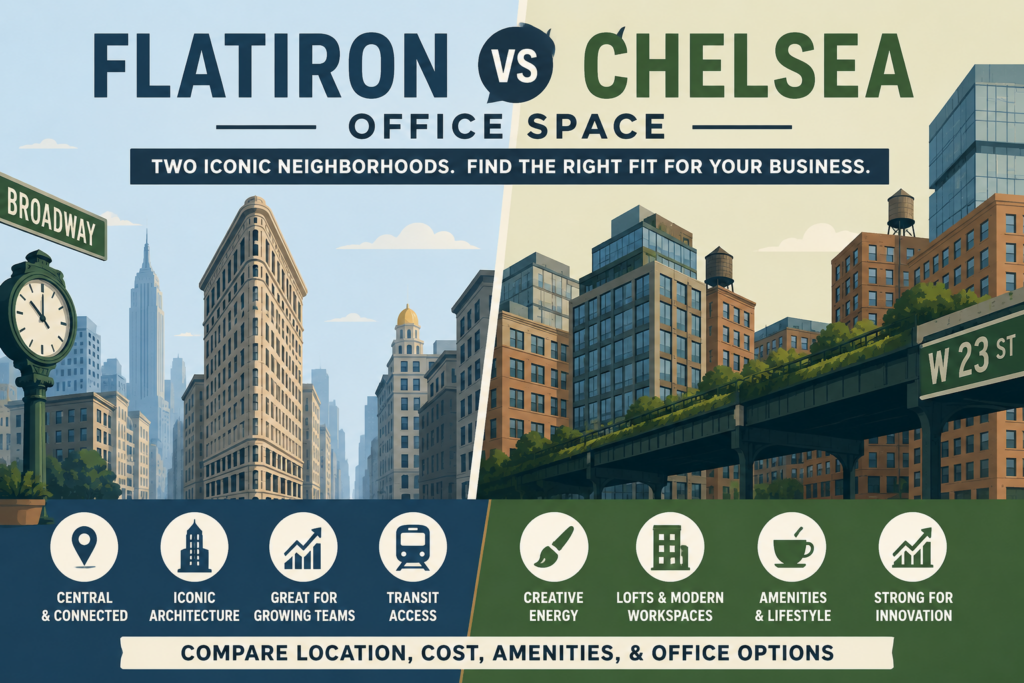
Flatiron vs Chelsea Office Space | Costs, Commute, Best Fit
If you are deciding between Flatiron and Chelsea office space, the short answer is this: Flatiron is usually the better choice for companies that want a more central Midtown South address, tighter access to Union Square and Madison Square Park, and a boutique loft-and-prebuilt office identity. Chelsea is usually the better choice for companies that want more west-side inventory, easier access to Penn Station and the A/C/E/L network, and a stronger art-gallery, High Line, and large-campus office feel. Current broker data also suggests Flatiron/Union Square is tighter, while Chelsea gives tenants more room to negotiate and more options to tour.
Flatiron is the better pick if you want a more central Midtown South identity
Flatiron works especially well for firms that care about address quality, centrality, client convenience, and an office environment that feels creative without drifting too far west. The district’s own positioning emphasizes the intersection of business and leisure, its public plazas, and its location around Madison Square Park. On the transit side, Flatiron’s orbit around Union Square, 23rd Street, and Herald Square makes it easy to reach from multiple subway lines and from nearby PATH access. Newmark’s Q1 2026 data also shows Flatiron/Union Square tighter than Chelsea, which usually translates into a stronger “this is where companies want to be” market signal.
Chelsea is the better pick if you want more options and a stronger west-side ecosystem
Chelsea tends to make more sense for companies that want a wider field of options, larger floor plates, or a distinct west-side identity. CommercialCafe currently shows far more visible office listings in Chelsea than in Flatiron, and Chelsea’s office story is reinforced by large properties such as 111 Eighth Avenue, the 2.9 million-square-foot Google building above the 14th Street/8th Avenue station. Chelsea’s cultural and amenity mix is also unusually strong: official tourism sources highlight galleries, the High Line, Chelsea Market, restaurants, nightlife, and performance venues. For a company that wants employees to feel like the office is embedded in a full neighborhood rather than just an office corridor, Chelsea is compelling.
Cost and availability are close, but the data needs to be read correctly
One reason this choice feels confusing is that published rent data changes depending on who is measuring it and what type of space they are measuring. Newmark’s Q1 2026 report puts Chelsea at $84.71 per square foot and Flatiron/Union Square at $87.18, with Flatiron/Union Square showing lower availability. Cushman & Wakefield groups Flatiron with Madison/Union Square and shows lower overall asking rents there than in Chelsea, but still shows Chelsea with more vacancy. Public listing portals add another layer: SquareFoot says Chelsea asking rents run around $96 per square foot, and that Midtown South averages just under $95.75, while also noting that Flatiron subleases can often be signed in the $50 to $60 range. The practical move is to compare direct space, sublease space, and flex space separately instead of trusting one headline number.
For flexible and furnished offices, Chelsea usually offers slightly better value
If you are shopping for all-inclusive team suites or short-term furnished space, Chelsea currently looks a little friendlier on price. Work Better NYC’s current ranges put Chelsea team offices at roughly $800 to $1,400 per person each month, while Flatiron runs about $900 to $1,500. That is not a substitute for broker-negotiated direct lease pricing, but it is a very useful decision shortcut for startups, agencies, and hybrid teams that want to move quickly without build-out risk. If your company expects to grow or reconfigure often, Chelsea’s wider visible inventory plus the slightly lower flex-office range can make the neighborhood easier to work with operationally.
Commute strategy may be the single most important difference
For commuter-heavy firms, Chelsea often wins because Penn Station brings together LIRR, NJ Transit, PATH, and nearby subway connections, and the neighborhood also benefits from A/C/E/L access at 14th Street/8th Avenue. Flatiron’s strength is different: it is more central to subway-driven commutes, especially for teams converging around Union Square, 23rd Street, and Herald Square. If most of your people are coming from Long Island or New Jersey, Chelsea deserves a hard look. If most of your team is already in Manhattan or Brooklyn and wants a more central daily meeting point, Flatiron often feels simpler.
The office product is different even when the rent feels similar
Flatiron tends to shine when you want classic Midtown South character: loft buildings, boutique floors, prebuilt suites, and that Madison Square Park address effect. Chelsea is not short on character, but it also has a clearer range from loft product to larger, more campus-like tech environments. The west-side art district identity, the High Line effect, and the presence of very large office properties give Chelsea a slightly broader product mix. That is why Flatiron often feels better for image-first boutique users, while Chelsea often feels better for firms that want more ways to trade off size, style, and commute.
So which neighborhood should your company actually choose
Choose Flatiron if your company wants a central Midtown South address, easy Union Square access, a sharper client-facing location, and a built environment that feels intimate, design-forward, and prestige-oriented. Choose Chelsea if your company wants more visible inventory, stronger west-side identity, easier Penn Station access, and a neighborhood that blends creative energy with larger-scale office options. Neither choice is wrong. The better answer depends on whether your highest priority is centrality and address quality, or flexibility and west-side scale.
Final verdict
If you forced a single market-wide answer, Flatiron generally wins for branding, centrality, and a tighter Midtown South identity. Chelsea generally wins for inventory breadth, larger-office optionality, and regional-commute practicality. For smaller creative firms, boutique financial firms, studios, and image-conscious startups, Flatiron is often the better fit. For larger hybrid teams, media and tech users that want west-side energy, and firms with heavier New Jersey or Long Island commuter patterns, Chelsea is often the smarter leasing market.
FAQ: Is Flatiron more expensive than Chelsea office space
Usually, yes, but not by enough to make the answer automatic. Newmark’s Q1 2026 numbers put Flatiron/Union Square slightly above Chelsea on asking rent, while Cushman’s boundaries produce a different headline number. Listing platforms also diverge because they mix direct, sublease, and visible advertised inventory differently. The safer conclusion is that Flatiron is usually tighter and can price like a premium submarket, while Chelsea usually offers more room to negotiate.
FAQ: Is Chelsea better for larger teams
Often, yes. Chelsea currently shows more visible office inventory online, has a stronger large-campus profile through properties such as 111 Eighth Avenue, and benefits from Penn Station plus west-side subway access. If you need multiple tour options, a larger block, or stronger commuter flexibility, Chelsea usually deserves first review.
FAQ: Are there good sublease and flexible-office options in both neighborhoods
Yes. SquareFoot says Flatiron subleases can often be signed in the $50 to $60 range in Class B and Class C buildings, while Work Better NYC shows live furnished team-office pricing for both Chelsea and Flatiron. That means both neighborhoods can work for short-term or growth-stage occupiers, but Chelsea tends to lean value on turnkey suites, while Flatiron can be attractive when you find the right sublease.
Fill out our 📋 online form or give us a call today 📞 212-967-2061 — let’s find the right office for your business.