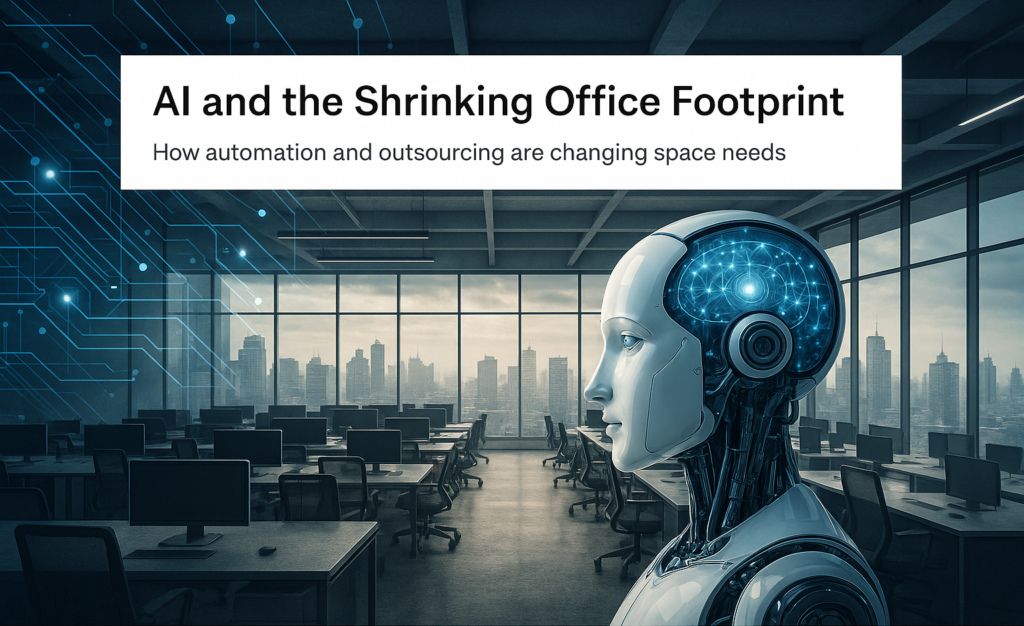
AI and the Shrinking Office Footprint
How Automation, Outsourcing, and Smart Tools Are Reshaping Office Space in 2025
The evolution of artificial intelligence (AI) is rapidly transforming the workplace—not just in how we work, but where we work. As automation, remote collaboration tools, and predictive systems continue to advance, they’re driving a noticeable shift in office space demand. Specifically, companies across industries are reevaluating their real estate needs and shrinking their physical footprints.
What Is AI and Why Does It Matter in Office Leasing?
AI refers to machines and software capable of simulating human intelligence—learning, problem-solving, predicting outcomes, and even understanding language. Most business applications today rely on “narrow AI” designed for specific functions, such as automating workflows, analyzing employee behavior, or assisting with scheduling and communications.
When applied to the workplace, AI is not just a productivity tool—it becomes a space management solution. By streamlining administrative tasks, optimizing employee movement, and guiding design decisions, AI is now an unseen force shaping the physical office itself.
How AI Is Driving the Shift to Smaller Office Spaces
1. Automating Work = Fewer Desks
AI can handle up to 70% of routine administrative tasks, according to McKinsey. From HR onboarding to finance reports, AI is reducing the need for support staff. The result? Fewer seats to fill, fewer offices to build, and more efficiency per square foot.
2. Remote + Hybrid = Smarter Footprints
AI-enhanced project management tools allow teams to work fluidly across locations. Hybrid work models mean fewer employees in the office at once—so tenants are downsizing, moving into flexible layouts, or adopting shared workstations.
3. Data-Driven Space Planning
Machine learning systems now analyze how office spaces are actually used. This includes tracking occupancy rates, peak usage hours, and workstation preferences. The insights lead to redesigned layouts that require less space to accomplish more.
4. Personalized, High-Performance Environments
AI doesn’t just reduce—it refines. In smaller footprints, systems can still create responsive environments: adjusting lighting, temperature, or even room usage automatically to employee needs. This makes compact spaces more attractive and functional.
5. Sustainability and Cost Control
AI-integrated building systems reduce energy waste by managing HVAC, lighting, and security with surgical precision. This not only lowers utility costs but allows tenants to justify renting less square footage while keeping performance high.
What Does This Mean for Tenants?
Companies are no longer seeking rows of cubicles or sprawling floorplans. They’re choosing smart, agile office environments that reflect the pace of modern business. In 2025, the best office isn’t the biggest—it’s the most efficient.
If you’re searching for a workspace that aligns with your AI-enabled, hybrid strategy, smaller offices with short- to mid-term leases in adaptable buildings may be your best bet.
Final Thought
AI isn’t just revolutionizing how we work—it’s redefining the office itself. As organizations rely more on automation and data, the physical workplace is evolving into a leaner, smarter, and more cost-effective asset. The shrinking footprint isn’t a loss—it’s a strategic optimization.
Looking to Right-Size Your Office for the Future?
As AI continues to reshape how and where we work, having the right office footprint is more critical than ever. At NewYorkOffices, we specialize in helping businesses secure flexible, cost-effective office space that aligns with their operational needs—whether you’re scaling back, reconfiguring, or building for the future. Our tenant representation services are always at no cost to you. Ready to explore smarter office solutions? Get in touch today.
Fill out our 📩 online form or give us a call today 📞 212-967-2061 — let’s find agile space for your business today.