Midtown vs. Downtown Manhattan Office Space for Nonprofits
For many nonprofits, choosing between Midtown and Downtown Manhattan starts with cost. However, rent alone rarely produces the right answer.
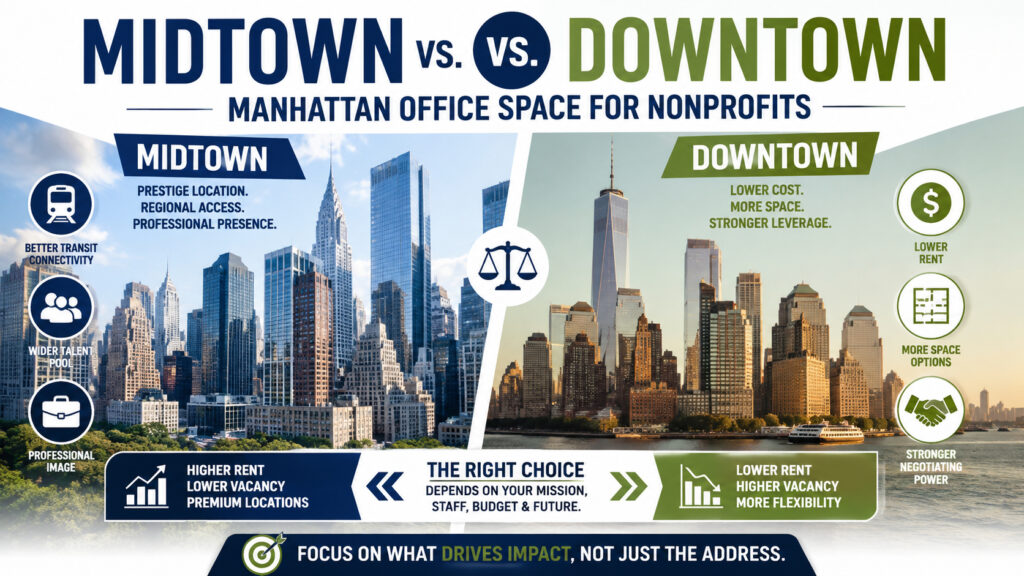
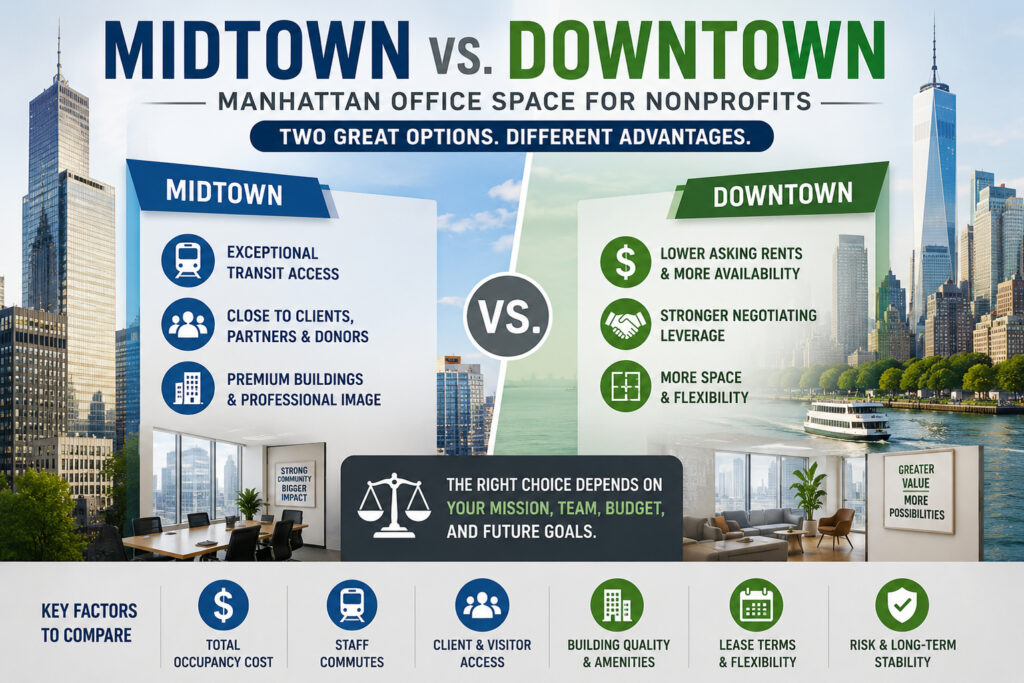
Midtown gives nonprofits exceptional regional access and a broad range of professional office environments. Downtown usually provides lower asking rents, more available space, and stronger negotiating leverage.
Neither location automatically works better for every nonprofit. The right choice depends on staff commutes, funding, visitors, programs, space design, and lease flexibility.
As tenant brokers, we represent organizations searching for office space rather than building ownership. That tenant-side position keeps the analysis focused on occupancy needs, economics, and long-term flexibility. The goal remains simple: secure the right office under the strongest practical lease structure.
Is Midtown or Downtown Better for a Nonprofit?
For a nonprofit prioritizing occupancy cost, Downtown usually deserves the first look. For one prioritizing regional access, Midtown often holds the advantage.
Current market numbers make the cost difference unusually clear.
During the second quarter of 2026, Midtown’s average asking rent reached $86.18 per square foot. Downtown averaged $61.34 per square foot during the same quarter. Midtown availability stood at 12.7%, compared with 16.6% Downtown.
| Current comparison | Midtown | Downtown |
|---|---|---|
| Average asking rent | $86.18/SF | $61.34/SF |
| Availability rate | 12.7% | 16.6% |
| Average sublease asking rent | $63.19/SF | $47.13/SF |
| General market position | Higher-cost, tighter | Lower-cost, more available |
That creates an average asking-rent difference of about $24.84 per square foot. Downtown therefore starts roughly 29% below Midtown on this broad benchmark.
For a 5,000-square-foot office, that spread equals about $124,200 annually before concessions. At 10,000 square feet, the difference reaches about $248,400.
A 15,000-square-foot nonprofit could see roughly $372,600 in annual asking-rent separation. At 25,000 square feet, the difference reaches about $621,000.
Those figures do not represent negotiated lease costs. Instead, they show why geography deserves attention before a nonprofit creates its shortlist.
Downtown’s advantage becomes especially meaningful for larger organizations. Every additional square foot magnifies the difference.
Yet Midtown is not one uniform premium market. Older Class B buildings can compete aggressively with newer Downtown towers.
Downtown also contains several distinct pricing tiers. Premium Lower Manhattan offices can cost much more than older Financial District inventory.
Another major 2026 market report showed the same directional difference. It placed Midtown overall asking rents at $76.98 per square foot and Downtown at $56.66.
Why do published averages differ?
Research firms track different building sets and use different methodologies. They may also define vacancy, availability, direct space, and sublease space differently.
Therefore, never compare a Midtown number from one dataset against a Downtown number from another dataset. Use the same quarter, methodology, and property category.
For additional pricing context, review our Manhattan office space rental cost guide.
The practical answer: Downtown usually wins the first round on cost. Midtown can win the final decision when location produces enough operational value.
What Midtown and Downtown Actually Mean for an Office Search
A nonprofit should define each market before comparing individual spaces. Otherwise, very different neighborhoods can enter the analysis under the same label.
Midtown generally covers Manhattan’s central business districts around the East and West 40s and 50s. Its major office corridors extend through Midtown East, Grand Central, the Plaza District, Sixth Avenue, Times Square, and Penn Station.
These areas do not price alike.
A prestigious avenue tower can sit blocks from an older building with much lower rents. Two offices may share a Midtown ZIP code while presenting completely different occupancy economics.
Downtown, for this comparison, primarily means Lower Manhattan’s established office districts. The Financial District, Civic Center area, World Trade Center area, and nearby Lower Manhattan corridors form its principal conventional office market.
Downtown also contains major internal differences. Premium modern towers can compete with Midtown pricing, while older Class B buildings can sit far below it.
That distinction matters because Downtown is not synonymous with inexpensive office space.
Midtown South deserves separate treatment. Flatiron, Union Square, Chelsea, Hudson Square, and nearby creative districts form another major office market.
Those neighborhoods sometimes enter a Midtown-versus-Downtown discussion because tenants consider them simultaneously. However, Midtown South does not provide a reliable proxy for Midtown pricing.
In fact, Midtown South has become expensive in several high-demand pockets. One current market report placed its overall asking rent at $81.14 per square foot. Class A asking rents reached $104.50 per square foot.
That means a nonprofit seeking “Downtown character at Midtown savings” should not automatically move its search into Midtown South.
The Financial District remains a different value proposition. Lower Manhattan offers a large collection of conventional Class A and Class B inventory.
Our broader Downtown Manhattan office space guide explores that inventory in greater detail.
Geography also affects how an organization feels to visitors.
Midtown communicates centrality, regional connectivity, and traditional Manhattan business positioning. Downtown can communicate institutional scale, civic proximity, and financial-district credibility.
Neither image automatically helps a nonprofit.
A neighborhood only creates value when that value supports the organization’s mission.
For example, a national association may care heavily about board travel. Another organization may depend more on employees commuting from Brooklyn.
A legal-services nonprofit may value proximity to government functions. Meanwhile, an education-focused organization may care more about training rooms and affordable expansion capacity.
Start with people and programs before prestige. A famous address cannot compensate for an office that staff struggle to reach.
Likewise, the lowest rent can become expensive when poor commute patterns hurt attendance or recruitment.
The Midtown-versus-Downtown question therefore asks something larger:
Which location lets the nonprofit operate effectively while protecting more money for its mission?
That question should guide every tour.
Rent Is Only the Beginning of Nonprofit Office Economics
Base rent creates the easiest comparison. Total occupancy cost determines whether the lease actually works.
A nonprofit should examine rent, escalations, construction, electricity, cleaning, security, furniture, technology, moving costs, and restoration obligations together.
Two offices asking the same rent can create very different budgets.
Free rent matters. A landlord may provide several months without base rent during a long lease.
However, free rent does not always mean free occupancy. Electricity, operating charges, insurance, and other costs may begin earlier.
Tenant improvement allowances matter just as much. These landlord contributions help fund construction inside the premises.
Downtown’s higher availability can strengthen a tenant’s bargaining position in many buildings. Midtown’s tighter supply can reduce leverage for the most desirable spaces.
That broad relationship appears clearly in current market conditions. Midtown availability reached 12.7% during Q2 2026, while Downtown stood at 16.6%.
Still, averages cannot negotiate an individual lease.
A Midtown landlord with a difficult vacancy may offer a stronger package than a nearly full Downtown building.
Always compare effective rent rather than face rent.
Suppose one space asks $70 per square foot with substantial free rent. Another asks $65 but provides little concession value.
The higher asking rent could produce the lower economic cost.
Construction creates another major variable.
A furnished second-generation office may let a nonprofit avoid expensive architectural work. Raw space can require substantial capital before anyone moves in.
Therefore, organizations with strict capital budgets should give existing conditions real monetary value.
Our guide to Downtown value for budget-conscious tenants explains how building class and lease structure influence this comparison.
Subleases deserve separate analysis.
Current Q2 2026 sublease asking rents averaged about $63.19 per square foot in Midtown. Downtown sublease asking rents averaged approximately $47.13.
A sublease can provide furniture, wiring, and a shorter commitment. Those advantages can suit nonprofits facing uncertain funding.
However, a sublease also adds another layer of risk.
The nonprofit depends on the original tenant’s lease. Remaining term, renewal rights, landlord consent, restoration language, and existing furniture all require review.
A short sublease can solve a near-term problem. It can also force another move sooner than expected.
Direct leases usually offer greater long-term control. They also create more room to negotiate construction and renewal terms.
Organizations should compare both structures whenever timing allows.
The nonprofit itself may also qualify for special tax treatment.
New York City exempts qualifying governmental bodies and certain nonprofit religious, charitable, or educational organizations from Commercial Rent Tax. Other nonprofit organizations can qualify under specified conditions.
A nonprofit should confirm its exact status with qualified tax counsel. The lease and the tax exemption operate as separate issues.
Most importantly, charitable status does not replace lease negotiation.
A nonprofit still needs to control rent increases, operating charges, construction exposure, renewal options, assignment rights, and exit risk.
Commutes Can Matter More Than the Address
Office location affects every workday. For nonprofits, that can influence attendance, recruitment, retention, volunteer participation, board meetings, and program access.
Midtown’s strongest argument often starts with regional transportation.
Grand Central serves Metro-North commuters and Long Island Rail Road riders. Penn Station serves Long Island Rail Road and New Jersey commuter traffic.
That gives Midtown unusual reach across the metropolitan region.
A nonprofit with executives, trustees, donors, consultants, or employees coming from suburban areas may place real value on that access.
Long Island commuters now have another Midtown choice through Grand Central Madison. That expanded rail access strengthened the eastern Midtown commute.
West Midtown supports a different regional pattern.
Organizations with significant New Jersey staff may favor areas around Penn Station. Nearby subway connections also distribute commuters across Manhattan.
Downtown’s transit strength follows another pattern.
Lower Manhattan connects directly with numerous subway routes and PATH service. The World Trade Center transportation complex provides connections to New Jersey and multiple subway stations.
That can make Downtown especially practical for employees living in Brooklyn and Lower Manhattan. Parts of Queens can also work well through direct or simple subway routes.
PATH access gives several New Jersey communities a strong Downtown commute. Ferry service adds another option from Brooklyn, Queens, and Staten Island.
Therefore, statements such as “Midtown has better transportation” need qualification.
Midtown often has better regional rail access. Downtown can provide better access for a Brooklyn-heavy or PATH-heavy workforce.
The nonprofit should test actual home locations.
Do not choose a neighborhood from a subway map alone.
Collect anonymized ZIP codes from employees. Then compare realistic morning and evening travel times.
Include board members when their attendance matters. Add volunteers, clients, students, patients, or program participants when relevant.
Next, examine transfers.
A 35-minute direct ride can feel easier than a 30-minute trip requiring two transfers.
Walking distance also matters.
Saving eight minutes on a train offers little benefit when the office adds a 15-minute walk afterward.
Accessibility deserves equal attention.
A nonprofit serving the public may receive visitors with mobility, visual, hearing, or other accessibility needs. Staff members may share those requirements.
Building entrances, elevators, restrooms, door clearances, and accessible travel routes need real-world inspection.
The World Trade Center transportation campus, for example, includes accessible PATH features and connections to accessible subway routes.
Midtown also offers accessible stations, although accessibility varies by station and entrance.
Never assume the nearest station provides the required route. Verify the actual entrance employees and visitors would use.
Commute analysis should happen before lease negotiations. Geography becomes harder to change after the organization falls in love with a space.
Building Quality, Layout, and Space Efficiency Change the Math
Many nonprofits start by comparing rent per square foot. Yet they ultimately operate inside rooms, not spreadsheets.
Layout efficiency can make an apparently expensive office cheaper.
Suppose one organization needs 10,000 rentable square feet in an inefficient building. A better floor plan might support the same program within 8,500 rentable square feet.
That difference can outweigh several dollars of rent.
Downtown often gives larger organizations more large-floor options.
Lower Manhattan includes many towers that developers originally designed for substantial institutional tenants. Large floor plates can support headquarters, training areas, open workstations, private offices, and program rooms.
Current Downtown availability remains higher than Midtown availability. That gives nonprofits a broader negotiating field at the overall market level.
However, not every nonprofit benefits from a huge floor.
A 4,000-square-foot organization may prefer a smaller Midtown floor with windows on several sides.
Older Midtown buildings can provide excellent nonprofit economics.
Midtown does not consist entirely of trophy towers. Class B buildings near major transportation can offer functional space without premium building costs.
That segment deserves particular attention when a nonprofit wants Midtown access but rejects trophy pricing.
The current market increasingly distinguishes premium buildings from older commodity inventory. Demand has tightened high-quality space across Manhattan.
Downtown shows the same division.
Since 2020, a large majority of Downtown leasing activity has concentrated in Class A properties. The rent gap between Class A and Class B space has also widened.
Therefore, the old assumption that Downtown means “older and cheaper” no longer works.
A nonprofit can find modern Class A Downtown space. It can also pursue functional Class B inventory at substantially lower costs.
Natural light deserves a line item in the comparison.
Deep floor plates can reduce daylight near the core. Large windows do not guarantee bright work areas everywhere.
Test fits should show where staff actually sit.
Conference rooms, private offices, classrooms, counseling rooms, and storage can consume window lines quickly.
Acoustics matter too.
Organizations handling confidential conversations may need more enclosed rooms than a conventional open office provides.
Healthcare, counseling, legal aid, social services, and advocacy groups can have especially demanding privacy requirements.
Program space changes the floor plan.
A nonprofit may need a boardroom only twelve times annually. Another might need a training room every day.
Some organizations host volunteers. Others receive families, clients, or community groups.
Reception design therefore deserves more attention than corporate office formulas usually provide.
Security also differs by mission.
Certain nonprofits require controlled access between public areas and staff areas. Others need package screening, secure records, or private arrival routes.
These requirements can change which building offers the best value.
A less expensive office becomes costly when major reconstruction must correct an unsuitable layout.
Which Nonprofits Usually Fit Midtown and Which Fit Downtown?
No mission type automatically belongs in one district. However, certain operational patterns create strong starting points.
Midtown often makes sense when regional access dominates the decision.
A nonprofit with a tri-state board may value quick access from commuter rail. The same applies to associations that host frequent regional meetings.
Organizations that meet corporate partners regularly may also prefer Midtown. So may groups that rely heavily on professional services nearby.
Midtown can also work well for a nonprofit with a small footprint.
A 3,000-square-foot tenant experiences a smaller absolute rent difference than a 30,000-square-foot organization.
For those smaller users, commute convenience can outweigh the rent premium.
Downtown often makes sense when occupancy efficiency leads the analysis.
A nonprofit that needs 10,000, 20,000, or 40,000 square feet can convert rent savings into meaningful annual dollars.
Those dollars may support salaries, grants, programming, technology, or reserves instead.
Lower Manhattan’s current availability rate also gives tenants more options overall. Meanwhile, Downtown leasing has strengthened sharply from earlier post-pandemic periods.
That recovery matters.
Downtown no longer represents a market tenants should consider only because Midtown feels expensive.
It offers active Class A inventory, large floor plates, substantial transportation, and several levels of pricing.
A Brooklyn-heavy workforce can shift the answer toward Downtown.
Conversely, a Westchester-heavy workforce can move the answer toward Midtown East.
Long Island staffing requires a more detailed analysis today. Rail service reaches both Penn Station and Grand Central Madison.
New Jersey also creates two different answers.
PATH-oriented commuters can find Downtown highly convenient. NJ Transit riders may prefer Midtown’s Penn Station area.
This is why a generic “best neighborhood for nonprofits” answer fails.
The organization’s people create its geography.
Consider several common cases:
| Nonprofit priority | Midtown may lead when… | Downtown may lead when… |
|---|---|---|
| Lowest occupancy cost | A value Midtown building closes the gap | Broad Downtown savings remain substantial |
| Board accessibility | Trustees rely on regional rail | Trustees use PATH or Lower Manhattan routes |
| Brooklyn workforce | Staff routes still favor Midtown lines | Direct Downtown subway access reduces travel |
| Large headquarters | A suitable Midtown block appears | Larger available floors improve efficiency |
| Public programs | Midtown serves participants better | Downtown serves participants better |
| Prestige | Central business positioning matters | Institutional Lower Manhattan presence fits |
| Flexibility | A Midtown sublease fits the term | Greater availability strengthens choice |
| Expansion | Adjacent space already exists | Larger blocks allow easier growth |
This is not a ranking system.
Instead, the table identifies where the first tour should begin.
A nonprofit can also discover that neither broad market wins.
One specific Midtown building may outperform the entire Downtown shortlist. Another search may produce the exact opposite result.
Building-level economics eventually replace neighborhood averages.
The neighborhood decides where to look. The building determines what the organization actually signs.
How to Choose, Tour, and Negotiate the Right Nonprofit Office
A disciplined office search should narrow the question in stages.
First, define the organization’s maximum occupancy budget. Do not start with maximum asking rent.
Occupancy budget should include recurring and one-time costs.
Next, define the workplace program.
How many people attend on a normal day? Which teams need private rooms?
Determine conference needs, training needs, storage, reception, security, and future headcount.
Then map employee commutes.
Include regular visitors when the mission depends on physical access.
After that work, compare Midtown and Downtown simultaneously.
Do not negotiate one geography in isolation.
A Downtown proposal can create leverage in a Midtown negotiation. A competitive Midtown alternative can do the same Downtown.
More importantly, parallel searches stop the organization from becoming emotionally dependent on one property.
Current market conditions support that approach.
Midtown remains tighter, with 12.7% availability in Q2 2026. Downtown’s 16.6% availability creates a larger overall pool.
However, premium space can tighten much faster than the overall market.
Midtown prime vacancy reached only 2.2% during Q2 2026.
A nonprofit seeking the newest, most amenitized Midtown product therefore faces a different market from one seeking Class B value.
Build a shortlist around economics, not decoration.
Beautiful furniture should not overcome poor lease terms.
A dramatic view should not overcome an impossible commute.
Likewise, a low rent should not excuse failing infrastructure.
During tours, test HVAC hours, elevators, natural light, restrooms, lobby access, loading, freight procedures, internet options, security, and after-hours access.
Ask how the landlord handles deliveries.
Find out when air conditioning operates without extra charges. Determine whether weekend programs create overtime expenses.
Check whether training or gathering areas create occupancy concerns. Confirm building rules before relying on large meetings.
Request a test fit before finalizing economics.
A test fit translates square footage into real rooms and seats.
It can expose unusable corners, oversized columns, deep interior zones, and circulation waste.
That exercise also lets organizations compare different floor plates fairly.
Then create an economic comparison.
Evaluate asking rent, free rent, tenant allowance, annual increases, electricity, operating expenses, construction exposure, moving costs, and furniture.
Convert everything possible into a comparable lease-period cost.
Board approvals should enter the schedule early.
Many nonprofits need finance committee, executive committee, or full board review.
That process can take longer than a typical privately held company’s approval.
Lease negotiations should reflect those internal deadlines.
Funding cycles can create another constraint.
Organizations relying on grants or government contracts may value termination flexibility, assignment rights, contraction options, or shorter commitments.
Landlords may resist those terms. Strong alternatives improve the negotiation.
Renewal language deserves attention on day one.
A nonprofit can spend substantial money building an office. Losing the space at expiration can destroy part of that investment.
Renewal rights therefore carry practical value.
Expansion rights can matter just as much.
Conversely, an organization with uncertain funding may care more about flexibility than expansion.
A tenant-side lease strategy should reflect the mission’s financial reality rather than conventional corporate assumptions.
Compare direct leases against subleases carefully.
A furnished Downtown sublease can deliver exceptional near-term value. A direct Midtown lease may create better long-term stability.
Neither structure wins by default.
The right answer depends on term, build-out, cash availability, growth, and funding visibility.
Common questions nonprofits ask during the comparison
Is Downtown Manhattan office space always cheaper than Midtown?
No. Downtown averages remain lower, but premium Downtown buildings can exceed older Midtown alternatives. Compare individual properties after establishing the broad market difference.
How much cheaper is Downtown right now?
Q2 2026 averages show a $24.84-per-square-foot difference between Midtown and Downtown. That equals roughly 29% of Midtown’s average asking rent.
Is Midtown Manhattan a good place for nonprofit office space?
Yes, especially when staff, board members, donors, or partners rely heavily on regional transportation. Midtown also contains value Class B inventory beyond its premium towers.
Is the Financial District a good nonprofit office location?
It can be. Lower rents, significant office inventory, PATH access, subway connections, and larger floor options create a strong value case.
Does Downtown mean lower building quality?
No. Lower Manhattan contains both premium Class A towers and older value buildings. Current leasing activity has increasingly concentrated in Class A Downtown properties.
Which market offers more available office space?
Downtown currently does on a percentage basis. Q2 2026 availability measured 16.6% Downtown against 12.7% Midtown.
Which location offers the better commute?
Neither wins universally. Midtown often favors commuter-rail users, while Downtown can favor PATH and many Brooklyn-oriented routes.
Should a nonprofit choose the cheapest office available?
Usually not. The cheapest face rent can lose its advantage through inefficient space, construction costs, poor access, or restrictive lease terms.
Can nonprofit status reduce occupancy taxes?
Qualifying nonprofit organizations can receive exemptions from New York City’s Commercial Rent Tax under applicable rules. Organizations should verify eligibility before building that benefit into a budget.
Should a nonprofit consider a sublease?
Yes, particularly when it needs furniture, a shorter term, or reduced upfront construction. Current averages also show lower sublease asking rents in both Midtown and Downtown.
When should the office search begin?
Begin early enough to compare markets, prepare test fits, negotiate terms, secure approvals, complete legal review, and finish construction.
For organizations already focused on Midtown, our current Midtown Manhattan office space for lease page provides a direct look at that side of the market.
Organizations leaning south can compare the broader Downtown Manhattan office market before narrowing individual buildings.
Midtown versus Downtown should never become a contest between prestige and thrift. It should remain a comparison of mission performance against occupancy cost.
For many nonprofits, Downtown’s lower rents will produce the stronger financial answer. For others, Midtown’s transportation and centrality will justify its premium.
The best lease appears when the organization tests both arguments against real buildings, real commutes, and real economics.
Fill out our 📋 online form or give us a call today 📞 212-967-2061 — let’s find the right options for your business.