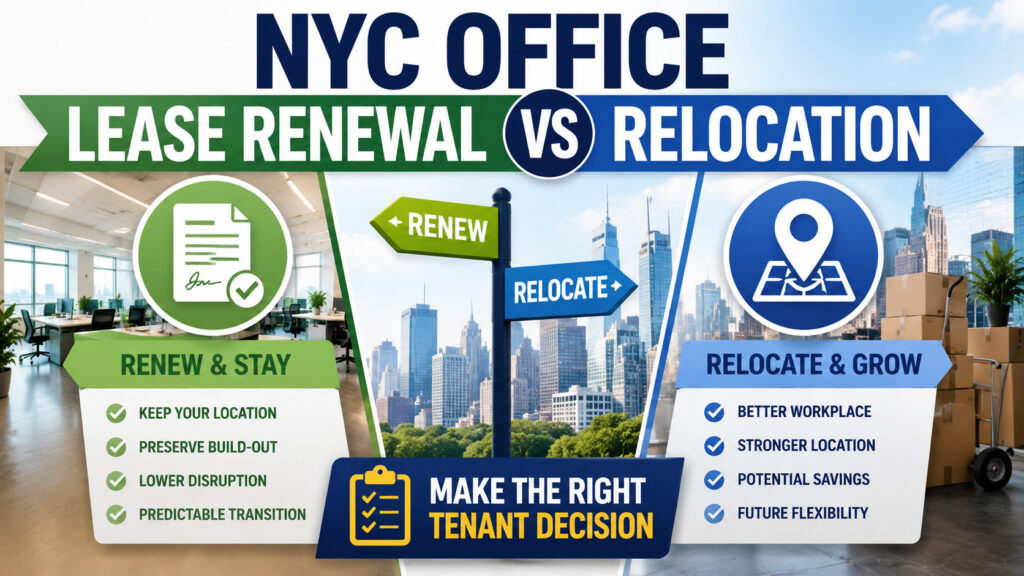
An expiring New York City office lease creates more than a choice between staying and moving. It creates a chance to reset occupancy costs, space needs, flexibility, location, and workplace strategy.
Renewing may preserve a valuable build-out while avoiding the cost and disruption of moving. Relocating may create a better workplace, smaller footprint, stronger location, or more favorable long-term economics.
Neither answer wins automatically. The right decision comes from testing both choices against the same requirements and financial assumptions. That process should also examine contraction, expansion, subleasing, renovation, and early restructuring.
The most important question is therefore not simply, “Should we renew or relocate?”
It is this:
Which occupancy strategy gives our business the best combination of economics, functionality, flexibility, location, and execution certainty?
The decision is bigger than renewing or moving
A tenant approaching lease expiration usually has several realistic paths. Treating renewal and relocation as the only choices can hide a better solution.
Your existing lease, future headcount, workplace attendance, budget, and current building will narrow those choices. However, tenants gain more leverage when they evaluate credible alternatives before negotiating exclusively with one landlord.
Occupancy path
What it means
When it deserves serious consideration
Renew in place
Extend the existing lease with little physical change
The location, footprint, and build-out still work
Renew and renovate
Stay while changing layout, finishes, technology, or amenities
The address works, but the workplace needs improvement
Expand or contract in the building
Add space, surrender space, or relocate internally
The building works, but the current footprint does not
Relocate
Lease another office and move operations
Another space creates enough value to justify moving
Sublease or create a bridge
Sublease excess space or use interim space
Timing, uncertainty, or excess space complicates a long commitment
A straight renewal can look simple. Yet the apparent simplicity can cause tenants to skip important diligence.
For example, your existing rent does not establish the market value of your premises. Your prior concession package does not establish today’s package either. Current building conditions, competing vacancies, ownership priorities, and your alternatives all matter.
Likewise, relocation should not mean touring buildings without a defined requirement. First determine how much office your company actually needs. Our office space calculator can help establish an initial planning range.
Renewal and renovation also require separate analysis. A tenant may love its location but dislike its current workplace. In that situation, redesigning the existing office can solve the operational problem without changing addresses.
However, construction inside an occupied office creates its own challenges. Phasing, noise, dust, furniture moves, technology work, and temporary seating can affect operations. Swing space may solve part of that problem.
Expansion presents another variation. Your landlord may have adjacent space, another floor, or future vacancies inside the building. An internal move can preserve the address while solving a footprint problem.
Contraction creates the opposite challenge. A tenant cannot simply stop paying for square footage that it no longer needs. The lease continues unless the landlord agrees otherwise.
Possible solutions include a negotiated giveback, internal move, early restructuring, or sublease. Each path creates different costs, risks, and timing requirements.
That distinction matters because unused square footage is not free merely because moving also costs money.
Start early enough to keep every option real
Timing creates leverage.
A tenant that starts early can compare alternatives, test layouts, negotiate terms, and solve unexpected problems. A tenant that waits may have fewer practical choices.
For many NYC office tenants, 12 to 18 months before expiration provides a useful decision window. Larger headquarters, complicated construction projects, or specialized workplaces may justify an 18-to-24-month process.
Starting early does not mean signing early. Instead, it preserves the ability to choose.
Pay particular attention to renewal-option deadlines. New York commercial lease disputes show why tenants should follow contractual notice procedures carefully. Courts regularly examine whether tenants exercised renewal rights within the required time and manner.
Do not assume an informal conversation protects a contractual renewal option. Likewise, do not assume a landlord must offer a new term because you occupy the space today.
Your attorney should interpret the actual lease and protect legal rights. Meanwhile, your tenant broker should establish market alternatives and negotiating leverage.
A practical office lease expiration process often develops like this:
Time before expiration
Tenant focus
18–24 months
Define long-term business needs for complex or larger occupancies
12–18 months
Audit lease, establish requirement, review market, and test alternatives
9–12 months
Tour credible spaces, prepare test fits, compare renewal economics
6–9 months
Negotiate proposals, resolve major business terms, advance preferred path
3–6 months
Complete documents, design, construction planning, technology, and move preparation
Expiration period
Occupy renewed space or complete the relocation without relying on holdover
Those ranges provide planning guidance rather than universal deadlines. Your lease may impose an earlier renewal notice or other critical date.
Do not let the renewal deadline become your decision deadline.
By that point, you should already understand the relocation market. Otherwise, the landlord may know that moving has become operationally difficult.
A credible alternative creates negotiating power even when you ultimately renew. Conversely, a serious renewal proposal prevents relocation discussions from becoming disconnected from your true stay-in-place economics.
That is why tenants should run both tracks in parallel until one becomes clearly stronger.
Compare renewal and relocation on the same cost model
Face rent does not answer the stay-versus-move question.
A proper comparison measures total occupancy cost and total transition cost. It also puts every option on the same time horizon.
For Q2 2026, Manhattan’s average asking rent reached $80.17 per square foot. Overall availability measured 14.4% under one major market methodology. Average direct and sublease conditions varied substantially by submarket and building quality.
Midtown averaged $86.18 per square foot with 12.7% availability during that quarter. Downtown averaged $61.34 per square foot with 16.6% availability.
Those averages provide context, not a quotation for your office. Two buildings several blocks apart can produce very different economics.
Moreover, research providers use different definitions for vacancy and availability. Therefore, compare trends within a consistent dataset rather than combining percentages from unrelated methodologies.
Your financial model should compare these items side by side:
Renewal economics
Relocation economics
Renewal base rent
New base rent
Annual escalations
Annual escalations
Free rent
Free rent
Renewal improvement allowance
New-space improvement allowance
Renovation above allowance
Build-out above allowance
Operating expense exposure
Operating expense exposure
Real estate tax exposure
Real estate tax exposure
Electricity and utility structure
Electricity and utility structure
Furniture reuse or replacement
Furniture purchase or relocation
In-place technology upgrades
Cabling, IT, telecom, and migration
Temporary swing space
Moving and transition costs
Internal disruption
Move-related downtime
Restoration obligations
Existing-space surrender obligations
Security changes
New security deposit or credit support
Professional fees
Professional and project costs
Next, normalize those figures over the proposed lease term.
A ten-year relocation with substantial free rent cannot fairly compare against a five-year renewal using only first-year rent. Likewise, a renewal should receive credit for avoided moving expenses.
However, avoid a common mistake: do not treat every existing investment as a reason to stay.
Money already spent on your old build-out may represent a sunk cost. What matters now is the value that build-out provides during the next lease term.
If the layout works for another seven years, that value can become substantial. Yet a beautiful office with the wrong size remains inefficient.
The same principle applies to furniture. Reusing furniture can reduce relocation expenses, but furniture dimensions may constrain a new test fit.
A landlord allowance reduces tenant capital only when it covers work you actually need. Construction pricing, architectural work, furniture, technology, permits, and contingencies can exceed the allowance.
Free rent also needs context. A long free-rent period may look impressive while a higher starting rent offsets part of its value.
Therefore, compare net effective economics, cash requirements, and accounting implications. Your finance team should also model occupancy costs under reasonable growth scenarios.
When renewing an NYC office lease makes more sense
Renewal often becomes the stronger choice when the office still supports the business.
That means more than liking the view or avoiding a move. The premises should meet future operating needs at a competitive total cost.
A renewal deserves priority when several conditions align.
Your employees can reach the office efficiently. The location also works for clients, recruits, and leadership.
The current footprint should fit expected staffing and attendance. In addition, conference rooms, private offices, collaboration areas, and support spaces should match future needs.
Existing infrastructure can strengthen the renewal case. Supplemental cooling, power, cabling, security systems, specialty rooms, and expensive architectural work may carry significant replacement costs.
Business continuity adds more value. A renewal can eliminate a physical move and reduce technology migration risks.
Even so, staying does not mean accepting the existing lease terms.
A renewal creates an opportunity to renegotiate rent, concessions, escalation structure, improvement dollars, security, options, and flexibility. It can also address rights that the original lease handled poorly.
Review our guide to office lease renewal options before assuming an option automatically creates an attractive deal.
A contractual renewal option and a negotiated renewal are different things.
An option may establish timing, term length, pricing mechanics, or a market-rent process. Another lease may provide no option at all.
When an option exists, protect it carefully. New York cases demonstrate that timing and notice mechanics can become decisive issues.
Yet exercising an option too early can also affect leverage. Coordinate legal protection with the broader negotiation strategy.
Renewal becomes especially compelling when moving economics fail to clear the hurdle.
Suppose another office saves $5 per square foot annually. That difference may disappear after construction, furniture, moving, technology, and downtime costs.
Conversely, staying at a modest rent premium may make financial sense when the current office requires little capital.
The landlord’s improvement package matters too. A tenant that needs substantial renovation should negotiate meaningful capital support rather than fund the entire refresh alone.
Current market conditions strengthen the need for building-level analysis. Manhattan recorded 5.93 million square feet of renewals during the first half of 2026.
At the same time, quality supply has tightened unevenly. Well-positioned buildings can command stronger economics than broad availability statistics suggest.
Therefore, a landlord may have limited incentive to discount desirable space. Another owner with harder-to-lease inventory may negotiate much more aggressively.
That difference explains why market testing matters even when you strongly expect to renew.
When relocation creates more long-term value
Relocation should solve a problem that staying cannot solve efficiently.
Moving only because another office looks newer rarely creates a sufficient business case. A meaningful relocation should improve economics, function, location, flexibility, or several factors together.
The clearest relocation trigger is a fundamental mismatch between your business and current premises.
Perhaps your company occupies 30,000 square feet but only needs 18,000. Negotiating a cheaper rate does not eliminate 12,000 unnecessary square feet.
An expanding company has the opposite challenge. Staying can suppress growth when the building cannot provide adjacent or nearby expansion space.
Layout inefficiency creates another reason to move. Older workplaces may contain oversized private offices, excessive circulation, obsolete file storage, or poorly located meeting rooms.
A more efficient plan can reduce square footage without reducing usable workplace capacity. That outcome may justify a higher rent per square foot.
Location can also overwhelm rent differences.
Commute patterns, subway access, regional rail, client proximity, neighborhood services, and recruiting priorities can change during a lease term.
A location that suited the company ten years ago may no longer fit the workforce. Moving closer to major transportation can strengthen attendance and recruiting for some tenants.
Recent leasing patterns show particularly strong tenant demand around upgraded, transit-rich office districts. One 2026 analysis found substantial relocation activity toward the Penn Station area during 2023–2025.
That does not mean every tenant should move west. It means location deserves direct measurement rather than assumption.
Map employee origin points. Compare commute times. Study client travel patterns. Then weigh those results against rent and building quality.
Building quality provides another relocation trigger.
Elevator performance, HVAC, power, backup systems, lobby quality, security, amenities, natural light, floorplate dimensions, and ownership investment can affect daily operations.
The market increasingly distinguishes between desirable offices and obsolete inventory. Manhattan can therefore show meaningful overall availability while premium options remain considerably tighter.
That divide creates an important tenant lesson:
Available space is not the same thing as suitable space.
A relocation search should identify spaces that actually satisfy your requirement. A spreadsheet containing hundreds of irrelevant vacancies does not create real leverage.
A landlord competing for a new tenant may provide free rent, improvement dollars, prebuilt work, or other inducements. Existing landlords may offer less when they believe the tenant prefers staying.
However, concessions should never distract from long-term cost. Evaluate the entire lease, including increases, operating charges, capital exposure, and flexibility.
Contraction, expansion, sublease, and early restructuring
Some lease expirations should not end with a conventional renewal or relocation.
Your business may need less space but cannot move immediately. Another tenant may need more space before its current lease expires.
A third company may face uncertainty about headcount, acquisitions, remote-work policies, or future capital needs.
Those situations call for a broader occupancy strategy.
Contraction can take several forms.
A landlord might accept a partial surrender when another tenant wants the space. Alternatively, you may move to a smaller suite inside the same building.
Subleasing excess premises creates another route. During Q2 2026, Manhattan’s sublease availability measured 2.6% under one major dataset. Average sublease asking rent reached $59.94 per square foot.
Downtown showed a larger 3.5% sublease availability rate and a $47.13 average sublease asking rent. Those figures illustrate how submarket conditions can alter sublease economics.
Yet subleasing does not automatically eliminate your lease liability. Your original lease determines approval rights, recapture rights, profit sharing, and other restrictions.
Furthermore, the original tenant usually retains obligations under the prime lease. Legal counsel should review those provisions before you market excess space.
Expansion requires equally early planning.
Check whether your lease contains expansion rights, first-offer rights, first-refusal rights, or options on adjacent space. Then compare those rights with current availability.
Internal expansion can avoid moving an entire company. However, disconnected floors or poorly configured additions may create operational inefficiency.
Sometimes one larger relocation creates better economics than maintaining fragmented suites.
An early restructure can solve a timing problem.
A landlord may extend the lease before expiration in exchange for near-term capital, new economics, or a longer commitment.
That approach can fund improvements while eliminating future lease-expiration uncertainty. Nevertheless, it reduces flexibility once the tenant commits.
Run a market comparison first. Otherwise, an early restructure can convert convenience into lost negotiating leverage.
A bridge strategy can buy decision time.
Short-term sublease space, temporary offices, or swing space may help during construction, consolidation, or uncertain growth.
The bridge should serve a defined objective. Repeated short-term solutions can create duplicate costs and recurring disruption.
The decision tree therefore looks less like “stay or go” and more like this:
Business condition
Strongest paths to test first
Current office fits and economics remain competitive
Renewal
Location works but workplace needs modernization
Renewal plus renovation
Business needs substantially less space
Contraction, internal move, sublease, or relocation
Business needs meaningful growth capacity
Expansion rights or relocation
Current building cannot support operations
Relocation
Long-term headcount remains uncertain
Shorter renewal, sublease, or bridge
Current lease has favorable terms but excess space
Sublease excess area
Timing makes a full move impractical
Renewal extension, restructure, or bridge
The right answer may combine several approaches. For example, a tenant could renew one floor, surrender another, and renovate the retained premises.
That combination can outperform both a complete renewal and full relocation.
How NYC location changes the renewal decision
New York City does not operate as one uniform office market.
Building quality, transportation, available sizes, ownership, and rent can change within a few blocks. Therefore, citywide averages should guide context rather than dictate a lease decision.
Midtown offers the largest concentration of established corporate office districts.
Within Midtown, however, Grand Central, Park Avenue, Sixth Avenue, Plaza District, Times Square, Penn Station, and other areas can produce different choices.
Q2 2026 Midtown availability measured 12.7% under one major dataset. Average asking rent reached $86.18 per square foot.
Yet the best buildings can behave like a much tighter market. That distinction matters during both renewals and relocations.
Midtown South creates another set of trade-offs.
Companies may value proximity to Flatiron, Chelsea, Union Square, NoMad, SoHo, and surrounding neighborhoods. Building stock can range from converted lofts to newer towers.
The correct comparison should consider more than asking rent. Floor efficiency, ceiling height, elevators, HVAC, amenities, and build-out condition can change total value.
Downtown can produce a different economic profile.
For Q2 2026, Downtown’s average asking rent measured $61.34 per square foot. Availability stood at 16.6% using the same methodology.
Those averages sat below Midtown pricing. Still, building quality and individual blocks produced substantial variation.
Qualified Downtown leases can also intersect with commercial incentive programs. City programs currently include benefits for certain eligible new, renewal, and expansion leases in qualifying buildings and locations.
Eligibility depends on detailed program rules. Tenants should confirm current requirements before including incentives in financial projections.
A neighborhood comparison should ultimately answer five practical questions.
How will the location affect employees? How will clients experience the office?
Next, what building quality can the same budget buy? Consider how the area supports future hiring.
Finally, determine whether the location will still work near the end of the next lease.
That last question matters because an office lease commits the company to a future operating model.
The goal is not to choose today’s most fashionable address. Instead, choose the location that supports the business throughout the expected term.
The final NYC office renewal versus relocation test
A good decision should survive financial, operational, and strategic scrutiny.
Before committing, place the renewal and strongest relocation alternative on one page. Use identical assumptions wherever possible.
Start with the premises. Does each option provide the correct amount of usable space?
Then examine layout efficiency. A smaller efficient office can outperform a larger cheaper office.
Include capital requirements as well as total expense. Two options with similar long-term costs may require very different cash commitments.
Measure business disruption separately. Renewal often reduces physical moving costs, but renovation can create substantial disruption.
Relocation introduces a move. However, a move into completed prebuilt space may prove easier than renovating an occupied office.
Evaluate location with data. Employee commute patterns, leadership access, clients, transportation, and recruiting should shape the decision.
Do not let habit substitute for measurement.
Review the building itself. Examine HVAC, elevators, electrical capacity, ownership plans, amenities, lobby condition, security, and planned capital work.
A weak building can undermine an otherwise attractive renewal.
Model flexibility. Ask what happens if headcount changes by 20% in either direction.
Look for expansion rights, contraction possibilities, sublease rights, assignment provisions, and termination opportunities.
Protect the lease calendar. Track renewal-option notices, lease expiration, holdover language, and internal approval deadlines.
Do not build your strategy around the assumption that a missed option deadline can get fixed later. New York commercial cases repeatedly demonstrate the importance of option timing and notice requirements.
Finally, test the decision against credible market alternatives.
Q2 2026 Manhattan leasing totaled 7.88 million square feet, which exceeded its five-year quarterly average by 24%. Availability also declined to 14.4%.
Another 2026 dataset showed even tighter conditions under its methodology. More importantly, it found growing competition for well-positioned and highly amenitized buildings.
That combination changes how tenants should interpret choice.
A market can contain millions of available square feet while offering few spaces that fit one specific tenant. Consequently, starting early protects your ability to compare real alternatives rather than theoretical inventory.
A renewal should win because it earns the decision
Staying makes sense when the existing office remains functional, strategically located, and financially competitive.
A landlord’s proposal should reflect the value of your tenancy. The renewal should also address whatever has changed since the original lease.
Perhaps your company needs more flexibility. Maybe the workplace needs renovation.
Security requirements may have changed. Expansion rights might now matter more than they did five years ago.
Whatever changed should appear in the renewal analysis.
A relocation should clear a higher hurdle
Moving introduces friction.
The new office should therefore create enough economic or strategic improvement to justify that friction. Better finishes alone rarely provide a complete reason.
A relocation becomes compelling when several advantages combine.
You might secure a materially better footprint. The new location could improve transportation.
Another building may deliver stronger systems and amenities. Competitive concessions could reduce capital requirements.
Most importantly, the office may support the business better throughout the next lease cycle.
Is renewing an NYC office lease usually cheaper than relocating?
Not automatically.
Renewal often avoids moving, furniture relocation, cabling, and certain construction expenses. Yet an existing landlord may offer a less aggressive concession package.
A competing landlord may offer substantial free rent or improvement capital. Therefore, the answer depends on net economics rather than face rent alone.
How far before expiration should an office tenant start?
Most tenants should begin meaningful planning roughly 12 to 18 months before expiration.
Larger occupancies, headquarters moves, specialized construction, and complex internal approvals can justify 18 to 24 months.
Your lease may require action earlier. Check every renewal and notice provision before relying on a general timeline.
Should a tenant tour alternatives before negotiating a renewal?
Usually, yes.
A market survey gives the tenant evidence about price, quality, location, concessions, and available sizes. Tours make that comparison more concrete.
The process does not commit the company to moving. Instead, it helps determine what staying is actually worth.
What happens when the current office is too large?
First quantify how much space the company genuinely needs.
Then compare partial surrender, internal relocation, subleasing, renewal of a smaller footprint, and complete relocation.
Use the office space calculator before negotiating around an outdated square-footage assumption.
What if the company expects to grow?
Determine when that growth will occur and how much space it requires.
Next, examine adjacent availability, expansion rights, internal building options, and future vacancies. Compare those choices with relocating into a larger flexible floorplate.
Avoid paying for several years of unnecessary space solely because growth might occur later.
What if the company cannot predict future headcount?
Uncertainty increases the value of flexibility.
A shorter extension, smaller direct lease, sublease, expansion right, or structured renewal may reduce long-term risk.
However, shorter commitments can carry different economics. Compare the flexibility premium against the cost of committing too much space.
Can a tenant renew and redesign the office?
Yes, and that option deserves its own financial analysis.
A renewal can include landlord-funded improvements, tenant-funded work, or a combination. Construction inside an occupied workplace may require phasing or temporary space.
Develop the build-out budget before accepting an improvement allowance at face value.
Does a renewal option guarantee favorable rent?
No.
The lease controls the option’s pricing and mechanics. Some options use fixed rent, while others establish formulas or market-based procedures.
A contractual right to remain can hold significant value. Nevertheless, the resulting economics still require careful review.
What if the lease contains no renewal option?
Do not assume continued occupancy.
Start a negotiated renewal early while maintaining credible alternatives. Your attorney should determine your contractual rights and notice obligations.
Meanwhile, market testing protects the business if ownership refuses acceptable terms.
Should a tenant consider sublease space when relocating?
Yes, when suitable inventory matches the requirement.
Subleases can provide different economics, existing improvements, furniture, or shorter remaining terms. They can also create less flexibility around alterations and extension rights.
Compare the prime lease, sublease documents, remaining term, credit structure, and build-out before choosing that route.
What should decide the final choice?
The strongest answer usually balances five issues:
total cost, workplace fit, location, flexibility, and execution risk.
No single factor should control every lease decision.
A cheap office that damages operations may not create value. Likewise, a premium office that exceeds the budget can create a different problem.
We represent office tenants, not landlords, throughout New York City. Our role is to price a renewal against credible alternatives before timing narrows your choices. Start by reviewing current office listings or contacting a tenant broker to compare the two paths.
Fill out our 📋online form or give us a call today 📞212-967-2061 — let’s find the right options for your business.