Office Space Near Union Square for Flatiron Tenants
Why this location works for Flatiron tenants
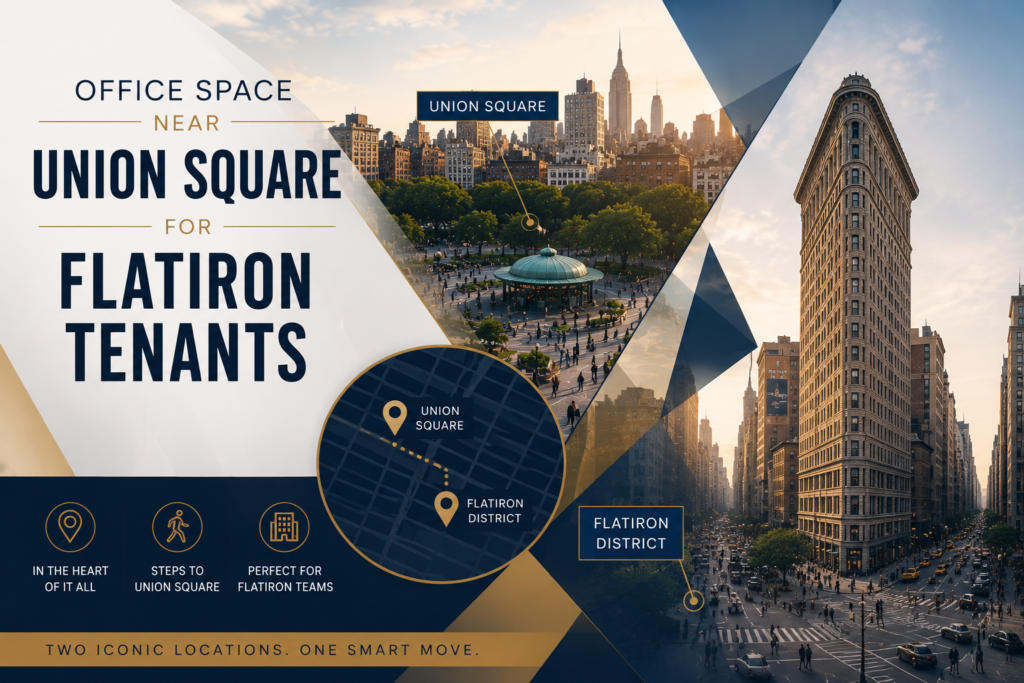
Flatiron tenants usually do not need a generic Union Square preview. They need the southern Flatiron band that connects fast to Union Square. On this requirement, Flatiron covers the area from 20th Street to Union Square, and it spans from Seventh Avenue to Gramercy. That geography keeps the scope tight and prevents this from drifting into a broad neighborhood roundup.
Union Square gives Flatiron tenants a real transportation edge. The Union Square–14th Street station ranks as one of the city’s biggest transit hubs. Eight subway lines meet there, and the district also draws seven bus lines. The Union Square Partnership says the hub serves more than 35 million travelers annually, while the district supports over 152,000 workers, 75,000 residents, and 60,000 students.
That volume matters because office demand tends to follow access. Union Square office availability stood at 10.9% in the district’s 2025 market report, which beat the Manhattan figure of 17.2% in that same report. Meanwhile, Newmark put Flatiron/Union Square asking rents at $87.18 per square foot in the first quarter of 2026, nearly in line with Midtown South at $88.32. In plain English, tenants near Union Square can stay inside the Flatiron ecosystem without paying a major submarket premium simply for proximity to better transit.
Put differently, this sub-market works best for tenants who want Flatiron identity plus Union Square access. That usually means firms that care about hiring reach, client convenience, flexible floor plates, and a better daily commute. It also suits teams that want loft character, move-in-ready subleases, or full-floor opportunities within a short walk of the hub.
The commuter logic that actually matters
Start with the obvious draw. Union Square gives direct access to the 4, 5, 6, L, N, Q, R, and W lines. MTA line maps also show nearby service at 23rd Street on the N, R, and W, plus additional access on the 4 and 6 nearby. That mix helps teams pull commuters from the East Side, West Side, Brooklyn, Queens, and many transfer points without forcing a long final walk.
For East Side riders, the Union Square equation stays simple. The 4, 5, and 6 lines keep Midtown East, Grand Central, and Lower Manhattan easy to reach. Several nearby Flatiron buildings also sit within walking distance of the 23rd Street and 28th Street stops, which adds another layer of flexibility for teams that do not want every commute to depend on one hub.
For Brooklyn and Queens riders, the corridor gets stronger as you move closer to Broadway and Union Square. The N, Q, R, W, L, and nearby F and M routes cover a broad share of cross-borough demand. Buildings such as 114 Fifth Avenue, 111–115 Fifth Avenue, and 902 Broadway all sit close enough to Union Square or 23rd Street to keep that commute logic intact.
New Jersey commuters should not ignore this area. Several Flatiron buildings near Union Square also point to PATH access at 14th Street and Sixth Avenue. That matters for firms with a Jersey City, Hoboken, or Newark labor pool. Moreover, the 14th Street busway improves east-west movement, and MTA says travel times on the corridor improved by 36% after the busway changes.
The street-by-street choice also changes the commute feel. Blocks at 14th through 17th Street give the shortest walk to the station. Fifth Avenue and Broadway from roughly 18th through 20th Street balance Union Square access with a stronger Flatiron office identity. The 21st through 23rd Street band still works well, but it shifts more of the commute load toward the 23rd Street stations and a slightly longer walk south. That is a practical inference from the transit network and the locations of nearby office buildings.
If your team brings clients in from outside Manhattan, the case gets even stronger. Union Square recorded a daily weekday average of 380,000 visits in 2025, and the 14th Street–Union Square station handled 22.9 million riders in 2024. That traffic creates a familiar meeting point, a strong retail base, and a simpler arrival pattern for guests who do not know the neighborhood well.
What tenants can lease near Union Square without leaving Flatiron
Near Union Square, Flatiron tenants usually see four real product types. First, you have small direct leases in classic loft buildings. Next, you have prebuilt or furnished subleases that cut move time. Then come mid-size direct leases for growing firms that need a stronger identity. Finally, the corridor offers full-floor and headquarters-style blocks for larger teams.
That range matters because the submarket does not force one style of tenancy. A small team can still chase a compact loft near the core. A hybrid team can push into a built space with wiring, conference rooms, and a kitchen. A scaling group can stay in the area and move into a bigger full-floor stack later. Even large users can now explore a building-scale opportunity in the district.
Current market conditions support that flexibility. Newmark’s first-quarter 2026 report showed Flatiron/Union Square at $87.18 per square foot, with 13.9% availability. Newmark also showed Midtown South at $88.32 and 16.9% availability, while CBRE’s June 2026 Midtown South figures put the broader submarket at 17.1% availability and $86.38 average asking rent. That tells tenants two useful things. First, the corridor stays competitive within Midtown South. Second, serious options still exist if you move quickly and size the search right.
Lease structure drives your strategy as much as the block. Subleases often come furnished, wired, and ready for short-term occupancy. New York Offices notes that subleases can run about 15% to 30% cheaper than direct leases, though they usually offer less control and shorter terms. By contrast, direct deals often give stronger long-term control and better room for negotiation on concessions, layout, or future growth.
The neighborhood also rewards tenants who understand building type. Broadway tends to produce classic Midtown South loft character. Fifth Avenue often adds stronger frontage, a cleaner branding line, and a more polished arrival. New York Offices points to the Broadway band in upper Flatiron and Union Square as one of the strongest zones for authentic prewar loft identity, while several Fifth Avenue buildings emphasize visibility, modern systems, and strong access to Union Square.
Team-size fit and nearby inventory
Space planning should start with people, not with a random square-foot number. New York Offices recommends a rough early benchmark of 125 to 175 rentable square feet per employee, then another 15% to 25% for common areas. A related guide suggests about 150 to 200 usable square feet per employee, depending on layout and work style. That means a 10-person office often starts around 1,500 square feet, while a 20-person office often begins around 3,000 square feet before you adjust for room mix or hybrid attendance.
Small teams should look first at compact loft space close to the core. The Small Flatiron District Office offers 1,025 square feet at 37 West 20th Street and supports about 4 to 10 seats. The listing also points to nearby F, M, R, W, 1, L, and 6 access, plus an easy walk to both Madison Square Park and Union Square. For a six- to ten-person team, that size and location line up well with a practical first office near the hub.
Mid-size teams often do best in the 3,000 to 7,500 square foot range. The Flatiron Prebuilt Office Space offers 5,594 square feet on West 23rd Street, with five private offices, three sizable conference rooms, and a kitchen. The Union Square Furnished Office Space at 853 Broadway gives roughly 7,000 square feet on a full floor near the station, along with glass offices, a boardroom, and more than 30 workstations. Those two products suit firms that want a faster move and a stronger collaboration layout.
Growth-stage teams that need a real headquarters feel should look at the 10,000 to 12,000 square foot range. The Flatiron Former WeWork Office at 149 Fifth Avenue spans 11,239 square feet, comes furnished and wired, and supports 48 workstations with room to push toward about 90. Nearby, the Flatiron Loft Office Rental offers 11,578 square feet with private rooms, a kitchen, dual bathrooms, and a large open area. For a team that expects growth but wants to stay near Union Square, those options hit a useful middle ground.
Large teams can stay in the same corridor instead of jumping elsewhere in Midtown South. The Flatiron Area Full Floor Office at 114 Fifth Avenue advertises 19,338 square feet on a full floor between Union Square and Madison Square Park. The page describes the suite as a fit for about 129 people and highlights direct access to FM, NQRW, L, and 456 service nearby. That scale gives larger tenants room for brand presence, internal neighborhoods, and stronger meeting infrastructure without giving up the Union Square commute advantage.
Very large occupiers should look at building-scale opportunities when they appear. 175 Fifth Avenue now markets a rare full-building opportunity of about 205,000 rentable square feet, with full floors of 10,400 square feet. That kind of supply almost never appears in this part of Midtown South, so enterprise users that want a landmark address near Union Square should keep an eye on it.
At the building level, a few addresses stand out for repeated tenant logic. 114 Fifth Avenue leans into frontage, modern systems, and direct Union Square access. 111–115 Fifth Avenue adds larger floor possibilities and broad transit coverage. 902 Broadway sits between Union Square and Madison Square Park and keeps both 23rd Street and the 14th Street hub in play. Each building serves a different size band, but all three support the same thesis: stay in Flatiron, gain Union Square access, and protect commute flexibility.
How to choose the right block and the right deal
If your team comes in from many boroughs, favor the shortest walk to Union Square. Buildings from 14th to 17th Street reduce the final leg and help hybrid teams, frequent visitors, and client-facing firms. That makes sense for companies that value fast arrivals more than a quieter office setting.
If you want a better balance, focus on the Fifth Avenue and Broadway stretch from about 18th to 20th Street. That band keeps Union Square easy while still feeling distinctly Flatiron. It also preserves access to Madison Square Park, nearby lunch options, and additional transit north at 23rd Street. In practice, many tenants find this zone gives the cleanest blend of commute quality and neighborhood identity.
If cost and flexibility lead the search, compare sublease and direct options side by side. Subleases often lower the initial cost and shorten the move timeline. Direct leases usually offer more control, more term flexibility, and a cleaner long-term solution once your team stabilizes. Small teams should usually test both lanes because the wrong structure can matter as much as the wrong block.
Do not stop at the asking rent. Note that loss factor changes the real cost per usable square foot. Two spaces can quote the same rent, yet one can waste far more space in shared corridors, lobbies, and building core. As a result, a seemingly cheaper deal can cost more once you measure the actual floor plan your team uses every day.
Budgeting also gets easier once you translate annual rent into monthly occupancy. At Newmark’s first-quarter 2026 Flatiron/Union Square average of $87.18 per square foot, a 1,500-square-foot search runs about $10,897.50 per month before add-ons, a 5,000-square-foot search runs about $36,325 per month, and a 10,000-square-foot search runs about $72,650 per month. Those figures do not replace a live quote, but they give tenants a practical screening range while they compare route, layout, and term.
Finally, tour with a commute map in mind. Ask where your staff actually live. Test the walk from Union Square, not just the lobby photos. Time the path from the train, check the lunch run, and measure how fast visitors can find the building. Near Union Square, little friction points add up fast, and the right block often wins before the negotiation even starts.
Frequently asked questions
Is Union Square better than deeper Flatiron for a hybrid team?
Often, yes. Hybrid firms usually benefit from easier arrivals because staff come in less often and value friction-free commutes more. Union Square gives eight subway lines, major bus service, and extremely high daily foot traffic, while nearby Flatiron inventory still delivers loft and prebuilt options.
How close should a Flatiron tenant stay to Union Square?
Many teams should stay within a short walk south of 20th Street or along Broadway and Fifth Avenue. That range keeps the 14th Street hub close while preserving a true Flatiron work setting. Firms with more West Side or PATH commuters can also stretch north toward 23rd Street without losing the concept.
Can small tenants still find office space near Union Square without taking coworking space?
Yes. The current field still includes compact direct lease space and smaller loft opportunities. A live example sits at 37 West 20th Street, where a 1,025-square-foot suite supports about 4 to 10 seats and keeps multiple subway lines within reach.
Should a tenant choose a sublease or a direct lease here?
Choose a sublease when speed, furniture, and lower upfront cost matter most. Choose a direct lease when you want more control, more term certainty, or better long-run alignment with growth. Near Union Square, both routes work because the inventory mix includes furnished sublets, loft direct leases, and larger full-floor options in the same corridor.
What kinds of spaces should Flatiron tenants tour first?
Start with the product that matches your headcount and work style. Small teams should begin with Small Flatiron District Office. Mid-size teams should compare Flatiron Prebuilt Office Space and Union Square Furnished Office Space. Larger users should tour Flatiron Former WeWork Office, Flatiron Loft Office Rental, Flatiron Area Full Floor Office, and the building pages for 114 Fifth Avenue, 111–115 Fifth Avenue, and 175 Fifth Avenue.
What is the real reason this search tends to perform?
Because it solves a specific problem. Tenants want Flatiron office identity, but they also want Union Square commuting power. When a page answers that exact need with transit logic, team-size fit, lease-type guidance, and nearby inventory, it serves the search far better than a generic neighborhood page. That conclusion follows from the district’s transit strength, visitor volume, market tightness, and the range of nearby listings.
Looking for Space Today?
We represent office tenants exclusively, never landlords. Our team helps businesses compare every available option near Union Square and Flatiron, negotiate stronger lease terms, reduce occupancy costs, and secure office space that aligns with both operational needs and long-term growth goals.
Unlike landlord-focused listing platforms, we advocate solely for the tenant throughout the process. From market analysis and site selection to financial negotiations and lease execution, we provide unbiased guidance designed to maximize leverage, flexibility, and value.
Fill out our 📋 online form or give us a call today 📞 212-967-2061 — let’s find the right office for your business.