True Monthly Cost of Office Space NYC
Why the Quoted Rent Never Tells the Full Story
We represent tenants only. Our work compares spaces, exposes hidden costs, and negotiates terms from the occupier’s side. That tenant-first approach matters because the asking rent rarely matches the real monthly bill.
Across major reports, Manhattan asking rent sits around $73 to $78 per rentable square foot yearly. One current market report puts Midtown near $76.96, Midtown South near $80.94, and Downtown near $56.67 on full-service asking rent. Another current report puts Manhattan overall at $78.01 with availability near 15.1%, while another shows $73.13 with vacancy near 19.9%, so tenants should compare buildings and deal terms, not one headline number.
Quick answer: In mid-2026, most Manhattan tenants should budget from the full monthly stack, not the face quote.
Your real number usually includes rent, electric, internet, insurance, city rent tax exposure, cleaning gaps, and move-in capital.
If you compare spaces without those lines, you can pick the wrong office for the wrong reason.
A smart tenant reads two numbers at once. First, read the invoice monthly cost, which covers the bills you will actually pay each month. Next, read the effective monthly cost, which spreads free rent, landlord work, deposits, furniture, and build-out economics across the full term. For broader context, pair this page with this commercial leasing guide.
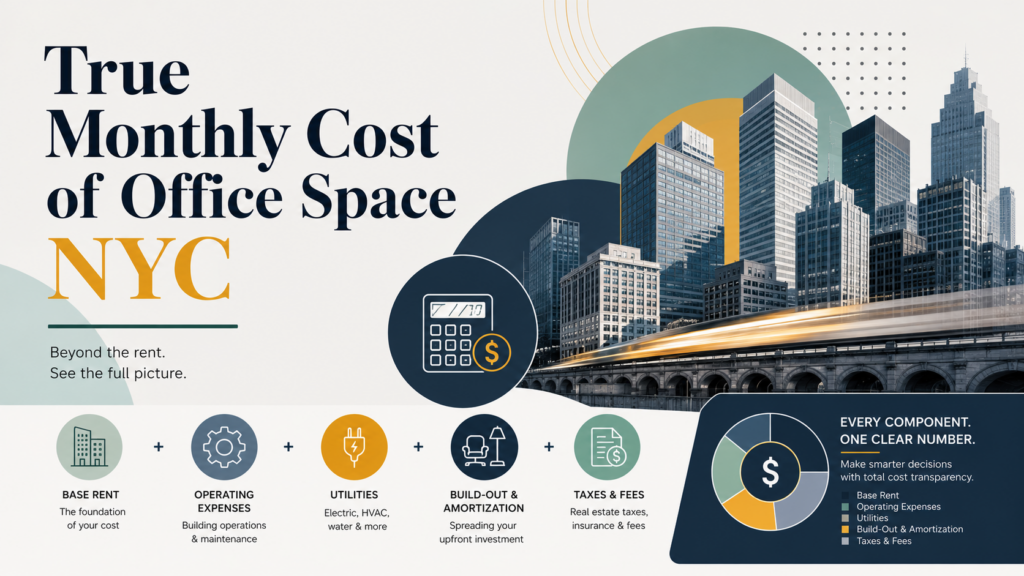
What You Actually Pay Every Month
Landlords bill tenants on rentable square feet, not just usable square feet. Common corridors, shared restrooms, and lobby areas push rentable area above the space your team controls. The city’s commercial leasing guide shows the math clearly. A 1,000-square-foot suite with a 10% share of 1,000 common square feet becomes 1,100 rentable square feet. At $50 per square foot yearly, that deal costs $55,000 yearly, or $4,583.33 monthly.
Monthly base rent = rentable square feet × annual rate ÷ 12.
Base rent still does not finish the budget. Many leases add annual operating-expense increases, real-estate-tax increases, fixed rent bumps, or wage-linked escalations. The city guide says tenants should ask for estimates of those extra charges before they sign. It also notes that fixed annual rent increases often run around 2% to 3%.
Electricity usually drives the first surprise. The city guide says tenants typically pay electric as a separate charge, either through a direct meter or a submeter, and it notes that direct meter usually costs less. A current occupier-side budgeting model for NYC office users pegs standard electric around $3 to $3.50 per square foot yearly. Need cooling after lease hours. Landlords often charge overtime HVAC when building systems run past standard hours.
Cleaning changes invoices too. Many top-tier buildings wrap nightly cleaning into the rent, but many others do not. A current NYC office budgeting source models cleaning near $2 per square foot yearly when the quote excludes it. That is not a huge line by itself, yet it adds up fast over a full term.
Internet and insurance look smaller, yet they still matter. Business internet in New York now advertises from about $50 to $69 monthly on entry plans. General liability often starts near $45 monthly, and New York pricing can run much higher. Once annual base rent reaches $250,000, another line can appear. Manhattan tenants south of 96th Street may owe the city’s commercial rent tax at an effective 3.9% rate. Credits can reduce that burden near the threshold. If you want to pressure-test square footage before you budget, use this office space calculator.
How NYC Location and Lease Type Change the Math
Location still shapes the biggest line item. Current Manhattan data show Midtown around $76.96 per square foot, Midtown South around $80.94, and Downtown around $56.67 on full-service asking rent. Another major research report puts Manhattan overall at $78.01, so you should treat those numbers as a market band, not a fixed citywide rule.
Inside Midtown, the spread grows wide. Recent data place Park Avenue near $111.97, Madison/Fifth near $103.95, and Penn Station near $105.81. The same data put Grand Central near $69.93 and Murray Hill near $59.21. Midtown South swings hard too. Chelsea sits near $82.27. Madison/Union Square sits near $73.79. SoHo sits near $76.96. Greenwich and NoHo run near $94.91.
Downtown usually gives the value play. Financial East sits near $52.86. Financial West sits near $50.71. The World Trade area sits near $69.04. TriBeCa sits near $70.79. Therefore, tenants who want lower face rent without leaving Manhattan often start Downtown, then compare the tradeoff in image, buildout, commute, and amenities. For live neighborhood inventory, browse Midtown East office space, Flatiron office space, and Financial District office space.
Lease type shifts the result again. Flexible private offices now quote around $400 to $1,200 per desk monthly. One recent Manhattan guide puts the local average around $750 to $800 per desk. Those deals often wrap furniture, internet, and common-area services into one payment. That format helps small teams, uncertain headcounts, and fast move-ins. Traditional leases often win later, especially when a team needs more seats and can spread startup costs across a longer term.
Space planning matters just as much as neighborhood choice. A practical Manhattan planning range runs about 100 to 250 rentable square feet per person. Startup and hybrid plans often start nearer 125 to 175. Hybrid teams can also reduce office size by about 20% to 40% when peak attendance stays below total headcount. If you want to test your own assumptions, use this office sizing guide before you tour.
Sample True Monthly Cost Scenarios
The scenarios below use full-service asking rent, the standard electric model above, entry-level business internet, and a small liability placeholder. They do not include furniture, cabling, custom construction, moving, or overtime HVAC. Therefore, treat them as working monthly budgets, not final proposals.
Budget direct lease. Suppose you lease 2,500 rentable square feet at $50 yearly. Base rent lands at $10,416.67 monthly. Add standard electric of about $625 to $729. Then layer in entry internet and light insurance, and the bill lands near $11,137 to $11,395 before cleaning. If the building excludes cleaning, add about $417 more each month. That pushes the live number near $11,553 to $11,812. At this rent level, annual base rent stays below the usual city rent tax threshold.
Mid-market lease. At $80 yearly on 2,500 rentable square feet, base rent reaches $16,666.67 monthly. Add the same electric range, internet, and light insurance, and you sit near $17,387 to $17,645 before cleaning. If the quote excludes nightly cleaning, the monthly stack rises near $17,803 to $18,061. This kind of math explains why a quote that looks manageable can still outrun the first draft budget.
Core Midtown lease. At $106 yearly on 2,500 rentable square feet, base rent hits $22,083.33 monthly. Electric adds roughly $625 to $729. Because annual base rent now exceeds $250,000, the city rent tax can add about $861 monthly below 96th Street. With internet and light insurance, that office can cost about $23,664 to $23,923 before any cleaning gap or after-hours HVAC. One line item did not cause that jump. The stack caused it.
Flex private office. A 10-desk private suite at roughly $750 to $800 per desk runs about $7,500 to $8,000 monthly. Many flexible deals already include furniture, internet, and cleaning. That simplicity can beat a traditional lease for a small or fast-changing team, even when the per-seat rate looks expensive at first glance. For live inventory examples, compare this small furnished Midtown suite, this full-floor Penn area office, and this larger furnished Downtown office.
Upfront Costs and Concessions Change the Effective Monthly Cost
Monthly cost tells only half the story. Landlords also ask for upfront security. The city’s leasing guide says two months of rent commonly appears. Current NYC office budgeting models often underwrite four to six months for many users, and much more for startups. That cash does not vanish forever, yet it still affects the real cost of taking space.
Furniture and cabling can quietly add a second rent payment. Current NYC tenant budgeting models place furniture around $10 to $30 per square foot and wiring around $5 to $10. On 2,500 square feet, that means roughly $37,500 to $100,000 upfront. Spread across five years, that capital adds about $625 to $1,667 per month. A team that ignores that line can misprice the deal by a wide margin.
Construction changes the picture even more. One current fit-out guide puts New York City hard construction near $220.62 per square foot. Its all-in example lands near $330.92. On 2,500 square feet, that equals about $551,550 in hard cost and roughly $827,300 all-in. Raw space can therefore crush a cheap rent quote. This is why prebuilt suites, furnished subleases, and landlord-delivered work carry real economic value.
Tenant improvement money softens that blow, but it rarely covers everything. Current Manhattan guidance places many prime Midtown Class A allowances around $50 to $75 per rentable square foot. Many Class B deals land around $35 to $50 on similar long terms. In other words, a generous allowance still covers only part of a full NYC build-out. If you want more detail on that tradeoff, review this tenant improvement guide.
Because of that gap, smart tenants model effective monthly cost, not just invoice cost. Start with total rent. Then subtract free rent, landlord work, and allowance dollars, add your own capital, and divide by the full term. That approach shows whether a seemingly cheaper option actually costs more after build-out, furniture, and deposit demands. For a concession glossary, review this lease incentives guide.
How to Cut the Real Cost Before You Sign
First, compare the whole stack. Ask what the quote includes. Ask how the building bills electric. Ask whether HVAC carries overtime charges. Ask whether the city rent tax applies. Then compare rentable square feet, not just the layout behind the glass front. Tenants lose money when they compare pretty floor plans but ignore the billing mechanics.
After that, size the office from peak attendance. Many teams overpay because they lease for total payroll, not daily demand. Use a realistic planning range, then test growth and hybrid assumptions with the office space calculator and the office sizing guide. Right-sizing usually beats rate shopping.
Product choice should match business certainty. Very small teams, short commitments, and urgent move-ins often favor flexible suites or furnished sublets. Stable teams with clearer growth paths often win more control and lower long-run cost through well-negotiated direct leases or subleases. The right answer changes with headcount, term, and how much capital you want to tie up on day one.
Negotiation still drives the final number. Push for capped escalations, lower deposits, free rent, turnkey work, audit rights on build-out invoices, and clear rules on after-hours HVAC. Also put every promised service in writing, because oral comments do not control the lease. A strong deal often wins through structure, not just through a lower face rate.
If you want live options by area, start with Midtown East office space, Flatiron office space, and Financial District office space. For plug-and-play examples, compare this small furnished Midtown suite, this full-floor Penn area office, and this larger furnished Downtown office.
FAQ
How much does office space cost in NYC each month? Across recent Manhattan reports, asking rent runs about $73 to $78 per rentable square foot yearly overall. That equals roughly $6.08 to $6.50 per rentable square foot monthly before electric, internet, insurance, and any city rent tax. Flexible private offices usually quote around $400 to $1,200 per desk monthly. Many Manhattan options cluster near $750 to $800.
What does $50 per year mean on a 2,500-square-foot lease? A $50 quote means $50 per rentable square foot, per year. On 2,500 rentable square feet, base rent equals $125,000 yearly, or $10,416.67 monthly. Add standard electric, internet, and insurance, and the live monthly bill lands higher. If the building excludes cleaning, add about $417 monthly more.
Does the monthly quote include electricity? Not always. NYC leasing guidance says tenants usually pay electric as a separate charge, either through a direct meter or a submeter. Current budgeting models peg standard office electric near $3 to $3.50 per square foot yearly, and direct metering usually costs less.
When does the city rent tax matter? It matters once annual base rent reaches $250,000 in Manhattan south of 96th Street. The effective rate is 3.9%, although credits can reduce the burden near the threshold. That means a high-rent Midtown office can carry a meaningful extra monthly line.
Does the apartment 30% rule help with office budgeting? No. Apartment screening logic does not fit office leasing. Use rentable square feet, headcount density, service inclusions, tax exposure, and growth plans instead. That method reflects how office leases actually work in Manhattan.
Which usually costs less, flex or direct? Flex often wins for very small teams or short terms because it bundles furniture and services. Direct or sublease space often wins once teams need more seats and can spread startup costs across longer terms. The only reliable answer comes from side-by-side monthly modeling, not from face rent alone.
Fill out our 📋 online form or give us a call today 📞 212-967-2061 — let’s find the right office for your business.