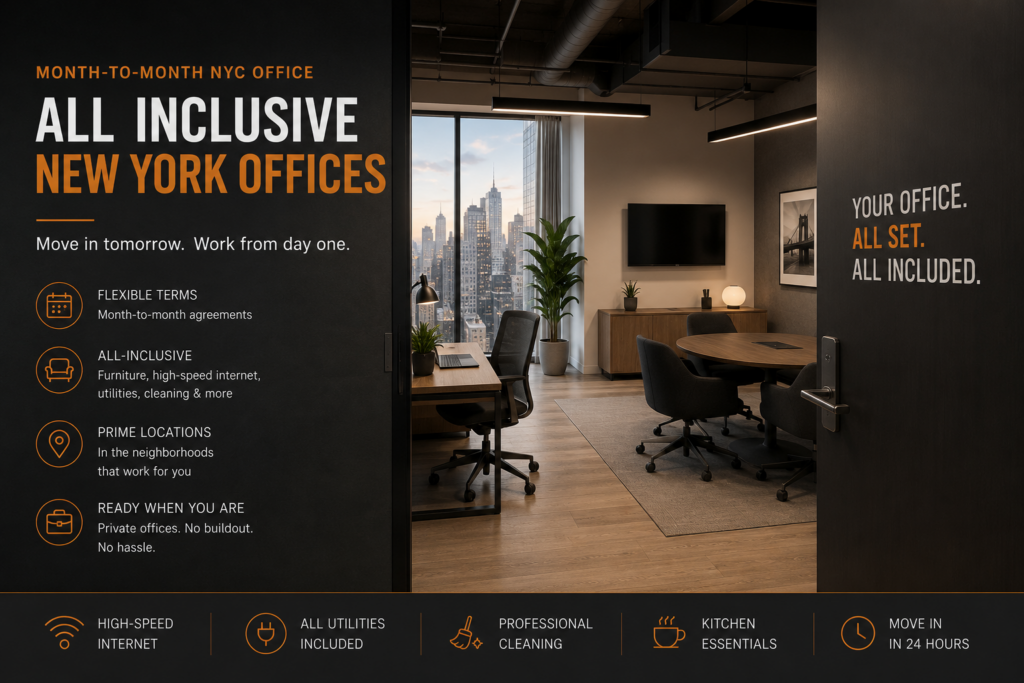
Month-to-Month NYC Office | All Inclusive New York Offices
This page still explains month-to-month space in plain English, because many tenants start there before moving into a real office.
As of May 2026, Manhattan supply had tightened to 69.18 million square feet, down 29.4% from the post-pandemic peak. Availability also fell to 13.2%, while asking rents reached their highest level since August 2020 after rising nearly 6% over the prior year. That backdrop matters because short-term office shoppers now compete inside a market with less slack than many headlines suggest.
Most searchers do not want a desk membership. Instead, they want privacy, a simple monthly bill, fast move-in, and no buildout. Operators answer that demand with furnished private offices, staffed receptions, meeting rooms, lounges, phone booths, cleaning, mail handling, and business internet.
Plain English: A true month-to-month NYC office usually means a private office inside managed, shared space. If your company wants a self-contained office and a term of two years or longer, compare office sublets and all office listings before you sign a flexible membership. In today’s market, that comparison can deliver more privacy, more control, and better economics.
This guide answers the questions that usually drive the search. It covers what month-to-month really means, what “all-inclusive” usually includes, what current pricing looks like, where flexible offices work best, and when a sublet or direct lease becomes the smarter move. It also answers the common follow-up searches around one-person offices, small offices, temporary offices, day offices, and private office suites.
What a month-to-month NYC office really means
The main office formats
Private office inside a shared floor. This remains the classic month-to-month product. You get a lockable room, shared kitchens, common lounges, furnished setup, and a recurring monthly bill. Operators often also bundle meeting rooms, reception support, and cleaning.
Managed team suite. This format serves small groups that need more privacy. The suite may still sit inside a flexible-office platform, but the room feels more self-contained. Public New York listings show many options for teams from one to ten people, with some larger team rooms as well.
Furnished sublet. This option rarely runs true month to month. Still, it often works well as a bridge solution. A furnished sublet can carry a team through a project, a buildout delay, a fundraise, or a trial run in a new neighborhood. Manhattan still had about 10.60 million square feet of sublet supply in May 2026, even after a sharp year-over-year decline.
Direct lease. This route almost never fits a real month-to-month search. However, it can still feel “all-inclusive” in the lease structure. In New York, a gross lease can include base-year operating costs and taxes, while a modified gross deal may still leave electricity or cleaning outside the quoted rent.
How month-to-month differs from direct space
A month-to-month office solves a speed problem first. It lets a company move fast, skip construction, and avoid a long commitment. By contrast, direct space solves a control problem. It gives a tenant its own front door, its own layout, stronger privacy, and deeper leverage in the lease.
That difference matters more now. JLL’s 2026 occupancy benchmark found that 70% of employees now work in the office three to five days each week, and the share coming in three to four days rose sharply in one year. As teams spend more time together, many firms outgrow a flexible room faster than they expect.
What searchers usually mean by this keyword
Most people who type this phrase do not seek a traditional landlord lease. They usually want one of six things: a one-person private office, a small office for a few people, a furnished monthly office, a temporary private room, an all-inclusive suite, or a day office fallback. Search results and provider pages lean heavily toward those use cases, especially for very small teams.
That is why this topic creates confusion. A tenant may search “month-to-month NYC office,” but the real need may be a project room for three months, a private office for one founder, a swing space while a permanent office gets built, or a short sublet with furniture. Once you sort the use case, the right product gets far easier to find.
What all-inclusive includes and what it costs now
What the bundle usually covers
In flexible office space, “all-inclusive” usually means more than four walls. The package often includes furniture, internet, utilities, cleaning, shared kitchens, lounges, staffed reception, and access to meeting rooms or bookable conference space. Several operators also promote phone booths, business printers, mail handling, community support, and events as standard amenities.
That convenience has real value. A small team can move in quickly, avoid furniture orders, skip contractor delays, and pay one monthly bill instead of managing multiple vendors. Therefore, all-inclusive space can make perfect sense for a startup launch, a project office, a satellite team, or a short runway decision.
Why headline pricing can mislead
The phrase “all-inclusive” does not always mean “everything included forever.” Some published starter rates assume a longer commitment, even on flexible-office pages. One major operator states that some advertised prices rely on a 12-month term, while another ties its low daily pricing to a 24-month contract.
Other pages add taxes, setup fees, deposits, or usage limits. One major marketplace notes one-time deposit and setup charges, a one-month minimum term, and month-to-month auto-renewal after the initial booking period. Because of that, tenants should ask for the real monthly number, not just the teaser price.
Meeting rooms also deserve attention. Some packages include credits, not unlimited conference use. Likewise, a premium window line, a larger office, more guests, higher bandwidth, or extra after-hours support can move the final cost higher. The headline gets you interested, but the footnotes tell you the truth.
What current NYC pricing looks like
Published quotes currently show a very wide spread. One national operator lists Manhattan private offices from about $369 to $945 per person monthly across several submarkets. Another large operator shows one-person private offices near $740 monthly. The same source shows two-person offices near $1,130 to $1,470. Meanwhile, marketplace listings include one-person quotes near $735, two-person quotes from roughly $625, and seven-person team offices around $3,750. Citywide marketplace data also shows serviced private offices starting around $1,100 monthly and coworking memberships near $300.
Grand Central examples show the same pattern. One recent overview of current flexible inventory in that area found a one-person office near $824 monthly and a ten-person office near $5,495. That same overview also found nearby inventory starting around $1,590 for teams of two to ten, plus another option near $2,295 for small teams.
The market skews small. Public listings cluster heavily around one-person, two-person, three-person, and five-person rooms. Therefore, very small users can usually find options faster than larger tenants. Once headcount rises, however, inventory narrows and pricing spreads widen.
How this compares with the wider Manhattan market
The broader Manhattan market looked much firmer in early 2026. Q1 asking rents averaged $78.01 per square foot citywide, or about $6,501 monthly for 1,000 square feet. Midtown averaged $84.74 per square foot, or about $7,062 monthly for 1,000 square feet. Downtown averaged $61.70, or about $5,142 monthly for the same footprint.
Those figures do not include every startup cost. Direct space can still require furniture, wiring, electricity, legal review, and janitorial coordination. Even so, those numbers matter because they frame the break-even point between flexible space and a self-contained office. A company should never compare only monthly stickers. It should compare the full occupancy cost and the amount of control each option buys.
JLL’s current planning benchmark helps with that math. The firm reports an average of 165 rentable square feet per person, with a target near 132. At Manhattan’s overall average asking rent, that works out to about $1,073 per person monthly at 165 rentable square feet, or about $858 at 132 rentable square feet, before furniture and other extras. That is why flexible offices can look attractive for very small teams, while direct or sublet space can become compelling once a stable team wants a private office for longer than a few months. The final answer depends on location, density, buildout, and term.
Where these offices work best in Manhattan
Midtown, Midtown South, and Downtown still anchor most office searches in Manhattan. In Q1 2026, Midtown asking rent averaged $84.74 per square foot, Midtown South averaged $84.37, and Downtown averaged $61.70. Yet flexible-office users rarely choose a place on rent alone. They usually rank commute, image, privacy, and move-in speed first.
Grand Central and Midtown East
Grand Central and Midtown East fit the widest set of users. The area offers dense transit, strong client access, and many managed-office options. Published examples show one-person offices near the high hundreds, two-person offices around the low four figures, and larger team suites rising from there. That mix makes the district a strong match for solo professionals, small advisory firms, and client-facing teams that want a classic Midtown address.
For tenants who start in flexible space and then need a private office, Midtown East also offers strong longer-term alternatives. See Midtown East office space for broader inventory, or review a ready-made example like Midtown furnished office space if your team wants a plug-and-play private setup instead of a shared-floor room.
Midtown South, Flatiron, and Union Square
Midtown South attracts teams that care about creative layouts, loft character, and a less formal feel. The district also supports many short-term searches because small teams often want energy, transit access, and a neighborhood that feels less corporate. Current market data shows Midtown South asking rents near Midtown levels, which tells you how strong demand remains there.
This area often makes sense for firms graduating from shared space. A company can start with a month-to-month team room, then move into a furnished sublet without leaving the same cluster of neighborhoods. If that path fits your team, compare Union Square furnished office space or Flatiron furnished office space with the cost of staying inside a flexible membership.
Financial District and Downtown
Downtown gives tenants the strongest value story among Manhattan’s major office districts. Q1 2026 asking rent averaged $61.70 per square foot, well below Midtown and Midtown South. At the same time, public flexible-office quotes show private office options from the high three hundreds or four hundreds per person in some Downtown locations, plus small team offices at higher all-in levels. That blend makes Downtown especially attractive for cost-aware companies that still want transit access and a serious business address.
Downtown also works well as a graduation market. A team can test the area through a monthly private office, then switch into a private sublet or direct deal when headcount stabilizes. Start with Financial District office space listings if that move appeals to you, or review a larger example like Furnished Wall Street office space for a more self-contained office path.
Penn Plaza and Midtown West
Penn Plaza and nearby Midtown West suit teams that depend on rail access. That matters for firms with commuters from New Jersey, Long Island, or the northern suburbs. Public listings in that zone include some of the lowest published private-office entry points in Manhattan, including small-office quotes in the sub-$500 per person range.
That price point can make the area attractive for small firms, project teams, and businesses that need predictable daily commuting. Yet the same rail convenience also supports larger self-contained offices. If you want to compare both paths, review Furnished office space in Penn Plaza or browse broader Midtown West offices.
When month-to-month works and when another path wins
Choose month-to-month for speed and uncertainty
Month-to-month makes sense when the timeline stays unclear. Your team may need swing space during a buildout. You may also need a temporary headquarters during a fundraise, a pilot office while you test Manhattan, or a private room for a short project. In those situations, fast move-in often matters more than perfect economics.
This product also suits one-person and very small team searches. Public provider pages show strong inventory depth for offices serving one to five people. Therefore, founders, small advisory shops, and short-run satellite teams can often solve the problem quickly with an all-inclusive office.
Choose a furnished sublet for privacy and a bridge term
A furnished sublet becomes attractive when your company needs more privacy than a shared floor can offer. It also makes sense when your team wants its own conference rooms, its own entry sequence, better network control, or a stronger client presentation, but still does not want a long direct lease. Manhattan’s sublet market remained sizable in May 2026, even after a large pullback from its peak. That continuing supply gives tenants real options in many neighborhoods.
Sublets also let a tenant skip some of the friction of a raw deal. Many arrive wired, built, and furnished. That saves time. It can also preserve cash. If you want to shop this lane, start with office sublets, or compare specific examples such as Plaza District turnkey office space and Furnished office space in Penn Plaza.
Choose a direct lease for control and a real office
A direct lease usually wins once the need stops being temporary. If your company expects stable headcount, wants a real front door, needs secure private rooms, or plans to stay put for two years or longer, direct space usually deserves a hard look. That is especially true in a market where supply has tightened, landlord competition still exists, and tenants can weigh concession packages against longer terms.
Current workplace data supports that shift. Employees now spend more days in the office than they did a year ago, and firms continue to refine layouts rather than abandon offices. As a result, many companies need a space that supports repeated in-person work, reliable conferencing, brand control, and predictable privacy, not just a monthly room rental.
That is where tenant-side brokerage adds the most value. Our team usually steps in when a company wants its own office, not shared seating. We focus on private offices, longer direct leases, and furnished sublets that give tenants more control than a shared-floor membership can offer.
How tenants should compare options
Start with the real monthly number
Begin with one question: What will I actually pay each month? Ask for rent, taxes, fees, deposits, setup charges, notice periods, and any recurring conference-room or guest costs. Also confirm whether the advertised rate assumes a longer commitment. Those details change the economics fast.
Next, confirm the operating bundle. Does the quote include furniture, internet, cleaning, reception support, mail handling, and after-hours access? Will the operator charge more for extra bandwidth, dedicated networking, printing, or additional storage? An “all-in” price only helps if the package matches your real daily use.
Size the office before you tour
Right-size the office early. JLL’s current benchmark puts average office allocation near 165 rentable square feet per person, with a target near 132. That gives tenants a useful planning band. Six people often translate to roughly 792 to 990 rentable square feet. Ten people often land near 1,320 to 1,650. Twenty people often need about 2,640 to 3,300, depending on conference needs and privacy.
That planning step protects you from two expensive mistakes. First, you avoid leasing too much space too early. Second, you avoid taking a room that looks fine on day one but fails after one hiring cycle. Headcount rarely stays flat. Because of that, every move should include a growth story, even if the answer is only a six-month bridge.
Review the agreement line by line
Short-term office paperwork can look simple, but the fine print still matters. Check notice periods, auto-renewal rules, insurance requirements, furniture ownership, guest access, meeting-room booking rules, and cleaning schedules. One marketplace explicitly notes month-to-month auto-renewal after an initial term, plus deposit and setup charges. That alone shows why a tenant should read every line.
Likewise, direct leases and subleases need legal review. New York City’s commercial leasing guide urges tenants to evaluate location, space needs, construction risk, key lease terms, and legal exposure before signing. The city also offers a lease assistance program that can provide free legal help to eligible small businesses dealing with commercial lease issues, including new leases, renewals, and terminations.
Use tenant-side help early
Tenants usually gain leverage before the final round, not after it. A good process compares neighborhoods, terms, footprints, and product types at the same time. That keeps the flexible-office quote honest. It also gives the tenant a fallback if a provider raises the number later or limits privacy more than expected.
If your team already knows it wants a private office for two years or longer, skip the shared-space rabbit hole and move into a real market search. Start with all office listings, compare office sublets, and then narrow by district through Midtown East office space or Financial District office space listings.
Frequently asked questions
What is a month-to-month NYC office?
A month-to-month NYC office is usually a private office or small team room inside managed flexible space. The tenant pays a recurring monthly amount and avoids a long conventional lease. In many cases, the setup comes furnished and includes shared amenities and support services.
What does all-inclusive usually include?
Most all-inclusive packages cover furniture, business internet, utilities, cleaning, shared kitchens, lounges, and staffed reception. Many also include meeting-room access, mail handling, printers, phone booths, and on-site support. Still, tenants should confirm the limits on conference use, taxes, deposits, and add-on services.
How much does a private office cost in NYC right now?
Current public quotes run across a wide band. Published Manhattan examples show private offices from roughly $369 to $945 per person monthly in some locations, single-person offices near $740 in others, and two-person offices around $625 to $1,470 depending on product and submarket. Small team rooms also vary sharply, with published five-person and seven-person examples ranging from the low thousands to much higher premium rates.
Can I really find a small office under $500?
Yes, but you should read that number carefully. Sub-$500 examples usually describe a per-person price, a compact room, a more value-driven submarket, or a longer commitment basis. That figure rarely means a large self-contained office with unlimited extras.
Can I rent an office for one day?
Yes. Day offices exist across New York. One major operator says day office pricing in New York starts at about $59 per person daily, while also offering hourly and monthly options. That solution fits a meeting day or a short client visit, but it does not replace a real private office for an active team.
Are month-to-month offices cheaper than normal leases?
Not always. Short-term space often charges a premium for flexibility, furniture, services, and speed. Direct space can look cheaper on a pure rent basis, while flexible space can look cheaper once you add furniture, internet, cleaning, and short-term risk. Therefore, the right comparison looks at total occupancy cost and term, not only base rent.
Is month-to-month good for teams above ten people?
It can work, but the search gets harder. Public flexible-office inventory still skews toward very small teams, though some larger suites do appear. Once a company needs more private offices, dedicated conference rooms, branded space, or a reliable long runway, a furnished sublet or direct lease often becomes the stronger option.
What should a stable company do instead?
If your company wants its own office and expects to stay for two years or longer, compare direct leases and furnished sublets before signing any month-to-month membership. In the current market, that path often creates better control, stronger privacy, and more room for negotiation. A good next step is to review office sublets, browse Midtown East office space, or search all office listings.
Is a month-to-month office the same as a temporary office?
Usually, yes, but the term “temporary office” covers more ground. It can mean a day office, a swing office, a short-term private suite, or a furnished sublet during a transition. The better question asks how long you need space, how private it must feel, and whether your team needs its own office identity.
What if I want an all-inclusive office but not shared space?
Then you should look at furnished sublets and some gross or modified-gross direct leases. That route can still feel simple, especially when the office comes built, wired, and furnished. It also gives more privacy than a shared-floor product. Review options like Plaza District turnkey office space, Union Square furnished office space, or Furnished office space in Penn Plaza if that sounds closer to your actual need.
We represent office tenants, not landlords. Our work centers on private offices, direct leases, and subleases for companies that want control.
Fill out our 📋 online form or give us a call today 📞 212-967-2061 — let’s find the right office for your business.