What Does Office Space Cost in NYC?
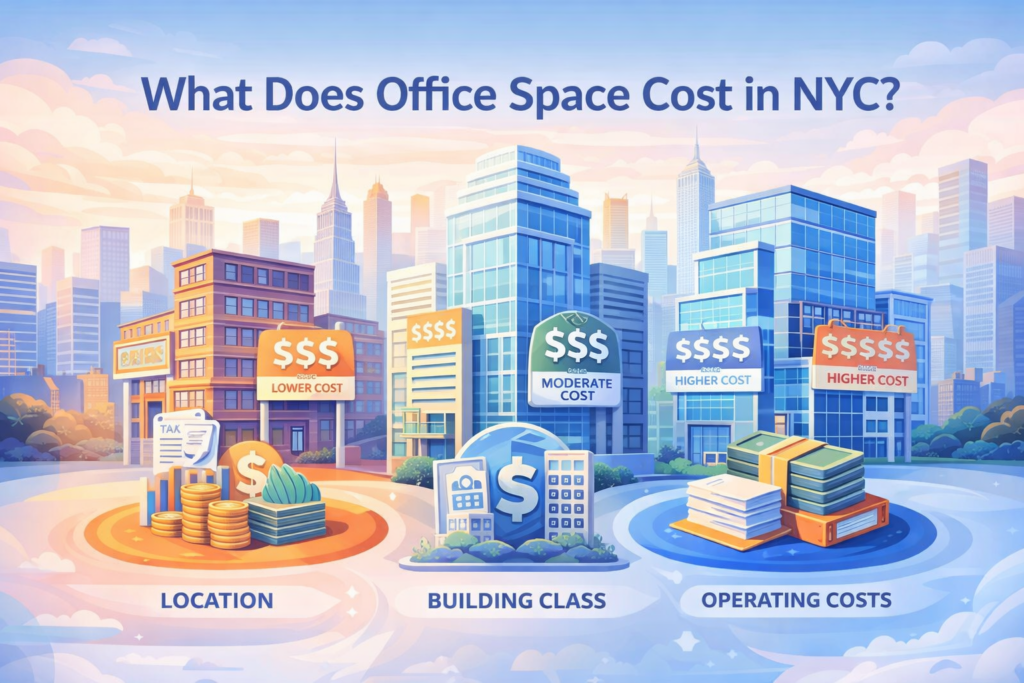
Understanding what office space costs in New York City requires more than looking at a single rent number. The price of office space in NYC varies widely depending on location, building class, floor quality, lease structure, and the amount of space a company occupies. Because of this, two offices with the same square footage can have dramatically different annual costs.
Most commercial office space in New York is priced per rentable square foot per year, not per month the way residential apartments are advertised. That distinction alone can confuse businesses evaluating the market for the first time.
The actual cost of office space in NYC typically reflects a combination of market rent, building operating costs, and the efficiency of the space itself.
Average Office Rent in NYC
Office rents across Manhattan vary significantly by neighborhood and building quality. However, general ranges help illustrate how the market works.
Typical asking rents in Manhattan often fall into the following ranges:
Class A office buildings
Approximately $70 to $120 per square foot annually depending on location and building prestige.
Class B office buildings
Approximately $45 to $70 per square foot annually.
Class C office buildings
Often range from $30 to $50 per square foot annually.
Prestige districts such as Park Avenue or the Plaza District can exceed these ranges, while emerging or value-oriented locations may fall below them.
What That Means in Real Dollars
To understand how these numbers translate into real cost, consider a simple example.
A 5,000 square foot office leasing at $60 per square foot would have an annual base rent of:
$300,000 per year
Divided monthly, this equals:
$25,000 per month
However, base rent alone does not always represent the full occupancy cost.
Additional Costs Beyond Base Rent
Many NYC office leases include additional operating expenses that tenants must account for.
Common cost components include:
• Building operating expense increases
• Real estate tax escalations
• Electricity charges
• Cleaning and maintenance
• Office buildout costs
• Furniture and infrastructure
Some buildings include electricity or cleaning services in the rent, while others charge separately. These details vary widely by property.
How Location Affects Office Cost
Location remains the single biggest factor influencing office rent in New York.
Midtown Manhattan tends to command the highest rents because of transit access, prestige buildings, and corporate demand.
Midtown South attracts technology and creative companies, often with slightly lower rents but strong demand for loft-style spaces.
Downtown Manhattan frequently offers newer buildings and competitive pricing, making it attractive for companies seeking modern space at lower cost than prime Midtown towers.
Because these districts operate differently, comparing buildings across neighborhoods often helps companies identify better value opportunities.
Building Class and Office Quality
Building class plays a major role in determining office price.
Class A buildings typically feature modern infrastructure, attended lobbies, advanced HVAC systems, and extensive tenant amenities.
Class B buildings often provide solid professional environments at lower cost, though they may lack some of the newest upgrades.
Class C buildings usually represent older properties with fewer amenities but can offer attractive pricing for companies prioritizing budget.
Many businesses balance cost and prestige by choosing well-maintained Class B buildings in strong locations.
How Much Space Your Company Needs
Office costs also depend on how efficiently a company uses space.
Traditional office layouts often allocate 150 to 250 square feet per employee, while more efficient layouts may reduce that number.
A company requiring 20 workstations might lease anywhere from 3,000 to 5,000 square feet depending on the layout and number of conference rooms or private offices required.
Because rent is calculated per square foot, space planning directly affects total cost.
Why NYC Office Prices Vary So Widely
The New York office market is one of the most complex in the world. Buildings differ dramatically in architecture, age, ownership structure, and tenant mix.
Two offices located only a few blocks apart may have rent differences of 30 percent or more simply because of building quality or lease structure.
For that reason, businesses rarely determine office cost by searching a single listing. Instead, companies typically compare multiple buildings across several neighborhoods before identifying the best value.
Finding the Right Office Within Your Budget
Companies evaluating office space in NYC benefit from understanding how rent, building class, and location interact. What initially appears to be a lower rent may become more expensive once operating costs or inefficient layouts are considered.
The best approach is to evaluate several buildings across different districts while analyzing the full cost structure of each lease.
NewYorkOffices.com helps businesses understand NYC office pricing, compare buildings across Manhattan, and negotiate leases that align with budget, operational needs, and long-term growth plans.
Fill out our 📋 online form or give us a call today 📞 212-967-2061 — let’s find the right office for your business.
NYC Office Space Cost Per Square Foot Explained
Most office space in New York City is priced using annual rent per rentable square foot. This pricing method differs from residential real estate, which is usually quoted monthly.
Understanding this pricing model is essential when comparing office listings.
For example, if a building advertises office space at $70 per square foot, that number represents the annual base rent per rentable square foot.
To calculate the approximate annual rent, companies multiply the rent by the number of rentable square feet in the office.
Example:
5,000 square feet × $70 per square foot =
$350,000 annual base rent
Divided monthly:
$350,000 ÷ 12 =
approximately $29,166 per month
However, base rent represents only part of the total occupancy cost. Additional expenses often affect the final budget.
Because of this, companies evaluating NYC office space typically compare full occupancy costs rather than base rent alone.
Average Manhattan Office Rent by Building Class
Office rents in Manhattan vary dramatically depending on building class and location.
Although individual buildings may fall outside these ranges, general averages illustrate how the market functions.
Class A Office Buildings
Class A buildings represent the newest or most prestigious properties in the market.
Typical characteristics include:
• modern building systems
• high-quality lobby environments
• extensive tenant amenities
• prime locations near major transit hubs
Average rents often range between:
$75 to $120 per square foot annually
Prestige corridors such as Park Avenue or Hudson Yards may exceed these ranges.
Class B Office Buildings
Class B properties often provide professional office environments at more moderate pricing.
These buildings may feature:
• renovated infrastructure
• solid professional lobbies
• smaller floorplates than Class A towers
Typical rent ranges:
$45 to $70 per square foot annually
Many companies seeking cost efficiency choose Class B buildings in strong locations.
Class C Office Buildings
Class C buildings generally represent older properties with fewer amenities.
However, they can offer significant cost advantages.
Typical rent ranges:
$30 to $50 per square foot annually
Companies prioritizing budget efficiency sometimes choose well-maintained Class C properties in strong neighborhoods.
How Much Does a Small Office Cost in NYC?
Companies searching for their first office often ask how much a small office space costs in New York.
Small offices typically range from 1,000 to 3,000 square feet depending on how many employees the company has.
To illustrate typical costs, consider several examples.
1,500 Square Foot Office
At $55 per square foot:
Annual rent = $82,500
Monthly equivalent = $6,875
2,500 Square Foot Office
At $60 per square foot:
Annual rent = $150,000
Monthly equivalent = $12,500
3,000 Square Foot Office
At $65 per square foot:
Annual rent = $195,000
Monthly equivalent = $16,250
Actual costs vary depending on building class and neighborhood, but these examples illustrate how rent translates into real dollars.
The “40x Rule” and Office Budgeting
Many companies researching office space encounter questions about a “40x rule” when budgeting for rent.
This rule originates from residential apartment leasing and is not commonly used in commercial office leasing.
Instead, companies typically evaluate office affordability using operational budget ratios.
Businesses often determine office budgets based on factors such as:
• revenue levels
• employee headcount
• growth projections
• operating margins
Rather than applying a fixed multiplier, companies typically determine office budgets by calculating how occupancy costs fit within their overall operating expenses.
For example, many professional service firms aim to keep office occupancy costs within a manageable percentage of total revenue.
Because office leases usually extend several years, companies often evaluate long-term cost stability rather than short-term affordability alone.
Coworking Space vs Traditional Office Costs
Flexible workspace providers such as WeWork, Bond Collective, and similar companies frequently appear in search results when businesses research NYC office costs.
Coworking spaces operate under a different pricing structure than traditional leases.
Instead of pricing space per square foot, coworking providers typically charge per desk or per private office.
Typical ranges may include:
• dedicated desks: several hundred dollars per person per month
• small private offices: thousands of dollars per month depending on size
• enterprise suites: custom pricing based on occupancy
Coworking environments offer advantages such as:
• flexible short-term agreements
• furnished offices
• shared meeting rooms and amenities
However, companies requiring larger or long-term office environments often find that traditional leases become more cost-efficient over time.
Because coworking pricing includes furniture, utilities, and shared services, the cost per square foot may exceed traditional office rent when calculated over longer lease terms.
Hidden Costs in NYC Office Leasing
Many businesses researching office costs initially focus on the base rent advertised in listings.
However, several additional factors influence the true cost of occupying office space.
Common hidden costs include:
Operating Expense Pass-Throughs
Many leases require tenants to pay increases in building operating expenses above a base year.
These costs may include:
• building maintenance
• insurance
• security services
• utilities
Real Estate Tax Escalations
New York City property taxes often increase over time.
Leases frequently pass these increases through to tenants.
Electricity Charges
Some buildings include electricity in rent, while others meter usage separately.
Office Build-Out Costs
Tenants often need to customize office layouts to support their workflow.
Construction costs may include:
• partition walls
• conference rooms
• wiring and technology infrastructure
Because these expenses vary by building and lease structure, evaluating them carefully is essential when comparing office opportunities.
Short-Term Office Space Costs
Some companies search for short-term office space in NYC rather than traditional long-term leases.
Short-term options often include:
• sublease spaces
• furnished office suites
• flexible workspace environments
Subleases can sometimes provide attractive pricing because the original tenant may be motivated to reduce carrying costs.
However, sublease opportunities depend heavily on market conditions and lease availability.
Flexible office providers may offer agreements lasting only several months, but the per-square-foot pricing often exceeds traditional office leases.
Companies evaluating short-term office options should consider both flexibility and long-term cost implications.
Why NYC Office Costs Vary by Neighborhood
Neighborhood location remains one of the most significant factors affecting office rent.
Several variables influence how neighborhoods price office space:
Prestige and Corporate Presence
Areas such as the Plaza District and Park Avenue corridor command premium rents because they house many global corporate headquarters.
Transportation Infrastructure
Locations near major transit hubs often command higher rents due to commuter convenience.
Building Inventory
Neighborhoods with newer Class A towers typically command higher rents than areas dominated by older buildings.
Industry Demand
Technology companies, finance firms, and professional services often cluster in specific districts, influencing local demand.
Because these factors vary widely between neighborhoods, office rent can differ significantly even within the same borough.
Market Data Sources and Office Cost Research
Several organizations publish reports analyzing NYC office rents and market conditions.
Companies researching office pricing may encounter sources such as:
• LoopNet — commercial real estate listings database
• Cresa — tenant representation advisory firm
• Instant Offices — flexible workspace platform
• WeWork — coworking provider
These organizations appear frequently in search results because they publish office market data and listings.
However, market reports typically provide broad averages rather than building-specific pricing.
Actual office costs depend on individual building characteristics, lease negotiations, and concession packages offered by landlords.
Because of this variability, businesses often compare multiple buildings before determining the most accurate cost estimate.
How Companies Reduce Office Space Costs
Businesses seeking office space in New York often reduce costs through strategic decision-making.
Common strategies include:
Choosing Efficient Floorplans
Efficient layouts reduce the amount of square footage required per employee.
Negotiating Lease Concessions
Landlords sometimes offer incentives such as rent abatements or build-out allowances.
Exploring Multiple Neighborhoods
Comparing buildings across different districts can reveal significant pricing differences.
Considering Class B Buildings
Many companies find strong value in well-maintained Class B buildings located in prime neighborhoods.
These strategies help businesses balance cost efficiency with operational needs.
Budgeting for Office Space in NYC
Companies evaluating office leases typically develop detailed occupancy budgets before signing a lease.
These budgets often include:
• base rent projections
• operating expense estimates
• build-out costs
• furniture and technology infrastructure
Understanding these variables allows businesses to determine whether an office environment aligns with their financial goals.
Because lease agreements frequently extend five to ten years, accurate budgeting plays a critical role in long-term planning.
Understanding the Real Cost of Office Space
The cost of office space in New York City reflects far more than the base rent quoted in a listing.
True occupancy costs depend on a combination of:
• building quality
• lease structure
• operating expenses
• location advantages
• office layout efficiency
Two offices with identical square footage may have dramatically different total costs depending on these variables.
For this reason, businesses evaluating NYC office space rarely rely on a single listing or price quote when making leasing decisions.
Instead, companies typically compare multiple buildings across several neighborhoods to identify the most appropriate balance between cost, location, and workspace quality.
Finding Office Space Within Your Budget
New York’s office market contains tens of millions of square feet of available space at any given time.
Because buildings vary widely in pricing, amenities, and lease structures, comparing multiple options often reveals opportunities that align with a company’s budget.
NewYorkOffices.com helps businesses understand NYC office pricing, evaluate buildings across Manhattan, and negotiate leases that support long-term operational and financial goals.
Whether a company is opening its first office, relocating within New York, or expanding into larger space, understanding the full cost of office occupancy is the first step toward securing the right environment for growth.