Best Neighborhoods for Office Space NYC
Companies searching for office space in New York City quickly realize that location decisions are not simply about geography. Choosing the right neighborhood determines how a company is perceived by clients, how employees commute to work, and how efficiently a business can operate within Manhattan’s dense commercial landscape.
Different submarkets support different industries, building types, and price points. Some neighborhoods are defined by institutional corporate towers, while others evolved from loft-style buildings that now house creative firms and technology companies.
Understanding the best neighborhoods for office space in NYC requires looking beyond rent levels and considering how each district functions as an operating environment for businesses.
This guide explains the major Manhattan office districts and how companies evaluate them when choosing a location.
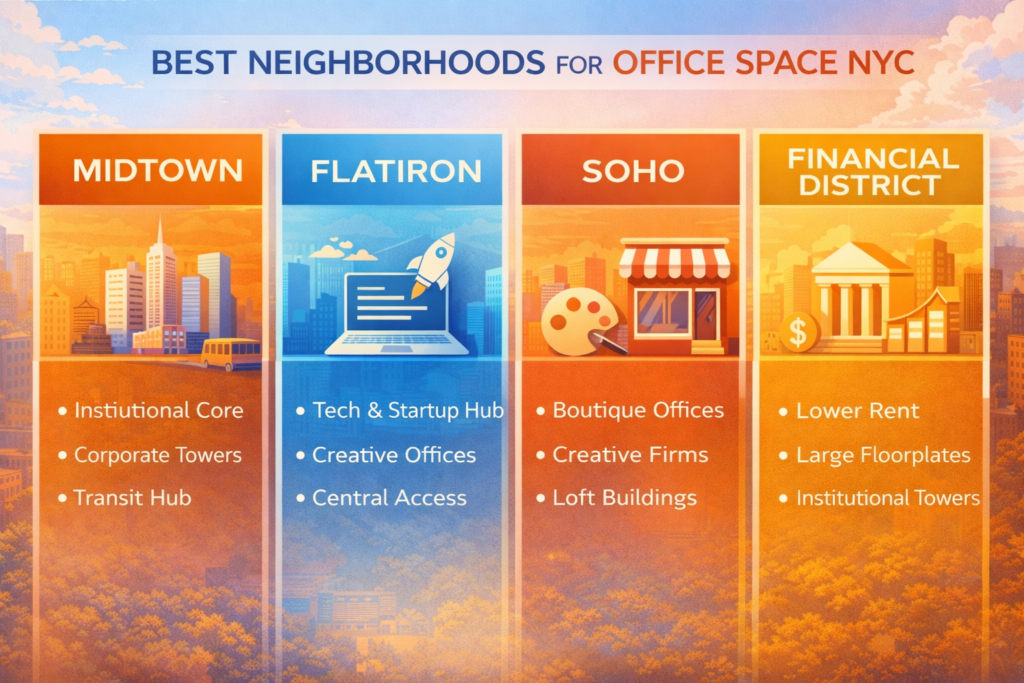
Midtown: Institutional Core of Manhattan
Midtown Manhattan remains the most recognized office district in the United States. The area surrounding Grand Central Terminal, Bryant Park, Park Avenue, and Sixth Avenue contains some of the city’s largest office towers and most established corporate tenants.
Companies choose Midtown primarily for its institutional presence and accessibility. Nearly every major subway line and regional commuter rail network converges in this part of Manhattan, making it one of the most accessible business districts in the world.
Midtown is particularly attractive for organizations that depend on client-facing meetings and formal corporate environments. Law firms, financial institutions, consulting firms, and large corporate headquarters frequently concentrate here.
However, Midtown rents tend to reflect that prestige. Companies that do not require the branding advantages of this location sometimes evaluate other submarkets where pricing is lower.
Midtown South: Creative and Technology Corridor
South of Midtown’s traditional corporate towers lies Midtown South, a district known for its loft buildings, creative office environments, and growing technology presence.
Neighborhoods such as Flatiron, NoMad, Union Square, and parts of Chelsea form the core of this submarket.
Midtown South offices often feature high ceilings, large windows, and open floor plates that support collaborative workspace layouts. These characteristics make the area particularly appealing to technology firms, design studios, marketing agencies, and media companies.
While Midtown South historically offered lower rents than Midtown, demand from technology companies has pushed pricing upward in many buildings. Even so, the district remains attractive for businesses seeking architectural character and flexible office layouts.
Downtown Manhattan: Value and Scale
Downtown Manhattan, including the Financial District and surrounding areas, has evolved into one of the most competitive office markets in the city.
This district historically served as the center of global finance, and many large office towers still house financial institutions and trading firms. Over the past two decades, however, Downtown has diversified significantly.
Companies are drawn to the area because it frequently offers larger floor plates and lower rental costs compared with Midtown.
Transit access has also improved dramatically. Multiple subway lines converge in the Financial District, and connections to Brooklyn, New Jersey, and the outer boroughs make commuting increasingly convenient.
As a result, Downtown has become attractive to companies seeking cost efficiency without leaving Manhattan.
SoHo: Boutique Offices and Brand Identity
SoHo occupies a unique position in the Manhattan office market. Known for its cast-iron architecture and historic loft buildings, the neighborhood provides an environment very different from traditional corporate districts.
Office inventory in SoHo is limited compared with Midtown or Downtown, but the space that does exist often appeals to companies prioritizing brand identity and creative presentation.
Design studios, fashion companies, technology startups, and boutique investment firms often locate here because the neighborhood conveys a distinctive aesthetic identity.
However, limited inventory means companies considering SoHo must evaluate whether the architectural appeal outweighs constraints in building size and availability.
Chelsea and Hudson Square: Media and Creative Expansion
The western side of Manhattan has become a major destination for media, technology, and creative firms.
Neighborhoods such as Chelsea and Hudson Square have experienced significant reinvestment over the past decade. Former industrial buildings and warehouses have been converted into modern office environments while retaining their loft-style character.
These areas appeal to companies seeking larger open layouts and modernized building infrastructure while remaining within Manhattan’s core business districts.
As new developments continue to emerge along the west side, these neighborhoods are increasingly viewed as growth corridors for companies that want creative environments without leaving the city’s central business districts.
Flatiron: Entrepreneurial Hub
The Flatiron District occupies a central position between Midtown and Downtown and has become one of Manhattan’s most recognizable technology and venture capital hubs.
This neighborhood combines historic loft buildings with modern office renovations, creating a hybrid environment that attracts both startups and established technology companies.
Flatiron’s central location allows businesses to access Midtown, Union Square, and Downtown within minutes. As a result, many firms view the district as an ideal balance between corporate accessibility and creative energy.
Financial District: Institutional Density
The Financial District, often called FiDi, remains one of the most concentrated office districts in the world.
Large towers dominate the skyline, many of which provide large contiguous floor plates that appeal to major corporations and financial institutions.
In recent years, the district has also attracted technology companies and startups seeking lower rents compared with Midtown while maintaining proximity to global financial infrastructure.
FiDi’s extensive subway connectivity and ferry access also make it one of the most transit-accessible office districts in Manhattan.
Choosing the Right Neighborhood
Selecting the best neighborhood for office space in New York depends on how a company balances several factors.
Some organizations prioritize prestige and client perception, which often leads them toward Midtown’s corporate towers.
Others prioritize architectural character and collaborative layouts, which draws them toward Midtown South or loft districts.
Companies seeking lower rent and larger footprints may find Downtown Manhattan the most practical option.
Meanwhile, creative industries often gravitate toward neighborhoods such as SoHo, Chelsea, or Flatiron where the built environment aligns with their brand identity.
The Strategic Role of Location
Ultimately, choosing the best neighborhood for office space in NYC is about aligning location with the operational needs of the business.
Each Manhattan submarket represents a different combination of building type, pricing structure, tenant profile, and transit access.
Companies that evaluate these variables carefully can position themselves in locations that support both employee productivity and long-term business growth.
Fill out our 📋 online form or give us a call today 📞 212-967-2061 — let’s find the right office for your business.
Additional NYC Office Districts Companies Should Evaluate
While Midtown, Midtown South, and Downtown Manhattan dominate most office leasing conversations, several additional neighborhoods increasingly influence how companies evaluate office locations in New York. These districts often emerge from changing industry patterns, building conversions, and new infrastructure investments.
For businesses comparing neighborhoods, understanding these secondary districts provides a more complete picture of how Manhattan’s office geography actually functions.
Each of the following districts serves different tenant profiles, pricing structures, and operational needs.
Hudson Yards: Manhattan’s New Corporate District
Hudson Yards represents the newest large-scale office district developed in Manhattan in decades. Located on the west side between Midtown and Chelsea, the neighborhood was built around large corporate towers designed to attract global companies seeking modern infrastructure.
The area has quickly become home to major corporate tenants including technology firms, financial companies, and media organizations.
Companies evaluating Hudson Yards are typically attracted to several defining characteristics.
First, the buildings themselves represent the newest generation of office construction in Manhattan. Large floor plates, advanced HVAC systems, and high-performance building infrastructure provide modern environments that many older Midtown towers cannot replicate.
Second, Hudson Yards offers a distinct brand identity. The district was designed as a modern corporate environment rather than a legacy office neighborhood. For companies prioritizing image, the location communicates innovation and scale.
Finally, the neighborhood benefits from improved transit connectivity following the extension of the Number 7 subway line. While historically the west side lacked direct transit access, Hudson Yards now connects easily to Grand Central, Times Square, and other major business districts.
However, companies must also weigh several considerations. Office rents in Hudson Yards often rank among the highest in the city due to the premium building quality and large corporate tenants occupying the area.
For organizations requiring modern space and institutional-grade buildings, Hudson Yards offers one of the most technologically advanced office environments in Manhattan.
Grand Central and the Plaza District: Prestige and Global Accessibility
The area surrounding Grand Central Terminal and the Plaza District remains one of the most prestigious office locations in the United States. Buildings along Park Avenue, Lexington Avenue, and Madison Avenue form the core of this district.
For decades, this neighborhood has been associated with major financial institutions, global law firms, consulting companies, and corporate headquarters.
Several structural factors explain why companies continue to prioritize this location.
The first is transit accessibility. Grand Central Terminal connects regional commuter rail networks from Westchester and Connecticut directly to Manhattan’s central business district. This access makes the area particularly attractive for companies whose employees commute from suburban areas.
Second, the neighborhood’s office buildings represent some of the most recognizable corporate addresses in the city. Companies located along Park Avenue or near the Plaza District often benefit from strong client perception and brand credibility.
Third, the building stock in this district frequently includes large contiguous floor plates capable of supporting major corporate operations.
While rents in this district often rank among the highest in the city, the location remains attractive to organizations whose business models depend on prestige, institutional presence, and proximity to major corporate clients.
NoMad: Emerging Office Destination for Growth Companies
North of Madison Square Park, the NoMad district has evolved into one of Manhattan’s fastest-growing office environments.
Historically characterized by smaller commercial buildings and hotels, the neighborhood has experienced significant redevelopment over the past decade.
Technology companies, venture capital firms, and creative businesses have increasingly located offices in NoMad due to the area’s central location and improving building inventory.
One major advantage of the district is its position between Midtown and Midtown South. Companies operating in NoMad gain easy access to both corporate Midtown and the more creative environments of Flatiron and Union Square.
Additionally, several older office buildings have been renovated into modern prebuilt office spaces with upgraded infrastructure and collaborative layouts.
For organizations seeking a balance between corporate accessibility and entrepreneurial culture, NoMad provides a compelling alternative to more traditional office districts.
Union Square: Technology and Startup Ecosystem
Union Square functions as a key hub for technology startups and venture capital firms in Manhattan. The neighborhood’s office market is smaller than Midtown or Downtown but plays a disproportionately important role in the city’s startup ecosystem.
Several factors explain why early-stage companies often locate here.
First, the area sits at the intersection of multiple subway lines, creating excellent connectivity to both uptown and downtown neighborhoods.
Second, Union Square provides proximity to neighborhoods such as the East Village, Flatiron, and NoMad where many technology professionals live and socialize.
Third, many office buildings in the area feature smaller floor plates and flexible layouts suited for early-stage companies.
While office rents can fluctuate depending on demand from technology companies, Union Square remains a strategic location for startups seeking proximity to venture capital networks and other technology firms.
Tribeca: Boutique Offices for Professional Firms
Tribeca has developed a reputation as a boutique office district favored by creative firms, private investment offices, and professional service companies.
The neighborhood’s historic architecture and converted loft buildings create a distinct office environment that differs significantly from Midtown’s large corporate towers.
Companies locating in Tribeca are often drawn by the neighborhood’s quieter atmosphere and architectural character. Office spaces frequently feature exposed brick, large windows, and unique layouts that appeal to firms seeking distinctive environments.
Additionally, Tribeca’s proximity to Downtown Manhattan provides access to major transit lines while maintaining a more neighborhood-oriented setting.
Because office inventory in Tribeca remains relatively limited, companies considering the area must evaluate availability carefully.
However, for organizations seeking a boutique environment with strong architectural identity, Tribeca offers one of the most distinctive office settings in Manhattan.
Brooklyn Office Districts: Expanding Beyond Manhattan
While Manhattan continues to dominate the New York office market, several Brooklyn neighborhoods have emerged as alternative office locations for companies seeking different pricing structures or creative environments.
Districts such as DUMBO, Williamsburg, and the Brooklyn Navy Yard now host growing concentrations of technology companies, media organizations, and design studios.
These neighborhoods often provide large loft-style office spaces within converted industrial buildings. The architectural character of these properties appeals to companies seeking collaborative environments and distinctive office layouts.
In addition to architectural appeal, Brooklyn office districts often offer lower rents compared to many Manhattan submarkets.
However, companies must evaluate transportation logistics carefully. While subway access connects many Brooklyn neighborhoods to Manhattan, commute times may vary depending on employee locations.
For companies prioritizing creative environments and cost efficiency, Brooklyn has become an increasingly viable office alternative.
Choosing the Best Neighborhood Based on Industry
Different industries tend to concentrate in specific Manhattan neighborhoods due to client proximity, talent distribution, and building infrastructure.
Understanding these patterns can help businesses evaluate where their competitors, partners, and clients are likely to be located.
Financial firms and investment companies frequently concentrate in Midtown and the Financial District, where proximity to major financial institutions remains important.
Law firms often choose Midtown locations near Grand Central or the Plaza District because these areas provide easy access for corporate clients and visiting executives.
Technology companies tend to cluster in Midtown South neighborhoods such as Flatiron, NoMad, and Union Square where office environments emphasize collaboration and creative layouts.
Media and creative companies frequently locate in Chelsea, Hudson Square, and SoHo where converted loft buildings support flexible office design.
While companies are not required to locate within their industry’s traditional districts, many organizations choose locations where industry networks already exist.
Transit Accessibility and Office Location Strategy
Transit connectivity remains one of the most important factors influencing office location decisions in New York.
Because employees commute from multiple boroughs and surrounding regions, offices located near major transit hubs provide operational advantages for recruiting and retaining talent.
Areas surrounding Grand Central Terminal, Penn Station, and major subway intersections often attract companies prioritizing employee accessibility.
For example, Midtown provides connections to nearly every subway line in the city as well as regional commuter rail networks.
Downtown Manhattan offers similar advantages with extensive subway connectivity and ferry service to Brooklyn and New Jersey.
Companies evaluating office neighborhoods must consider how commute patterns affect employee productivity and retention.
In many cases, the most accessible location may provide greater long-term value than marginal differences in rent.
How Office Pricing Varies by Neighborhood
Office rents across Manhattan vary significantly depending on neighborhood, building class, and building amenities.
Midtown’s premier towers typically command the highest rents due to their prestige, building quality, and proximity to corporate clients.
Midtown South districts such as Flatiron and Chelsea often offer a mix of creative loft spaces and renovated offices that may appeal to companies seeking collaborative environments.
Downtown Manhattan frequently provides larger floor plates and lower rents compared to Midtown while still maintaining excellent transit access.
Emerging districts such as NoMad and Hudson Square may offer a balance between accessibility and pricing depending on building inventory.
Understanding these pricing differences allows companies to evaluate how neighborhood selection affects overall occupancy costs.
The Role of Building Type in Neighborhood Selection
Neighborhood identity alone does not determine office suitability. The type of building available in a district also influences how companies evaluate location decisions.
Midtown districts often feature large institutional office towers designed to accommodate major corporations.
Midtown South neighborhoods typically contain loft buildings with open floor plates and architectural character.
Downtown Manhattan offers a mixture of historic towers and modern office buildings with large floor plates.
Converted industrial buildings in neighborhoods such as Chelsea and Tribeca provide creative environments suited to design-oriented companies.
By evaluating both neighborhood and building type together, companies can identify office environments that align with their operational needs.
Long-Term Trends in Manhattan Office Geography
Over the past two decades, Manhattan’s office geography has evolved significantly.
Industries that once concentrated exclusively in Midtown have expanded into Midtown South and Downtown districts as companies seek different office environments.
Technology companies have driven demand for creative office spaces with open layouts and flexible infrastructure.
Meanwhile, financial institutions and law firms continue to prioritize traditional corporate towers in Midtown and the Plaza District.
These evolving patterns demonstrate that the “best neighborhood for office space in NYC” ultimately depends on how a company defines its operational priorities.
Evaluating Office Neighborhoods Strategically
Choosing an office neighborhood is not simply a real estate decision. It is a strategic choice that affects how a company interacts with clients, employees, and the broader business ecosystem.
Organizations evaluating office locations should consider:
• proximity to clients and partners
• employee commute patterns
• building infrastructure and layout
• industry clustering patterns
• long-term pricing stability
By analyzing these factors together, companies can identify neighborhoods that support both operational efficiency and long-term growth.
Final Perspective on Manhattan Office Neighborhoods
Manhattan offers one of the most diverse office markets in the world. From Midtown’s corporate towers to Midtown South’s creative loft spaces and Downtown’s large-scale office buildings, each district provides a different combination of accessibility, building style, and tenant profile.
The best neighborhood for office space in New York ultimately depends on how a company balances prestige, cost, flexibility, and industry positioning.
Businesses that evaluate neighborhoods strategically — considering both present needs and future growth — can position themselves in locations that strengthen their brand, improve employee experience, and support long-term success within the New York office market.