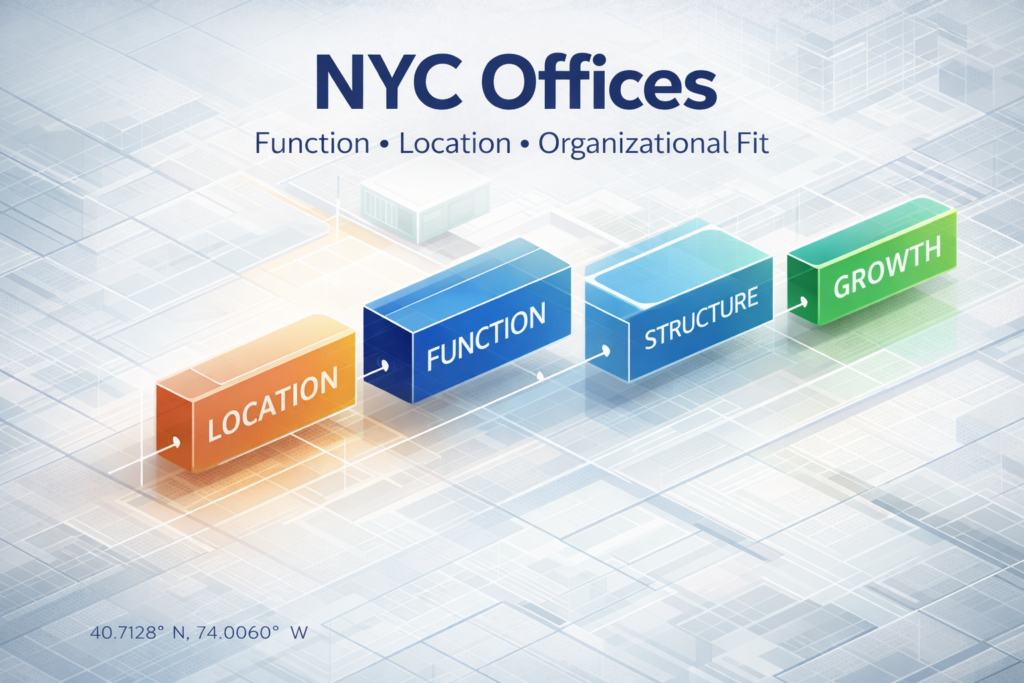
NYC Offices
NYC offices are where businesses actually operate inside New York City. They are not abstract square footage calculations or theoretical real estate concepts. They are working environments shaped by commute patterns, building infrastructure, neighborhood culture, and the daily realities of running a company in one of the most competitive markets in the world.
Companies searching for office space are usually past the exploratory stage. They are not asking whether they should have an office in New York City. They are asking what kind of office makes sense now, where it should be located, how it should function, and how much flexibility it needs to support the next phase of the business.
This page explains how office space works in practice, how companies choose them, and how location, layout, and building quality affect real business outcomes.
What People Mean When They Say “NYC Offices”
“NYC offices” is shorthand. It is how people inside the market talk about their workplace presence in New York City. The phrase typically refers to business offices used by companies, firms, startups, and organizations operating in Manhattan and nearby commercial districts.
Unlike more formal search terms, “NYC offices” almost always implies a business context. It can refer to a headquarters, a regional office, a satellite location, or a dedicated team space, but it rarely refers to government agencies or public institutions.
Understanding this distinction is important, because it explains why NYC offices are evaluated differently than generic office space.
Managed, Serviced, and Flexible Office Space
When people search for NYC offices, they are often shown results for managed, serviced, or flexible office solutions. These offices are fully operated by third-party providers and typically include furniture, shared amenities, and short-term agreements.
Managed and serviced offices play a role in the New York City office ecosystem, particularly for companies that need immediate occupancy, temporary space, or minimal operational responsibility. However, they are not the same as establishing a long-term NYC office presence. These solutions prioritize convenience and speed over control, customization, and long-term cost efficiency.
For companies planning to operate in New York City beyond a short horizon, managed offices are best understood as a category within NYC offices rather than a default solution. Businesses evaluating NYC offices should distinguish between provider-operated environments and offices they control directly.
Private Offices Versus Full NYC Offices
Private offices are another common interpretation of the term NYC offices. In this context, a private office typically refers to a single enclosed suite within a shared environment or multi-tenant floor. These offices offer privacy and defined boundaries but often limit layout flexibility and long-term scalability.
A full NYC office, by contrast, refers to a dedicated operational workspace designed around a company’s specific needs. This may include multiple offices, open work areas, conference rooms, and internal support spaces. Full offices allow companies to control workflow, branding, and future growth.
Understanding the difference between private offices and full NYC offices helps businesses evaluate whether they are solving for immediacy or for long-term operational fit.
Where NYC Offices Are Concentrated
Most commercial spaces are concentrated in Manhattan, where transit access, building inventory, and professional infrastructure are deepest. While offices exist throughout the five boroughs, the majority of businesses that use the term “NYC offices” are referring to Manhattan-based locations.
Midtown NYC Offices
Midtown remains the most common location for commercial space. It offers the largest concentration of office buildings, the strongest transit connectivity, and the widest range of office sizes. Companies that value accessibility, client convenience, and predictable building infrastructure often choose Midtown for their NYC office.
Midtown South NYC Offices
Midtown South is closely associated with creative, technology, media, and growth-stage companies. Commercial Space in this area often feature loft-style layouts, higher ceilings, and more flexible design. For companies that want a less traditional office environment without sacrificing central access, Midtown South is a frequent choice.
Downtown Manhattan NYC Offices
Downtown Manhattan offers a mix of modernized towers and historic buildings, often at more competitive pricing than Midtown. Commercial Units located downtown appeal to companies seeking value, newer infrastructure, or proximity to transit hubs serving multiple boroughs.
NYC Offices by Neighborhood
Offices in Manhattan are distributed across neighborhoods that serve different business priorities. Companies rarely choose neighborhoods randomly. Location decisions reflect how a business operates, whom it serves, and how its workforce moves through the city.
Midtown NYC offices are typically associated with corporate density, transit access, and client-facing operations. Midtown South NYC offices are often favored by creative, technology, and growth-stage companies seeking flexible layouts and cultural alignment. Downtown Manhattan NYC offices attract businesses prioritizing value, infrastructure, and access to major transit hubs.
Neighborhood selection shapes how a commercial unit functions day to day. The right location supports efficiency and retention, while the wrong one introduces friction that compounds over time.
Types of NYC Offices Companies Use
Offices are not one-size-fits-all. Companies choose different office types based on size, budget, culture, and growth expectations.
Full-Floor NYC Offices
Full-floor offices provide control, privacy, and branding opportunities. Companies that want separation from other tenants and the ability to design space around their teams often choose full-floor NYC offices.
Prebuilt and Move-In Ready NYC Offices
Prebuilt offices allow companies to move quickly without managing construction. These offices are common in competitive buildings and are often used by companies that prioritize speed and simplicity over customization.
Flexible and Short-Term NYC Offices
Some NYC offices are designed for flexibility. Furnished spaces, short-term leases, and transitional offices allow companies to maintain a presence without long-term commitment. These solutions are useful during periods of growth, restructuring, or market testing.
Flexible Workspaces
The contrast between operational offices vs short-term/flexible solutions.
👉 https://newyorkoffices.com/flexible-workspaces/
How Much Does a Private Office Cost Per Employee in Manhattan?
Supports private vs full offices, planning, sizing, budgeting.
👉 https://newyorkoffices.com/how-much-does-a-private-office-cost-per-employee-in-manhattan/
Government Offices and Public Agencies in NYC
Some users searching for NYC offices are looking for government agencies, public departments, or official city offices. New York City hosts thousands of public offices across municipal, state, and federal jurisdictions, each serving distinct administrative and regulatory functions.
This page does not list government offices or agency locations. Official directories and government resources maintain the most accurate and up-to-date information for public offices. Businesses evaluating NYC offices should distinguish between public administrative offices and private operational offices when planning their presence in the city.
Office Providers Versus Companies Operating NYC Offices
A critical distinction in the NYC offices landscape is the difference between office providers and companies operating offices. Office providers supply space as a service, managing the environment on behalf of multiple tenants. Companies operating NYC offices use space as an extension of their organization.
This difference affects cost structure, control, flexibility, and brand perception. Provider-based offices emphasize access and simplicity. Operator-controlled offices emphasize identity, stability, and alignment with internal processes.
Businesses planning a meaningful NYC presence typically move from provider-based solutions toward offices they operate directly as their needs become clearer.
Is This the Right Page for You?
If you are searching for a specific government office, agency, or public department, official government directories will provide the most accurate results.
If you are comparing coworking providers or short-term serviced office solutions, those offerings represent one category within the broader NYC offices landscape.
If you are evaluating how to establish, structure, or refine a business office presence in New York City, the sections below address how companies think about NYC offices in practice.
Rent Office Space NYC: A Complete Tenant Guide
Broad real estate context that informs office decisions.
👉 https://newyorkoffices.com/rent-office-space-nyc/
How NYC Offices Are Planned and Used
Because space is expensive and relocation is disruptive, NYC offices must be planned carefully. The most successful offices balance efficiency with usability and allow teams to work comfortably without excess square footage.
How Much Office Space Do I Need?
Connects to your planning section (right sizing, hybrid work).
👉 https://newyorkoffices.com/how-much-office-space-do-i-need/
Right-Sizing an NYC Office
The right size for an NYC office depends on how teams actually use space. Headcount alone is not enough. Meeting needs, collaboration styles, and hybrid work patterns all influence how much space a company truly requires.
Layout Strategy in NYC Offices
Layouts in commercial units must account for building constraints such as column spacing, window lines, and shared systems. A well-designed layout can make a smaller office function better than a larger but poorly planned one.
What Office Layout Is Best for My Business?
Supports layout strategy research
👉 https://newyorkoffices.com/what-office-layout-is-best-for-my-business/
Planning for Growth and Change
Office units should be flexible enough to accommodate change. Businesses evolve quickly, and office layouts that allow reconfiguration help companies avoid premature moves.
Office Search Time Table
On planning and search process.
👉 https://newyorkoffices.com/office-search-time-table/
Commercial Space as an Operational Decision
An NYC office is not just a place to work. It is a strategic decision that affects how a business functions within New York City. Location, building quality, layout, and control over space all influence productivity, cost stability, and long-term flexibility.
Companies that approach office space as operational assets rather than transactional space tend to make more durable decisions and avoid premature relocations.
When Companies Decide They Need an NYC Office
Most companies decide they need an commercial lease before they know exactly what that office should look like. The decision is often driven by growth, client access, hiring needs, or market presence.
Clarifying why an NYC office is needed makes it easier to determine what type of office supports that goal. This distinction separates effective planning from reactive leasing.
Buildings and Amenities That Shape NYC Offices
The building housing an NYC office plays a major role in daily experience. Infrastructure, management quality, and shared amenities influence how offices perform over time.
Amenity Centers and Shared Facilities
Shared conference rooms, lounges, and fitness facilities reduce the need for in-suite space and improve employee experience. Many modern NYC offices rely on building amenities to enhance functionality without increasing footprint.
Office Building Amenities That Attract Tenants
A comprehensive dive into amenity benefits.
👉 https://newyorkoffices.com/office-building-amenities-that-attract-tenants/
Light, Air, and Physical Comfort
Natural light, ceiling height, and air quality have a direct impact on how people feel at work. Manhattan spaces that feature strong light and ventilation tend to be more desirable and retain value longer.
Lobby Experience and Building Management
The lobby and common areas shape first impressions. Well-managed buildings with professional staffing and security support smoother daily operations and reinforce brand perception.
What Office Amenities Are Most Important in a Lease?
Aligns with “office features that matter.”
👉 https://newyorkoffices.com/what-office-amenities-are-most-important-in-a-lease/
Why Building Amenities Are Worth Paying For
A breakdown of amenity value vs cost.
👉 https://newyorkoffices.com/why-building-amenities-are-worth-paying-for/
How Companies Secure a Lease
Securing an NYC office involves more than finding availability. It requires timing, market awareness, and an understanding of how deals are structured.
The Space Search Process
Most companies begin by defining needs, evaluating neighborhoods, touring options, and negotiating terms. Each step introduces risk if handled without context or preparation.
Common Mistakes When Choosing Offices in Manhattan
Common mistakes include overcommitting to size, focusing only on rent, or choosing space based solely on appearance. These missteps often lead to costly adjustments later.
Why Space Decisions Fall Apart
Office deals can fall apart due to timing issues, misaligned expectations, or hidden constraints uncovered late in the process. Early diligence reduces these risks.
Reasons How a Real Estate Office Lease Deal Can Fall Apart
Discussion on negotiation, risk, and pitfalls.
👉 https://newyorkoffices.com/reasons-how-a-real-estate-office-lease-deal-can-fall-apart/
NYC Offices vs Office Space
While often used interchangeably, “NYC offices” and “office space” describe different ideas. An NYC office is an operational presence. Office space is the real estate that supports it. Companies often decide they need an NYC office before determining what type of office space best serves that goal.
Understanding this difference helps businesses approach office decisions with clarity and intent.
NYC Offices Versus Office Space
The terms NYC offices and office space are related but not interchangeable. An NYC office refers to a company’s operational presence. Office space refers to the real estate that supports that presence.
Businesses often commit to establishing an NYC office before identifying the specific office space that best fits their needs. Understanding this sequence allows companies to approach office decisions with intention rather than urgency.
Choosing the Right NYC Office
The right NYC office supports how a business operates today while leaving room for change tomorrow. It aligns location, layout, and cost with operational priorities and long-term strategy.
How Much Is Office Space?
“offices vs office space” as in cost context
👉 https://newyorkoffices.com/how-much-is-office-space/
Aligning Office Space With Business Goals
Office decisions should reinforce growth, not constrain it. The best NYC offices support teams, clients, and leadership without unnecessary complexity.
When to Start Looking for an Office in Manhattan
Starting early expands options and improves leverage. The earlier a company begins planning, the more control it has over outcomes.
Next Steps Toward the Right NYC Office
Clear priorities, informed decisions, and strategic planning are the foundation of a successful office.
Choosing the Right Office Space in NYC
The right NYC office aligns location, layout, and cost with how a business operates today and how it expects to operate tomorrow. It supports teams, reinforces brand, and allows for change without unnecessary disruption.
Clarity around priorities, timing, and use cases is the foundation of a successful commercial space outcome.
Fill out our 📋 online form or give us a call today 📞 212-967-2061 — let’s find the right options for your business.