Startup Office Space NYC
Startup office space in NYC is not a real estate exercise. It is a risk-management decision made under uncertainty.
Most startups do not struggle because they chose the wrong building or paid the wrong rent. Instead, they struggle because they committed to office space that assumed stability before the business had earned it. This page exists to address that mistake directly.
If you are a startup evaluating office space in New York City, the goal is not to secure an office quickly.
The goal is to preserve flexibility, protect cash, and maintain exit optionality while supporting day-to-day execution.
This guide explains how to approach startup office space in NYC with discipline rather than momentum.
What Startup Office Space NYC Actually Represents
Startup office space in NYC is defined by volatility, not square footage.
Unlike established companies, startups face overlapping unknowns:
- Revenue that fluctuates quarter to quarter
- Headcount that expands or contracts rapidly
- Funding timelines that shift with market conditions
Because of this, startups cannot optimize office decisions around permanence. Instead, they must optimize around reversibility.
Office space should support the business without dictating its future.
Why Startups Repeatedly Choose the Wrong Offices
Startup office mistakes tend to follow a predictable sequence.
Momentum builds. Hiring accelerates. Investors visit. Founders feel pressure to appear established. At that point, office space becomes symbolic rather than operational.
As a result, startups often:
- Lease more space than they can reliably use
- Choose longer terms to reduce headline rent
- Accept rigid lease structures without exit protection
- Invest heavily in build-outs that cannot be recovered
In NYC, these errors compound quickly because leases favor landlords and unwind slowly.
The Central Rule: Optionality Beats Optimization
For startups, the best office is rarely the cheapest or the most impressive. It is the one that preserves the most options.
Startup office space in NYC should be evaluated across three dimensions:
- Time risk – How difficult is it to exit if plans change?
- Capital risk – How much cash is locked outside the business?
- Operational drag – How much attention does the space demand to maintain?
If a space scores poorly in all three areas, it becomes a liability regardless of appearance.
Lease Structures That Tend to Work Best for Startups
Startups should compare structures before comparing layouts.
Office structures that align with startup risk profiles typically include:
- Shorter or interruptible lease commitments
- Subleases with defined exit mechanics
- Minimal construction timelines controlled by the tenant
- Limited restoration obligations at expiration
Direct long-term leases can work for startups, but only when flexibility is built into the lease itself. Without that protection, they magnify downside risk.
Why Asking Rent Misleads Startup Decisions
Rent is visible. Risk is hidden.
In NYC, startups must evaluate cost beyond asking rent, including:
- Annual rent escalations that compound during flat growth
- Operating expense pass-throughs that rise independently of revenue
- Electricity billing methods that penalize density
- Tenant improvement allowances that obscure real construction exposure
Two offices with identical asking rents can produce dramatically different outcomes over time.
Lease Clauses Startups Cannot Afford to Ignore
Most startup risk lives inside the lease document, not the floor plan.
Clauses that matter disproportionately for startups include:
- Assignment and subletting rights without landlord profit sharing
- Early termination or contraction options
- Expansion rights that avoid forced relocation
- Personal guarantee limitations or burn-off provisions
Landlords rarely offer these terms unprompted. Startups must negotiate them deliberately and early.
The Credibility Trap: Image Versus Control
Startups often select offices to signal legitimacy to investors, recruits, or clients. In NYC, that instinct increases risk.
Credibility does not require excess space or permanent construction. Instead, it requires stability, clarity, and consistent execution.
A flexible, right-sized office that allows quiet adaptation usually outperforms a prestigious space that forces hard decisions later.
When a Traditional Lease Can Make Sense for a Startup
Not all startups should avoid long-term leases. However, startups must qualify before committing.
A traditional lease may be appropriate when:
- Funding visibility exceeds the lease term
- Headcount projections are conservative and stable
- The business requires fixed infrastructure
- Exit provisions are negotiated rather than assumed
Without these conditions, long leases convert uncertainty into obligation.
Planning for Growth Without Locking Into Assumptions
Growth does not require betting on a single office outcome.
Effective startup leasing strategies often include:
- Modeling multiple future scenarios rather than one forecast
- Avoiding build-outs that cannot be reused or reassigned
- Treating office space as a modular tool instead of a permanent headquarters
In NYC, adaptability consistently outperforms precision.
Startup Office Mistakes That Create Lasting Damage
Some office mistakes slow growth. Others constrain it.
The most damaging startup errors include:
- Signing leases without understanding exit mechanics
- Assuming subleasing will always remain viable
- Allowing landlords to control delivery timelines
- Underestimating the distraction cost of construction
Once executed, these decisions are costly to reverse.
How This Page Differs From Other Office Size Guides
This page does not define startup space by size.
Startup office space in NYC is defined by uncertainty, not square footage.
While small office pages focus on efficiency, and mid-size pages focus on balance, this page focuses on optionality, reversibility, and survival. The priorities differ because the risk profile differs.
Final Perspective
Startup office space in NYC should never function as a milestone. It should function as a temporary operating decision with a built-in exit plan.
The objective is not to predict the future accurately.
The objective is to avoid being punished when the future changes.
Startups that understand this lease smarter, preserve capital, and retain control longer.
That is the advantage this page is designed to deliver.
Fill out our 📋 online form or give us a call today 📞 212-967-2061 — let’s find the right office for your business.
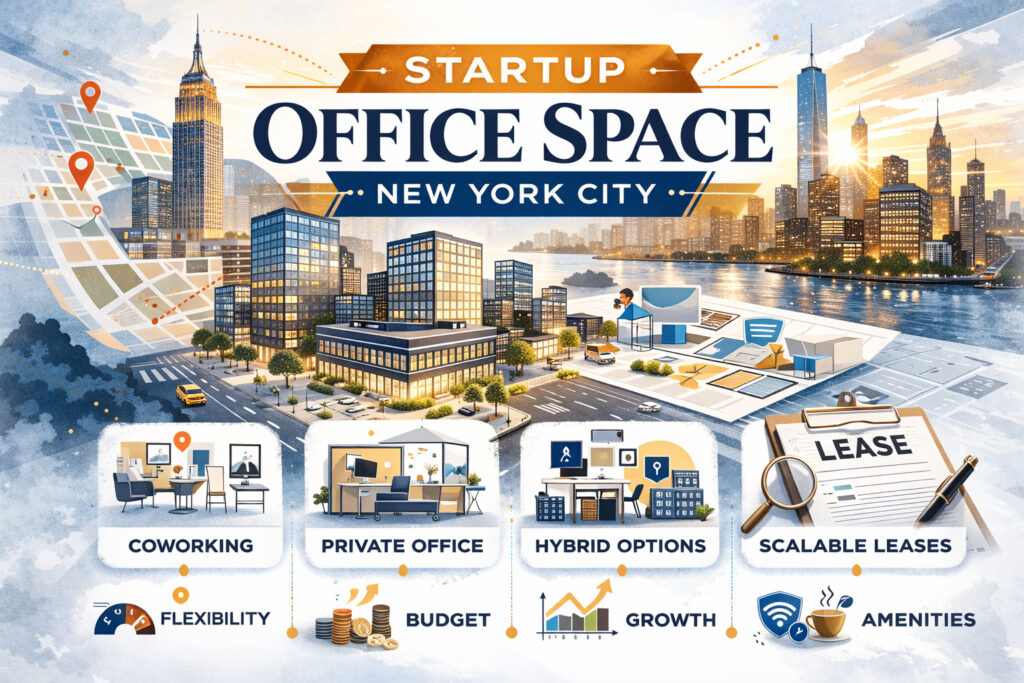
Startup Office Space NYC
How Startups Find, Evaluate, and Lease Office Space in New York City
Startup office space NYC is a high-intent search, but it does not point to a single type of office. Instead, it reflects a wide range of needs that startups face at different stages of growth, funding, and operational maturity.
Because of this, search results for startup office space in New York City include a mix of private office providers, coworking brands, office aggregators, brokerage firms, guides, and map-based results. This page explains what startups are typically looking for when they search this term, why so many different companies appear, and how startups can evaluate office options without being steered into the wrong category.
What “Startup Office Space” Means in NYC
In New York City, startup office space does not describe a lease structure or building class. Instead, it describes a business profile.
Most startups searching for office space are prioritizing some combination of:
• Speed to occupancy
• Flexibility during growth or fundraising
• Controlled upfront costs
• A professional environment for hiring and clients
• The ability to expand or relocate without major disruption
Because startups vary widely in headcount, funding stage, and runway, the term startup office space NYC is interpreted broadly by search engines.
📍 Startup-Friendly Office Listings
• Furnished Full Floor Flatiron Area Office – 11,306 sq ft
Pre-built, full-floor office space in Flatiron — creative layout with open collaborative areas, meeting rooms, and flexible design. Great for scaling teams or tech startups needing branding and autonomy in a vibrant neighborhood.
• Small NoMad Office Space – 1,000 sq ft
Compact, pre-built office in Midtown South ideal for early-stage startups or small teams transitioning out of coworking and needing their own space with character and direct lease terms.
• SoHo Turnkey Office Space – 2,691 sq ft
Turnkey loft-style office in SoHo with open area and private offices — attractive for creative startups, small tech firms, or design teams seeking a flexible, move-in ready environment.
• Full Floor SoHo Office Space – ~5,550 sq ft
Full floor loft office in SoHo that balances boutique character with room for growth — great for startups that require a distinct brand presence and space for collaboration.
• Open Collaborative Office in Midtown – 5,117 sq ft
Open, modern collaborative environment near Times Square — well suited for startups or small creative firms that emphasize teamwork and flexible workspace layout.
• Park Avenue Furnished Office Space – 6,131 sq ft
Larger furnished sublet with modern amenities and room for teams to scale, blending professional presentation with startup-friendly amenities and collaborative areas.
• Third Avenue Class A Office Space – 9,104 sq ft
Class A Midtown East office with flexible layout potential — this size and setting can work well for well-funded startups ready to establish a strong NYC presence.
Why the Search Results Include So Many Different Companies
Search engines treat startup office space NYC as a blended intent query. As a result, the results page pulls from several overlapping office categories that startups commonly evaluate.
Understanding these categories is essential to choosing the right option.
Private Office and Flexible Workspace Providers
Companies such as Industrious, Regus, WeWork, Jay Suites, and similar providers appear prominently because they market private offices and team suites that are frequently used by early-stage and growth-stage startups.
These spaces are typically:
• Fully furnished
• Located within shared buildings
• Offered under license agreements rather than leases
• Available with shorter commitment terms
For some startups, this model provides a fast and predictable way to establish an office presence. For others, particularly those planning to scale headcount or remain in place for several years, flexible offices may function as an interim solution rather than a long-term headquarters.
Coworking Brands and Startup-Focused Messaging
Coworking brands appear frequently because they explicitly market to tech startups, entrepreneurs, and founders. These companies often emphasize community, amenities, and flexibility.
While coworking environments can support early collaboration and networking, they may introduce limitations around privacy, branding, layout control, and long-term cost predictability as a startup grows.
Their visibility in the results reflects marketing alignment with startup culture, not necessarily suitability for every startup stage.
Office Listing Platforms and Aggregators
Platforms such as Metro Manhattan Office Space, LoopNet, SquareFoot, Deskpass, and similar services appear because they aggregate a wide range of office inventory across New York City.
These platforms may include:
• Traditional office leases
• Subleases
• Prebuilt startup-friendly offices
• Flexible offices and executive suites
Because listings vary widely in lease structure, pricing methodology, and delivery condition, startups may see dramatically different options grouped under the same search term. This is often where confusion begins.
Startup Office Guides and “Best Of” Lists
Guides such as “best startup office space NYC” or “startup office space NYC complete guide” appear because many startups are searching for education, not just listings.
These pages typically address questions like:
• How much space does a startup need
• What neighborhoods are startup-friendly
• How office costs affect runway
• Whether to lease or use flexible space
Their presence indicates that startup office space NYC is an evaluation-stage query, not just a transactional one.
Map Results and Local Office Providers
The map section often highlights local office providers and brokerages because the query is interpreted as a location-based commercial real estate search.
Businesses appear here due to proximity, service classification, and relevance to office leasing—not necessarily because they specialize in startup-specific office strategy.
What Startups Are Actually Trying to Decide
Most startups searching for startup office space NYC are trying to answer several core questions at once:
• Do we need a real office yet
• How much space is enough without overcommitting
• Can we afford a lease without harming runway
• How flexible does our office need to be
• Will this space support hiring and credibility
Because these questions evolve quickly as startups grow, the search results surface multiple office formats rather than a single answer.
Common Types of Startup Office Space in NYC
In practice, startup office space in New York City usually falls into one of the following categories:
Flexible private offices for early-stage teams prioritizing speed
Prebuilt offices designed for startups with immediate needs
Small to mid-size traditional offices for funded startups seeking control
Subleases offering shorter commitments with existing build-outs
Each option carries different implications for cost, flexibility, legal structure, and long-term scalability.
Why Pricing Searches Appear Alongside This Query
Related searches such as small startup office space NYC, startup office space NYC rent, or WeWork pricing per month appear because startups are highly sensitive to cash flow and burn rate.
In New York City, total office cost depends on:
• Rentable versus usable square footage
• Operating expenses
• Lease term length
• Escalations
• Build-out obligations
Without understanding these factors, startups may compare options that are not financially equivalent.
Why Remote Office and Hybrid Options Appear
Searches related to remote office space, shared office space, and virtual offices appear because many startups operate hybrid or distributed teams.
These solutions can complement a physical office but do not replace the operational, cultural, and branding benefits of a dedicated startup office for companies that require in-person collaboration.
How NewYorkOffices.com Approaches Startup Office Space
NewYorkOffices.com focuses on helping startups understand when a traditional office makes sense, what size is appropriate, and how to structure a lease without introducing unnecessary risk.
This page does not promote specific office providers. Instead, it explains how the New York City office market interprets startup demand and how founders can approach the search with clarity rather than guesswork.
When a Traditional Office Makes Sense for a Startup
A traditional startup office is often appropriate when:
• The team exceeds ten to fifteen employees
• Hiring requires in-person collaboration
• Client meetings matter
• Brand presence is important
• The company plans to remain in NYC for multiple years
At that stage, understanding lease structure becomes more important than short-term flexibility alone.
Summary
Startup office space NYC is not a single product. It is a decision phase shaped by growth, funding, and operational priorities.
The variety of search results reflects the range of office solutions that startups consider, from coworking and flexible offices to traditional commercial leases. This page exists to explain how those options fit together so startups can choose office space that supports growth rather than constrains it.