Coworking vs Office Space NYC
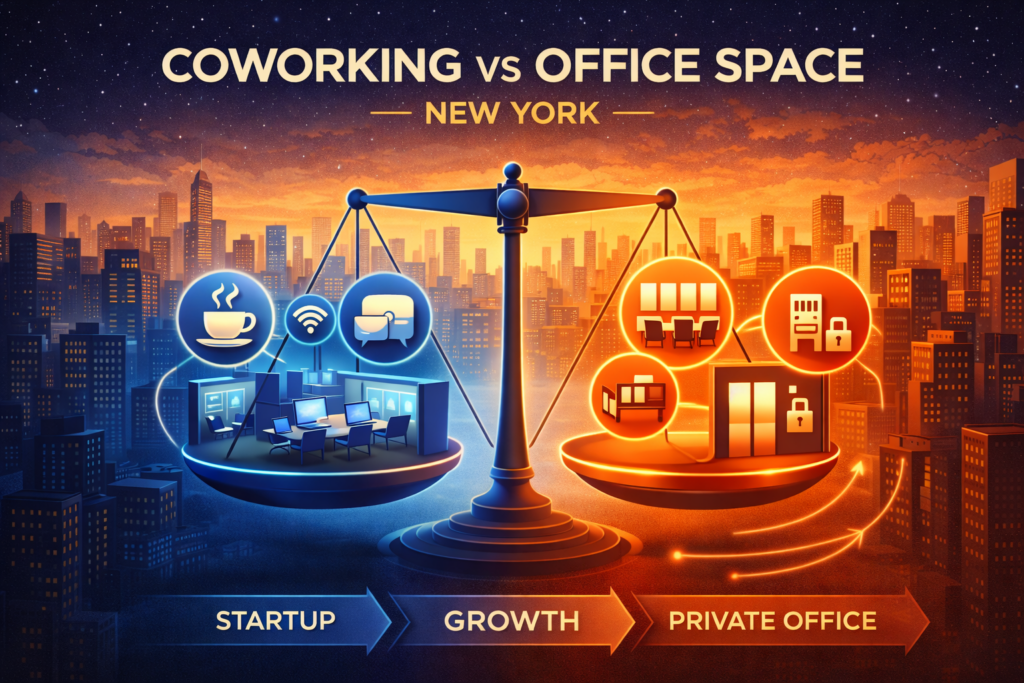
Coworking versus traditional office space in New York City is one of the most common decisions companies face as they grow. At first glance, coworking appears flexible and convenient, while private offices appear more structured and permanent. However, the real difference between coworking and traditional office space in NYC lies in control, long-term cost, operational stability, and brand presence.
This page explains how the two models function, when coworking environments make sense, and when companies reach the point where leasing private office space becomes the smarter operational decision.
Understanding this transition is critical because many businesses remain in coworking environments long after the model stops working financially or operationally.
What Coworking Space Means in the New York Office Market
Coworking spaces are shared workplace environments operated by third-party providers that lease large office floors and subdivide them into smaller suites, desks, and meeting areas.
Companies typically pay monthly memberships rather than traditional leases, which allows them to occupy space quickly without negotiating long-term commitments.
Most coworking environments include:
• shared conference rooms
• open desk areas
• small private suites
• reception services
• shared kitchens and lounges
• high-speed internet
• short-term agreements
Because these services are bundled together, coworking is often marketed as turnkey workspace.
However, that convenience comes with structural tradeoffs.
What Traditional Office Space Means in NYC
Traditional office space refers to a direct lease between a tenant and a building owner or landlord.
Instead of paying a membership fee, the tenant rents a defined office suite measured in rentable square feet.
These offices can be configured to include:
• private offices
• conference rooms
• reception areas
• internal kitchens
• collaborative work areas
• workstation environments
Unlike coworking, the company controls its own office environment, layout, and security.
Consequently, traditional offices function as dedicated operating environments rather than shared platforms.
Pricing Differences Between Coworking and Private Offices
One of the biggest misunderstandings in the Manhattan office market is how coworking pricing compares to private office leasing.
Coworking typically charges per person per month, while traditional offices are priced per square foot per year.
Typical coworking pricing in Manhattan often ranges between:
$600 to $1,200 per desk per month
Premium coworking suites may exceed:
$1,500 per desk per month
In contrast, traditional office space rents across Manhattan commonly fall within ranges such as:
• Class A Midtown: $80–$130 per square foot annually
• Midtown South: $70–$110 per square foot annually
• Downtown Manhattan: $50–$85 per square foot annually
When translated into per-person occupancy cost, traditional offices frequently become less expensive once a team reaches approximately eight to twelve employees.
Therefore, coworking often becomes more expensive than private offices once companies grow beyond early startup stages.
Why Early-Stage Companies Choose Coworking
Coworking environments serve an important role for very small companies and early-stage teams.
They provide:
• immediate occupancy
• minimal upfront investment
• short commitment periods
• administrative simplicity
A startup with two or three employees may prefer coworking because signing a multi-year lease could create unnecessary risk.
Additionally, coworking environments often provide social networking opportunities that appeal to early entrepreneurs.
However, these advantages diminish as companies grow.
When Coworking Starts to Break Down
As teams expand, coworking environments often become operationally inefficient.
Several issues begin to appear:
Lack of Privacy
Shared environments make confidential meetings and internal discussions difficult.
This becomes especially problematic for industries handling sensitive information.
Limited Brand Presence
Coworking spaces rarely allow companies to create meaningful visual identity.
Offices are typically standardized, meaning companies cannot design spaces that reflect their brand or culture.
Cost Escalation
Because pricing is calculated per desk, coworking costs grow rapidly as teams expand.
At the same time, companies gain no long-term equity in the space.
Layout Limitations
Coworking offices often restrict how tenants use their workspace.
Furniture layouts, meeting room access, and common areas are controlled by the operator rather than the tenant.
When Private Office Space Becomes the Better Choice
Companies usually begin evaluating traditional office space once their teams reach eight to fifteen employees.
At this stage, private offices provide several advantages.
Cost Control
Renting a private office suite allows companies to spread occupancy costs across the entire team, often reducing the effective per-person cost.
Workspace Customization
Tenants can design layouts that support their workflow.
This may include dedicated conference rooms, quiet offices, collaboration areas, and internal kitchens.
Brand Identity
Companies gain the ability to create offices that reflect their culture, which is particularly important when hosting clients or recruiting employees.
Long-Term Stability
Traditional leases provide predictable occupancy costs over multi-year periods, which helps companies plan for growth.
The Transitional Stage: Serviced Offices
Between coworking and traditional leases, some companies choose serviced office suites.
These environments provide private offices but include bundled services such as furniture, internet, and reception support.
Serviced offices offer more privacy than coworking while still allowing relatively flexible commitments.
However, they typically remain more expensive than direct leases over longer time horizons.
The New York Growth Pattern
Many Manhattan companies follow a similar progression.
Early stage teams begin in coworking environments.
As they grow, they transition to small private offices between two thousand and five thousand square feet.
From there, companies eventually scale into larger office suites as their workforce expands.
This transition reflects a shift from flexibility to operational control.
Summary
The choice between coworking and traditional office space in NYC is not simply about flexibility versus permanence.
It is about control, cost structure, privacy, and long-term operational needs.
Coworking environments work well for very small teams that need immediate workspace without long-term commitments.
However, once companies begin expanding, private offices typically provide greater efficiency, stronger brand presence, and better cost control.
Understanding when to make that transition allows businesses to avoid paying premium coworking rates long after the model stops serving their needs.
Fill out our 📋 online form or give us a call today 📞 212-967-2061 — let’s find the right office for your business.
Major Coworking Providers in New York City
When companies search “Coworking vs Office Space NYC,” they often encounter several large coworking operators that dominate the Manhattan flexible workspace market.
Understanding how these providers operate helps clarify how coworking environments differ from traditional leased office space.
WeWork
WeWork remains one of the largest coworking operators in New York City, with locations across Midtown, Downtown Manhattan, and Brooklyn.
Typical WeWork offerings include:
• open coworking lounges
• dedicated desks
• private office suites
• shared conference rooms
• community events and networking programs
Membership structures usually include monthly coworking memberships, dedicated desk memberships, and private office suites for small teams.
While these environments allow companies to move in quickly, the workspace itself remains part of a shared operational platform where layout, infrastructure, and branding are controlled by the coworking operator rather than the tenant.
Industrious
Industrious positions itself as a hospitality-oriented coworking provider, focusing on premium service and professionally managed work environments.
Locations often provide:
• furnished private offices
• shared conference rooms
• concierge-style reception services
• hospitality amenities such as snacks and beverages
Compared with traditional coworking environments, Industrious locations are often quieter and more structured, appealing to professional services firms or smaller corporate teams.
However, companies still operate within a shared workspace infrastructure, meaning long-term operational control remains limited.
Workville
Workville operates coworking space in Midtown Manhattan and is frequently listed in directories of best coworking spaces in NYC.
Facilities often include:
• coworking desks
• private offices
• conference rooms
• rooftop terrace workspace
Because Workville locations often emphasize outdoor space and smaller coworking communities, they appeal to freelancers and small creative teams seeking flexible workspace environments.
Nomadworks
Nomadworks operates coworking environments in Manhattan neighborhoods such as Nomad and Midtown East.
The company focuses on flexible workspace designed for startups and small teams that need office infrastructure but want to avoid long lease commitments.
Typical offerings include:
• open coworking seating
• private office suites
• meeting rooms
• event spaces
These environments allow companies to scale workspace up or down quickly but operate within operator-controlled layouts and policies.
The Yard
The Yard provides coworking environments in Manhattan neighborhoods including Flatiron District, Lower Manhattan, and Williamsburg.
The company focuses on design-oriented workspace environments intended to support collaboration and creative teams.
Spaces often include:
• furnished private offices
• shared meeting rooms
• coworking lounges
• event and networking spaces
Like most coworking platforms, The Yard offers short-term agreements and bundled services, making it attractive to early-stage teams.
Types of Coworking Memberships in NYC
Another common search intent around coworking environments involves understanding how coworking memberships actually work.
Most coworking providers offer several tiers of workspace access.
Open Coworking Membership
Open coworking memberships typically allow individuals to work from shared seating areas within the coworking facility.
These memberships may include:
• access to communal work tables
• limited meeting room credits
• high-speed internet
• shared kitchen areas
This option is typically used by freelancers, remote workers, or very small startups.
Dedicated Desk Membership
A dedicated desk membership provides a reserved workstation within a shared coworking environment.
Members receive:
• a permanent desk location
• storage lockers
• extended workspace access
This structure provides more stability than open coworking seating while maintaining flexibility.
Private Office Suites
Many coworking providers offer enclosed private offices designed for small teams.
These spaces typically include:
• furnished office suites
• shared conference room access
• reception services
• internet and utilities
While these offices provide privacy, the company still operates within a shared coworking building infrastructure.
Day Passes and Temporary Workspace
Another search category involves temporary workspace access, often referred to as coworking day passes.
These passes allow individuals to use coworking environments for a single day without committing to a monthly membership.
Day pass access usually includes:
• temporary desk access
• internet connectivity
• shared lounge seating
• limited meeting room availability
This option is frequently used by traveling professionals, remote employees, or individuals needing occasional workspace access.
However, day passes are generally not practical for companies seeking long-term operational headquarters.
Neighborhoods With the Most Coworking Spaces
Coworking environments in New York City are concentrated in specific business districts where flexible workspace demand is highest.
Midtown Manhattan
Midtown remains the largest coworking hub due to its proximity to major corporations, transportation infrastructure, and client-facing businesses.
Many coworking providers operate locations near:
• Grand Central Terminal
• Bryant Park
• Times Square
• Midtown East office corridors
Flatiron and NoMad
The Flatiron and NoMad districts became early coworking hubs due to the presence of technology startups and creative companies.
These neighborhoods provide:
• boutique coworking environments
• startup-focused workspace communities
• access to restaurants and transit
Downtown Manhattan
Lower Manhattan has also developed a strong coworking presence as technology firms and media companies expanded south of Midtown.
Locations often appear near:
• Wall Street
• Fulton Center
• World Trade Center
These areas provide modern office buildings and strong transit connectivity.
Coworking vs Serviced Offices
Search results often mix coworking environments with serviced office providers, which operate slightly differently.
Serviced offices typically provide private office suites with bundled services, but they operate more like traditional offices than coworking environments.
Typical serviced office features include:
• private offices
• dedicated reception staff
• furnished workspace
• shared meeting rooms
However, unlike coworking lounges, serviced offices usually provide more privacy and a quieter environment, making them appealing to professional services firms.
Even so, serviced offices often remain more expensive over long periods than traditional leased office space.
“Best Coworking Spaces NYC” Lists
Many search results display editorial lists of the “best coworking spaces in NYC.”
These lists typically evaluate coworking providers based on factors such as:
• workspace design
• community events
• amenities
• neighborhood location
While these rankings can help individuals discover workspace options, they rarely evaluate the long-term operational tradeoffs that businesses face when scaling beyond small teams.
Companies planning to grow often discover that coworking environments optimized for individuals or small teams become less efficient once organizations reach larger headcounts and more complex workflows.
Why Many Companies Eventually Leave Coworking
Another key search question is why companies often transition away from coworking environments.
As businesses grow, several structural limitations begin to emerge.
These include:
Operational control limitations
Coworking environments operate under building policies established by the coworking operator.
Companies typically cannot modify:
• office layouts
• branding elements
• workspace design
This makes it difficult to create a workplace aligned with company culture or operational needs.
Scaling cost structure
Because coworking pricing is typically calculated per desk, costs scale directly with team size.
As organizations expand, this pricing structure can become significantly more expensive than leasing traditional office space.
At larger headcounts, companies often realize that private offices leased directly from landlords provide lower per-employee occupancy costs.
Limited brand identity
Coworking environments often present a standardized workspace aesthetic across all tenants.
This makes it difficult for companies to create:
• branded client environments
• customized workspace layouts
• distinctive company culture within the office
For businesses hosting clients or investors, this lack of brand presence can become a disadvantage.
The Decision Point: When Companies Transition to Private Offices
Many New York companies follow a predictable growth pattern.
Early-stage teams often begin in coworking environments due to flexibility and minimal startup costs.
However, once organizations reach approximately eight to fifteen employees, companies typically begin evaluating traditional office leases.
At that stage, private office space provides:
• lower long-term occupancy costs
• workspace customization
• stronger company identity
• operational control over the environment
This transition represents a shift from flexibility-driven workspace decisions to operational infrastructure planning.
Why Coworking vs Office Space Remains a Key NYC Business Decision
The decision between coworking and traditional office space reflects broader changes in how companies approach workspace.
Coworking environments emphasize speed, convenience, and flexibility, making them useful for early-stage teams or temporary workspace needs.
Traditional office leases emphasize control, stability, and long-term operational efficiency, which becomes increasingly important as organizations grow.
For companies operating in New York City’s competitive business environment, understanding this transition point allows them to avoid paying premium coworking costs long after a traditional office would provide greater operational value.