Financial District Office Space NYC
Financial District Office Space NYC represents Manhattan’s most infrastructure-heavy office market. Unlike Midtown’s prestige-driven towers or Flatiron’s startup ecosystem, the Financial District functions as a large-scale institutional environment designed to accommodate major employers, compliance-heavy industries, and tenants requiring substantial contiguous space.
However, the district is frequently misunderstood.
Many tenants evaluate Financial District office space solely through the lens of lower rents relative to Midtown. While pricing advantages do exist, the submarket’s true value lies in scale, transit density, and operational efficiency.
This page explains how the Financial District functions as a large-format office environment, when its cost structure creates strategic leverage, and when Midtown proximity still outweighs pricing benefits.
Geographic Boundaries
Financial District Office Space NYC generally refers to the southernmost portion of Manhattan, typically bounded by:
- Chambers Street to the north
- The East River and South Street Seaport to the east
- Battery Park and New York Harbor to the south
- West Street and the Hudson River to the west
Notably, the district includes several micro-areas such as Wall Street, Battery Park City, and portions of the Fulton Transit corridor.
Because of this geographic concentration, the Financial District operates as one of the densest office districts in the United States.
Buildings often cluster around major transportation nodes rather than traditional avenue corridors.
Explicit Pricing Context
Financial District Office Space NYC typically trades at a measurable discount compared with Midtown’s premium corridors.
Current broad market ranges include:
Class A Financial District Towers
Approximately $55 to $85 per rentable square foot
Renovated Class B Office Buildings
Typically $40 to $65 per rentable square foot
Older or Value-Oriented Inventory
Often $35 to $50 per rentable square foot
Consequently, tenants relocating from Midtown can frequently realize rent reductions between 20 and 35 percent depending on building quality.
Additionally, landlords in the Financial District frequently offer aggressive concession packages including:
Extended free rent periods
Larger tenant improvement allowances
Flexible expansion options
As a result, effective occupancy costs can fall even further below Midtown averages.
However, tenants must evaluate whether lower rent aligns with operational needs.
Discount alone does not determine strategic fit.
Floor Plate Scale
One defining characteristic of Financial District Office Space NYC is the availability of large floor plates.
Many buildings in the district offer 20,000 to 50,000 rentable square feet per floor, significantly exceeding the typical sizes found in Midtown South or Flatiron.
This scale supports organizations that require:
Large trading floors
Call center operations
Compliance-heavy administrative teams
Institutional corporate headquarters
Because of these larger floor plates, companies often secure contiguous blocks that would be difficult to assemble elsewhere in Manhattan.
The district functions as Manhattan’s large-format office environment.
Transit Density
Financial District Office Space NYC benefits from one of the most extensive transit networks in the city.
Major subway lines serving the district include:
1, 2, 3 trains
4 and 5 trains
A, C, and E lines
R and W lines
J and Z lines
In addition, the area provides direct access to:
PATH trains to New Jersey
Staten Island Ferry
Multiple ferry terminals along the East River
Consequently, employees commuting from Brooklyn, Queens, and New Jersey often experience shorter travel times to the Financial District than to Midtown.
Transit accessibility remains one of the district’s strongest structural advantages.
Industry Alignment
Financial District Office Space NYC historically served as the headquarters location for financial institutions and global banking operations.
While the tenant mix has diversified over time, the district continues to attract industries that require:
Regulatory compliance environments
Large operational teams
Institutional security infrastructure
Long-term tenancy stability
Typical tenants include:
Financial services firms
Insurance companies
Legal and compliance teams
Government-related organizations
Large technology infrastructure groups
Because of these industry requirements, many buildings incorporate robust security systems and large infrastructure capacity.
Building Infrastructure
Financial District buildings frequently contain mechanical and structural systems designed for institutional-scale operations.
Tenants often benefit from:
Large elevator banks
Heavy power capacity
Advanced telecommunications infrastructure
Secure lobby and access systems
Additionally, many towers underwent extensive modernization after the early 2000s, improving building systems while maintaining competitive rental pricing.
These upgrades allow tenants to access institutional-grade infrastructure at lower cost levels than Midtown.
When the Financial District Makes Strategic Sense
Financial District Office Space NYC aligns particularly well with organizations that:
Require large contiguous floor plates
Maintain cost discipline across large employee populations
Operate compliance-driven or institutional business models
Employ staff commuting from outer boroughs or New Jersey
Prioritize operational efficiency over Midtown prestige
For these companies, the district offers a combination of scale and affordability difficult to replicate elsewhere in Manhattan.
Cost leverage becomes operational leverage.
When Midtown Still Wins
Despite its advantages, the Financial District may not suit every tenant.
Organizations sometimes encounter challenges when:
Client-facing meetings occur frequently in Midtown
Brand positioning depends on Midtown prestige corridors
Smaller boutique floor plates are preferred
Recruitment focuses heavily on Midtown-centered talent pools
In these cases, Midtown or Midtown South locations may still provide stronger strategic alignment despite higher rent levels.
Location must support the business model.
Relationship to Other Submarkets
Financial District Office Space NYC occupies a unique position within Manhattan’s leasing ecosystem.
Midtown represents institutional prestige and headquarters visibility.
Midtown South supports creative and hybrid office environments.
Flatiron functions as a startup and venture ecosystem.
Meanwhile, the Financial District provides Manhattan’s largest concentration of large-scale office inventory at comparatively lower cost levels.
Each submarket answers a different operational requirement.
Summary
Financial District Office Space NYC offers tenants large-format office environments supported by extensive transit infrastructure and competitive rental pricing. However, the district’s value extends beyond rent discounts alone.
Companies requiring scale, operational efficiency, and institutional-grade infrastructure often find the Financial District uniquely suited to their needs.
At the same time, organizations prioritizing Midtown proximity or boutique office environments may find the district less aligned with their strategic goals.
Financial District office space is not simply cheaper Manhattan.
It is Manhattan’s operational-scale office market.
Fill out our 📋 online form or give us a call today 📞 212-967-2061 — let’s find the right office for your business.
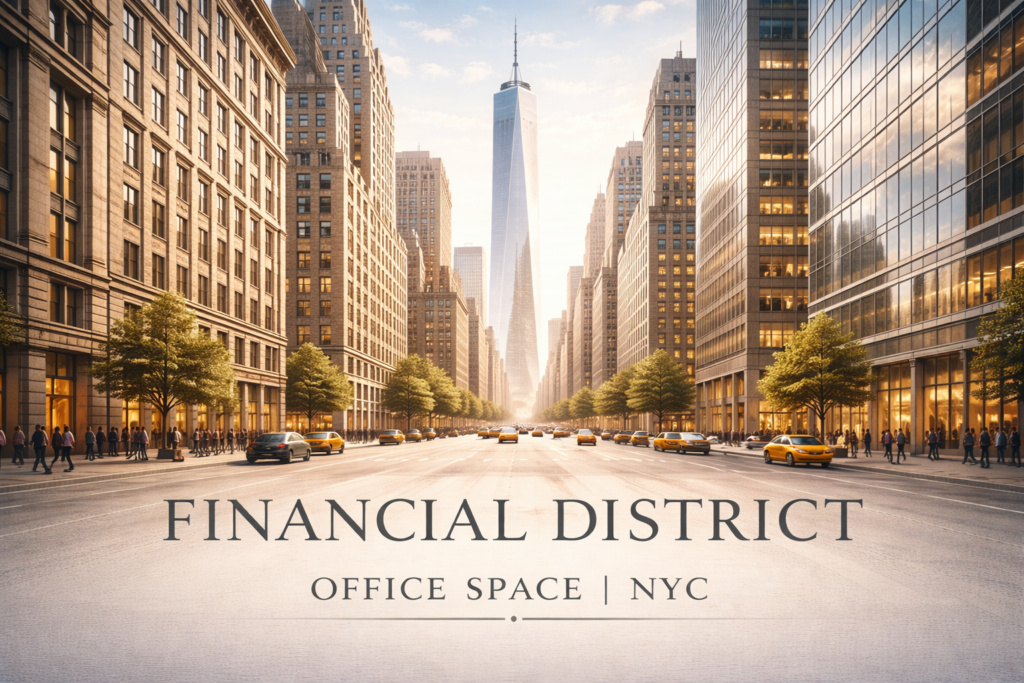
Financial District Office Space for Rent
Many searches for Financial District Office Space NYC originate from companies actively looking for available offices rather than researching the district itself. Common search variations include:
Financial District office space for rent
Office space Financial District NYC
Commercial office space Downtown Manhattan
Offices near Wall Street
These searches typically reflect tenants that have already decided to operate in Lower Manhattan and are comparing available buildings.
Because the Financial District contains one of Manhattan’s largest concentrations of office inventory, leasing opportunities exist across a wide range of building types.
Tenants can encounter:
Boutique prebuilt offices in historic buildings
Mid-size office suites in repositioned towers
Large contiguous blocks within institutional office towers
This diversity allows companies with very different operational requirements to locate within the district.
Typical Office Sizes Available in the Financial District
Unlike Midtown South’s boutique loft environment, the Financial District frequently offers larger office configurations.
Common availability patterns include:
Small offices ranging from 2,000 to 5,000 rentable square feet
Mid-size suites between 5,000 and 15,000 rentable square feet
Full floors exceeding 20,000 rentable square feet in large office towers
Large blocks above 50,000 square feet occasionally appear when major tenants relocate or consolidate operations.
Because of this inventory scale, the Financial District remains one of the few Manhattan markets capable of accommodating both growing startups and large corporate headquarters within the same submarket.
Coworking and Flexible Office Space in the Financial District
Search results frequently include coworking providers and flexible workspace environments within the Financial District.
Flexible office operators in the district typically offer:
Private furnished offices
Short-term membership suites
Meeting rooms and conference facilities
Shared collaboration areas
These environments allow companies to enter the district quickly while maintaining operational flexibility.
However, as organizations expand, many transition from coworking environments into traditional leased offices in order to stabilize long-term occupancy costs.
Because the Financial District contains significant building inventory, companies graduating from flexible workspaces can often remain within the neighborhood while upgrading into larger private offices.
Pricing Questions About Financial District Office Space NYC
Search queries often focus on pricing comparisons such as:
Financial District office space cost
Financial District NYC office rent
Average rent Downtown Manhattan office space
Compared with Midtown, the Financial District frequently offers lower headline rental rates while still providing large institutional office buildings.
Pricing differences typically reflect:
The district’s distance from Midtown prestige corridors
Higher building supply levels
Competition among large towers seeking tenants
As a result, companies relocating from Midtown frequently find that effective occupancy costs decline even while obtaining larger office environments.
In many cases, concession packages further reduce real occupancy costs beyond the published rental rate.
Office Space Listings in the Financial District
Search results also indicate strong demand for office space listings within the Financial District.
Companies exploring the district often compare multiple building types including:
Historic financial buildings converted to modern offices
Repositioned Class A towers along Water Street
Modern skyscrapers near the World Trade Center campus
Boutique offices in smaller Lower Manhattan buildings
Because the district contains such varied inventory, listings can range from compact professional suites to large multi-floor headquarters spaces.
This breadth of supply allows tenants to evaluate several building styles while remaining within the same geographic district.
Small Office Space in the Financial District
Although the Financial District is known for large corporate towers, the district also supports demand for smaller office suites.
Smaller office users often include:
Professional service firms
Financial advisory groups
Legal practices
Technology startups establishing downtown operations
These companies frequently seek spaces ranging from 2,000 to 6,000 rentable square feet within repositioned buildings or smaller historic assets.
For organizations that require access to Lower Manhattan infrastructure but do not need large corporate footprints, these boutique offices provide an efficient entry point into the district.
Frequently Asked Questions About Financial District Office Space
Is the Financial District cheaper than Midtown for office space?
In many cases, yes. The district often offers lower headline rents and more aggressive concession packages compared with Midtown office markets.
Does the Financial District have large office buildings?
Yes. The area contains many large towers capable of supporting major corporate headquarters and multi-floor office operations.
Is coworking available in the Financial District?
Yes. Flexible workspace providers operate throughout Lower Manhattan and offer short-term office solutions.
Are smaller offices available downtown?
Yes. While large towers dominate the skyline, smaller professional offices can be found in many repositioned buildings throughout the district.
What types of companies operate in the Financial District?
The district traditionally hosts financial institutions, insurance firms, legal practices, and corporate headquarters, though technology and media companies are increasingly present.
Strategic Role of the Financial District in Manhattan’s Office Market
Financial District Office Space NYC occupies a distinctive position within Manhattan’s broader office landscape.
The district combines:
Large institutional office towers
Extensive transit infrastructure
Competitive rental pricing
High concentrations of financial and corporate institutions
For organizations that require large office environments, global connectivity, and cost efficiency, the Financial District continues to represent one of Manhattan’s most strategically practical locations.
Companies prioritizing Midtown prestige or boutique creative environments may choose alternative submarkets. However, firms requiring scale, infrastructure, and operational efficiency often find the Financial District uniquely suited to their long-term office strategy.