Creative Office Space New York
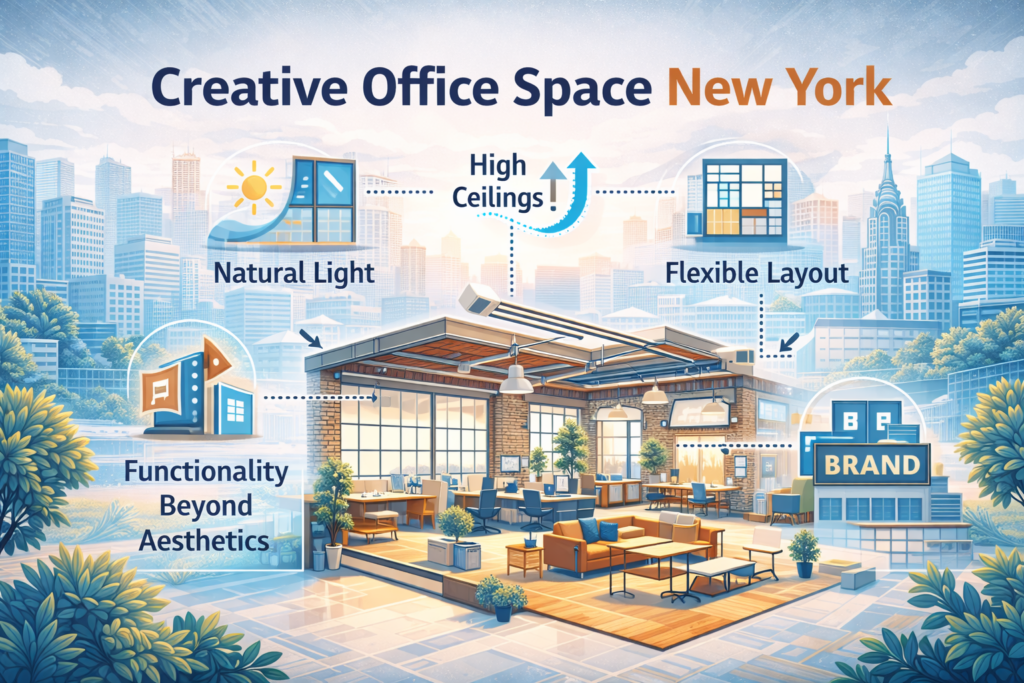
Creative office space in New York is often misunderstood as a style choice rather than a functional one. Exposed brick, open ceilings, and industrial finishes may signal creativity, but they do not define whether a space actually works for design-driven teams. In New York City, truly creative office space is determined by how well the environment supports collaboration, production, flexibility, and day-to-day workflow.
This page clarifies what qualifies as creative office space in New York, how creative teams evaluate space beyond aesthetics, and why many companies mistake visual appeal for operational fit.
What “Creative Office Space” Means in New York
Creative office space in New York refers to offices that support design-oriented, media, fashion, advertising, architecture, production, and content-driven teams. These spaces prioritize openness, adaptability, and environmental qualities that influence how people think and work.
Unlike size-based office categories, creative office space is defined by physical characteristics rather than square footage alone. Ceiling height, natural light, column spacing, floor depth, and layout flexibility matter more than whether a space is technically small, mid size, or large.
A creative office can exist at many sizes. What matters is how the space behaves.
🎨 Creative Office Space Listings
• Broadway Pre‑Built Office Space – Soho Creative Office (7,184 sq ft) – A bright, open workspace in SoHo with exposed brick, high ceilings, and collaborative areas ideal for creative and modern teams.
• Grand Central Creative Prebuilt Office – Midtown Creative Workspace (6,252 sq ft) – Turnkey prebuilt office with polished concrete floors, glass partitions, and versatile common areas fostering collaboration and design thinking.
• Furnished Flatiron District Office Space – Loft‑Style Creative Office (5,418 sq ft) – A loft-like open floorplate with exposed beams and hardwood floors, perfect for creative or collaborative teams.
• Downtown Furnished Office Space – Financial District Creative Layout (6,517 sq ft) – A creatively themed office with playful conference rooms, cafe-style pantry, and open workstations.
• West 18th Street Office for Rent – Creative Flatiron Loft (2,400 sq ft) – Industrial-style office featuring exposed ceilings, hardwood floors, and bullpen areas ideal for agencies and arts-oriented teams.
• Lafayette Street Office Space for Rent – Soho Creative Sublet (3,154 sq ft) – A light-filled office in SoHo with prime exposure, suitable for creative sectors like fashion, design, advertising, and media.
• Midtown Loft Office Space – Pre‑Built Creative Workspace (6,266 sq ft) – Loft office with glass partitions and open collaboration areas in a historic building near Grand Central.
• Furnished Union Square Office Space – Flexible Creative Layout (6,500 sq ft) – Open area with sit/stand desks and multiple meeting rooms in a vibrant Union Square environment.
Optional Larger Creative Canvas:
• Union Square Full Floor Office – Creative Open Plan (14,005 sq ft) – A larger full-floor space with industrial feel and flexible open plan, ideal for bigger creative teams or agencies.
Aesthetics Versus Functionality
One of the most common mistakes creative tenants make in New York is selecting space based on appearance alone.
Industrial finishes, exposed brick, timber beams, or concrete floors may photograph well, but they do not guarantee that a space functions effectively. Poor acoustics, limited power distribution, shallow window lines, or awkward column grids can undermine even the most visually striking office.
Creative office space must work before it looks good. A visually compelling office that restricts collaboration, production flow, or flexibility quickly becomes a liability.
Natural Light and Window Line
Light is one of the most important factors for creative teams, and New York buildings vary widely in how they deliver it.
Creative offices benefit from wide window lines, multiple exposures, and shallow floor plates that allow daylight to penetrate deep into the space. Large expanses of glass support both visual comfort and spatial flexibility, especially in open-plan environments.
Dark interiors, narrow window bands, or deep floor plates limit layout options and often force artificial lighting solutions that conflict with creative workflows.
Ceiling Height and Volume
Ceiling height is a defining feature of effective creative office space.
Higher ceilings improve air circulation, reduce visual compression, and allow for flexible lighting, rigging, and acoustic treatments. In many creative environments, ceiling height contributes as much to perceived openness as square footage itself.
Low ceilings, even in otherwise attractive spaces, can constrain layout options and reduce long-term adaptability. Creative teams often underestimate how quickly ceiling height becomes a limiting factor as needs evolve.
Layout Flexibility and Column Spacing
Creative work rarely fits into rigid office grids.
Teams may need open collaboration zones, production areas, flexible meeting spaces, or project-based layouts that change over time. Offices with wide column spacing, minimal structural obstructions, and open floor plates support this adaptability.
Tightly spaced columns, narrow bays, or highly compartmentalized layouts restrict movement and force workarounds that reduce efficiency. Creative office space should allow teams to reconfigure without rebuilding the office every time priorities shift.
Acoustics and Environmental Control
Creative offices tend to be louder, more collaborative, and more dynamic than traditional professional environments.
Sound control, HVAC zoning, and environmental balance become critical. Exposed ceilings and hard surfaces can create echo and noise issues if not addressed properly. Conversely, overly enclosed spaces can stifle collaboration.
Effective creative office space balances openness with acoustic planning, allowing teams to work collaboratively without sacrificing focus or comfort.
Infrastructure Beyond Desks
Creative teams often require infrastructure that extends beyond standard office needs.
Power density, data capacity, equipment loads, lighting controls, and production support areas can influence which buildings and floors are viable. These requirements may not be immediately visible during a tour but often determine whether a space can scale with the team.
Failing to assess infrastructure early is a common cause of creative offices outgrowing their space faster than expected.
Location and Building Type Considerations
Creative office space in New York is frequently associated with certain building types rather than specific neighborhoods.
Former industrial buildings, loft-style properties, and converted commercial structures often provide the physical attributes creative teams value. However, not all older or converted buildings deliver functional creative environments.
Building systems, code compliance, and base building conditions still matter. A creative office should not require constant operational compromise to maintain its aesthetic.
Why Creative Office Space Is Not a Size Category
Creative office space does not compete with small, mid size, or large office classifications. It intersects with them.
A creative team may occupy a small office today, a mid size office tomorrow, or a large multi-floor space later. What remains consistent is the need for light, volume, flexibility, and functional openness.
Treating creative office space as a standalone size category leads to mismatches between image and usability.
When Creative Office Space Makes Sense
Creative office space in New York works best for teams whose output depends on collaboration, visual thinking, production flow, and adaptability.
It is less suitable for organizations that require strict privacy, heavy compartmentalization, or rigid operational structures. In those cases, traditional office layouts often perform better.
Choosing creative office space should be driven by how the work gets done, not how the office looks on day one.
How This Page Fits Into the Leasing Process
This page is not intended to showcase listings or promote specific buildings. Its role is to help creative teams understand which physical characteristics matter before evaluating availability, pricing, or lease terms.
Once functional requirements are clear, the next step is identifying spaces that meet those criteria across New York City without sacrificing operational stability.
Skipping this clarity phase often leads to beautiful offices that fail in practice.
The Bottom Line
Creative office space in New York is defined by performance, not decoration.
Light, ceiling height, layout flexibility, acoustics, and infrastructure determine whether a space supports creative work over time. Aesthetic appeal matters, but only after functional needs are met.
This page exists to help design-driven teams recognize the difference between offices that look creative and offices that actually work before committing to space.
Fill out our 📋 online form or give us a call today 📞 212-967-2061 — let’s find the right office for your business.
Creative Office Space New York
How the New York Market Interprets “Creative Space” and Why the Results Look Fragmented
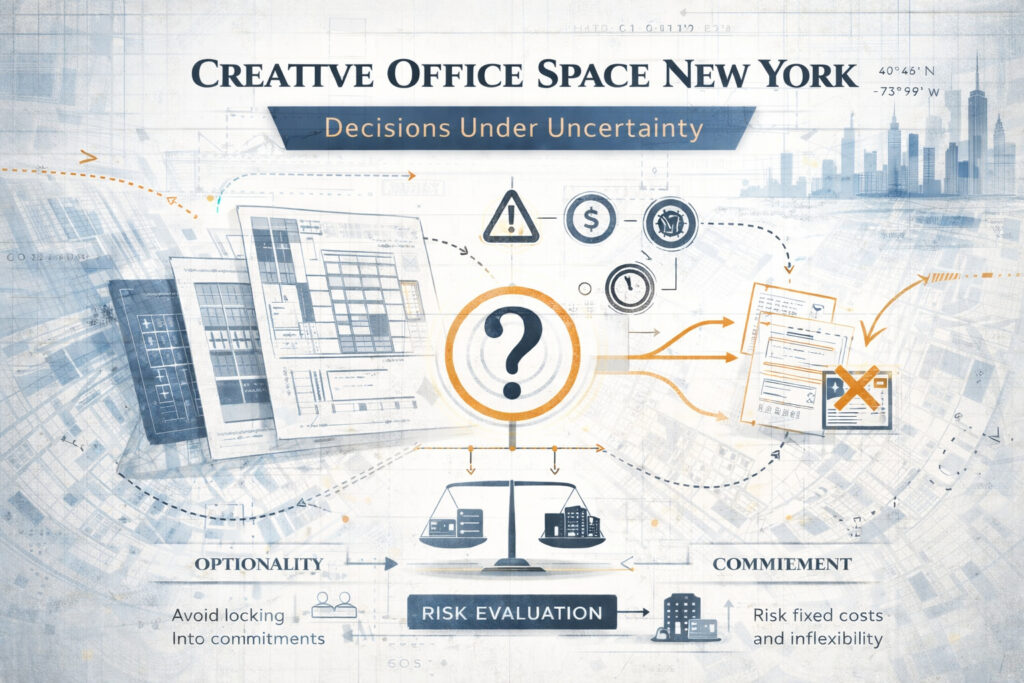
Creative office space New York is a high-ambiguity search. Unlike size-based office categories, it does not describe square footage, lease structure, or price range. Instead, it reflects a mix of use cases, industries, and physical characteristics that different groups interpret differently.
Because of this, search results for creative office space in New York pull from many adjacent categories: artist studios, coworking spaces, shared creative hubs, traditional offices with creative layouts, rehearsal spaces, brokerage listings, and editorial guides. This page explains how those categories intersect, why specific names appear, and how tenants should interpret the results without being misdirected.
What People Mean When They Search Creative Office Space New York
When users search creative office space New York, they are usually not looking for a specific building. They are trying to describe how they work, not how much space they need.
Common underlying intents include:
• Space for design, media, fashion, architecture, or content teams
• Offices that support collaboration, visual work, or production
• Environments that feel non-corporate or non-traditional
• Flexibility in layout, use, or evolution over time
Because none of these requirements map cleanly to a single office category, the search term pulls results from multiple markets at once.
Why Artist Studio Space Appears So Prominently
Autocomplete suggestions such as artist studio space for rent NYC, artist live/work space NYC, and artist studio space Brooklyn appear because artist studios are one of the oldest and most visible forms of creative workspace in New York.
Organizations and listings tied to artist studios often focus on:
• Raw or industrial-style interiors
• Flexible use definitions
• Lower-cost buildings in outer neighborhoods
• Zoning or use allowances for art production
However, artist studios are not the same as creative office space for companies. Studios are often governed by different zoning rules, building codes, and lease structures, which may not support teams, clients, or long-term business operations.
Their presence reflects creative use, not business office suitability.
Why Coworking and Shared Creative Spaces Rank Highly
Companies such as Industrious, Regus, WeWork, Creative Workspace, WORKVILLE, and similar operators appear because coworking brands actively market themselves as creative-friendly environments.
These spaces emphasize:
• Design-forward interiors
• Community and collaboration
• Shorter commitments
• Furnished, move-in-ready offices
For freelancers, small teams, and early-stage creatives, coworking can provide fast access to a professional environment. For established creative companies, coworking may lack privacy, layout control, acoustic management, or infrastructure needed for sustained production work.
Their visibility reflects marketing alignment, not a definition of creative office space itself.
Why Creative Resources, Foundations, and Rehearsal Spaces Appear
Results tied to organizations like New York Foundation for the Arts, The Alliance of Resident Theatres/New York, and rehearsal or studio-focused operators appear because creative work in New York spans arts, performance, and production, not just office-based businesses.
These organizations support:
• Artists and performers
• Rehearsal and practice environments
• Non-office creative activity
They appear because the term creative space overlaps culturally with creative work, even when the underlying real estate requirements are fundamentally different.
Why Brokerage Listings and Aggregators Show Up
Platforms such as LoopNet, Deskpass, Gigster, and brokerage-related listings appear because they tag properties using descriptive language like creative, loft, or studio-style.
These listings often include:
• Loft offices
• Converted industrial buildings
• Open-plan layouts
• Non-traditional finishes
However, the label creative office is not standardized. One listing may describe exposed brick and high ceilings, while another refers to layout flexibility or zoning. Without context, the same phrase can describe very different spaces.
Why Places and Map Results Are So Dense
The map section clusters coworking spaces, shared studios, and flexible offices because Google interprets creative office space New York as a location-based service query.
Businesses appear based on:
• Category relevance
• Physical proximity
• User engagement signals
This does not mean those locations specialize exclusively in creative office leasing. It reflects how Google organizes nearby results for broad workspace terms.
What Creative Companies Are Actually Trying to Decide
Behind the search, most tenants are trying to answer a few core questions:
• Does our work require an office at all
• Do we need production capability, collaboration space, or client-facing areas
• How much permanence versus flexibility makes sense
• Can a space evolve as our work changes
Because these questions differ by industry, team size, and business model, the search results surface multiple workspace types rather than a single answer.
How Creative Office Space Differs From Other Categories
Creative office space in New York is not defined by size, neighborhood, or rent. It intersects with:
• Small office space
• Mid size office space
• Loft office space
• Flexible and prebuilt offices
What differentiates it is how the space supports creative output over time, not how it looks on day one. Treating creative office space as a standalone category often leads to mismatches between image and function.
How NewYorkOffices.com Fits Into This Search
NewYorkOffices.com approaches creative office space as a leasing strategy question, not a stylistic label.
Rather than promoting specific studios, coworking brands, or buildings, the goal is to help creative teams understand:
• Which physical characteristics actually matter
• Which options are offices versus studios versus shared environments
• When a traditional lease supports creativity better than flexible space
• How to avoid committing to spaces that limit growth or workflow
This page exists to organize the market, not to narrow it prematurely.
When Creative Office Space Makes Sense as a Concept
Creative office space is most relevant when teams:
• Depend on collaboration and visual communication
• Require adaptable layouts
• Balance creative work with business operations
• Need credibility with clients, partners, or investors
In those cases, the right space is defined by performance and adaptability, not aesthetic cues alone.
Summary
Creative office space New York is not a single product category. It is a crossroads search where art, business, real estate, and culture intersect.
The variety of search results reflects how many different workspace models claim relevance to creative work. This page exists to help tenants interpret those signals clearly, understand how the market uses the term, and move forward with office decisions grounded in function rather than labels.