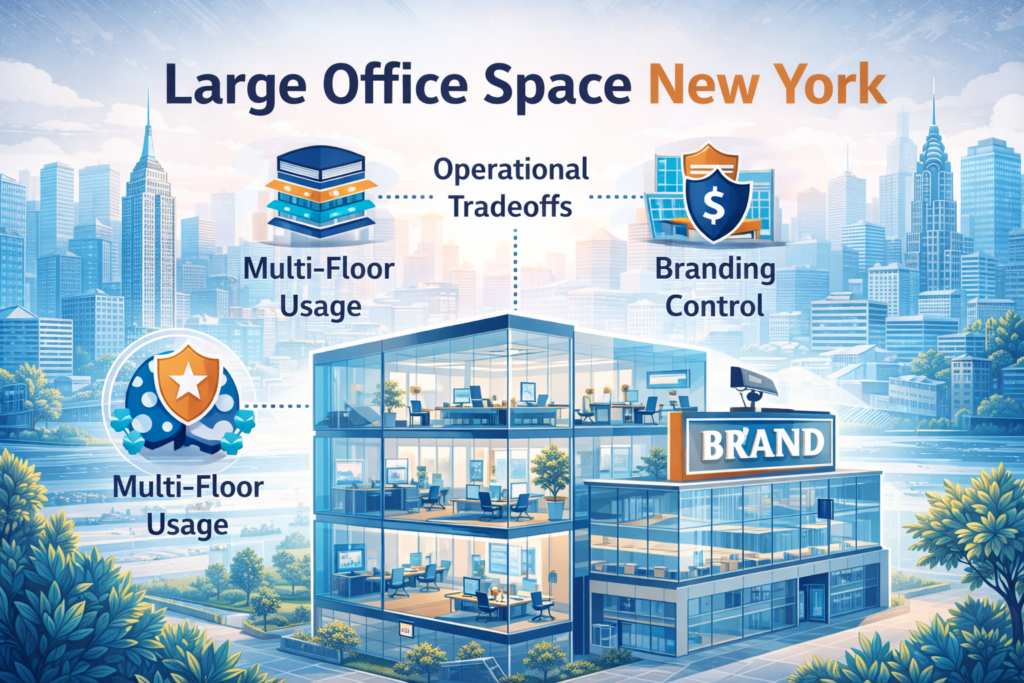
Large Office Space New York
Large office space in New York represents a strategic decision rather than a simple expansion of square footage. At this scale, office space becomes an operational platform that shapes branding, workflow, cost structure, and long-term flexibility. When executed correctly, large-format offices support control and presence. When misjudged, they amplify risk and lock organizations into rigid commitments.
This page explains when large office space in New York makes sense, how multi-floor environments change day-to-day operations, and what tradeoffs emerge as companies scale beyond mid size footprints.
What Qualifies as Large Office Space in New York
In the New York office market, large office space generally begins at approximately fifteen thousand rentable square feet and extends upward into multi-floor and full-building occupancies. At this size, tenants often control entire floors or multiple contiguous floors, introducing new levels of autonomy and complexity.
Large office users typically include established enterprises, fast-scaling companies with stable revenue, headquarters operations, and firms with brand-driven or security-sensitive requirements. This category is less about headcount alone and more about organizational structure and control.
Once a company reaches this threshold, office decisions stop being incremental and start becoming architectural.
📌 Examples of Large Office Space Listings
1. Hudson Yards Furnished Office Space (20,222+ sq ft)
An expansive ~20,222 sq ft sublet in 10 Hudson Yards — turnkey workspace with panoramic city views and modern finishes. This is a strong real-world example of large office space above the typical threshold you describe in your piece.
For example, a full-floor sublet like Hudson Yards Furnished Office Space spans over 20,000 sq ft — a scale that typically demands dedicated vertical circulation, zoning strategies, and brand expression as described above.
2. Hudson Yards Office Space Headquarters (45,942 sq ft)
A rare, headquarters-scale opportunity with nearly 46,000 sq ft, spanning full floors — exemplifying the type of high-impact occupancy strategy you talk about.
At the highest tier, opportunities such as the Hudson Yards Office Space Headquarters show how large office footprints can become a long-term organizational anchor for firms requiring substantial operational capacity
3. Full Floor Fifth Avenue Office Space (7,956 sq ft)
A full-floor layout in Midtown West offering ~8,000 sq ft — a good example of multi-functional office space that supports departmental separation or vertical organization.
Even at around 7,000–8,000 sq ft, full-floor spaces (like Union Square Furnished Office Space or Full Floor Fifth Avenue Office Space) illustrate the transition from mid-size to true large office layouts.
4. Union Square Furnished Office Space (7,687+ sq ft)
An entire 19th-floor space in Union Square — ~7,600 sq ft — showing how larger contiguous floor plans can support collaboration zones and flexible layouts.
When Large Office Space Makes Strategic Sense
Large office space makes sense when a company requires consistency, visibility, and long-term operational stability.
Organizations that benefit most from large-format offices often need to centralize teams, support multiple departments under one roof, or project a strong market presence. These tenants usually have predictable staffing levels, defined workflows, and leadership alignment around long-term occupancy.
Large office space works poorly for companies still experimenting with structure, hybrid policies, or rapid organizational change. At scale, uncertainty becomes expensive.
Multi-Floor Offices Change How Companies Operate
Once an office spans multiple floors, vertical circulation becomes an operational consideration.
Staircases, elevators, and internal connections affect collaboration, supervision, and efficiency. Teams separated across floors communicate differently than teams on a single plane, and leadership visibility often decreases as distance increases.
Multi-floor environments also introduce zoning decisions. Departments may cluster by function, hierarchy, or workflow, each with implications for culture and productivity. These decisions require planning beyond simple space allocation.
Large offices demand intentional internal organization.
Branding and Control at Scale
Large office space offers branding opportunities that smaller spaces cannot support.
Full-floor or multi-floor tenants often gain control over signage, lobby presence, entry sequencing, and architectural identity. This level of control reinforces brand image for clients, recruits, and partners.
However, branding at scale carries responsibility. Custom finishes, specialized layouts, and branded environments increase build-out costs and reduce flexibility. The more bespoke the space becomes, the harder it is to adapt or exit if conditions change.
Brand presence must be weighed against long-term optionality.
Operational Complexity Increases with Size
As office size increases, operational demands expand.
Large offices require more sophisticated planning around IT infrastructure, security, access control, HVAC zoning, and maintenance coordination. Meeting room scheduling, departmental adjacencies, and shared amenities must scale with the organization.
Operational inefficiencies that go unnoticed in smaller offices can compound quickly at larger sizes. Poor circulation, underutilized areas, or misaligned layouts create ongoing cost and friction.
At this level, office design becomes an operational discipline rather than an aesthetic exercise.
Cost Structure Shifts at Large Sizes
Large office leases in New York often offer lower rent on a per-square-foot basis, but total occupancy cost increases substantially.
Operating expenses, real estate taxes, cleaning, security, and energy usage scale with size. Build-out costs also rise, especially when spaces are customized for specific workflows or brand standards.
Because of these factors, budgeting for large office space requires a focus on total cost of occupancy rather than headline rent alone. Small percentage changes translate into significant dollar impacts over time.
Lease Terms and Risk Exposure
Large office leases typically involve longer terms, greater financial exposure, and more complex legal structures.
Expansion rights, contraction options, renewal clauses, and sublease flexibility become critical tools for managing risk. At this scale, even well-capitalized companies benefit from preserving optionality where possible.
Landlords may offer more concessions to large tenants, but they also expect commitment and clarity. Negotiation leverage increases, but so do expectations.
Strategic lease structuring is as important as space selection.
Large Offices in a Hybrid Work Environment
Hybrid work has reshaped how large offices function, not whether they are needed.
Many large tenants now require fewer desks but more collaboration areas, training rooms, and flexible zones. The challenge lies in designing space that supports presence without overbuilding permanent workstations.
Large offices that fail to adapt to hybrid realities risk underutilization and inefficiency. Successful layouts prioritize versatility and shared use rather than fixed assignments.
Scale magnifies both good and bad design decisions.
When Large Office Space Is the Wrong Choice
Large office space is a poor fit for organizations with volatile staffing, unclear leadership alignment, or short planning horizons.
It also creates risk for companies that expand space as a symbolic milestone rather than an operational necessity. In New York, oversized offices become financial and cultural burdens faster than expected.
Growth alone does not justify scale. Stability and clarity do.
How This Page Fits Into the Leasing Process
This page is not intended to showcase listings or promote availability. Its purpose is to help organizations assess whether large office space aligns with their structure, goals, and risk tolerance before entering the market.
Once that determination is made, the next step is evaluating buildings, pricing, and lease mechanics that support large-format occupancy across New York City.
Skipping this strategic layer often leads to overextension and long-term constraints.
The Bottom Line
Large office space in New York offers control, presence, and operational capacity that smaller formats cannot match. It also introduces complexity, cost, and risk that require deliberate planning.
When aligned with organizational stability and long-term vision, large offices support growth and authority. When chosen prematurely, they magnify uncertainty and reduce flexibility.
This page exists to help you recognize when scale is a strategic advantage and when it becomes a liability before you move forward.
Fill out our 📋 online form or give us a call today 📞 212-967-2061 — let’s find the right office for your business.
Large Office Space New York
Searching for Large Office Space New York is not a casual query. It signals that a business has crossed an operational threshold where size, stability, and long-term control matter more than flexibility or short-term convenience.
Companies searching this phrase are typically expanding headcount, consolidating multiple offices, exiting coworking, or planning a multi-year lease that must support growth without disruption. As a result, the search results span many different formats, interpretations, and business models.
This page exists to unify that fragmented landscape.
Instead of pushing a single listing type or vendor, it explains what large office space in New York actually means, why different companies appear in search results, how those options apply to large-scale tenants, and what decisions must be made before committing to a lease of this size.
What Qualifies as Large Office Space in New York City
In New York City, large office space generally refers to offices exceeding approximately ten thousand rentable square feet, though many tenants only begin using this term once requirements exceed fifteen thousand, twenty thousand, or more.
At this size, leasing dynamics change.
Large office space often involves full floors, multi-floor layouts, or contiguous space that supports centralized operations. These offices are typically found in Midtown Manhattan, Midtown South, Downtown Manhattan, and select emerging districts with larger floor plates.
More importantly, large office space marks a shift away from short-term occupancy models and toward traditional commercial leasing, where decisions affect budgets, staffing, build-outs, and business risk for years.
📌 More Large Office Space Listings
• Liberty Street Furnished Office Space – 44,042 sq ft of fully prebuilt, direct-lease space on an entire floor in Lower Manhattan — a true large-format office example that aligns with your definition of strategic scale (~15k sq ft+).
• Water Street Office Space – 8,755 sq ft available in the Financial District — a sizeable direct-lease opportunity with multiple work areas and private offices suitable for larger teams.
• Full Floor Park Ave Office – 9,142 sq ft Class A full-floor office on Park Avenue — an example of a contiguous floorplate that supports departmental adjacencies and workflow zoning.
• Furnished Bryant Park Office Space – 7,040 sq ft of furnished office space near Bryant Park — a larger footprint that can serve as a transition point between mid-size and large-format occupancy.
• Bryant Park Furnished Office Space – 6,000 sq ft on the entire 16th floor in the Bryant Park area — a larger contiguous sublet, useful as a comparative data point in discussions around scaling workspace.
• Midtown South, Penn Station West 33rd Street Full Floor Condo – 13,996 sq ft full-floor office condo — another substantial office product that sits just under 15,000 sq ft and makes a good bridge to your definition of “large” office space.
• Commercial Buildings for Sale or Lease – 10,748 + sq ft through an opportunity at 10 Harrison Street in Tribeca — rare whole-building scale that underscores both the brand and operational control you write about.
Why the Search Results Look Fragmented
The search term Large Office Space New York activates multiple intent lanes at once. Google surfaces results from each lane because the query overlaps several interpretations of “office space.”
Some results emphasize raw inventory.
Others emphasize brokerage services.
Some promote furnished or serviced offices.
Others appear as local business listings or maps.
Each lane answers a different question, but none of them explain the full picture on their own.
Listing Marketplaces and Inventory Platforms
Well-known platforms such as LoopNet and SquareFoot appear prominently because they aggregate large volumes of office listings across New York City.
These platforms are designed to surface availability, price ranges, and building locations. They are useful for scanning supply, but they are not designed to evaluate whether a space actually fits a tenant’s operational needs.
For large office requirements, listings alone are often incomplete. Asking rents may not reflect effective rent. Delivery conditions may be unclear. Floorplate efficiency, loss factor, and concession structures are rarely explained in depth.
These platforms appear because they collect inventory, not because they guide large-scale leasing strategy.
Brokerage Firms and Office Leasing Agencies
Brokerage brands such as Metro Manhattan Office Space appear because large office leases almost always involve broker representation.
At this size, tenants are negotiating multi-year commitments, operating expenses, tenant improvement allowances, and legal terms that require professional coordination. Brokerage firms exist to facilitate those negotiations.
However, brokerage-driven pages often prioritize listings or representation services rather than education. They typically assume the tenant already understands how large office leasing works in New York.
That assumption is where most mistakes begin.
Coworking and Serviced Office Providers
Brands such as WeWork and Regus appear because Google treats “office space” as a flexible workspace category by default.
For smaller teams, these environments can function as transitional space. However, for tenants searching Large Office Space New York, coworking rarely aligns with long-term needs.
Large teams face escalating per-seat costs, limited control over layout, branding restrictions, and short-term license agreements rather than true leases. These providers appear in search results because of keyword overlap, not because they are ideal solutions for large tenants.
Local Business Listings and Maps
Map results and local business panels appear because Google interprets the query as location-driven.
These results highlight office providers, business centers, and serviced suites within proximity to the searcher. While useful for finding physical locations, maps do not differentiate between temporary workspace and true large-scale office leasing.
For tenants planning a multi-year move, proximity alone is rarely the deciding factor.
What Large Office Tenants Actually Need to Evaluate
Large office space decisions require a different lens than smaller leases.
Tenants must evaluate floorplate efficiency, not just square footage. They must understand how rentable area converts to usable space. They must assess whether a building can support current density and future growth.
Lease structure matters as much as size. Escalations, operating expense exposure, renewal options, and expansion rights all affect long-term cost. Delivery condition determines whether a space can be occupied immediately or requires months of build-out.
None of these considerations are visible in a simple listing or map result.
Why This Page Exists
Most search results for Large Office Space New York either sell inventory or sell services. Very few explain how the pieces fit together.
This page is designed to sit above those lanes.
It clarifies why different companies appear, how each category applies to large tenants, and where each option fits within the broader leasing process. It is written for businesses that want to make informed decisions, not rushed ones.
Large Office Space Is a Strategy, Not a Search Result
Large office space in New York is not something you “find” in a single click. It is something you structure.
It requires aligning size with layout, budget with lease terms, location with staffing needs, and timing with operational risk. Search results can surface options, but they cannot replace strategy.
That is why this page exists as a reference point.
Moving Forward With Confidence
If you are searching Large Office Space New York, you are likely past the exploratory stage and entering a decision phase that carries real consequences.
Understanding why different results appear is the first step. Understanding how they apply to your business is the second. Structuring the right lease is the final and most important step.
NewYorkOffices.com exists to support that process from a tenant-first perspective, with clarity, market context, and practical guidance designed for businesses operating at scale.