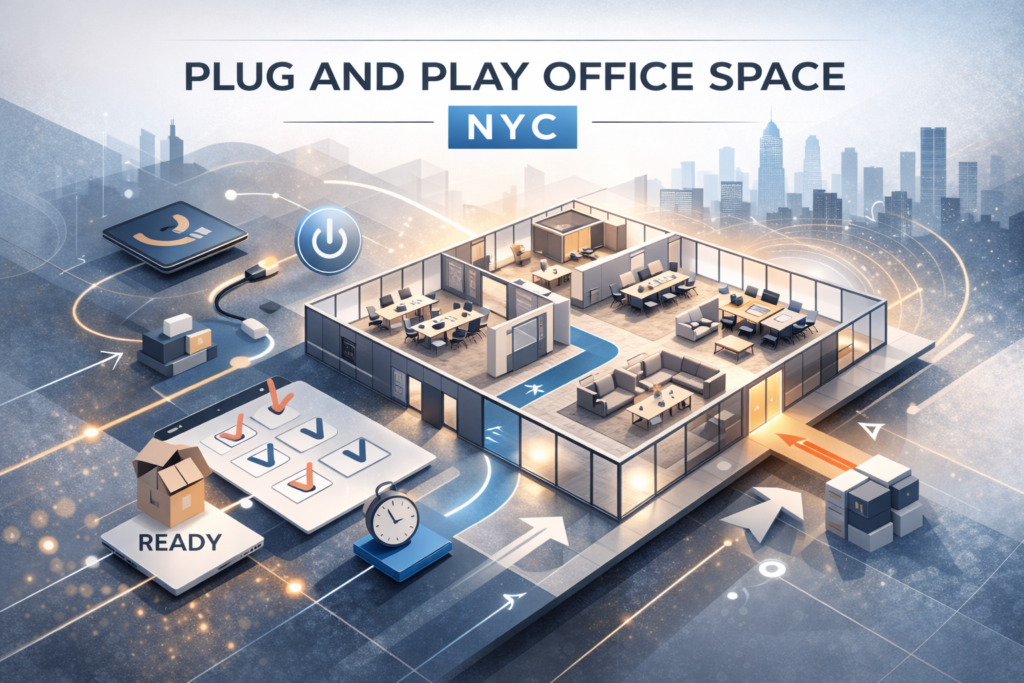
Prebuilt Office Space NYC
Prebuilt office space in NYC exists for one reason: speed without chaos.
In New York, timelines collapse quickly. Headcount changes arrive early. Lease expirations rarely wait for perfect planning. As a result, many companies need an office that can be occupied fast, with predictable effort, and without the delays of a full custom build.
This page explains what prebuilt office space in NYC is, what it is designed to solve, where tenants misjudge it, and how to decide whether a prebuilt office is a smart operational shortcut or a long-term mismatch.
This is not a design page.
It is a readiness page.
What Prebuilt Office Space Means in NYC
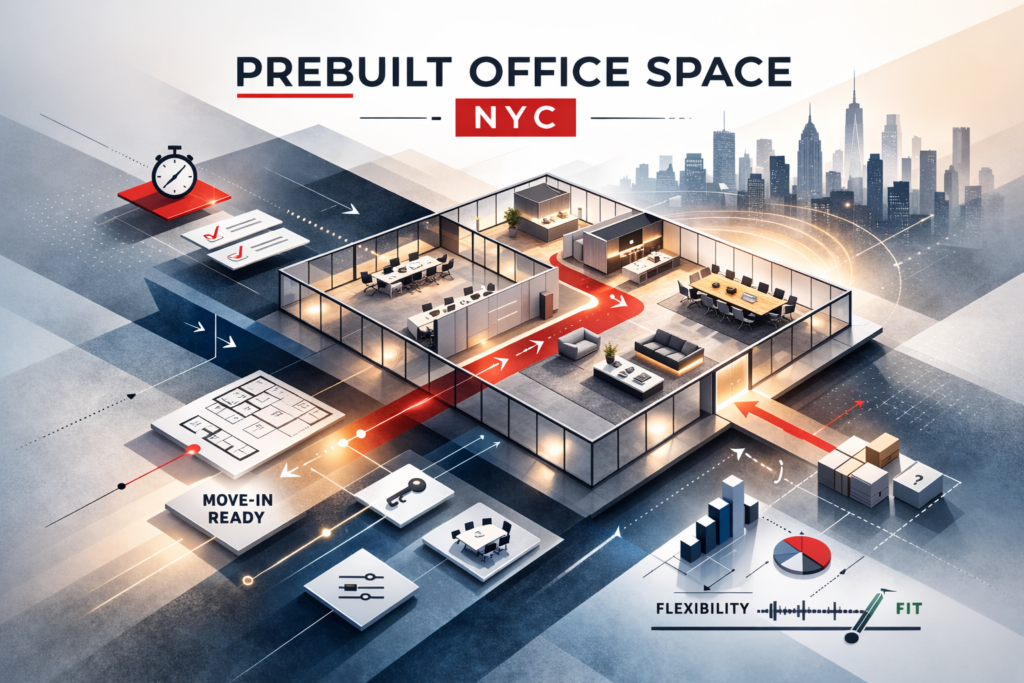
Prebuilt office space in NYC refers to offices that are delivered with a completed build-out by the landlord or building ownership. Instead of starting from raw space and designing from scratch, tenants step into a layout that already exists.
Most prebuilts include finished rooms, lighting, flooring, ceilings, and basic infrastructure. Some are delivered with additional features, such as a pantry, conference room, reception, and a set of private offices. Others are more minimal, focusing on speed and simplicity.
A prebuilt office is not defined by furniture. It is defined by a completed interior that is ready for occupancy.
Prebuilt Office Space: What It Is and When It Makes Sense for NYC Tenants
Explains how prebuilt office space in Manhattan works, why landlords deliver turnkey layouts, and when moving into a ready-built office is faster and more practical than building space from scratch.
Grand Central Creative Prebuilt Office
Large Midtown prebuilt office near Grand Central featuring a mix of open workstations, private offices, and conference rooms designed for collaborative teams.
Prebuilt Seventh Avenue Office
Move-in-ready office at 810 Seventh Avenue offering immediate occupancy, modern buildout, and capacity for a mid-size staff in the Times Square corridor.
Park Avenue Prebuilt Office Rental
Turnkey Park Avenue office suite near Grand Central with multiple windowed offices, meeting rooms, and open workstation space in a Class-A Midtown tower.
Park Avenue Prebuilt Office Space
High-end prebuilt office at 499 Park Avenue featuring modern glass offices, conference space, and a polished reception area suitable for client-facing firms.
Pre-Built Lexington Avenue Office
Corner prebuilt office at 420 Lexington Avenue with private offices, conference space, bullpen seating, and immediate access to Grand Central transit.
High-End Pre-Built Third Avenue Office
Full-floor prebuilt office at 767 Third Avenue with reception, breakout areas, meeting rooms, and an efficient workstation layout for growing companies.
State Street Prebuilt Office Space Rental
Downtown Manhattan prebuilt office with private offices, bullpen seating, and sweeping views of New York Harbor in a Financial District tower.
Furnished Bryant Park Office Space for Lease
Large furnished prebuilt office floor near Bryant Park designed for large teams with multiple meeting areas, workstations, and support spaces.
Furnished Union Square Office Space
Fully furnished prebuilt office at 920 Broadway featuring sit-stand desks, meeting rooms, pantry space, and strong natural light in the Union Square submarket.
Why Prebuilt Office Space Exists
Prebuilt office space exists because build-outs take time, and time creates risk.
Design phases, approvals, contractor schedules, lead times, inspections, and final sign-offs can turn an intended move-in into a long delay. Meanwhile, businesses still need a place to operate. Prebuilt offices shorten that gap.
For many NYC tenants, the real value of prebuilt space is not convenience. It is timeline certainty.
What Prebuilt Office Space Solves
Prebuilt office space in NYC solves problems that are operational, not aesthetic.
It reduces planning burden. It limits decision fatigue. It avoids the long chain of construction variables that can derail occupancy dates. It also allows companies to control costs more easily because much of the build-out risk has already been absorbed by ownership.
In addition, prebuilt space often simplifies budgeting by reducing early-stage capital outlay. Instead of funding a custom interior upfront, a tenant can often allocate resources toward technology, hiring, or growth.
Where Tenants Commonly Get Prebuilt Space Wrong
Prebuilt office space fails when tenants treat speed as the only variable.
The layout may not match the way a business actually functions. The conference room count may be wrong. Private office placement may conflict with team adjacency needs. Storage and support space may be insufficient. Circulation may waste square footage.
These issues do not look serious during a walkthrough. However, they become obvious once the office is in daily use.
Prebuilt space is fast, but it is not neutral. The layout makes assumptions on your behalf.
Prebuilt Office Space Versus Custom Build-Out
A custom build-out allows a tenant to design around workflow, culture, and long-term needs. In contrast, prebuilt office space trades customization for immediacy.
That trade is often rational. Still, it should be evaluated honestly.
If a company expects stable operations, consistent headcount, and predictable usage patterns, a prebuilt office can function well for years. On the other hand, if a business expects rapid change, the same prebuilt layout can become restrictive quickly.
The decision hinges on whether your business can live inside someone else’s assumptions.
The Economic Tradeoff of Prebuilt Space
Prebuilt office space in NYC often reduces upfront friction. Yet the economics still require scrutiny.
Some prebuilts command a premium because they remove time and effort from the tenant’s side. Others price competitively because the landlord wants velocity. In either case, tenants should evaluate the tradeoff between a faster start and a potentially less efficient layout.
Over the term of a lease, layout inefficiency can quietly cost more than a delayed move-in would have. The best prebuilt deals are the ones that preserve speed while still supporting day-to-day function.
Who Prebuilt Office Space Tends to Fit Well
Prebuilt office space in NYC often aligns with businesses that value certainty and simplicity.
It can work well for:
- companies relocating on short notice
- organizations with straightforward workflows
- teams that can operate with flexible seating arrangements
- tenants who want to reduce early-stage project management
In these cases, prebuilt offices reduce complexity and allow the business to focus on operations rather than construction.
When Prebuilt Office Space Becomes a Poor Fit
Prebuilt office space becomes risky when a tenant needs precision.
Businesses with strict adjacency requirements, frequent confidential meetings, specialized equipment needs, or dense storage requirements may find that standard prebuilt layouts cause ongoing inefficiency.
Similarly, teams expecting rapid growth often outgrow a prebuilt layout faster than expected. Expansion may require redesign, relocation, or compromise.
Speed is valuable, but only when the space remains workable after move-in.
What to Evaluate in a Prebuilt Office
A prebuilt office should be evaluated like a finished product, not like an empty canvas.
Tenants should focus on:
- circulation and how people move through the suite
- meeting room usefulness relative to daily demand
- private office placement and noise control
- pantry location and support-space adequacy
- flexibility for future adjustment
A prebuilt office works best when the layout aligns with real behavior, not idealized behavior.
How Prebuilt Office Space Fits Into the NYC Market
Prebuilt office space is a response to the pace of New York leasing.
It sits between fully built plug-ready occupancy and long-cycle custom construction. It is designed to reduce uncertainty, shorten downtime, and allow tenants to make decisions without committing to a prolonged project.
Understanding prebuilt space as a readiness product helps tenants evaluate it rationally instead of treating it as a design shortcut or a compromise.
Making the Right Decision About Prebuilt Office Space NYC
Choosing prebuilt office space in NYC requires a simple discipline: separate the urgency of move-in from the reality of daily use.
A prebuilt office can be the most efficient solution when time matters and the layout matches operational needs. However, the wrong prebuilt suite can create friction that lasts longer than any construction delay would have.
The goal is not merely to occupy space quickly.
The goal is to occupy space quickly without inheriting a long-term problem.
This page exists to make that decision clearer before the lease is executed.
Fill out our 📋 online form or give us a call today 📞 212-967-2061 — let’s find the right office for your business.
How Search Engines Interpret “Prebuilt Office Space NYC”
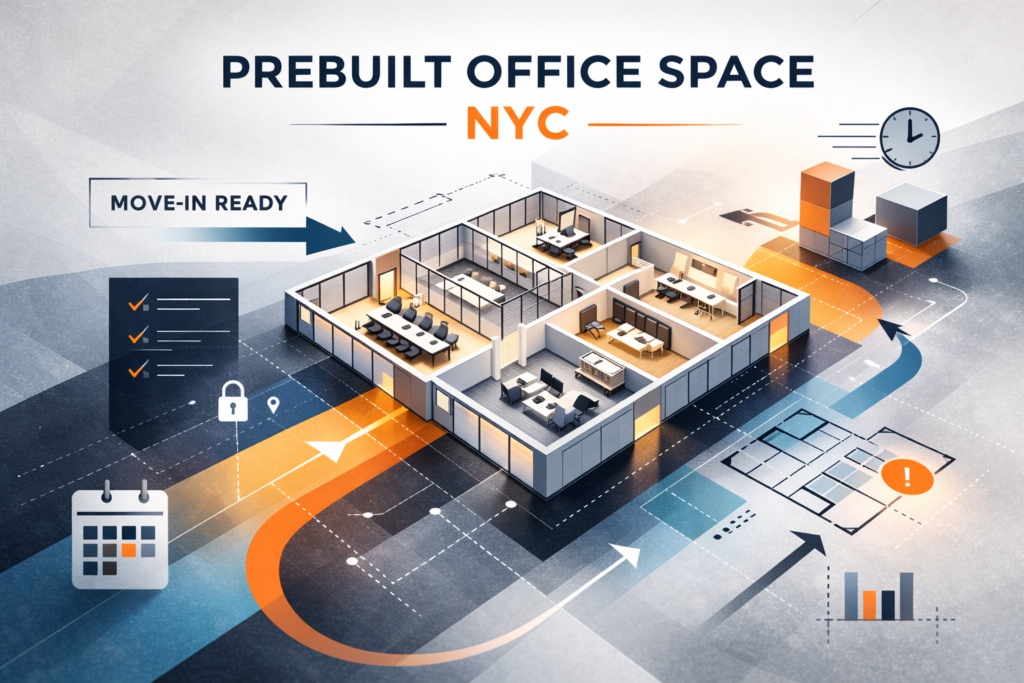
When tenants search for prebuilt office space in NYC, search engines interpret the phrase as a readiness-and-urgency query, not a design or classification query.
Unlike searches for full floor, modern, or luxury office space, this term is strongly associated with:
- Imminent occupancy needs
- Compressed decision timelines
- Risk avoidance rather than optimization
- Operational continuity over customization
As a result, search results skew heavily toward availability, providers, and inventory—often at the expense of explaining what prebuilt space actually commits a tenant to long term.
Why Flexible Office Providers Appear for Prebuilt Searches
Premium flexible office operators such as Industrious and Regus appear prominently because search engines associate prebuilt with:
- Immediate usability
- Finished interiors
- Minimal setup friction
- Predictable move-in timelines
From a ranking perspective, these providers satisfy the surface definition of prebuilt: offices that are already built and ready to use.
However, most flexible offices are licensed rather than leased and do not carry the same assumptions, responsibilities, or duration as a true prebuilt lease suite. They rank because they answer speed, not because they define prebuilt office space as it functions in traditional Manhattan leasing.
Why Listing Marketplaces Dominate Visibility
Commercial real estate marketplaces such as LoopNet rank heavily because search engines treat this query as inventory-driven.
These platforms surface because they allow tenants to filter for:
- “Prebuilt” or “turnkey” suites
- Square footage ranges
- Neighborhood availability
- Asking rent visibility
What listings rarely communicate is whether a prebuilt layout aligns with how a tenant actually operates. Circulation inefficiencies, meeting room mismatch, storage constraints, and growth limitations are difficult to surface in inventory-based formats.
Marketplaces rank because they show options, not because they evaluate fit.
Why Brokerage Pages and Agencies Surface
Tenant-focused brokerages and office agencies appear organically because prebuilt searches often signal a high-stakes timing constraint.
Search engines infer that a tenant searching for prebuilt office space may be:
- Facing lease expiration
- Experiencing unplanned headcount change
- Requiring immediate operational continuity
As a result, intermediaries who publish availability-focused content surface alongside marketplaces and providers—even though that content rarely explains when prebuilt space introduces long-term inefficiency.
The SERP emphasizes access. It does not emphasize consequence.
Why “Move-In Ready” and “Turnkey” Language Appears So Often
Search engines strongly associate prebuilt office space with terms such as:
- Move-in ready
- Turnkey
- Plug-and-play
- Fully built
These phrases perform well because they reduce perceived friction. However, they also collapse meaningful distinctions.
A prebuilt office can be:
- Efficient or inefficient
- Flexible or rigid
- Aligned or misaligned
Search systems do not distinguish between these outcomes. They reward readiness language, not operational durability.
What Related Searches Reveal About Tenant Anxiety
Related searches around prebuilt office space frequently include:
- “Prebuilt office space NYC cost”
- “Move-in ready office NYC”
- “Furnished office NYC”
- “Small office space NYC”
This indicates that tenants are often trading certainty today against uncertainty tomorrow.
Many are unsure whether speed is a strategic advantage—or merely a way to defer deeper decisions.
This uncertainty explains why prebuilt, flexible, furnished, and small office searches often overlap in the results.
How Tenants Should Interpret These Results Correctly
The variety of providers, marketplaces, and brokers appearing for this query does not mean prebuilt office space is a neutral shortcut.
It means search engines are responding to urgency signals, not suitability signals.
A true prebuilt office decision should account for:
- Whether the existing layout matches real workflows
- How circulation and meeting space function under daily use
- Whether growth, contraction, or reconfiguration is likely
- What assumptions the space makes on the tenant’s behalf
Prebuilt space saves time only when those assumptions hold.
What the Search Results Ultimately Confirm
Taken together, the search results reinforce a core reality already established on this page:
Prebuilt office space in NYC is not a design solution.
It is a timeline solution.
Search engines prioritize speed, availability, and simplicity. Lease outcomes depend on whether that speed introduces hidden rigidity or long-term cost.
Tenants who understand this difference evaluate prebuilt space as a readiness decision—not a convenience upgrade.
Why This Final Distinction Matters Before Signing
Search results optimize for immediacy.
Leases lock in behavior.
This final layer exists to explain why so many different result types appear for the same phrase—and why none of them, by default, determine whether a prebuilt office will still work six, twelve, or twenty-four months after move-in.
Speed is valuable only when it does not force a business to inherit the wrong assumptions.
That distinction is what turns prebuilt office space from a shortcut into a strategy.