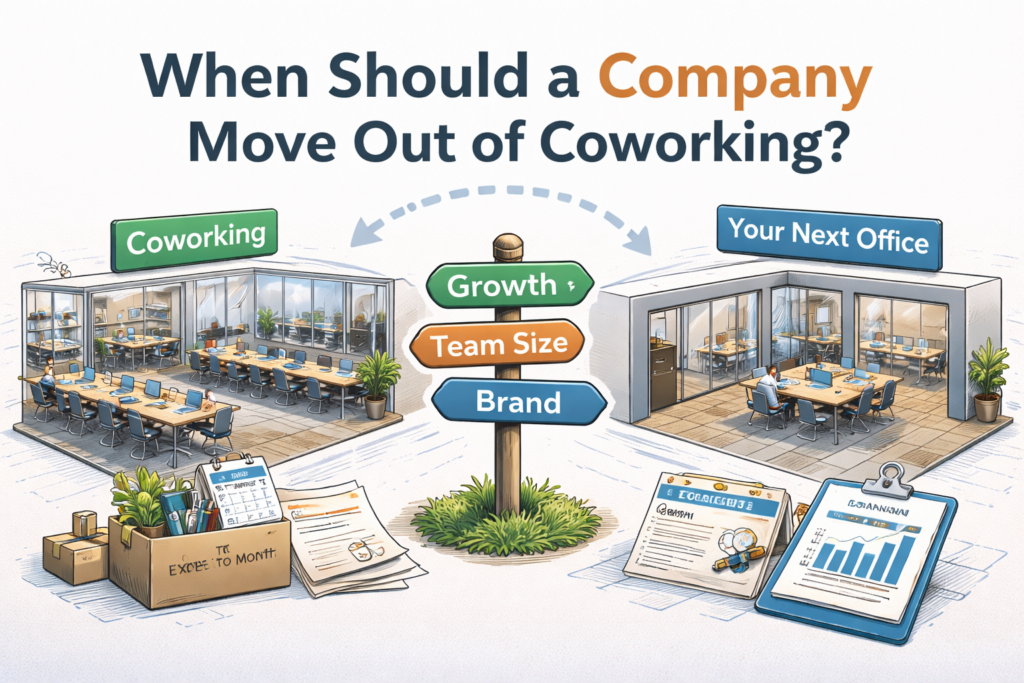
When Should a Company Move Out of Coworking?
The Real Answer (This Isn’t About Cost Alone)
Most advice online frames this as a financial decision:
“Move out when coworking gets too expensive.”
That is only one piece—and often not the deciding factor.
Companies don’t leave coworking because of price alone.
They leave because coworking stops working operationally.
The real trigger is this:
When your workspace starts slowing your business down instead of supporting it
That happens gradually—and most companies miss the moment.
The Five Signals It’s Time to Leave Coworking
These are the real-world indicators—not theory.
1. Your Team Has Outgrown the Space (Even If Desks Exist)
Coworking providers will always “fit” you in.
But ask yourself:
- Are teams split across different areas?
- Are people hunting for meeting rooms?
- Is collaboration harder than it should be?
👉 If your team is no longer sitting and working together cohesively,
you’ve already outgrown coworking
2. You’re Paying for Flexibility You No Longer Need
Coworking pricing includes:
- Short-term flexibility
- Ability to scale up/down quickly
But if your team is now:
- Stable
- Predictable
- Not shrinking
Then you are paying a premium for something you are not using.
👉 At this stage, coworking becomes financially inefficient
3. Your Brand Starts to Matter More
Early stage:
- No one cares where you sit
Growth stage:
- Clients notice
- Candidates notice
- Partners notice
Coworking creates:
- Shared identity
- Limited customization
- No true brand presence
👉 When perception matters, you need your own environment
4. Your Layout Is Working Against You
Coworking layouts are designed for:
- General use
- Not your business
This leads to:
- Too many distractions
- Not enough private space
- Inefficient workflows
Examples:
- Sales team next to quiet roles
- No dedicated meeting zones
- Leadership without privacy
👉 When layout friction increases, productivity drops
5. You’re Thinking 12–24 Months Ahead (Not 30 Days)
Coworking is built for:
- Immediate needs
Leasing is built for:
- Future planning
If you are now asking:
- “Where will we be in a year?”
- “How do we grow into space?”
👉 You are already in a leasing mindset
The Real Inflection Point (This Is the Key Insight)
Most companies don’t leave coworking at a specific headcount.
They leave when three things happen at once:
- Team size reaches ~15–30 people
- Growth becomes predictable
- Operational friction increases
👉 That combination—not just size—is the trigger
Visualizing the Transition
Coworking Phase (Early / Flexible)
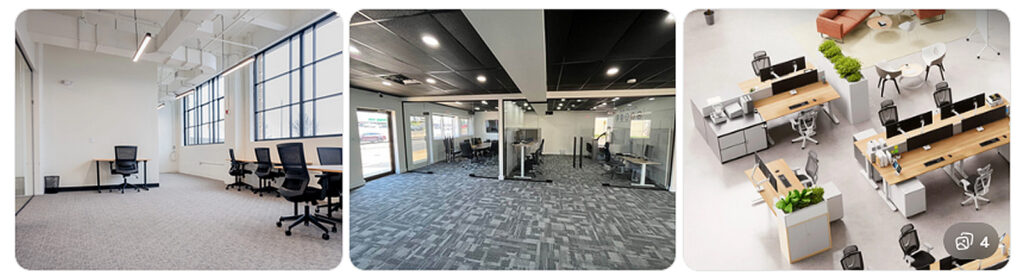
👉 Fast, flexible, but not tailored
Post-Coworking Office (Controlled Environment)

👉 Structured, optimized, and built around your team
The Biggest Mistake Companies Make
They wait too long.
Why?
Because coworking is:
- Easy
- Familiar
- Low-friction
So they tolerate:
- Higher cost
- Poor layout
- Brand limitations
👉 Until it becomes a real problem
The Cost Trap (Hidden but Real)
Even if coworking “feels manageable”:
At ~20–30 employees:
- You are often paying more than a lease would cost
- While getting less control and efficiency
👉 The danger is:
You are overpaying and underperforming
Real-World Scenarios
Scenario 1: Startup (5–10 Employees)
👉 Stay in coworking
- You need flexibility
Scenario 2: Growing Team (10–20 Employees)
👉 Start planning exit
- You’re approaching inefficiency
Scenario 3: Scaling Company (20–40 Employees)
👉 Move out of coworking
- You need structure, control, and cost efficiency
Scenario 4: Established Business
👉 Coworking is usually no longer appropriate
- You’re paying for the wrong product
The Strategic Shift (What’s Actually Happening)
Moving out of coworking is not just a real estate decision.
It is a shift from:
- Flexibility → stability
- Shared → controlled
- Reactive → planned
👉 It’s a signal your business is maturing
The Question You Should Really Be Asking
Not:
“Should we leave coworking?”
But:
“Is coworking still aligned with how our business operates?”
Final Answer (Clear + Actionable)
You should move out of coworking when:
- Your team reaches ~15–30 employees
- Your growth becomes predictable
- Your layout needs become specific
- Your brand starts to matter
- You no longer need short-term flexibility
The Insight Competitors Miss
Most content treats coworking as a cost comparison.
But the real issue is:
Coworking eventually stops scaling with your business
That’s the moment to move—not before, not after.
If you’re starting to feel friction in your coworking setup, you’re likely closer to outgrowing it than you think. We’ll map out what your next office should look like and show you real options that fit your team—so you can move at the right time, not too early and not too late.
Fill out our 📋 online form or give us a call today 📞 212-967-2061 — let’s find the right options for your business.