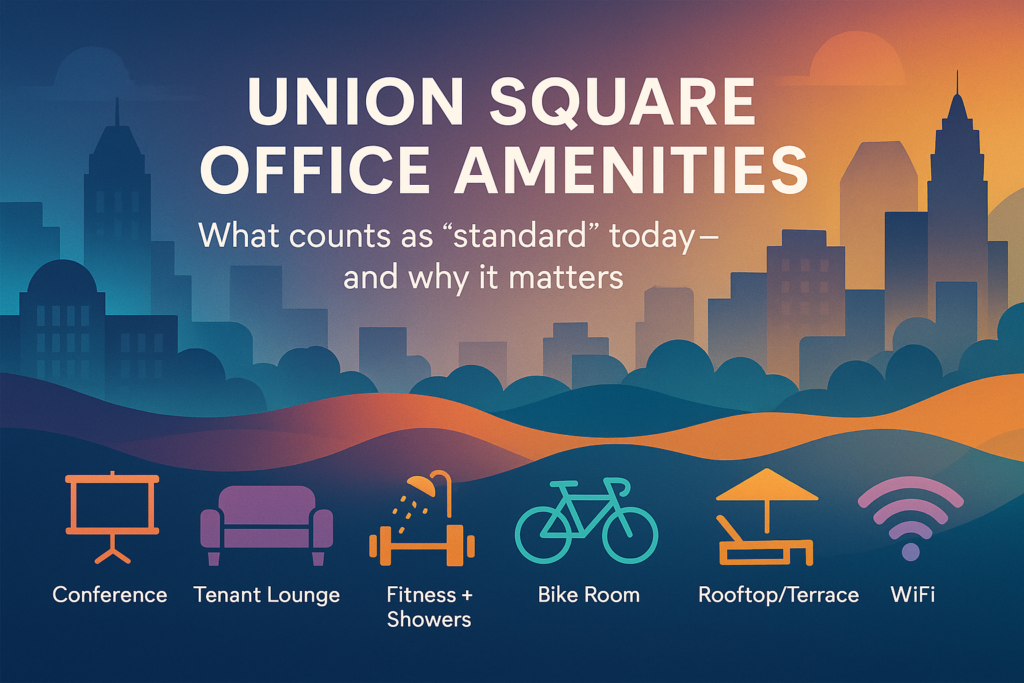
Union Square Office Amenities
What counts as “standard” today—and why it matters
In 2025, the typical Union Square Office Amenities package blends practical, high-usage features with the district’s signature classic loft finishes. Think multi-room conference hubs, tenant lounges built for quiet collaboration, fitness with showers and lockers, bike rooms, smart access + visitor QR, and, increasingly, rooftop/terrace access. Because many buildings here are renovated B/B+ and A-lite rather than ultra-trophy, amenities skew toward daily utility over spectacle—exactly what small and midsize tenants need to reduce in-suite capex and lower the true cost per productive seat.
The amenity stack at a glance (tenant-first matrix)
| Amenity Category | What’s “standard” in Union Square | Why it matters to SMBs | Your leverage moves |
|---|---|---|---|
| Conference hub | Laddered rooms (6–8p, 10–12p, divisible 14–24p), reliable AV, calendar booking | Avoid overbuilding big rooms in-suite | Negotiate monthly hour banks, priority windows, AV support SLAs |
| Tenant lounge(s) | Soft seating, power at every seat, focused alcoves | Spillover for hybrid peaks & guests | Ask for quiet-zone rules, event hour credits |
| Fitness + showers + lockers | Right-sized gyms, clean showers, towel service varies | Commuter comfort; late-night sprints | Request credits or year-one holiday |
| Bike room / end-of-trip | Secure racks, repair stand, drying lockers in better assets | Healthy commutes; keeps gear out of suite | Confirm capacity, e-bike policy, access hours |
| Terrace / rooftop | Seasonal access; event booking system; furniture/planters | Client events without in-suite hospitality spend | Reserve quarterly event blocks, furniture/AV included |
| Smart access & visitor QR | Mobile credentials; QR pre-reg; turnstile analytics | Faster 9 a.m. throughput; cleaner guest flow | Codify peak throughput targets and support SLAs |
| Air & sustainability | Upgraded filtration; monitoring in modernized cores | Staff comfort, ESG reporting | Put targets in the workletter; require commissioning |
| Freight & deliveries | Predictable freight windows; package rooms | Move-in and sample flow with fewer bottlenecks | Lock freight reservations and off-hours rules |
| IT & risers | Diverse carrier entry common; managed risers | Reliable bandwidth; quicker cutover | Fix MDF/IDF locations; allow low-voltage re-use |
| Classic loft finishes | Exposed brick/concrete, timber or polished slab, high ceilings, big windows | Light, character, strong on camera | Balance with acoustics, glare control, and HVAC zoning |
Terraces and rooftops: what’s typical—and how to book them
Union Square terraces are increasingly common due to repositionings. Expect seasonal hours, occupancy caps, and event calendars. A strong building includes permanent furniture, shade, electrical, and sometimes caterer access.
Tenant playbook
- Negotiate quarterly event blocks at lease signing (e.g., two evenings/quarter).
- Ensure AV and furniture are included to avoid last-minute rentals.
- Write in a weather fallback (reschedulable window) and noise policies.
Lounges and collaboration zones: utility beats spectacle
Union Square lounges are designed for heads-down sprints, 1:1s, and small huddles more than cocktail theatrics. Look for power density, quiet alcoves, and acoustically treated ceilings.
What to ask for
- Quiet-zone rules during peak hours.
- Soft seating plus tables near power so laptops aren’t balanced on laps.
- Overflow booking rights during all-hands weeks.
Conference hubs: replace big rooms in-suite
The smart use of a building conference hub lets midsize tenants keep in-suite rooms smaller and more frequent. Standard stacks include 6–8p, 8–10p, 10–12p, and at least one divisible room to create a 14–24p format.
Negotiate
- Monthly hour banks sized to your cadence, with priority windows (top of the hour; Tue–Thu, 10–2).
- AV standards (dual displays, room mics, recording, VC interoperability) and response SLAs.
- Overtime HVAC rates and notice windows for hub floors.
Fitness, showers, bike rooms: small things, big impact
For commuter-heavy teams, the end-of-trip experience matters. Many Union Square buildings include secure bike rooms, showers, and lockers—a quality-of-life amenity that keeps staff punctual and comfortable.
Checklist
- Count bike racks vs. your expected demand.
- Confirm e-bike storage and charging rules.
- Ask for membership credits or a year-one fee holiday.
Classic loft finishes: the look is real—so manage the acoustics
The district’s identity—exposed brick, tall slab-to-slab heights, timber or polished concrete floors, big windows—is a recruiting and brand win. Nonetheless, untreated loft elements can hurt performance.
Design guardrails
- Put STC targets, door seals, and white noise into the workletter; require field testing for phone rooms.
- Use glass fronts for private offices to preserve daylight while controlling sound.
- Add glare film and indirect lighting for camera-heavy desks.
- Increase thermostat density near enclosed rooms; specify supplemental cooling for edit/podcast/server nooks.
Smart access, security, and visitor flow
Most renovated Union Square assets run mobile credentials, visitor QR, and analytics at turnstiles. The payoff is shorter lines at 9 a.m. and cleaner guest arrivals.
Lock down in the lease
- Peak throughput targets (e.g., max queue time) and staffing SLAs.
- Multiple entry paths for storm days and accessible routes.
- Package room process (notifications, oversized items, after-hours pickups).
Air quality, sustainability, and lighting
While not every building is a newly minted trophy, many have upgraded filtration, outside air strategies, and sensors. Ask for commissioning documentation, light-level targets, and daylight/occupancy controls to keep staff comfortable and energy use in check.
IT, risers, and power: the invisible amenity that saves weeks
Union Square is well-served by carriers, and repositioned buildings often have managed risers. For midsize tenants, the difference between a two-week and six-week network cutover is whether riser access and MDF/IDF are settled early.
Non-negotiables
- Diverse carrier entry and path diversity to your floor.
- Confirm MDF/IDF locations and cooling.
- Permit re-use of existing low-voltage where safe; reserve freight for installs.
Use the building so your suite can do less (and cost less)
Amenity floors are meant to replace in-suite spend—not duplicate it. That’s how Union Square Office Amenities translate into lower effective rent.
Hybrid room ratios that work
- Phone rooms: ~1 per 8–10 open seats (with door seals + mechanical extraction).
- Huddles (2–4 ppl): ~1 per 12–16 seats.
- Conference: 1 per 30–40 seats (8–10p); add a 12–14p only if truly needed—otherwise use the hub.
- Wellness/mothers’ room: ~1 per 60–80 ppl if applicable.
- Pantry + landing counter: Near the entry to absorb arrivals and keep quiet zones protected.
Cost modeling: how amenity choices change your effective number (illustrative)
Amenity fees and overtime HVAC belong in your economic model. Consider a 12,000 RSF tenant comparing two buildings:
- Building A (practical stack): Amenity fee $3/RSF → $36,000/yr; conference hour bank included; overtime HVAC $120/hr.
- Building B (premium stack): Amenity fee $6/RSF → $72,000/yr; hub access per-use; overtime HVAC $180/hr.
If you use 150 hours of after-hours HVAC annually and run two half-day events/month in the hub, the delta can exceed $30–60k/yr—enough to fund acoustic packages, task seating upgrades, and better lighting that lift daily productivity.
Abatement & TI still rule the total
- 10-year example: 120 months with 10 free → pay 110/120 = 0.9167 of face. At $82/SF, abated base ≈ $75.17/SF.
- Add $110/SF TI (≈ $11/SF/yr) and the economic number steps down further.
- If furnished is in play, model avoided FF&E (conservatively ~$8–$12/SF/yr for years 1–3; or ~$4/SF/yr blended on a 3-year sublease).
Where amenities cluster inside Union Square (micro-rings you can act on)
- Near-Park East → Irving/Gramercy edge: Polished entries; consistent conference hubs and lounges; terraces more frequent in repositioned assets.
- Broadway/University Place (14th–18th): Boutique full floors with strong loft finishes; reliable hubs and fitness/showers; great elevator identity.
- Park Avenue South fringe (17th–20th): A-lite with credible lobbies; smart access, bike rooms, and cap-friendly amenity programs.
- West of Park toward Sixth: Deeper savings; frequent furnished sublets; practical amenity sets with good freight.
(Use rings to structure a shortlist; outliers often win on value.)
Red flags—and easy fixes
- Under-ventilated phone rooms: Many booths look great but lack extraction. Specify mechanical ventilation + door seals; require field tests.
- Amenity creep: Per-use or uncapped fees erode savings. Secure hour banks and fee caps in the lease.
- Abatement burn: No early access? Free months vanish into setup. Lock 30–60 days of pre-rent access.
- Over-conferencing in suite: Build fewer, smaller rooms; book the hub for larger meetings.
- Glare and hot spots: Add film, indirect lighting, and thermostat density—especially near glass offices.
Negotiation plays that work specifically for amenities
- Conference hub hour banks + priority windows (with rollover and AV support SLAs).
- Amenity fee caps and fitness credits; publish fee schedules in an exhibit.
- Overtime HVAC caps (suite and amenity floors), minimum hours, and notice windows.
- Terrace event blocks per quarter with furniture/AV included and weather reschedule terms.
- Early access (30–60 days) so low-voltage/AV/furniture installs don’t burn abatement.
- TI add-alternates held open (extra booths, acoustic baffles, glass adjustments, lighting upgrades).
- Freight reservations embedded for move-in weeks and recurring vendor days.
Tour checklists
Operations & Access
- Time turnstiles/elevators at 8:45–9:15 a.m.; test visitor QR.
- Confirm bike room capacity, showers, and lockers.
- Inspect package room flow and freight windows.
Conference & Lounges
- Inventory room sizes, AV kits, and booking rules.
- Validate backup rooms during peak hours; check acoustic treatment.
Air, Light, and Sound
- Ask for commissioning/test reports; walk phone rooms while nearby rooms are in use.
- Check glare at perimeter desks; verify thermostat placement.
IT & Power
- Verify riser diversity, MDF/IDF location, and carrier options.
- Identify floor boxes and spare capacity before furniture orders.
A practical 6–8 week path to go-live (illustrative)
- Week 0–1: Program & test-fit; amenity usage forecast (meetings, events, after-hours).
- Week 2–3: Term sheet; negotiate hour banks, fee caps, HVAC caps; price TI add-alternates.
- Week 4: Lease markups; early-access date fixed; low-voltage/AV/furniture scheduled.
- Week 5–6: Possession; furniture swaps; signage/branding; conference hub blocks reserved.
- Week 7–8: IT cutover; AV commissioning; staff orientation; punch-list + air-balance close.
Tenant advantage
Done right, Union Square Office Amenities convert shared building features into lower in-suite costs and higher day-to-day productivity. By leaning on conference hubs, lounges, fitness/showers, bike rooms, smart access, and terraces, you can keep your plan focused on smaller, more frequent rooms—the spaces teams actually use. Then, by negotiating hour banks, fee caps, HVAC caps, early access, and TI add-alternates, you pull the economic effective number below the sticker while delivering a faster, calmer workday.
We represent tenants exclusively. We’ll map your real amenity usage, test-fit multiple Union Square buildings, and model true effective rent—including amenity economics—so you only pay for what your staff uses. When you’re ready to turn this submarket’s amenity stack into measurable ROI, we’ll guide you from shortlist to signed lease—cleanly and quickly.
Fill out our 📋 online form or give us a call today 📞 212-967-2061 — let’s find the right office for your business.