Summary & Takeaways for Commercial Leasing
What Every Manhattan Office Tenant Should Carry Forward
Leasing office space in Manhattan is not a single decision—it is a sequence of interlocking choices that affect cost, flexibility, risk, and long-term business performance. The purpose of this guide has not been to overwhelm, but to equip tenants with enough structural understanding to avoid the most common and expensive mistakes.
This final section distills the most important lessons from the entire leasing process and reframes them as practical takeaways that tenants can apply immediately.
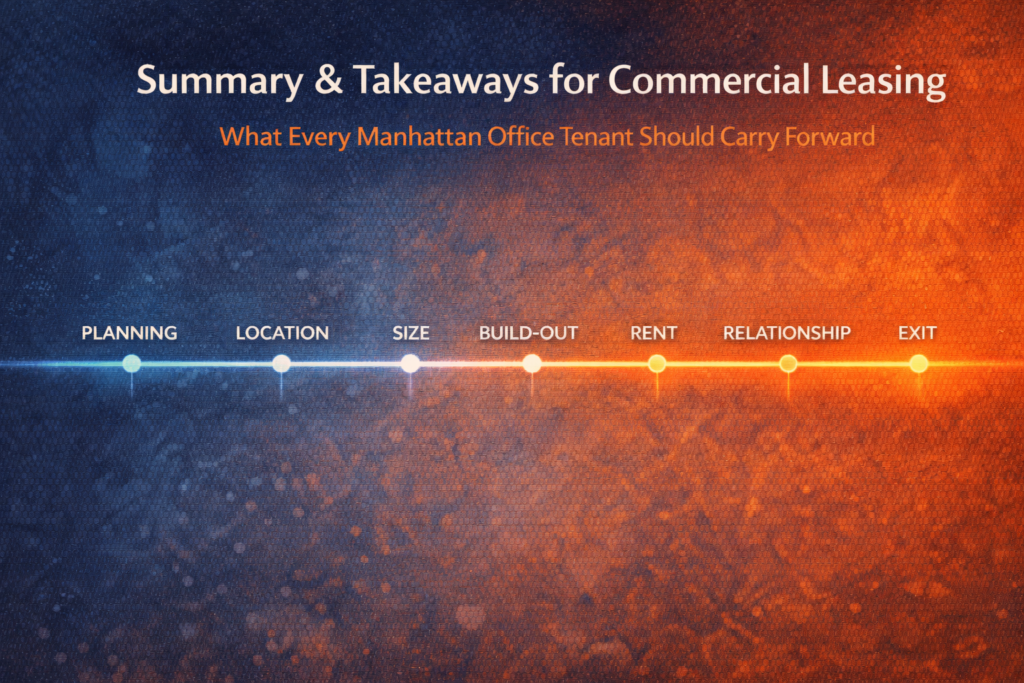
Planning Comes Before Touring
Successful office leases begin long before a tenant ever steps into a building. Tenants who define their operational needs, growth assumptions, budget tolerance, and risk appetite early make faster, better decisions later.
Location, size, and timing are not independent variables. A space that looks attractive but does not align with staffing patterns, commute realities, or growth plans often becomes a liability within a few years. Planning is not about perfection—it is about reducing avoidable friction.
Rent Is a Formula, Not a Number
One of the most persistent misconceptions in Manhattan office leasing is that rent is simply the advertised price per square foot. In reality, rent is the result of multiple inputs working together, including rentable square footage, loss factor, additional rent, escalations, and operating expenses.
Tenants who compare deals based only on headline rent often choose the wrong space. Understanding how RSF, USF, and loss factor interact allows tenants to evaluate true cost and efficiency rather than surface-level pricing.
Professionals Are Risk Management Tools
Brokers, lawyers, architects, engineers, and contractors are not optional accessories—they are safeguards. Each professional addresses a different category of risk, from legal exposure to construction feasibility to timing failures.
The cost of professional guidance is usually visible and finite. The cost of skipping it is often hidden and compounded over time. Tenants who engage the right professionals early tend to spend less overall, not more.
The Lease Is the Relationship
In commercial leasing, there are very few automatic protections. The lease defines nearly everything: who pays, who fixes, who is liable, who can leave, and who cannot. If a right or protection is not written into the lease, it generally does not exist.
Letters of intent, conversations, and emails do not override the final lease document. Tenants should assume that the lease will be enforced exactly as written—especially when disputes arise.
Risk Is Structural, Not Hypothetical
Personal guaranties, security deposits, insurance requirements, and indemnification clauses determine how much damage a bad outcome can cause. These provisions matter most when something goes wrong, not when everything is working smoothly.
Tenants who structure leases through appropriate entities, limit guaranties where possible, and align insurance coverage with real exposure preserve optionality. Risk cannot be eliminated, but it can be contained.
Build-Out Decisions Echo at the End of the Lease
Alterations are not just a construction issue—they are a future exit issue. Decisions made during build-out affect restoration obligations, move-out costs, and timing years later.
Tenants who negotiate clear alteration rights, realistic timelines, and defined restoration obligations avoid end-of-lease disputes. Those who do not often discover too late that leaving the space is more expensive than entering it.
The End of the Lease Is a Second Negotiation
Renewal, relocation, or exit should never be treated as an afterthought. Notice deadlines, holdover penalties, restoration requirements, and renewal rights all come into play at the end of the term.
Tenants who plan early maintain leverage. Tenants who wait often find themselves reacting under pressure, with fewer options and higher costs.
A Practical Leasing Mindset
Across every stage of the process, the most successful tenants share a common mindset:
They do not assume.
They do not rush.
They do not rely on unwritten promises.
Instead, they ask precise questions, document key terms, and treat the lease as a long-term business instrument rather than a formality.
Final Takeaway
A Manhattan office lease can support growth, stability, and credibility—or it can quietly drain resources and restrict flexibility. The difference is rarely the building itself. It is almost always the structure of the deal.
Tenants who understand how leases work make better decisions not just at signing, but throughout the life of the lease.
Fill out our 📋 online form or give us a call today 📞 212-967-2061 — let’s find the right office for your business.
Source Acknowledgment
Portions of this Commercial Lease Guide are informed by publicly available educational materials published by the New York City Department of Small Business Services. This website is not affiliated with, endorsed by, or acting on behalf of the City of New York or any government agency. All interpretations, explanations, and market commentary reflect independent analysis focused on Manhattan office tenants.