Short Term Office Space NYC
Short term office space in NYC is frequently misunderstood. Many tenants assume that a shorter lease automatically reduces risk, lowers cost, or increases flexibility. In reality, term length in New York does something very different.
A short term office lease changes who holds leverage, how risk is priced, and where costs quietly concentrate. When evaluated incorrectly, short-term space often becomes more expensive and more restrictive than long-term alternatives.
This page explains what short term office space in NYC actually means, how lease duration reshapes negotiations, and why tenants regularly overpay for time without gaining control.
This is not a speed page.
It is a leverage page.
What Short Term Office Space Means in NYC
In the New York office market, short term office space generally refers to leases with a commitment significantly below the market norm.
While traditional office leases often span multiple years, short-term arrangements compress that duration, sometimes dramatically. However, there is no single definition of “short term.” What qualifies depends on building type, ownership strategy, and market conditions.
Short term does not describe how the office looks or functions. It describes how long a tenant is obligated—and how much negotiating power they surrender in exchange.
Why Term Length Matters More Than Tenants Expect
Lease duration in NYC is not a neutral variable.
Longer terms provide predictability for landlords. That predictability increases concessions, lowers effective rent, and improves tenant leverage. Shorter terms remove that predictability, shifting risk back to ownership.
Landlords respond by protecting themselves through pricing, structure, and reduced flexibility elsewhere in the lease. As a result, shorter commitments rarely produce proportional savings.
Short term leases trade time for margin.
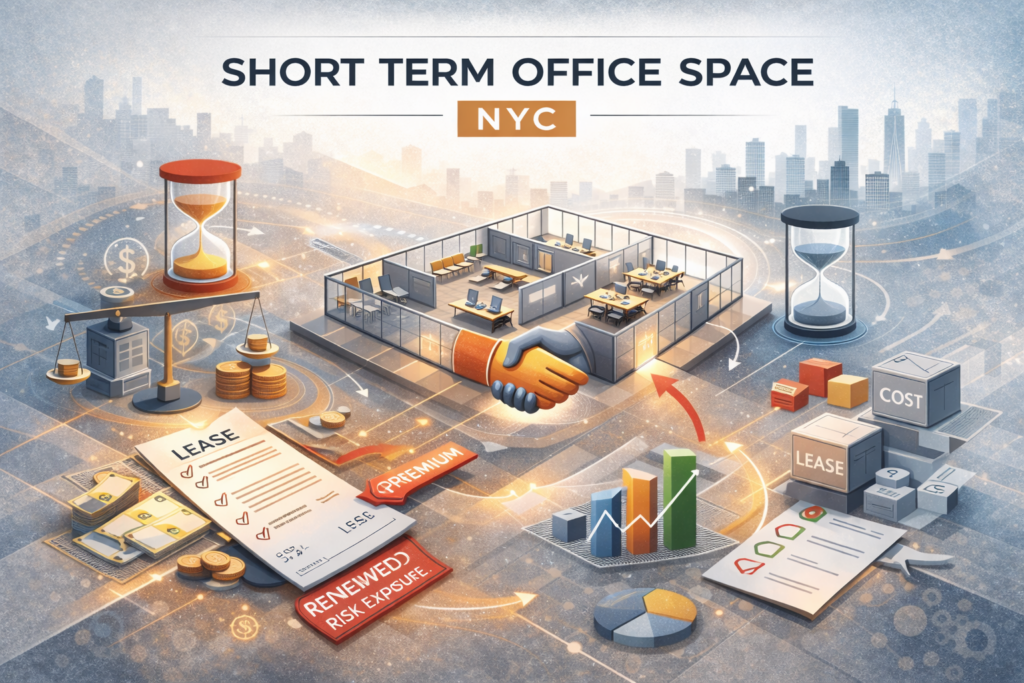
The Cost Illusion of Short Term Office Space
Short term office space in NYC often appears attractive because it lowers total commitment on paper. However, focusing only on total dollars obscures the real cost.
Short-term leases typically carry:
- higher base rent
- reduced or eliminated concessions
- limited build-out contributions
- stricter renewal terms
When measured monthly or annually, short-term space frequently costs more than longer commitments—even before accounting for inefficiency or relocation risk.
Paying less time does not mean paying less money.
Where Tenants Overpay for Duration
Tenants most often overpay for short term office space when they confuse uncertainty with urgency.
Businesses unsure about future headcount, funding, or strategy often default to short-term leases to preserve optionality. However, landlords price that uncertainty aggressively.
In many cases, tenants pay a premium for flexibility they do not actually use, while absorbing higher operating costs and weaker negotiating positions.
Duration alone does not create leverage.
Short Term Office Space Versus Flex Arrangements
Short term office space is often conflated with flex office space, but the two operate differently.
Short term leasing changes how long the obligation lasts. Flex arrangements change who holds the obligation. A short-term lease may still require the tenant to manage build-out, operations, and restoration. Flex models abstract those responsibilities away.
Understanding this distinction prevents tenants from choosing the wrong tool for the problem they are trying to solve.
When Short Term Office Space Makes Sense
Short term office space in NYC can be effective under specific conditions.
It tends to work best when:
- a company has a known, near-term exit or consolidation event
- space is needed to bridge a defined transition
- market conditions strongly favor tenant pricing
- the tenant has leverage outside lease duration
In these scenarios, short-term commitments align with a clear timeline rather than open-ended uncertainty.
When Short Term Office Space Creates Risk
Short term office space becomes risky when it delays decisions instead of supporting them.
Tenants may face repeated relocations, escalating rents, and reduced bargaining power at each renewal. Over time, the cost of instability can exceed the perceived safety of shorter commitments.
Short-term space should resolve uncertainty—not extend it.
Renewal Risk and Repricing Exposure
One of the least discussed aspects of short term office space in NYC is renewal exposure.
At the end of a short lease, tenants often renegotiate from a weaker position. Landlords understand the disruption cost of moving and may reprice aggressively. Without long-term security, tenants lose protection against market shifts.
Short term leases compress risk into renewal moments.
How Short Term Office Space Fits the NYC Market
Short term office space exists because New York is volatile.
Markets shift. Industries contract and expand. Ownership strategies change. Short term leasing provides a pressure valve for this volatility, but it is not designed to optimize cost or control.
Understanding short-term space as a tactical instrument, rather than a default solution, allows tenants to use it deliberately instead of defensively.
Making the Right Decision About Short Term Office Space NYC
Choosing short term office space in NYC requires separating fear from strategy.
The correct question is not whether a shorter lease feels safer. The correct question is whether paying for reduced duration improves your negotiating position or simply increases your cost per month.
Short term office space can be effective when tied to a defined outcome. When used reflexively, it often delivers the opposite of what tenants expect.
This page exists to clarify that distinction before time becomes the most expensive variable in the lease.
Fill out our 📋 online form or give us a call today 📞 212-967-2061 — let’s find the right office for your business.
How Search Engines Interpret “Short Term Office Space NYC”
When tenants search for short term office space in NYC, search engines interpret the phrase as a duration-compression query, not a cost-savings or flexibility query.
The intent signal is typically one of:
- Immediacy
- Uncertainty
- Temporary need
- Risk avoidance
As a result, search engines surface results that emphasize access and speed, even when those results do not reflect how short-term leasing actually behaves in the New York office market.
This explains why the SERP is dominated by providers that monetize urgency rather than landlords that reward commitment.
Why Flexible Office Providers Dominate Short-Term Results
Operators such as Regus, Industrious, and WeWork appear prominently because search engines associate short term with:
- Minimal obligation
- Bundled services
- Immediate occupancy
- Simplified decision-making
These providers rank because they remove duration from the tenant’s responsibility, even though they often replace it with higher effective pricing and reduced control.
They appear not because short-term leasing behaves this way in traditional NYC real estate—but because they operationalize short horizons in a way search systems can easily interpret.
Why Hourly, Daily, and Meeting-Room Results Appear
Search engines frequently surface results for:
- Office space by the hour
- Daily office rentals
- Meeting rooms and event space
This occurs because short-term searches are often driven by immediate use cases, not long-term occupancy planning.
From a search perspective, these options satisfy “short term” literally. From a leasing perspective, they are not substitutes for office space at all.
Their presence reflects urgency and convenience signals—not equivalence.
Why Listing Marketplaces Still Rank
Commercial marketplaces such as LoopNet appear because search engines also treat this query as availability-driven, even when duration is the core concern.
These platforms surface listings labeled:
- Short term
- Flexible term
- Temporary
What they rarely clarify is that in NYC, shorter lease terms usually mean:
- Higher base rent
- Reduced concessions
- Limited build-out participation
- Increased renewal exposure
Marketplaces rank because they display inventory—not because they explain the economics of compressed duration.
Why “Cheap” and “Affordable” Variants Appear in Related Searches
Related searches frequently include:
- Cheap short term office space NYC
- Best short term office space NYC
- Office space for rent by the day
This indicates that many users conflate shorter commitment with lower cost.
Search engines respond by surfacing options that minimize upfront friction, even when those options maximize cost over time.
This is one of the most persistent misconceptions in NYC office leasing—and a major reason tenants overpay when selecting short-term arrangements.
How Tenants Should Interpret These Results Correctly
The dominance of flexible providers, hourly rentals, and simplified offerings does not mean short-term office space is inherently safer or more economical.
It means search engines are reacting to urgency signals, not negotiating realities.
In the New York market, lease duration directly affects:
- Pricing power
- Concession availability
- Renewal leverage
- Exposure to repricing
Shorter terms often reduce tenant leverage rather than increasing it.
Understanding this prevents tenants from mistaking speed for advantage.
What the Search Results Ultimately Confirm
Taken together, the results reinforce a core reality already established on this page:
Short term office space in NYC is not a shortcut to flexibility.
It is a trade-off that concentrates cost and risk into a shorter window.
Search engines reward immediacy and access. Lease outcomes depend on how duration reshapes leverage.
Tenants who recognize this difference use short-term space tactically—rather than defensively.
Why This Final Distinction Matters Before Committing
Search results prioritize convenience.
Leases prioritize structure.
This final layer exists to explain why so many different result types appear for the same phrase—and why none of them, by default, indicate whether a short-term commitment improves a tenant’s position or weakens it.
Short term space works best when tied to a defined endpoint.
When used without one, time becomes the most expensive variable in the lease.
That distinction is what separates intentional short-term strategy from costly indecision.