Office Space New York
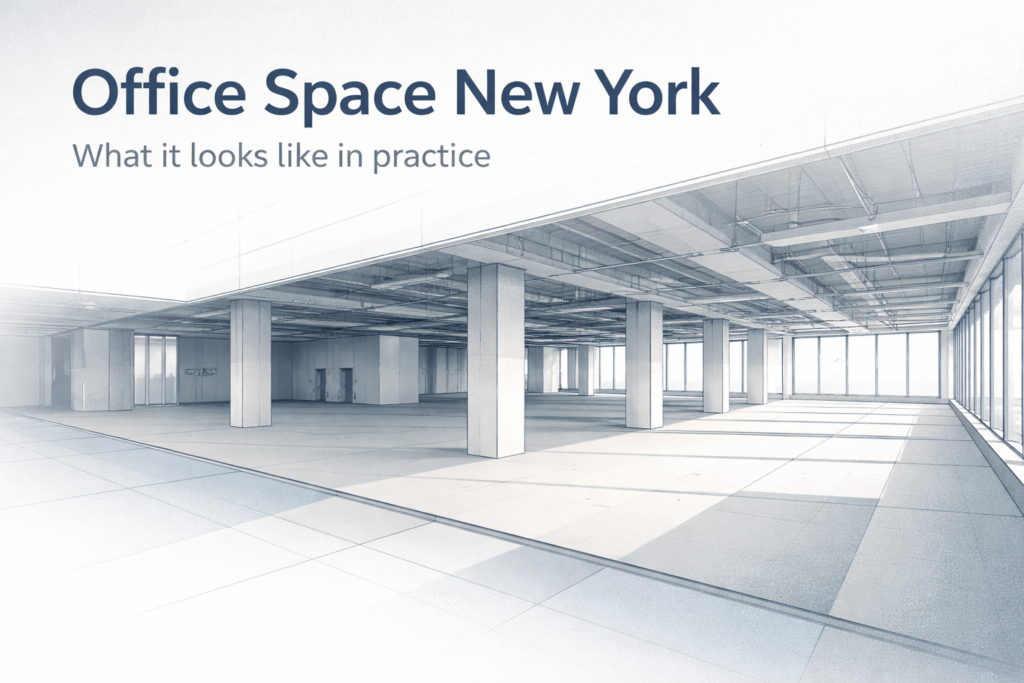
Office space New York is not a concept. It is a physical reality that companies encounter the moment they begin touring buildings. Floorplates, columns, ceiling heights, window lines, cores, elevators, and light conditions matter more here than almost anywhere else, and they vary dramatically from one building to the next.
This page is written for businesses that are past the idea stage and are actively looking at office space in New York. It focuses on what office space actually looks like in practice, how companies compare it, what surprises people once tours begin, and where mistakes are commonly made when space is evaluated only on paper.
If you are trying to understand how office space in New York behaves in the real world, this page is meant to ground expectations.
What Office Space in New York Actually Looks Like
Office space in New York rarely matches first impressions from listings. Square footage numbers often conceal major functional differences, and two spaces with identical size and rent can feel completely different once you step inside.
Many New York offices are shaped by older construction, resulting in long and narrow floorplates, irregular column spacing, or deep interior zones with limited light. Others are center-core towers where usable space is fragmented by elevators, stairs, and mechanical systems. These physical realities shape how space works far more than marketing descriptions.
Understanding office space New York starts with recognizing that geometry, not just size, determines usability.
Why Square Footage Is Misleading in New York
In New York, square footage is an unreliable proxy for capacity. Loss factor, core placement, and window lines often reduce usable space significantly, even in newer buildings. A five thousand square foot office with clean perimeter exposure can outperform a much larger space that is chopped up by columns and deep interior zones.
This is why companies touring office space in New York frequently revise their space assumptions after seeing layouts in person. What works on a spreadsheet often fails on the floor.
How Much Office Space Do I Need?
planning logic for right-sizing
👉 https://newyorkoffices.com/how-much-office-space-do-i-need/
How Much Does a Private Office Cost Per Employee in Manhattan?
“square footage alone doesn’t tell the story.”
👉 https://newyorkoffices.com/how-much-does-a-private-office-cost-per-employee-in-manhattan/
How Companies Actually Compare Office Space in New York
When businesses evaluate office space in New York, they rarely choose based on a single factor. Comparisons happen across multiple dimensions at once.
Companies compare how much of the space can be used for desks versus support areas, how conference rooms fit without blocking circulation, whether offices steal light from work areas, and how easily the layout can change over time. They also compare how the building itself feels, how elevators operate during peak hours, and whether the space supports the pace of daily work.
What Office Layout Is Best for My Business?
functional layout evaluation
👉 https://newyorkoffices.com/what-office-layout-is-best-for-my-business/
What Changes Once Tours Begin
Online listings create expectations that often collapse during tours. Ceiling heights feel lower than expected. Columns interrupt layouts that looked clean on floorplans. Light that appeared generous in photos disappears in person. Furniture hides scale issues rather than solving them.
For many companies, touring is the moment when office space in New York stops being theoretical and becomes tangible. This is also when priorities shift. A space that seemed perfect on paper may be eliminated in minutes, while a less polished option suddenly feels right because it functions better.
Office Search Time Table
real-world touring and deal timing expectations.
👉 https://newyorkoffices.com/office-search-time-table/
Common Office Space Traps in New York
One of the most common traps is overestimating usable area. Another is assuming furniture makes a bad layout workable. Companies also underestimate how much circulation space is lost to cores and columns, especially in older buildings.
Another frequent mistake is choosing office space based on appearance rather than performance. Exposed ceilings, finishes, and branding elements draw attention, but they do not fix fundamental layout inefficiencies.
Prebuilt Space Versus Raw Space in Practice
Prebuilt office space in New York offers speed, but it also locks companies into someone else’s assumptions. Conference rooms may be oversized, offices may be misaligned with workflow, and support spaces may not reflect how the team actually operates.
Raw space introduces cost and time, but it allows companies to solve specific layout problems created by New York’s building stock. For longer-term occupancy, raw space often performs better because it is designed around real constraints rather than generic layouts.
The choice between prebuilt and raw space is less about convenience and more about control
Why Office Space Feels Different From Building to Building
Office space in New York is deeply influenced by building era. Pre-war buildings often deliver character and light but introduce structural quirks. Mid-century buildings may suffer from low ceilings and inefficient cores. Newer towers offer cleaner plates but sometimes sacrifice warmth and identity.
These differences explain why companies often tour multiple buildings in the same neighborhood before finding space that works. Commercial space as in the context of an office is as much about selecting the right building type as it is about location.
What Office Amenities Are Most Important in a Lease?
what makes NYC office space feel good.
👉 https://newyorkoffices.com/what-office-amenities-are-most-important-in-a-lease/
When Office Space Stops Being the Real Problem
In many searches, companies assume the issue is finding better office space. In reality, the problem is often misaligned expectations about how the office will be used. Too much space is taken for infrequent meetings. Too little is allocated to focused work. Growth is assumed rather than planned.
At that point, changing office space alone does not solve the issue. Reframing how the office functions becomes more important than upgrading finishes or increasing square footage.
How This Page Fits With Related Topics
Office space New York is closely related to other ways companies think about offices, but it serves a different purpose.
This page focuses on physical reality and comparison.
Other pages address market structure, organizational offices, or business presence.
Understanding where this page fits you helps avoid confusion and leads to better analysis.
Choosing Office Space in New York With Clear Eyes
The best are made when companies accept constraints early and compare spaces honestly. Light, layout, and circulation matter more than aesthetics. Usability matters more than square footage. Flexibility matters more than novelty.
Query Related Topics
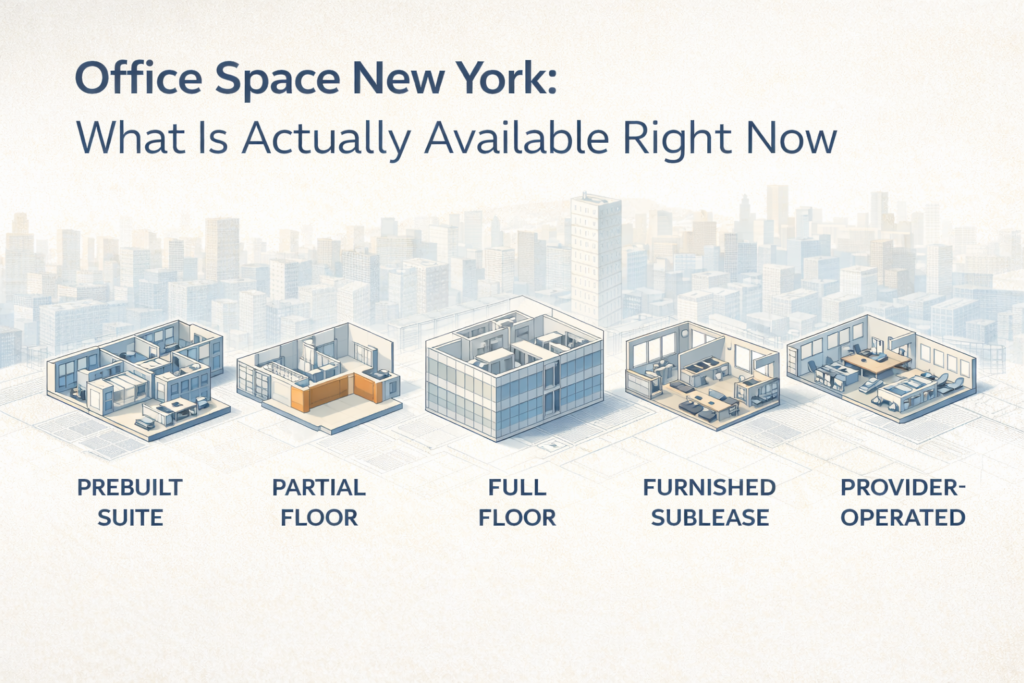
Office Space New York: What Is Actually Available Right Now
Search results for office space New York are dominated by listings, providers, and marketplaces because many users are trying to understand what types of space currently exist, not just how leasing works. While availability changes constantly, office space in Manhattan generally falls into a limited number of real, recurring categories.
Most companies evaluating space encounter prebuilt suites, partial-floor offices, full-floor offices, furnished subleases, and provider-operated spaces. Each category behaves differently in terms of cost, flexibility, and usability, even when square footage appears similar.
Understanding these availability patterns helps companies interpret search results and listings more realistically.
Small and Temporary Office Space in New York
A significant portion of searches for office space New York are driven by companies looking for small offices or temporary solutions. These searches often include modifiers such as small office, short term, furnished, or flexible.
Small office space in New York typically refers to suites under five thousand square feet, often delivered as prebuilts or furnished subleases. These spaces prioritize speed and simplicity but frequently involve tradeoffs related to layout efficiency, light, and long-term scalability.
Temporary office space solutions can serve short-term needs, but they are rarely optimized for companies planning to operate in New York beyond an initial phase. Businesses evaluating temporary space should be clear about whether they are solving a timing problem or postponing a larger decision.
Commercial Space vs Provider-Operated Space
Many search results for office space New York point to serviced office providers and coworking operators. These offerings represent one segment of the market but should not be confused with traditional office space.
Provider-operated spaces bundle rent, furniture, and services into a single package and emphasize speed and flexibility. Traditional office space, by contrast, gives companies control over layout, branding, and long-term cost structure.
Companies comparing these options should recognize that they are evaluating different products, even if both appear under the same search term.
Why “Office Space for Rent” Results Look Similar
Listings for office space New York often appear interchangeable at first glance. Rents cluster within narrow ranges, photos look polished, and descriptions emphasize similar features. In practice, performance varies widely.
The differences usually emerge in circulation efficiency, core placement, ceiling height, window exposure, and how much of the space can actually be used for desks and meeting rooms. These factors are rarely visible in search results but become obvious during tours.
This is why office space New York is chosen through elimination rather than selection. Most options are ruled out quickly once real constraints are revealed.
Sublease Office Space in New York
Sublease office space appears prominently in search results because it can offer pricing or term advantages. Subleases allow companies to occupy space that another tenant no longer needs, often with existing build-outs or furniture.
However, sublease space also introduces limitations. Extension rights may be restricted, layout changes may be prohibited, and long-term stability is not guaranteed. Subleases work best when timing aligns perfectly, not as a default strategy.
Office space New York includes subleases, but they require careful evaluation beyond headline rent.
Neighborhood Signals in Office Space Searches
Search results for office space New York frequently surface neighborhood-based pages because location remains a primary filter. Midtown, Midtown South, Downtown Manhattan, and select Brooklyn areas dominate availability.
What matters most is not the neighborhood name but how buildings in that area behave. Transit access, building age, elevator counts, and floorplate styles vary dramatically by location and affect how space performs day to day.
Companies searching by neighborhood should treat location as a starting point rather than a conclusion.
Furnished Office Space and the Illusion of Readiness
Furnished office space is often marketed as move-in ready, but furniture does not resolve fundamental layout problems. Desks can obscure circulation issues, hide undersized conference rooms, or mask poor light distribution.
Furnished space can be useful for short-term needs, but companies evaluating commercial space should look past furniture and assess whether the underlying space works without cosmetic enhancements.
When Office Space Becomes a Commodity Search
Many users arrive at office space New York pages expecting a marketplace experience. In reality, office space does not behave like a standardized product. Two spaces with the same size and rent can deliver very different outcomes.
The most effective searches shift from commodity filtering to functional evaluation early in the process. This shift reduces wasted tours and leads to better long-term decisions.
Commercial Space and Decision Timing
Timing pressure leads companies to over-value availability and under-value fit.
Office space decisions made under time constraints are harder to correct later. Understanding what exists in the market is important, but aligning space with actual use matters more than securing something quickly.
Using Office Space New York Search Results Effectively
Search results provide exposure to what is marketed, not necessarily what will work. Listings, provider pages, and marketplaces are entry points, not answers.
Companies that use office space New York searches effectively treat results as a survey of options rather than a menu of solutions. Real clarity emerges through comparison, tours, and functional evaluation.
Office Space New York as a Practical Exercise
Office space New York is best approached as a practical exercise rather than a theoretical one. Buildings impose constraints. Layouts impose tradeoffs. Timing imposes pressure.
The companies that succeed are those that understand what office space in New York actually delivers in practice and adjust expectations accordingly.
Fill out our 📋 online form or give us a call today 📞 212-967-2061 — let’s find the right office for your business.