Grand Central Office Space: Midtown’s Transit-Oriented Powerhouse
The New Normal: Transit Hubs Win in a Post-Pandemic World
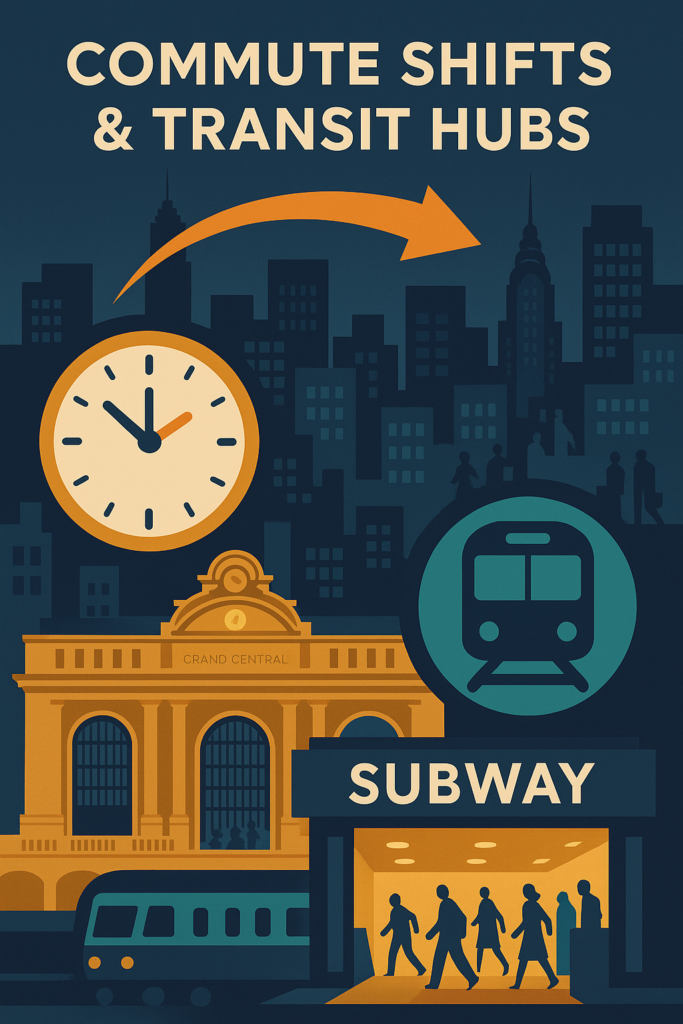
There’s a “new normal” in the post-pandemic workplace. Remote work and lifestyle changes have reshaped where employees live and how they commute. A recent JLL report found that the suburban footprint of Manhattan office workers has grown by 45,000 people since COVID-19, with over one-third of those employees now living in new far-flung suburbs beyond traditional areas like Suffolk County, NY. In practical terms, this shift means two things for offices: workers now seek office locations near major transit hubs, and they also aim to leave the office earlier to accommodate family life and avoid long commutes.
In other words, location and scheduling flexibility have become critical competitive advantages in the office market. Companies are learning that “commute friction has become an economic variable, not just a lifestyle issue,” as JLL vice chairman Kevin Kelly explained. Offices situated by transit centers like Grand Central Terminal and Penn Station allow employees to travel more conveniently, making it easier for firms to enforce hybrid or in-person work without losing talent. In fact, JLL found that office buildings near these hubs “continue to outperform in both return-to-office compliance and leasing velocity”. Examples include Vornado’s Penn 1 by Penn Station and Marx Realty’s 10 Grand Central adjacent to Grand Central Terminal – both have seen stronger tenant demand relative to buildings in less accessible locations.
Equally telling is how workday schedules have changed. Even with more employees back in the office due to return-to-office mandates, many aren’t staying as late as they did pre-pandemic. On average, New York office workers are leaving 13 minutes earlier in 2025 than in 2019, and some depart nearly an hour earlier. The peak homeward-bound rush has moved up dramatically – for instance, the busiest evening train from Manhattan to a suburb like Summit, NJ, shifted from 6:00 p.m. in 2019 to 4:00 p.m. by 2025. Similar trends hold in other cities (San Francisco employees now leave ~26 minutes earlier; Chicago ~22 minutes earlier). The takeaway for employers is clear: flexibility in timing and location is key to productivity and retention. Fully remote setups haven’t been ideal for collaboration, but rigid 9-to-5 office rules ignore the new family routines that have set in. The companies likely to “win” going forward are those who craft work strategies that balance in-person productivity with the realities of modern family life. And when it comes to location, being near transit is now paramount – in fact, landlords with office buildings at major transit hubs are expected to come out on top in the evolving office market.
Grand Central: A Business-First District (No Residential Conversions)
Amid these shifts, Grand Central’s office district stands out as a resilient, business-first enclave in Midtown Manhattan. While many parts of the city are contemplating or undergoing office-to-residential conversions to address high vacancies, the Grand Central/Midtown East area is largely exempt from this trend. New York City planners explicitly rezoned East Midtown (the 73-block area around Grand Central) in 2017 to reinforce it as a “world-class business district and major job generator”, discouraging conversion of offices into apartments or hotels. In fact, the **East Midtown rezoning plan ** excludes new residential or hotel uses — such uses are only allowed by special permit and in limited proportions. This was done to prevent erosion of the commercial core. City studies had warned that if outdated offices in Midtown East weren’t replaced or upgraded, they might become targets for residential conversion, undermining the area’s business ecosystem. By enacting zoning protections, the city ensured that East Midtown will remain a predominantly office district for the foreseeable future, unlike lower Manhattan or Midtown South where conversions are adding residences.
What does this mean for Grand Central area businesses and landlords? In short, stability and long-term value. Companies leasing here know that the surrounding buildings won’t suddenly turn into condos, which helps maintain a critical mass of office activity. The “Greater East Midtown” plan incentivizes new state-of-the-art office development and requires developers to contribute to transit and public space improvements, rather than convert buildings to apartments. This focus has already paid off: instead of emptying out, the Grand Central office district is seeing a wave of reinvestment in modern offices (more on that below). The net effect is a vibrant, 9-to-5 (and beyond) business neighborhood that isn’t losing its daytime population to residential use. Tenants benefit because the area remains an “office-first” environment – with plenty of nearby corporate neighbors, services, and daytime foot traffic – rather than a mixed-use zone where offices might feel isolated in a residential canyon.
Elsewhere in Manhattan, by contrast, older office buildings are being eyed for conversion into housing to combat vacancies and spur activity. For example, downtown’s Financial District is in the midst of large office-to-residential projects (like the 1,300-unit conversion at 25 Water Street). The city has even launched a “Midtown South Mixed-Use” plan to encourage housing in parts of Midtown South. But East Midtown’s Grand Central area is charting a different course, doubling down on its commercial identity. No foreseeable shift to residential means investors can confidently pour capital into office upgrades here, and tenants can sign long-term leases knowing the district will remain a bustling corporate hub. This policy choice “ensures East Midtown’s future as a business district,” encouraging new commercial buildings and adding jobs while funding transit improvements to support them.
Landmark Buildings Holding Value and Modern Upgrades
The Grand Central submarket is home to an impressive roster of landmark office properties that continue to endure with value – often enhanced by recent renovations. This area blends historic architectural icons and brand-new skyscrapers, offering both prestige and modern amenities. On the historic side, consider the Graybar Building (420 Lexington Ave) and the Chanin Building (122 E 42nd St), gorgeous Art Deco towers from the 1920s that have been restored and updated for today’s tenants. The famous Chrysler Building (405 Lexington) – one of the most recognizable landmarks in NYC – also anchors the Grand Central skyline, and while it changed ownership in recent years, it’s undergoing upgrades to remain attractive to creative and corporate tenants. These Art Deco and Beaux-Arts landmarks are character-rich and offer unique spaces (like Chrysler’s crown floors or Chanin’s ornate lobby) that still draw tenants looking for a distinctive address. Many feature new interiors, upgraded systems, and added amenities to keep up with Class A expectations even at lower price points (for example, Chanin offers lower cost per square foot than nearby newer towers, making it a value play for firms seeking history with savings).
At the same time, the Grand Central area boasts cutting-edge modern office towers – some newly built, others recently redeveloped – that cement its status as a premier office district. One Vanderbilt, opened in 2020 next to Grand Central, redefined the Midtown East skyline. At 1,401 feet tall, this gleaming tower introduced ultra-modern, trophy Class A+ office space with sky-high observation decks and top-tier amenities. Its presence not only brought prestige but also spurred nearby owners to modernize their buildings. Another game-changer is JPMorgan Chase’s brand new global headquarters at 270 Park Avenue, which has just opened in 2025. This 60-story, 1,389-foot skyscraper developed by JPMorgan on the site of its old building delivers 2.5 million square feet of state-of-the-art offices for 14,000 employees. It’s the tallest fully electric (hydropower-fed) tower in New York and features everything from an advanced wellness center to a public plaza and direct connection to Grand Central Madison. The sheer scale and $3+ billion investment in this tower underscores confidence in the Grand Central area as the place for corporate headquarters. “270 Park Avenue is set to be a new landmark” and is now among the most modern office buildings on the planet.
Beyond new towers, many existing Class A buildings around Grand Central have undergone major upgrades to retain their elite status. For example, the MetLife Building (200 Park Avenue) – an iconic 58-story tower straddling Park Avenue – has invested in infrastructure upgrades and remains a headquarters-quality property with direct terminal access and panoramic views. One Grand Central Place (60 E 42nd St), formerly the Lincoln Building, completed modernizations and amenity additions (like a tenant lounge and conference center) to compete with newer stock. 335 Madison (GM Building Annex) rebranded as “The Company Building” with a tech incubator focus. Venerable addresses like 299 Park, 300 Park, and 280 Park have all received lobby redesigns, new elevators, and HVAC systems in the last decade. And boutique towers like 10 Grand Central (155 E 44th St) were repositioned with a hospitality flair – featuring high-design pre-built suites and even landscaped tenant terraces – to attract upscale tenants. In short, landlord reinvestment has kept Grand Central’s office stock competitive. Many properties now boast amenity floors, outdoor terraces, modernized elevators, and energy-efficient systems, blending classic architecture with contemporary performance. This combination of iconic legacy buildings and next-generation offices gives tenants a wide range of choices – and it ensures the area continues to hold its value as a top-tier office district.
Importantly, the East Midtown rezoning (2017) has unlocked even more potential value in the area. It paved the way for approximately 16 new office developments over 20 years (up to 6 million sq ft of new space), in exchange for contributions to public improvements. We are already seeing plans for towers like Project Commodore (175 Park Ave), a proposed 1,500-ft mixed-use skyscraper above the Grand Hyatt site, and 350 Park Avenue, a 1,300+ ft office tower in the works. These projects promise to bring next-generation office product to Grand Central in coming years, keeping it on the cutting edge and further boosting the area’s global competitiveness. Despite challenges (high land costs and complex lot assemblages), East Midtown’s transformation is progressing, focusing first on sites around Grand Central and Park Avenue where new development is most feasible. The commitment to preserve landmark exteriors while encouraging new, taller office towers means the district will both honor its past and embrace its future, remaining the heart of business in Manhattan.
2025 Leasing Velocity: Big Deals and New Headquarters
If 2025’s leasing activity is any indication, Grand Central’s office market is alive and well – with several significant leases and expansions demonstrating tenant confidence in the area. Below are some of the notable office deals signed in 2025 (so far) around the Grand Central/Midtown East district:
- Webster Bank – 360 Lexington Ave: The Connecticut-based commercial bank reaffirmed its commitment to Midtown by renewing 30,621 sq. ft. and expanding by another 15,397 sq. ft. at 360 Lexington, bringing its total footprint to 46,018 sq. ft. across three floors. Webster’s real estate head praised the “ideal [transit-accessible] location” as key to serving customers.
- Signers National (Insurance) – 360 Lexington Ave: In the same building, Signers National signed a new 15,000 sq. ft. lease across two floors, relocating its headquarters to be closer to Grand Central. The insurer moved from 420 Lexington (Graybar) just a few blocks away, citing the new space’s collaborative layout and transit convenience as reasons for the move.
- A&E Networks – 227 East 45th St: The media and entertainment firm (owner of A&E, History Channel, Lifetime, etc.) renewed its 151,920 sq. ft. headquarters lease at 227 E 45th Street, a building just east of Third Avenue. This long-term renewal keeps A&E’s sizable Midtown East presence intact – the company has been in that location (and an adjacent building for studios) for years. According to Colliers, Midtown office rents were averaging about $78–$79 per sq. ft. at the time of the deal, and A&E’s recommitment is a vote of confidence in the neighborhood.
- Santander Bank – 437 Madison Ave: In a major financial sector move, Santander extended its lease for 192,000 sq. ft. at 437 Madison Avenue (at 50th Street). While a bit north of Grand Central proper, this renewal in Midtown East’s “Plaza” area shows large firms choosing to stay in East Midtown. The tower (home to many financial firms) remains one of Santander’s key U.S. office hubs.
- Geller & Company (Consulting) – 99 Park Ave: Geller, a financial consulting and family office services firm, leased 45,000 sq. ft. at 99 Park Avenue, a Class A building at Park & 40th Street. This deal is a prime example of flight to quality – 99 Park (also known as 292 Madison) offers modernized offices just a block from Grand Central, likely appealing to Geller for both prestige and convenience.
- Kirkland & Ellis – 900 Third Ave: (Just outside the immediate Grand Central zone, but notable) Top law firm Kirkland & Ellis took 131,000 sq. ft. at 900 Third Ave in an expansion, indicating that even as some firms decentralize, Midtown East continues to draw big legal tenants. Proximity to Grand Central’s commuter lines was surely a factor for their attorneys and staff.
- Other Deals: Numerous mid-sized leases underscore breadth of demand: e.g. Coalition Space (coworking) took 16,000 sq. ft. at 485 Madison, SharkNinja (appliances) 14,000 sq. ft. at 41 Madison, NYU Langone Health 21,000 sq. ft. at 645 Madison, and Kimelman & Baird (finance) extended 5,000 sq. ft. at 800 Third. Meanwhile, Citadel’s massive 504,000 sq. ft. lease at 660 Fifth Ave (a few blocks west) grabbed headlines as one of NYC’s largest deals – showing that flight-to-quality is in full swing for trophy properties near the Grand Central area.
These transactions highlight a few trends. First, renewals by major tenants (like A&E, Santander) signal that companies are holding onto their well-located Midtown offices rather than downsizing or fleeing. Second, expansions and new leases (Webster, Signers, Geller) illustrate that firms are betting on the accessible, transit-rich Grand Central area for growth. Even in an era of hybrid work, they value the ability for employees and clients to reach the office easily. Landlords have noted that leasing momentum in prime locations is picking up, whereas more isolated or outdated buildings struggle. As one landlord at 360 Lexington put it, recent deals “reflect positive leasing momentum across NYC’s office market and early signs of a significant rebound” – especially in “primely located office spaces that bolster collaboration and overall tenant satisfaction.” Grand Central checks those boxes.
Finally, it’s worth noting new headquarters commitments in the area: Signers National moving its HQ to 360 Lex, the United Nations consolidating its offices (more on that later), and of course JPMorgan Chase opening its new global headquarters at 270 Park – a project that by itself brings thousands of employees into the neighborhood. In August 2025, JPMorgan began moving the first employees into the tower, which will ultimately host teams previously spread across older buildings. Such a high-profile HQ reaffirmation (literally rebuilding on Park Avenue) underscores that Grand Central remains the address of choice for flagship offices. We are seeing the “HQ effect” with other companies too: many are re-evaluating their office footprints and often consolidating into upgraded space in central, commuter-friendly areas like Grand Central, rather than maintaining satellite offices in less convenient spots. All told, the deals of 2025 indicate that Grand Central’s office market is rebounding and adapting – with a healthy mix of renewals, new leases, and top-tier development that position it well for the future.
Transit Connectivity: Unmatched Access for Top Talent
One of Grand Central’s greatest strengths – and a key reason it’s “best for business” – is its unparalleled transit connectivity. Located at 42nd Street and Park Avenue, Grand Central Terminal is a world-renowned transportation hub, and being near it gives office tenants a huge edge in attracting employees from all over the region. Few office districts in NYC (or anywhere) can rival the breadth of transit options at Grand Central’s doorstep:
- Metro-North Commuter Rail: Grand Central is the Manhattan terminus for Metro-North Railroad, which funnels in tens of thousands of commuters daily from suburban counties north of NYC (Westchester, Fairfield, etc.) and parts of Connecticut. This makes it ideal for companies who employ talent living in the northern suburbs – they can get to the office by a one-seat train ride. In the post-pandemic era, Manhattan has 45,000 more office workers living in suburbia than before, many in areas served by Metro-North’s Hudson, Harlem, and New Haven lines. Having an office at Grand Central directly taps into that labor pool with minimal “commute friction.”
- Long Island Rail Road (LIRR): In early 2023, the new Grand Central Madison terminal opened beneath Grand Central, finally bringing LIRR trains from Long Island into the East Side of Manhattan. Now employees coming from Nassau and Suffolk counties (and parts of Queens) can arrive directly at Grand Central as well, instead of going to Penn Station on the West Side. This is a game-changer for East Midtown offices – effectively expanding the talent catchment to Long Island. Companies can hire from a broader geography, confident that a Midtown East location is viable for Long Islanders’ commute. Grand Central Terminal now serves as a dual commuter rail hub (Metro-North and LIRR), dramatically increasing its reach.
- Subway Lines: Grand Central is served by multiple subway routes. The 4, 5, 6 lines (Lexington Avenue line) connect it north-south to the entire East Side of Manhattan and the Bronx. The 7 line connects west to Times Square and into Queens (Flushing), and the 42nd Street Shuttle (S) provides a quick hop to Times Square as well. Within a few blocks are stations for the B, D, F, M lines (at Bryant Park/Rockefeller Center) and the S/4/5/6/7 lines directly below the terminal. In the coming years, the Second Avenue Subway Phase 3 could extend the T line down to 42nd Street, potentially connecting to Metro-North at Harlem–125th and further easing crosstown connections – but even now, Grand Central offers easy subway access from almost any borough.
- Buses and Ferries: Dozens of MTA bus routes crisscross Midtown, many stopping near Grand Central, which is also a hub for airport shuttles (to LaGuardia, JFK) and express buses. And while not adjacent, the East River ferry stop at 34th Street is a short shuttle ride away, giving an alternative commute option for those near NYC’s waterways.
What this all adds up to is unmatched accessibility for talent. Top companies know they need to draw employees back to the office by making the commute as painless as possible – Grand Central delivers that in spades. An employee can live in New Jersey, Long Island, Westchester, Connecticut, or any NYC borough and reasonably commute to Grand Central. (Even New Jersey commuters can take NJ Transit into Penn and a quick subway or a future one-seat ride if Gateway program and Penn Station connections progress). This centrality is why Grand Central area offices have seen higher attendance rates: when the train literally drops you at the office’s basement, the hurdle to coming in is lower. And for hybrid arrangements, employees appreciate that on the days they do come in, they can leave earlier to beat the rush – something the abundance of train options facilitates (e.g. many Metro-North trains now depart in the 4–5 pm hour to accommodate earlier departures).
For employers, being at Grand Central also means access to clients and visitors is easier. Clients from across the region (or flying in via regional airports) can reach your office conveniently. Out-of-town visitors can hop on the 7 train or shuttle to go between meetings at Hudson Yards, Times Square, and Grand Central in minutes. Simply put, Grand Central is a nexus – it connects to everywhere, which is invaluable in business.
To illustrate, JLL’s report noted that commute time has literally become tied to productivity and talent recruitment. A Grand Central office helps optimize that equation. It “cuts down travel friction and accommodates hybrid schedules with unparalleled ease,” as one brokerage put it. This transit superiority was always a selling point, but post-pandemic it’s a make-or-break factor for many companies choosing offices. It’s no coincidence that offices near Grand Central and Penn Station are leasing up faster – being on top of transit is now seen as crucial to getting workers back and happy.
And it’s not just present connectivity – future transit improvements will further boost the area. The MTA’s capital plan includes the Penn Station Access project (bringing Metro-North into Penn Station, which could indirectly relieve pressure and improve flexibility for commuters to Midtown East via transfers) and ongoing work to modernize signals on the Lexington line (to run more trains). The city is also pushing for better pedestrian links, like the proposed below-ground concourse connecting Grand Central to buildings along the East Side. In essence, Grand Central’s connectivity moat will only widen.
For all these reasons, Grand Central office space offers companies a way to tap into the deepest regional talent pools. A Midtown East location says to current and prospective employees: “We value your time – you can get here easily, and get home in time for family dinner.” That’s a compelling pitch when talent attraction is key.
Who’s Here: Anchor Tenants and Industry Clusters
Grand Central’s vicinity has long been a magnet for blue-chip companies and institutions, a trend that continues today. The area’s tenant base is a who’s who of finance, law, real estate, media, and more – all drawn by the prestige and convenience of a Grand Central address. Some of the traditional anchor tenants and prominent companies in the neighborhood include:
- Global Finance Headquarters: Perhaps most notably, JPMorgan Chase – the largest U.S. bank – has been synonymous with Park Avenue near Grand Central. It maintained its headquarters at 270 Park Avenue for decades and is now opening its new HQ tower on that same site. In addition, JPMorgan occupies other large footprints (e.g. 277 Park Ave and 383 Madison Ave) in the area. MetLife, though its official HQ moved, still gives its name to 200 Park Avenue (MetLife Building) and occupies significant space there, reflecting its legacy in the district. Other financial giants have regional or global hubs here: Blackstone (a leading investment firm) calls 345 Park Avenue home for its HQ, Morgan Stanley has offices at 522 Fifth and formerly at 1585 Broadway (Times Square), and Bank of America’s investment banking arm sits nearby at Bryant Park. Wells Fargo and Citibank also have offices in East Midtown. In 2025, Santander’s 192k sf renewal at 437 Madison kept another major bank in the area.
- Major Law Firms: The Grand Central area, especially along Third, Park, and Madison Avenues in the 40s and 50s, hosts many top law firm headquarters or large offices. For example, Gibson, Dunn & Crutcher is a long-time anchor at 200 Park Ave (MetLife). Paul, Weiss was at 1285 6th but some offices in midtown. Latham & Watkins had offices at 885 Third Ave (nearby). Kirkland & Ellis’ new lease at 900 Third shows continued legal sector presence. Skadden Arps is just west at Times Square, but firms like Milbank, Winston & Strawn, Debevoise & Plimpton, and many midsize firms favor the Grand Central area for its proximity to both courthouses (via subway) and client corporations. The “Lawyers’ Row” on Third Avenue (with buildings like 800 Third, 805 Third, 845 Third, etc.) remains popular for law offices. Many partner-model firms appreciate the area’s professional tone and classic offices with perimeter windowed rooms.
- Insurance and Real Estate Firms: Given the financial nucleus, it’s natural that insurance companies like New York Life (51 Madison just south), Mutual of America (320 Park), and various reinsurance firms cluster around. Travelers and MetLife historically had big footprints here. On the real estate side, several major landlords have their corporate offices in the area (e.g. SL Green Realty, NYC’s largest office landlord, is headquartered at One Vanderbilt). Commercial brokerage firms like CBRE and JLL have significant offices here too – CBRE, for instance, moved its NYC HQ to 200 Park Avenue a couple years ago, and JLL occupies space at 330 Madison. The Grand Central submarket also is home to institutional investors, private equity, and venture capital firms – e.g. General Catalyst recently took 43,000 sq. ft. at 130 E 59th (just north).
- Media and Tech Companies: While many media/tech firms are in Midtown South or Hudson Yards, Grand Central has attracted some as well, especially as buildings modernize their spaces. A&E Networks (as mentioned, ~152k sf renewed) anchors East 45th Street. Nearby, Bloomberg LP has its massive headquarters at 59th/Lex (still East Midtown). TikTok is reportedly taking space at 150 E 42nd. IBM has offices at 590 Madison. Spotify was at 4WTC but some operations around. Additionally, co-working and flex space operators have set up shop to cater to startups and tech outposts – e.g., WeWork and Industrious have multiple centers in the Grand Central area (Industrious and CBRE’s Hana took 64,000 sf at Lever House, 390 Park). Tech firms appreciate that many Grand Central buildings have been retrofitted with open floor plans and creative layouts (polished concrete floors, exposed ceilings) to suit modern tastes. The area’s image is no longer stuffy corporate only – it’s increasingly mixed with young tech and media companies alongside the banks and law firms.
- Government and Nonprofits: The proximity to the United Nations has made the East 40s a logical place for diplomatic missions, UN agencies, and NGOs. For example, UNICEF’s HQ is at Three UN Plaza (E 44th & 1st), and various countries’ UN missions and consulates occupy office buildings in the East 40s and 50s. Nonprofits and industry associations are also present – the Asia Society is on Park & 70, and groups like the Municipal Art Society recently leased space at 520 8th but others remain in Midtown. Notably, the United Nations itself just consolidated and renewed 425,000 sq. ft. at 1-2 UN Plaza for the long term, as part of the $500M modernization there (more below). This ensures the UN and affiliated organizations will continue to infuse the area with global activity (even if UN Plaza is technically just outside the “Grand Central” office district, it’s adjacent and related).
- Hospitality and Retail Headquarters: Some hotel companies and luxury retailers have corporate offices in East Midtown to be near their flagship stores on Fifth/Madison. For instance, LVMH had space at 598 Madison, Estee Lauder is at 767 Fifth, Michael Kors at 11 W 42. These are on the periphery but contribute to the employment mix around Grand Central.
This rich mix of industries – finance, law, insurance, media, tech, diplomacy – creates a dynamic ecosystem. It means lunchtimes around Grand Central are buzzing with professionals of all stripes. It also means there’s a network effect: many companies choose the area precisely because their clients, partners, or peer companies are nearby. A law firm might want to be near the banks and Fortune 500s it serves; a tech startup might like being near venture investors or big media companies. Grand Central offers a prestigious address and neighbors to match.
It’s also notable how varied the tenant sizes are. The submarket contains around 43 million sq. ft. of offices across 171 buildings, including 72 Class A properties. This means there are giants like JPMorgan occupying millions of square feet, but also many buildings that cater to mid-size and smaller firms. In fact, one strength of Grand Central is the range of floor plate sizes: you can find a full floor of 2,500–6,000 sq. ft. in a boutique building for a growing startup, or 100,000+ sq. ft. blocks in a tower for a large enterprise. This diversity allows companies to enter the submarket at various stages of growth. A small hedge fund might start in a prebuilt suite at 370 Lexington; as it expands, move to a full floor at 280 Park; then as a major firm, take multiple floors at One Vanderbilt. The tenant retention in the area is high partly because companies can “graduate” to bigger spaces nearby without leaving the district.
In summary, Grand Central remains the favored home for a cross-section of corporate America and beyond. The tenant roster—from stalwart banks and law firms to new-media and nonprofits—showcases the area’s adaptability and broad appeal. And with each major lease renewal or new HQ, the message is reinforced: this is the place to be for business in NYC.
Diverse Office Options and Rental Rates
One of the perhaps underappreciated aspects of the Grand Central office market is its breadth of office space types and price points. Companies shopping for space here will find everything from ultra-luxe, brand-new skyscrapers to more economical older buildings – often within a few blocks of each other. This diversity means Grand Central can accommodate firms of all sizes and budgets, making it a more inclusive business district than, say, the Plaza District (where nearly every building is pricey Class A+) or Hudson Yards (mostly new and high-end).
Commercial brokers often categorize Grand Central buildings by class (A+, A, B), each with typical asking rent ranges:
- Class A+ (“Trophy”): These are the premier, best-in-class properties – new constructions or iconic towers with top amenities and prestige. In Grand Central, examples are One Vanderbilt, the MetLife Building (200 Park), and 101 Park Avenue. Asking rents here typically range $85–$120+ per sq. ft. (with penthouse or tower floors sometimes even higher). These buildings have premium lobby finishes, modern HVAC, destination elevators, concierge services, and often special features like outdoor terraces or sky lounges. Tenants paying top dollar here are often major finance firms, hedge funds, or Fortune 100 companies that want impressively built-out space and panoramic views. For instance, One Vanderbilt achieved some leases well over $150/sf for upper floors, setting post-pandemic records.
- Class A (Mainline Modern): High-quality buildings with strong amenities, but not quite trophy level or a bit older (1980s through 2000s renovations). In the Grand Central area, One Grand Central Place (60 E 42nd), 100 Park Avenue, 605 Third Avenue, 110 East 42nd (Bowery Savings building) would fall here. Asking rents roughly $70–$90 per sq. ft.. Many of these have gone through substantial renovations to lobbies, elevators, windows, and systems in the last 10-15 years, so they offer a modern tenant experience at a slight discount to the newest towers. They appeal to mid-sized corporates, upscale professional firms, and any tenant seeking Class A prestige with a bit more value. Notably, recent market reports put the overall average asking rent in the Grand Central submarket around $69.87/sf as of mid-2025, reflecting a mix of high and mid-tier Class A.
- Class B (Value and Boutique): These are older but well-located buildings, often with smaller floor plates or historical architecture, that offer more affordable rents in the $55–$70 per sq. ft. range. Buildings like the Chanin Building (122 E 42nd), 370 Lexington, 380 Lexington (Liberty Tower), 275 Madison, or 211 East 43rd fall into this category. They typically have less glassy modern design but can feature beautiful Art Deco or mid-century style. Many are 15–30 stories, vs. the 50+ story towers, which means smaller companies can often get their own full floor (privacy and branding) without excess space. These Class B options are perfect for firms seeking proximity to Grand Central on a tighter budget – for example, a boutique law firm, a nonprofit, or a startup that doesn’t need a shiny new build but wants a convenient, respectable address. These buildings often have attended lobbies and decent tech infrastructure, but fewer amenities like gyms or terraces (though some have been adding shared conference centers or roof decks as competitive upgrades).
(There is also Class C in the broader Midtown market, typically very old or tenement-style office buildings with minimal services, but in the Grand Central core, Class C is minimal. Most buildings are A or B given the prominence of the district. If Class C exists here, it might be small brownstones or older side-street buildings, perhaps asking in the $40s per sq. ft. Still, those represent a tiny fraction of inventory.)
The spread in rents means Grand Central has both “trophy towers and budget-friendly finds”. As one real estate advisor put it, the submarket offers “Class A finishes and high-end upgrades at pricing 10–15% less than pricier submarkets like the Plaza District or Chelsea”. Indeed, a firm might save money by choosing, say, a $75/sf space at 100 Park Ave instead of $90/sf in a comparable building near Rockefeller Center – and still enjoy a top location. This relative value has been a selling point, especially as companies become more cost-conscious.
Additionally, the abundance of sublease space on the market has introduced opportunities for even steeper discounts in some cases. Subleases in Midtown can offer 10–30% lower effective rents depending on the term and build-out condition. In the Grand Central area, for example, if a large corporation downsizes and sublets a full floor that’s already built and furnished, a smaller firm could snap it up below direct asking rents and get a turnkey installation. Landlords, to stay competitive, have also been offering generous concessions (tenant improvement allowances, free rent periods) to sweeten deals. This means that even if asking rents seem high, the net effective rent a tenant ends up paying can be considerably lower after negotiations – especially in older Class A/B buildings that need upgrades.
It’s also worth noting that space can be found for all size requirements. Current listings range from tiny 1,000 sq. ft. suites (great for a 5- to 10-person firm) up to entire floors of 40,000+ sq. ft. in big towers. For instance, as of mid-2025, one could find a 3,100 sq. ft. prebuilt at 60 East 42nd, a 3,300 sq. ft. loft-style space at 420 Lex (Graybar), or a large block of 25,000 sq. ft. at 383 Madison if available. Prebuilt and furnished options are plentiful, which is attractive to tenants looking to “tour today, move in tomorrow” without long construction lead times. This kind of flexibility and inventory depth is unique to large, established office districts like Grand Central.
In summary, Grand Central offers a spectrum of office solutions. The premium Class A+ towers satisfy those seeking the absolute best and willing to pay for it. The solid Class A and renovated B buildings hit a middle-market sweet spot of quality and value. And the older Class B stock and sublease deals provide budget-conscious choices that still reap the benefits of the location. This diversity ensures that as companies evolve – upsize, downsize, or reconfigure – they can likely find a suitable space without leaving the Grand Central area. It’s a key reason the district manages to retain a wide array of tenants through market cycles.
Neighborhood Improvements and Lifestyle Perks
Beyond the office buildings themselves, the Grand Central area has been benefiting from significant neighborhood improvements and offers a rich array of lifestyle amenities. Business districts must keep evolving to remain attractive places to work – and Midtown East is doing just that, with both public-sector initiatives and private building investments enhancing the experience for employees and clients alike.
One headline project is the planned transformation of Fifth Avenue just west of Grand Central. In 2025, the city fully funded a $400+ million “Future of Fifth” plan to remake Fifth Avenue from Bryant Park (42nd Street) up to Central Park (59th Street) into a more pedestrian-friendly, world-class boulevard. This is essentially Midtown’s next great revitalization, akin to what the High Line or Times Square pedestrianization did for those areas. The redesign will expand Fifth Ave’s sidewalks by 46%, reducing it from five car lanes to three, adding 25 feet of clear walking space on each side plus an 8-foot strip for trees and plantings. Over 230 new street trees, lush planters, seating, and modern lighting will turn Fifth Avenue into a greener, more inviting corridor. For Grand Central workers, this means when they walk one block over to Fifth (e.g., for lunch or shopping), they’ll enjoy a far more pleasant stroll – think Champs-Élysées style boulevard instead of honking traffic jam. The city envisions outdoor cafes, public plazas, and a generally safer, more vibrant street life. Construction on utilities and streetscape will occur in phases (design finalizing by 2025, major work by 2028), but the commitment of funds is secured. Notably, since this project was announced, there’s been nearly $4 billion in property sales on Fifth Ave as investors anticipate value growth. This bodes well for the 42nd Street/Bryant Park end of Fifth, which is right at Grand Central’s corner – likely spillover improvements (pedestrian plazas around the Library/Bryant Park and better connections toward Grand Central). The Grand Central Partnership BID and Bryant Park Corporation are involved in ensuring these changes knit seamlessly into the broader neighborhood fabric.
Meanwhile, Park Avenue itself is slated for a makeover in the coming years. The City and MTA have discussed rebuilding the Park Avenue medians (which sit atop the train tunnel) into a more usable public space – perhaps widening them into a linear park with seating and greenery. This is part of the East Midtown rezoning’s public realm improvements fund. With contributions from developments like One Vanderbilt, a “shared street” concept on Vanderbilt Avenue (just west of Grand Central) has already been piloted: portions of Vanderbilt Ave next to the terminal were pedestrianized, creating a small plaza with tables and public art. One Vanderbilt’s base delivered a new transit hall and improvements to the subway station, plus an outdoor plaza along 42nd Street. These micro-improvements cumulatively make the streets around Grand Central more walkable and enjoyable than a decade ago. We can expect more as new towers come online (e.g., the JPMorgan tower includes a 10,000 sq. ft. landscaped public plaza on Madison Ave side, due to complete soon, offering seating and greenery for office workers and visitors).
Building owners are also adding green and leisure spaces within their properties to cater to tenant expectations. It’s becoming common for upgraded buildings to feature outdoor terraces or rooftop gardens – giving workers a chance to get fresh air without leaving the building. For example, 10 Grand Central’s recent renovation added landscaped terrace space. The Chrysler Building’s owners talked of creating a cocktail bar in its crown. One Vanderbilt has a dramatic glass-enclosed observation deck (the Summit) – not exactly a green space, but an amenity for tenants and the public alike to enjoy skyline views. Many towers are pursuing LEED certifications and wellness ratings, incorporating biophilic design (natural elements indoors, improved air filtration, etc.). Newer office layouts emphasize wellness rooms, coffee bars, and collaboration lounges – often with plants and natural light to soften the corporate feel. For instance, 511 Fifth (a boutique building on 43rd St) installed a 9,000 sq. ft. amenity floor with a juice bar, lounge, and gym in 2023, while maintaining a historic facade – a blend of old and new.
Employees returning to the office also care about what’s for lunch (or after-work) – and here the Grand Central area shines with countless options. Grand Central Terminal itself houses the Dining Concourse, a food hall with diverse offerings (from Shake Shack to sushi), and the elegant Grand Central Oyster Bar, a classic spot for client lunches or happy hour. Outside, within a few block radius, you have everything: quick-service salad and sandwich spots for the grab-and-go worker, high-end restaurants for power lunches, and cozy pubs for after-work drinks. A few highlights: the new Publix food hall in One Vanderbilt, Michelin-starred Le Pavillon by Daniel Boulud in the same building (overlooking Grand Central), steakhouse staples like Palm, Capital Grille, Sparks, sushi at Zuma on Madison, and countless cafes and bakeries. The variety can satisfy any palate and any occasion – from impressing a client to treating the team or just daily routine.
For a bit of leisure or errand-running, employees have Bryant Park just two blocks west – a wonderful urban oasis with lawns, seating, free concerts, and a winter ice rink/market. The New York Public Library Main Branch at 42nd/Fifth is not only a cultural landmark but also hosts exhibits and events (and a nice spot to read or decompress). Shopping is abundant on Fifth and Madison: luxury boutiques, department stores (Saks is up on 49th), and more practical retail as well. The Vanderbilt Hall market in Grand Central and seasonal fairs offer unique shopping opportunities during lunch breaks. Essentially, the area provides all the conveniences and perks of being in the center of Manhattan – one reason companies see value in bringing people back to such an environment, as opposed to remote work’s isolation.
Additionally, the neighborhood’s safety and cleanliness are actively maintained by organizations like the Grand Central Partnership (a Business Improvement District). They provide supplemental sanitation, security, and even outreach to help the homeless population, ensuring the streets are as inviting as possible for workers and visitors. The BID also sponsors street festivals, public art installations, and holiday decorations that add vibrancy to the district year-round.
Finally, one cannot overlook the proximity to the United Nations headquarters (just a 10-minute walk east to First Avenue). While the UN complex itself is secure and separate, its presence means international conferences, delegations, and events frequently spill into the Grand Central area. Hotels in the vicinity (like the Grand Hyatt, Roosevelt – though closed for redevelopment – the Yale Club, and UN Plaza hotels) host diplomats and business travelers. For companies in international sectors or with global clients, being near the UN can be advantageous. It’s common during UN General Assembly week to see heightened activity (and yes, more traffic restrictions), but also an energy of global importance. The UN’s presence underscores New York’s status as a world city, and Grand Central office tenants are in the thick of that. With the recent plan to revitalize One and Two UN Plaza with $500M of upgrades, the UN community is solidifying its foothold. The UN has committed to long-term leases in those buildings, consolidating operations – meaning thousands of international staff will continue to work just a stone’s throw from Grand Central, patronizing local businesses and adding an international flair to the area’s mix.
In summary, Grand Central’s neighborhood context is improving and engaging. Workers here can enjoy new pedestrian plazas and green streets (soon), take advantage of building amenities like terraces and lounges, and explore a rich dining and cultural scene at their doorstep. These lifestyle factors are increasingly important in convincing employees that coming to the office is worth it. Midtown East is ensuring that when they do come in, the experience is dynamic and rewarding – both professionally and personally. This fusion of efficient work environment and enjoyable surroundings is part of why Grand Central remains a top choice for businesses.
Grand Central – Poised to Prosper
Bringing it all together, the Grand Central office district exemplifies the evolving priorities of the post-pandemic era – and is uniquely positioned to thrive. In a time when companies are navigating how to entice workers back and maximize productivity, Grand Central offers the ultimate one-two punch of location advantages: unparalleled transit access and a concentration of high-quality office product. It’s no wonder that transit-centric buildings here are outperforming others in both leasing and attendance, as studies show.
Crucially, Grand Central’s future as a business hub is protected and bright. Unlike some areas dealing with half-vacant towers and conversion plans, Midtown East’s pro-office zoning and ongoing reinvestment mean it will continue to be “all business” – attracting new headquarters, retaining anchor tenants, and delivering modern workspaces that keep New York City competitive on the global stage. Major deals in 2025 and the opening of JPMorgan’s new headquarters signal confidence that this district will lead the office market’s rebound.
The combination of legacy prestige and forward-looking upgrades gives Grand Central an edge. Historic landmarks side-by-side with cutting-edge skyscrapers create an environment where any company can find its fit – and grow over time. At street level, improvements in infrastructure, public space, and amenities are enhancing the daily experience, acknowledging that in 2025 and beyond, an office must be more than just a place to work; it must be part of a vibrant, flexible lifestyle.
As we look ahead, one thing is clear: landlords with buildings near Grand Central (and other transit hubs) are likely to come out on top. The “new normal” in work favors what this district has to offer. Grand Central Terminal, that architectural jewel, isn’t just a postcard image – it’s the beating heart of a resilient office ecosystem. Every afternoon under its opal clock, you can witness workers hurrying to trains a bit earlier than they did years ago, proof of changing times. But importantly, they came into the office – and did so because Grand Central made it convenient.
In the grand calculus of the future of work, where and how we work is directly tied to productivity and talent recruitment. Grand Central meets those needs by balancing productivity (through proximity and collaboration in top-tier offices) with the realities of modern life (through transit ease and neighborhood enhancements). It’s a formula that will keep Grand Central at the pinnacle of NYC’s business districts.
For any company charting its next chapter – whether seeking a trophy Park Avenue address or a cost-effective modern office with a view of the Chrysler Building – Grand Central remains a compelling choice, offering that rare mix of convenience, prestige, flexibility, and vibrancy. In the ever-evolving tapestry of New York real estate, Grand Central’s star is shining brightly, poised to guide the city’s office market into its next era of success.
Fill out our 📋 online form or give us a call today 📞 212-967-2061 — let’s find the right Grand Central office for your business.