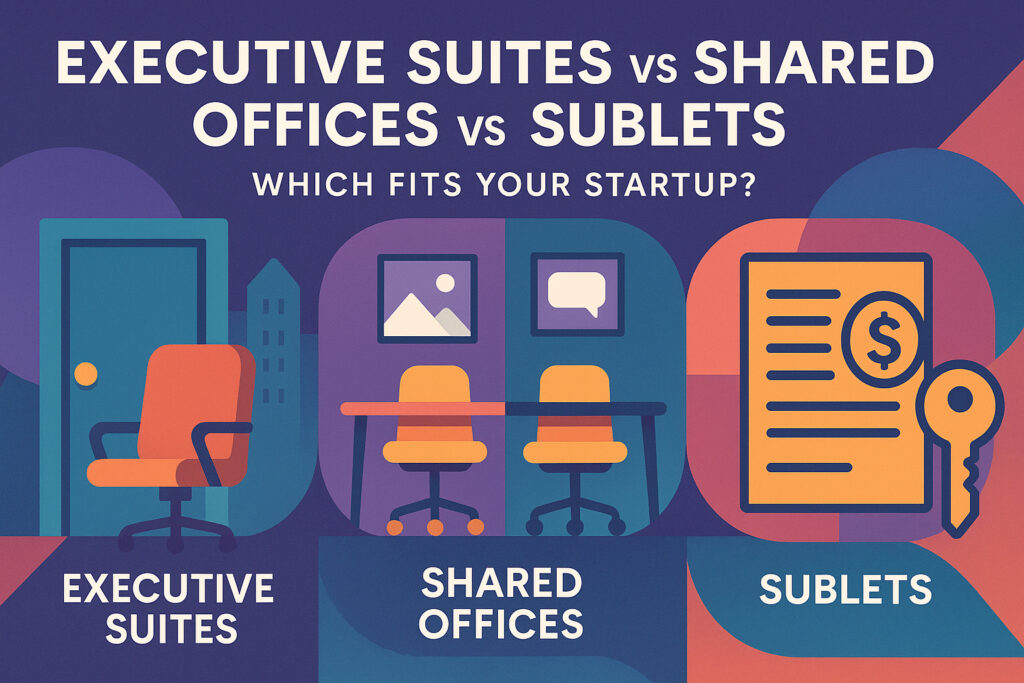
Executive Suites vs Shared Offices vs Sublets: Which Fits Your Startup?
Choosing your first independent office space is a critical moment in your startup’s growth—and making the right decision early can have lasting effects on your budget, team culture, and ability to scale. With so many searchers typing into Google phrases like “executive suites vs shared offices,” “startup sublet office NYC,” or “short term vs flexible office space Manhattan,” it’s clear that growing companies are trying to understand which space type matches their needs best.
This topic guide explores the question of executive suites vs shared offices vs sublets in Manhattan today, with a tenant-first perspective: what fits your headcount, image, and operating style, and what gives you the flexibility to evolve without locking yourself into unnecessary overhead.
What Are the Workspace Options?
Executive Suites (a.k.a. Serviced or Managed Offices)
Executive suites offer a month-to-month, turnkey office solution. Think furnished rooms inside a professionally managed suite with access to shared conference rooms, pantries, and lounges. These are ideal for small teams seeking minimal effort and maximum speed.
Shared Offices
Shared offices typically mean leasing a portion of another company’s office—maybe a few desks, a room, or shared common space. Agreements vary, but these are often seen as short-term, flexible setups that bridge the gap between coworking and full independence.
Sublets
Sublets are typically private spaces leased from an existing tenant (rather than directly from the landlord). In NYC, many sublets come pre-furnished, already wired for internet, and can be secured at below-market rates. Lease terms often span 6 to 24 months—making them perfect for a startup looking to test or expand without a 5-year lease.
Who Is Each Space For?
Startups and small businesses at different stages have different priorities:
- If you’re early-stage, focused on reducing friction, and don’t mind working under someone else’s brand, executive suites may be appropriate.
- If you’ve outgrown coworking and want a semi-private space, shared offices can buy you time while keeping costs low.
- If you’ve received funding or have a stable roadmap, and you want privacy, branding, and control, a sublet office space likely offers the best value.
What About Budget, Layout, and Term Flexibility?
Let’s look at how the three options compare across real-world tenant concerns:
Rent & Occupancy Cost
- Executive suites charge the most per square foot, but you’re paying for the convenience of not dealing with cleaning, wiring, or furniture.
- Shared offices fall in the middle—some bundled costs, some shared amenities.
- Sublets usually offer the lowest effective rent, especially when the primary tenant is eager to sublease space. These often allow startups to stretch budget dollars toward better location or more space.
Lease Term and Risk Management
- Month-to-month is standard for executive suites, though this flexibility comes at a premium.
- Shared offices may require 3–12 month commitments.
- Sublets are commonly structured for 6, 12, or 24 months, and in NYC often include a Good Guy Clause, which allows you to exit early with notice and no financial penalty beyond what’s owed.
Layout and Ergonomics
- Executive suites are fixed in layout. Expect small private offices, little room to reconfigure, and generic furnishings.
- Shared offices may offer more layout variety, but your use of space is limited by what the host company is willing to share.
- Sublets typically provide your own entrance, bullpen layout, conference rooms, and enclosed offices—ideal for a team with a specific seating model (benching, bullpen, or executive office configurations). These allow you to match space to work style.
Image, Branding, and Privacy
- Executive suites place you under a shared operator’s branding. That can work short-term, but long-term it lacks identity.
- Shared offices provide some visual flexibility but limited brand projection.
- Sublets support brand presence: your logo, your team, your rules. A sublet is essentially your own office—with the added advantage of furniture and wiring already in place.
Why This Matters Now—In the Manhattan Market
Office space in Manhattan continues to evolve, especially post-pandemic. Sub-5,000 sq ft suites are in high demand, especially among funded startups and AI or fintech firms. But what many founders don’t realize is that short-term furnished sublets are readily available, offering a perfect stepping stone between a coworking seat and a full-scale direct lease.
As leasing trends shift, companies with 6–20 employees are best served by interim spaces that are private, affordable, and not overly binding. The key is to know where the value is—and when the flexibility no longer outweighs the cost.
Final Take: Which Space Type Works Best?
- Choose executive suites if you need a branded location tomorrow and don’t want to lift a finger—but know you’ll pay more for less control.
- Choose shared offices if you’re in a financial holding pattern or want to be near another firm, but don’t require privacy or customization.
- Choose a startup-friendly sublet if you’re aiming to control your environment, reduce costs, and avoid long-term commitments. You’ll often find spaces that were built by other startups just like yours, already set up with ergonomic furniture and collaborative layouts.
Where We Come In
At NewYorkOffices.com, we are not landlords. We’re not operators. We’re tenant brokers—and we only represent the tenant’s side of the deal. Our clients are small to mid-sized businesses looking for office space in Manhattan that works today, and scales with them tomorrow. We don’t promote coworking. We help you grow out of it—by guiding you toward smarter, more cost-effective, and better-planned space options.
If you’re trying to decide between an executive suite, a shared office, or a sublet for your next step—we can help you weigh the pros, uncover the hidden costs, and secure a flexible deal that supports your vision.
Let us help you find the right fit—not just the right address.
Fill out our 📋 online form or give us a call today 📞 212-967-2061 — let’s find the right options for your business.